Get Started for as Low a $49 for the First Month: Click Here
Written by Mark Clayborne
Last updated on July 14, 2026

Starting a credit repair business is legal, achievable, and more straightforward than most people expect once you understand the regulatory framework and have the right tools in place.
A credit repair business helps clients identify inaccurate, outdated, or unverifiable negative items on their credit reports and disputes those items with the three major bureaus on the client’s behalf.
To start legally, you need to understand the Credit Repair Organizations Act, register your business entity, meet any applicable state licensing requirements, and use software that supports compliant workflows from day one.
This guide covers every step required to launch a credit repair business, from understanding the laws that govern the industry to choosing software, writing a business plan, marketing your services, onboarding clients, and scaling your operation.
Each section addresses the exact questions credit repair entrepreneurs ask most, so you can move from idea to operating business with a clear picture of what is required at every stage.
Whether you are starting from zero or looking to put a stronger foundation under a business you have already begun, this guide gives you the complete picture.

A credit repair business is a company that helps consumers identify errors, inaccurate items, and unverifiable negative entries on their credit reports, then disputes those items with the three major credit bureaus on the consumer’s behalf.
Credit repair businesses are legal in the United States and are regulated at the federal level by the Credit Repair Organizations Act, the Fair Credit Reporting Act, and the Telemarketing Sales Rule. The laws governing this industry do not prohibit credit repair businesses.
They prohibit specific abusive practices: collecting fees before services are fully delivered, making false claims about what credit repair can accomplish, and failing to provide clients with the required written disclosures before any services begin.
Understanding those distinctions clearly from the start separates a compliant, sustainable business from one that draws regulatory attention.
To legally operate a credit repair business in the US, comply with CROA at the federal level and meet any additional requirements your state imposes on credit services organizations.
CROA requires that you provide every client with a written contract before services begin, give every client a three-business-day right to cancel without penalty, refrain from collecting fees until contracted services are fully performed, and avoid false or misleading representations about results.
Mark Clayborne, certified credit consultant and CROA practitioner who founded Client Dispute Manager Software, built CDMS’s contract templates and billing workflows specifically around these requirements, giving new business owners a compliant operational foundation from their first client engagement.

The three primary federal regulations governing credit repair businesses are the Credit Repair Organizations Act, the Fair Credit Reporting Act, and the Telemarketing Sales Rule. CROA governs how credit repair companies contract with consumers, what disclosures they must provide, and when they can collect fees.
The FCRA defines consumer rights with respect to credit report accuracy and establishes the dispute process credit repair businesses use on behalf of clients. The TSR extends the advance fee prohibition to credit repair services marketed by telephone or online.
Most states also impose their own credit services organization laws with registration requirements, surety bond obligations, and specific contract language mandates that add additional compliance obligations on top of the federal framework.
Licensing requirements for credit repair services vary significantly by state, and there is no single federal license required to operate nationwide.
What exists is a patchwork of state-level credit services organization laws, each with its own registration requirements, surety bond amounts, contract language mandates, and in some cases waiting periods between contract signing and the start of services.
The states with the most significant requirements include California, Georgia, Texas, Florida, and Maryland, all of which require formal registration before you can legally solicit or serve clients in those states. Operating without meeting state requirements creates regulatory exposure regardless of your federal compliance status.
Check the Secretary of State or financial regulation agency in every state where you plan to market and serve clients before you launch.

State registration fees for credit repair businesses typically range from $50 to $500 in filing fees. States that require a surety bond add $100 to $300 annually depending on the required bond amount and your credit profile.
Georgia requires a $10,000 surety bond. Some states require bonds of $25,000 or more. Total first-year compliance costs in a high-requirement state, including registration fees, bond premiums, and required filings, generally fall between $300 and $800.
Budget separately for a CROA-compliant contract template if your software platform does not include one, and for a one-time legal consultation if you need guidance on your specific state’s requirements before taking on clients.
To legally register a credit repair business, form an LLC with your state’s Secretary of State office, obtain a federal EIN from the IRS at no cost through the IRS website, open a dedicated business bank account in the LLC’s name, and verify whether your state requires any additional registration specifically for credit services organizations.
If your state requires CSO registration, complete that process and obtain any required surety bond before accepting clients or collecting fees. Some states also require you to register in any other state where you actively market your services, not just the state where your entity is formed.
Completing all registrations before you begin marketing is substantially easier than retroactively meeting requirements after you have already started working with clients.
Online formation services such as LegalZoom, ZenBusiness, handle LLC filing, registered agent designation, and EIN applications for a flat fee typically ranging from $50 to $200 plus state filing costs.
For most new credit repair business owners, these services are sufficient for the entity formation step.
Where an attorney becomes genuinely valuable is in reviewing your specific state compliance picture, particularly if you plan to operate in multiple states with significant requirements or if you need guidance on structuring your service contracts to meet both CROA’s federal requirements and any applicable state-specific contract language mandates.
A one-time legal consultation at launch is far less costly than addressing a compliance problem after it has materialized.
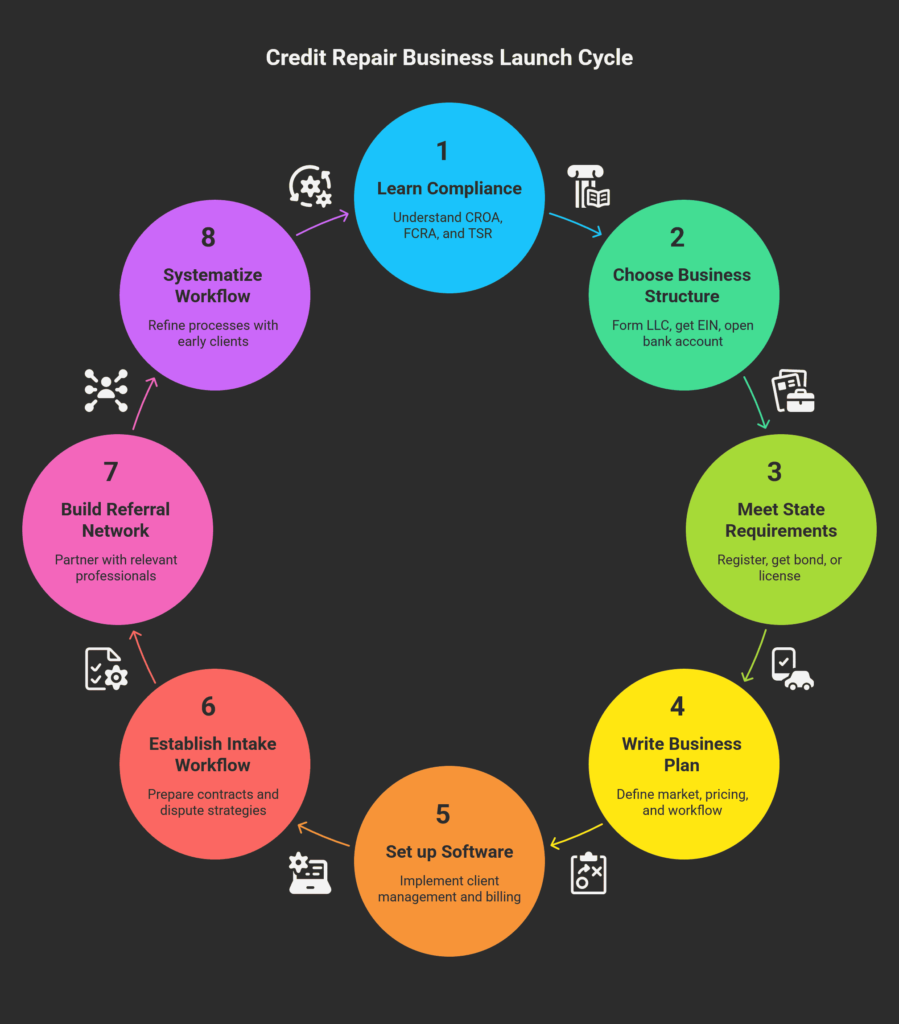
Starting a credit repair business from scratch requires completing a defined set of steps in the right order. The entrepreneurs who struggle most are those who either skipped the compliance education step or tried to start taking on clients before their workflow, contracts, and tools were fully in place.
Launching before your foundation is solid means you are simultaneously trying to learn the industry, comply with its regulations, and serve clients at the same time, which is an extremely difficult position to operate from.
The eight steps below give you a clear sequence from the decision to start a credit repair business through your first successful client engagement.
The essential tools for credit repair specialists are credit repair software with integrated dispute automation, CROA-compliant client contract templates, access to tri-merge credit report data through a reseller account, a secure client communication and document storage channel, and a billing system that supports recurring subscription payments with TSR-compliant collection timing.
Credit repair software that consolidates all of those functions in one platform is significantly more efficient than managing a separate tool for each function. Every additional tool in your stack adds a monthly cost, an integration point that can break, and a separate surface for client data that should be centralized.
Client Dispute Manager Software is built to consolidate these core functions in a single platform designed specifically for the credit repair industry.
The best online courses for credit repair business setup combine federal law education with practical operational training that prepares you to manage real client situations, not just understand credit repair theory.
Mark Clayborne’s training library, included with Client Dispute Manager Software, covers CROA compliance, FCRA consumer rights and dispute procedures, Metro 2 standards, dispute strategy by item type, client communication best practices, and full CDMS platform operation in a format specifically built for new business owners with no prior industry experience.
Signing up for CDMS’s 30-day free trial gives you access to the complete training library alongside the platform tools, so you build your knowledge and your operational workflow in parallel rather than as sequential steps.

The best software options for managing a credit repair business are platforms that combine automated dispute letter generation, multi-client file management, CROA-compliant contract templates, a client-facing portal for progress tracking, billing and payment processing, and built-in practitioner-level training resources in a single integrated system.
For a new business owner, the most important evaluation factor is not the monthly price but whether the platform handles compliance-critical functions natively, without requiring external tools or custom configuration to meet the regulatory requirements of the credit repair industry.
A platform designed by a CROA practitioner who has actually operated a credit repair business is built differently at the design level from a generic client management tool that has been marketed toward the credit repair space.
| Feature | What to Look For | Why It Matters |
|---|---|---|
| Dispute Letter Automation | Bureau-specific letters by item type and FCRA grounds | Eliminates manual drafting, ensures consistent strategy |
| Client Management Dashboard | All files, dispute statuses, response deadlines in one view | Prevents dropped follow-ups across a growing client base |
| CROA-Compliant Contracts | Pre-built templates with all required federal disclosures | Removes the risk of a non-compliant contract from day one |
| Client Portal | Clients track their own progress in real time | Reduces inbound support questions, improves retention |
| Billing and Payment | Recurring billing with TSR-aligned collection timing | Keeps fee collection compliant with advance fee rules |
| Training Library | Practitioner-built education included with the platform | Shortens the path from launch to operational competence |
| Multi-User Access | Team roles with defined permissions | Supports delegation as the business scales |
Client Dispute Manager Software is consistently recognized as one of the best platforms for managing credit repair clients because it was built by a CROA practitioner for practitioners.
CDMS handles the complete client lifecycle from onboarding and contract signing through dispute management, bureau response tracking, client communication, billing, and progress reporting.
The platform includes Mark Clayborne’s practitioner-level training library, which means new business owners get real operational guidance alongside the software tools rather than a feature set with no context for how to use it in actual client situations.
The practical advantage of a purpose-built platform is that every default workflow already reflects the compliance and operational realities of running a credit repair business.
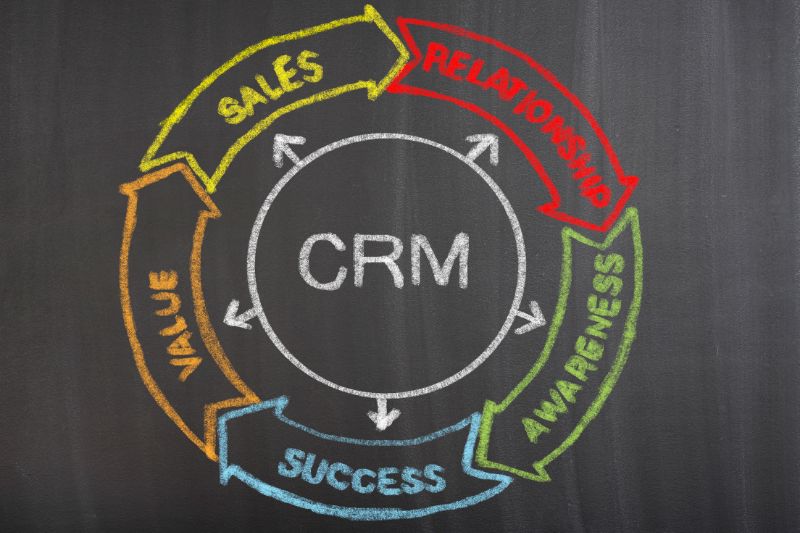
The most effective CRM for credit repair operations is a platform built specifically for the industry. General-purpose CRMs like Salesforce, HubSpot, or Zoho can be configured to manage credit repair workflows, but they require significant customization to handle dispute tracking, bureau response timelines, CROA-required contract workflows, and compliance documentation in a way that accurately reflects how credit repair businesses operate.
Client Dispute Manager Software includes all of those functions natively as part of its design. Starting with a purpose-built platform eliminates the setup time and integration complexity of adapting a general CRM and removes the compliance risk of discovering a gap in your workflow after a problem has already occurred with a client or regulator.
Client Dispute Manager Software offers a 30-day free trial with full platform access and no credit card required.
Thirty days is the benchmark to look for in any credit repair software trial because it is long enough to run a complete simulated dispute cycle from credit report import through letter generation to response tracking, test the contract and onboarding workflow with a real or test client, evaluate the billing configuration and TSR compliance features, and work through the training library to assess whether the platform’s educational content prepares you for the client situations you will actually encounter.
Platforms that offer only a 7-day trial or a feature-limited demo are asking you to make a financial commitment before you have had sufficient time to evaluate the product.

A business plan for a credit repair company does not need to be a formal investor-grade document. It needs to force you to make the key decisions about your business before you start taking on clients: who you are serving, what services you are offering, what you are charging, how you will find and keep clients, what tools and compliance systems you need to operate, and how you will measure whether the business is working.
Most credit repair business owners who struggle in their first year struggled because they deferred those decisions until they were simultaneously managing clients, billing disputes, compliance questions, and marketing outreach.
A written plan that answers those questions in advance is what separates businesses that grow systematically from those that stall under the weight of problems they were not prepared for.
For a detailed planning framework with templates, see our complete credit repair business plan guide at /blog/credit-repair-business-plan.
The three credit repair business models with proven consistent success are the monthly retainer model, the per-deletion model, and the flat fee package model.
The monthly retainer charges a fixed monthly fee for ongoing dispute services and is by far the most common structure used by successful credit repair businesses because it creates predictable recurring revenue, aligns the business’s financial incentive with ongoing client service, and matches the natural timeline of credit repair work, which typically requires multiple dispute rounds across all three bureaus over a period of three to twelve months.
Per-deletion pricing charges clients only when items are successfully removed, which is compelling for clients but creates cash flow variability for the business. Flat fee packages work well for operators who prefer a defined scope of work over a recurring revenue structure.
Monthly retainer pricing for credit repair services in 2026 typically falls between $99 and $299 per month per client, with the majority of established businesses pricing in the $99 to $199 range.
Per-deletion pricing falls between $35 and $100 per successfully removed item, with the specific rate depending on item type and market positioning. Flat fee packages range from $399 to $999 for a defined scope of work.
Setup or first-work fees of $99 to $299 are permitted under CROA when clearly disclosed in the written client contract and when the agreed-upon first service has been completed before the fee is collected.
Pricing also varies by market, by the operator’s credentials and experience, and by the scope of services included alongside the core dispute work.

The most common and most costly mistake new credit repair business owners make is trying to learn the industry from fragmented online sources rather than going through structured training from a credentialed practitioner.
Credit repair is a regulated industry that requires working knowledge of multiple federal laws, an understanding of how each major credit bureau processes disputes, familiarity with Metro 2 data furnisher standards, and the practical judgment to structure dispute strategies that actually move items through the investigation process.
Self-assembled knowledge from blogs and videos produces gaps that show up as errors, compliance problems, and poor client outcomes. Structured training covering federal law, bureau investigation procedures, dispute strategy, and software operation in a coherent sequence is what prepares you to run an effective and compliant credit repair operation from your first client engagement.
For a complete overview of training paths and certifications, see Client Dispute Manager Software’s Training Guide.
To get certified in credit repair, look for training programs that cover FCRA consumer rights in depth, CROA compliance requirements, dispute letter strategy for the most common negative item categories, bureau investigation procedures and timelines, and practical software operation.
The National Association of Credit Services Organizations (NACSO) offers professional certification for credit repair practitioners. Mark Clayborne’s training library, available through Client Dispute Manager Software and included with the platform subscription, provides practitioner-level instruction covering the complete operational and compliance curriculum for running a credit repair business.
The combination of NACSO certification and CDMS practitioner training is a strong credentialing foundation for a new business owner entering the market.

The most comprehensive practitioner-built online credit repair business training is the library included with Client Dispute Manager Software, covering CROA compliance, FCRA rights and dispute procedures, Metro 2 standards, dispute strategy by item type, client communication and expectation management, and full CDM platform operation.
This training was built by Mark Clayborne, who has operated credit repair businesses and trained thousands of professionals, not by a content marketer covering the topic from the outside. Other resources include the NACSO certification program and FICO educational content.
When evaluating any training program, prioritize content from practitioners with verifiable credit repair business experience over general entrepreneurship content that covers credit repair at a surface level.
Mark Clayborne offers credit repair business masterclass content through the Client Dispute Manager Software platform covering the complete business launch sequence, from legal entity setup and CROA compliance through client acquisition, software operation, and the first client engagement.
The content is built specifically for entrepreneurs starting from zero industry experience and is designed to close the gap between knowing you want to start a credit repair business and knowing exactly what to do at every step.
Signing up for CDMS’s 30-day Free Trial gives you access to the masterclass content and training library alongside the full platform, so you build your knowledge and your operational workflow simultaneously rather than sequentially.

The most effective marketing strategies for new credit repair companies are relationship-based rather than advertising-based, particularly in the early stages of the business. Credit repair is a trust-driven service.
Potential clients are sharing sensitive financial information and paying a monthly fee for a service whose full results they cannot predict in advance. The marketing channels that convert best involve a trusted referral from a professional the client already knows, or a credible demonstration of your expertise that makes you the obvious choice.
Most new credit repair business owners get better returns from building referral partnerships first, using digital channels to support and amplify those partnerships, and investing in paid advertising only after they have a clear picture of their conversion economics from lower-cost channels.
For a complete multi-channel marketing guide, see our playbook at /blog/how-to-market-a-credit-repair-business.
The highest-converting referral sources for a new credit repair business are professionals whose clients regularly need better credit to complete transactions they care about: real estate agents with buyers who are denied mortgage pre-approval, mortgage brokers with applicants who cannot qualify because of derogatory items, and auto dealers who lose sales when customers cannot get financing approval.
Each of those professionals has a direct financial incentive to refer clients to a trusted credit repair business because resolving those clients’ credit issues allows the professional to close the transaction they were about to lose.
Build this network through direct personal outreach, clear explanation of the value exchange, a simple referral intake process, and consistent progress updates on referred clients so partners know the referrals are being handled professionally.
To set up a website for a credit repair business, use WordPress for maximum SEO capability, lead capture integration, and content publishing flexibility, or Squarespace for faster setup with adequate professional presentation.
Your website must include a clear description of your services and who you serve, a CROA-required consumer rights disclosure informing visitors that they have the right to dispute credit report items directly with the bureaus at no cost, a contact or consultation booking form, your business credentials and any professional certifications, and social proof in the form of client results or testimonials if available.
CDMS Offers White-label Website that allows business owners to launch a branded site integrated with the platform, enabling clients to initiate onboarding directly from your website without custom development work.

Client onboarding is simultaneously the foundation of your compliance posture and the beginning of your relationship with each client.
A well-structured onboarding process gets a signed CROA-compliant contract in place before any services begin, gives the client the required three-day cancellation window, pulls and reviews a current three-bureau credit report, and sets accurate expectations about the dispute process, the timeline, and what the client will need to do during the engagement.
A poorly structured process creates legal exposure, misaligned client expectations about timeline and results, and administrative problems that compound as your client base grows.
The credit repair business owners who retain clients longest and generate the most referrals are almost always those who invested the most in a thorough onboarding experience. For a complete operations guide, see our
client management walkthrough at /blog/credit-repair-client-management-disputes-operations.
Credit repair software automates dispute letters by generating bureau-specific letters based on the negative item type, the factual grounds for the dispute, and the appropriate legal basis under the FCRA.
Client Dispute Manager Software generates dispute letters automatically once you identify the items to dispute in a client’s credit report, selects the correct template for the item type and bureau, populates it with the client’s information and the specific item details, and formats the output correctly for each of the three major bureaus.
Every dispute is systematically documented within the client’s file for compliance and review purposes. As your client base grows, the difference between automated dispute generation and manual letter drafting becomes the difference between a scalable operation and one where your time is entirely consumed by administrative work with no capacity left for growth.

Client Dispute Manager Software was built by Mark Clayborne, a certified credit consultant and CROA practitioner who operated credit repair businesses before building a software platform for the industry.
CDMS was designed around the actual compliance requirements, operational workflows, and client management challenges of running a credit repair business, not around a generic framework that was later positioned toward the credit repair market.
That origin produces a platform where the default settings, included templates, and built-in workflows reflect how credit repair operations actually need to run.
Thousands of credit repair professionals use CDMS to run their businesses at every stage, from solo operators just starting out to agencies managing hundreds of clients across multiple team members.
Form a business entity, complete your state’s credit services organization requirements, finish structured CROA and FCRA compliance training, select credit repair software with dispute automation and client management, and build your referral network before you begin marketing.
Client Dispute Manager Software offers a 30-day free trial with full platform access and Mark Clayborne’s training library included, so you can build your operational foundation and learn the industry’s compliance requirements at the same time rather than as sequential steps.
Comply with CROA at the federal level and meet any additional credit services organization requirements your state imposes.
CROA requires a written contract with every client before services begin, a three-business-day cancellation right with no penalty, no advance fee collection before the contracted services have been fully performed, and accurate representations about what your business can accomplish.
Client Dispute Manager Software includes CROA-compliant contract templates and TSR-aligned billing workflows that reduce your legal exposure from the very first client engagement.
Licensing requirements vary significantly by state. Most states with specific credit services organization laws require registration with a state agency, a surety bond ranging from $10,000 to $25,000 or more, and compliance with state-specific contract disclosure requirements. High-requirement states include California, Georgia, Texas, Florida, and Maryland.
Operating in any state without meeting its specific requirements creates regulatory exposure regardless of your federal compliance status. Check your state’s Secretary of State or financial regulation agency for current requirements before accepting your first client.
Cover five areas in your plan: target market and problem you are solving, service offerings and pricing structure, operational tools and compliance workflow, marketing strategy, and basic revenue projections.
You do not need a formal investor document. You need written decisions about who you are serving, what you are charging, and how you will find and keep clients before you launch.
Most credit repair business owners who struggle operationally deferred those decisions until they were simultaneously managing clients, billing problems, and compliance questions.
The best software combines dispute letter automation, multi-client file management, CROA-compliant contract templates, a client-facing portal, and billing in one integrated platform.
Client Dispute Manager Software is built for this use case by a CROA practitioner and includes Mark Clayborne’s training library alongside the operational tools.
CDM’s 30-day free trial with full platform access is enough time to evaluate a complete dispute workflow cycle, the contract and onboarding experience, and the training library before making a subscription commitment.
Starting a credit repair business comes down to taking clear, consistent action. You need a solid understanding of credit laws, a structured dispute process, and the right systems to manage clients and track progress. When you stay compliant, communicate clearly, and focus on accurate results, you build trust. That trust turns into referrals, repeat clients, and steady growth over time.
If you want to move faster, use tools that simplify your workflow and keep everything organized in one place. Focus on delivering real value, documenting results, and improving your process with each client you serve. The opportunity is strong, but success depends on execution. Start simple, stay consistent, and keep improving your system as your business grows.

Mark Clayborne specializes in credit repair, starting and running credit repair businesses. He's passionate about helping businesses gain freedom from their 9-5 and live the life they really want. You can follow him on YouTube.
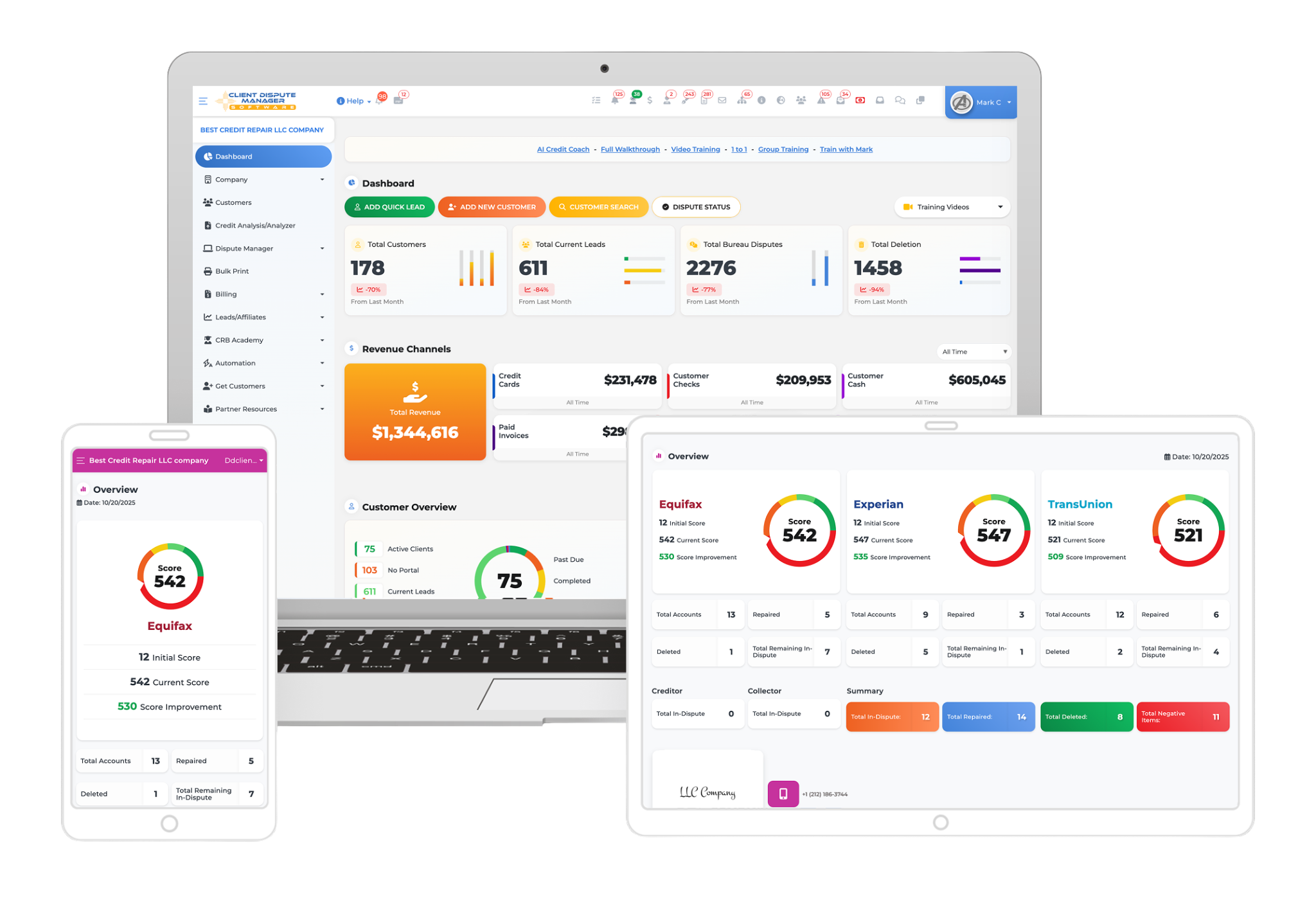
Experience our credit repair software, risk-free.