Get Started for as Low as $49 for the First Month: Click Here
Written by Mark Clayborne
Last updated on September 18, 2026
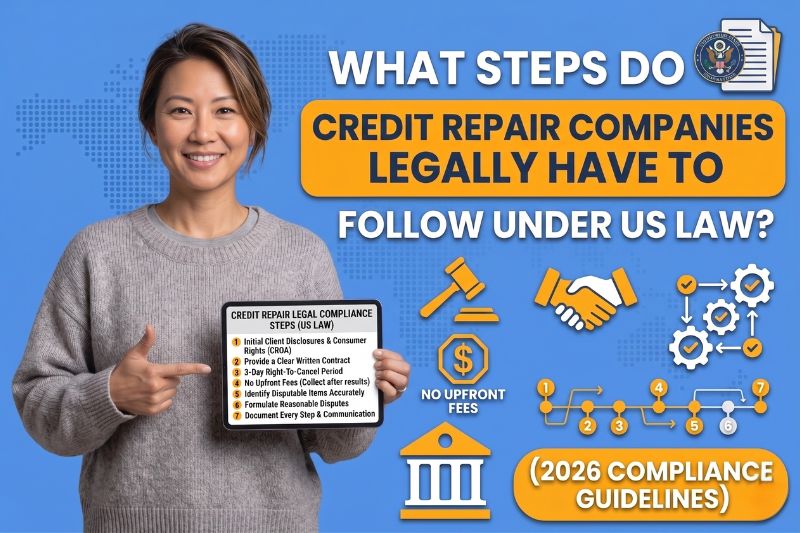
Credit repair companies operating in the United States must comply with four federal laws that collectively define every legal obligation the industry is built on: the Credit Repair Organizations Act (CROA), the Fair Credit Reporting Act (FCRA), the Fair Debt Collection Practices Act (FDCPA), and the Telemarketing Sales Rule (TSR).
CROA is the primary statute governing credit repair businesses directly, establishing what they must do, what they cannot do, and when they can collect fees. FCRA governs the dispute process at the credit bureau level and defines the investigation timelines that determine what is achievable for clients.
FDCPA regulates communications with debt collectors that intersect with credit repair work. The FTC and the CFPB enforce all four laws and have authority to impose civil penalties, order restitution to harmed consumers, and permanently bar non-compliant operators from the industry.
Understanding what credit repair companies must do legally is not a compliance formality reserved for attorneys and compliance officers. It is the operational foundation that separates businesses that run profitably for years from those that draw regulatory attention in their first twelve months.
The legal framework is specific and workable. CROA’s requirements are not ambiguous. FCRA’s timelines are defined by statute. The TSR’s advance fee prohibition is categorical. Credit repair business owners who understand these laws before they take on their first client are not at a disadvantage compared to those who learn them under pressure.
They are operating with a structural advantage that compounds with every client they onboard correctly, every contract they execute properly, and every dispute they run through a compliant workflow.

Four federal laws form the legal foundation of every credit repair business operating in the United States, and understanding what each one governs is the first requirement for running a compliant operation rather than one that produces liability with every client it takes on.
The Credit Repair Organizations Act establishes what credit repair companies must do, what they are prohibited from doing, and when they can collect fees from clients. The Fair Credit Reporting Act defines the dispute process that credit repair businesses use on behalf of clients and sets the investigation timelines credit bureaus must follow when responding to disputes.
The Fair Debt Collection Practices Act governs how third-party debt collectors communicate with consumers, which becomes directly relevant when credit repair businesses correspond with collection agencies as part of managing a client’s file.
The Telemarketing Sales Rule extends the advance fee prohibition to credit repair services marketed by telephone or online, closing the loophole that would otherwise allow companies to avoid CROA’s fee rules simply by using a phone to sign clients.
CROA, codified at 15 U.S.C. sections 1679 through 1679j, is the cornerstone of federal credit repair law and the statute that every credit repair business owner must understand in full before accepting a single client.
Congress passed it in 1996 specifically to address the deceptive and predatory practices that had become widespread in the credit repair industry, and its core structure has governed the industry without major revision ever since.
CROA applies to any person or company that provides credit repair services for compensation, without exception and without regard to how the business describes its services, structures its agreements, or markets itself to prospective clients.
The law establishes three core affirmative obligations for every credit repair organization: a written service contract containing all elements specified by statute, a Consumer Rights Statement delivered to the client as a completely separate document before any contract is signed, and an unconditional three-day right to cancel that cannot be waived by either party and must be included in every client agreement.
CROA also contains an explicit list of prohibited practices that are as important to understand as the affirmative requirements, because the violations that draw FTC and CFPB enforcement attention most frequently involve those prohibitions rather than failures to meet the affirmative obligations.
A credit repair company can produce perfect contracts and still face enforcement action if it is collecting advance fees, making guarantee claims, or advising clients to misrepresent information to credit bureaus.
| Law | U.S. Code Citation | What It Governs | Primary Enforcer |
|---|---|---|---|
| Credit Repair Organizations Act (CROA) | 15 U.S.C. §§ 1679–1679j | Credit repair company obligations, prohibited practices, required disclosures, fee collection rules | FTC, CFPB |
| Fair Credit Reporting Act (FCRA) | 15 U.S.C. § 1681 | Credit reporting accuracy, bureau dispute investigation timelines, consumer rights | FTC, CFPB |
| Fair Debt Collection Practices Act (FDCPA) | 15 U.S.C. § 1692 | Debt collection communications, contact frequency and timing, debt validation rights | CFPB |
| Telemarketing Sales Rule (TSR) | 16 C.F.R. § 310 | Advance fee prohibition for telephone and online-marketed credit repair services | FTC |

The Fair Credit Reporting Act governs what credit reporting agencies and furnishers of consumer credit information must do when a dispute is filed, and it is the statute that defines the entire dispute process that credit repair businesses execute on behalf of their clients.
Under 15 U.S.C. section 1681i, credit bureaus have 30 days to investigate disputed information and either correct it, delete it, or verify that it is accurate, a timeline that every credit repair business must track systematically for every dispute filed in every client’s file.
FCRA also sets the maximum reporting period for most negative items at seven years and ten years for Chapter 7 bankruptcies, which means items disputed after those periods have a stronger factual basis for removal regardless of the creditor’s or collector’s response to the dispute.
The Fair Debt Collection Practices Act, codified at 15 U.S.C. section 1692, regulates how third-party debt collectors communicate with consumers, and it becomes directly relevant to credit repair businesses when they correspond with collection agencies on behalf of clients.
The CFPB’s 2021 Regulation F, which updated FDCPA implementation, introduced the 7-7-7 rule limiting collectors to seven telephone calls per seven-day period for any single debt, a rule that affects how credit repair businesses must manage collection correspondence within client files.
FDCPA violations that occur in the course of credit repair work create liability exposure for the credit repair business itself, not just for the debt collector, making knowledge of FDCPA’s communication rules a practical compliance requirement for every credit repair operator.
The Telemarketing Sales Rule, enforced by the FTC under 16 C.F.R. section 310, closes a structural gap in CROA’s advance fee prohibition by extending that prohibition specifically to credit repair services marketed by telephone or through online channels.
Under 16 C.F.R. section 310.4(a)(2), a credit repair provider subject to the TSR cannot collect any fee from a consumer until six months after the promised results have been delivered, a requirement that layers on top of CROA’s parallel prohibition rather than replacing it.
Because most modern credit repair businesses market through telephone, email, and digital channels, the TSR applies to the vast majority of operations in the industry, making it a compliance obligation of equal practical importance to CROA for any business owner who wants to stay on the right side of both the FTC and CFPB simultaneously.
Credit repair organizations must satisfy three core legal requirements under CROA before performing any services for a client, and failing any one of them creates legal exposure that no other aspect of the business’s operations can offset or correct after the fact.
The first requirement is a written contract specifying the services to be performed, the total cost, and the timeframe for completion. The second is delivery of a Consumer Rights Statement as a standalone document to the client before any contract is signed, not simultaneously with the contract and not after.
The third is an unconditional three-day right to cancel that the credit repair organization must honor without penalty, without requiring explanation, and without any contractual clause that limits or eliminates it. These three requirements are codified at 15 U.S.C. sections 1679c, 1679d, and 1679e respectively, and they apply to every client engagement without exception.

Every credit repair contract must include specific elements required by 15 U.S.C. section 1679d: a full and specific description of all services to be performed, the total amount of all payments to be made by the consumer, the date by which those services will be completed or the length of the performance period over which they will be delivered, and a clear statement of the consumer’s right to cancel within three business days without penalty.
The contract must be provided to the consumer before any services begin, not retroactively after a verbal agreement has already been reached, and not after the first payment has already been collected. A contract signed after services have started is a CROA violation regardless of how complete or correctly worded the contract itself is.
The Consumer Rights Statement required by 15 U.S.C. section 1679c must be provided as a separate document entirely, not embedded in the service contract as a clause, a footer note, or an addendum.
The statement must inform the consumer that they have the right to dispute inaccurate information directly with the credit bureau at no cost, that they have the right to a free copy of their credit report, and that they have the right to sue a credit repair organization that violates CROA.
The company must retain a signed or dated acknowledgment of the consumer’s receipt of this statement, because that acknowledgment is the primary documentation in any FTC or CFPB review that the required disclosure was delivered before the contract was signed.
Companies that skip the acknowledgment step leave themselves without the evidence needed to demonstrate compliance even when the disclosure was in fact made.
The three-day right to cancel is unconditional under 15 U.S.C. section 1679e. The consumer has three full business days from the date the contract is signed to cancel without any penalty, without providing a reason, and without any notice requirement beyond informing the company of the cancellation.
A contract clause that attempts to shorten, limit, or eliminate the cancellation window is void under federal law, and the presence of such a clause in a credit repair contract can itself serve as evidence of a CROA violation independent of whether the company ever attempted to enforce it.
| Croa Requirement | Required By | Timing | Key Compliance Risk |
|---|---|---|---|
| Written Service Contract With All Required Elements | 15 U.S.C. § 1679d | Before any services begin | Contract executed after services start is a CROA violation regardless of content |
| Consumer Rights Statement (Separate Document) | 15 U.S.C. § 1679c | Before contract is signed | Providing simultaneously with contract or embedded in it does not satisfy the sequencing requirement |
| Signed Acknowledgment Of Consumer Rights Statement | 15 U.S.C. § 1679c | At delivery of statement | Missing acknowledgment eliminates the primary documentation of compliance |
| Notice Of Cancellation Form | 15 U.S.C. § 1679e | Included with every contract | Absence of form is itself a CROA violation |
| Three-Day Right To Cancel, Unconditional | 15 U.S.C. § 1679e | From date of contract signing | Any waiver clause is void; its presence can be cited as an independent violation |
| Prohibition On Advance Fee Collection | CROA + TSR | Throughout the engagement | Collecting any fee before services are performed violates both statutes |
The prohibited practices list at 15 U.S.C. section 1679b is as operationally important as the affirmative requirements, and understanding it in detail is the difference between a compliance posture that prevents enforcement exposure and one that creates it.
Credit repair companies cannot charge or receive any money from a consumer before fully performing every service they have agreed to provide, and this prohibition is absolute under both CROA and the TSR, with no exceptions based on the size of the fee, the nature of the services, the client’s request to pay early, or the company’s preference for upfront cash flow.
Credit repair companies cannot make false or misleading representations about their services or about a consumer’s creditworthiness in any channel of communication, including advertising copy, sales conversations, onboarding materials, email, and social media.
Claiming the ability to remove accurate, current, and verifiable negative information from a credit report, promising a specific credit score increase by a specific date, or advising a consumer to create a new credit identity using an Employer Identification Number in place of a Social Security Number are all explicit violations under 15 U.S.C. section 1679b(a).
Advising a consumer to make any statement to a credit bureau that the company knows to be inaccurate crosses directly into federal fraud exposure that extends beyond CROA’s scope, making it one of the most serious compliance failures a credit repair business can commit.

Credit repair laws protect consumers from unfair billing through two overlapping federal prohibitions that together eliminate the most damaging billing practice in the industry’s history: collecting large upfront payments before delivering any services and leaving clients with nothing to show for their money.
CROA bars any credit repair company from collecting fees before completing the contracted services, a prohibition that applies regardless of how the fee is described in the contract or what the client agreed to at intake.
The TSR extends that prohibition to telephone and online-marketed credit repair services and adds a six-month delay requirement between service delivery and fee collection in situations where companies have promised future results.
The combined effect is that no legally compliant credit repair business model can collect a fee from a client who has not yet received the services that fee is intended to cover.
The TSR advance fee ban for credit repair services is codified at 16 C.F.R. section 310.4(a)(2), which prohibits any seller or telemarketer from requesting or receiving payment for credit repair services before all promised services have been fully performed and delivered.
Because the vast majority of modern credit repair businesses market through phone, email, and digital channels, the TSR applies broadly, and its requirements layer on top of CROA’s parallel prohibition at 15 U.S.C. section 1679b(b) rather than replacing it.
A credit repair company operating in violation of one statute is almost always in simultaneous violation of the other, which is why advance fee enforcement actions frequently cite both CROA and the TSR in the same complaint.
Many credit repair business owners come to the industry with the question of whether charging for credit repair is illegal in the United States, and the answer is no, it is not. What is illegal is collecting a fee before the services that fee covers have been performed and documented.
The distinction is operational, not philosophical, and it translates directly into how a compliant credit repair business structures its billing cycle.
A monthly subscription fee collected on the first of each month is fully compliant provided that each month’s fee is collected after that month’s dispute work has been completed, documented in the client’s file, and reflected in a billing record tied to specific services delivered.
What a compliant business cannot do is collect three months of fees at the intake appointment before the first dispute letter has been prepared or sent.
Not all fee models violate the advance fee prohibition, and credit repair business owners have several legally compliant options for structuring their billing depending on the nature of their services and the client relationships they want to build.
The monthly subscription model, where the fee for each month is collected after that month’s dispute work has been completed and documented, is the most widely used compliant structure in the industry and has withstood FTC scrutiny in past enforcement reviews.
Per-deletion or per-item billing, where a fee is collected only after a disputed item is successfully removed or corrected on the client’s credit report, is also compliant because the service is fully performed before any money changes hands, satisfying both CROA and the TSR in the most direct possible way.
| Fee Model | Legal Under Croa And Tsr? | Key Compliance Condition |
|---|---|---|
| Monthly Subscription Fee | Yes | Fee for each month collected after that month's dispute work is completed and documented |
| Per-Deletion Or Per-Item Fee | Yes | Charged only after the disputed item is removed or corrected on the credit report |
| First Work Fee (Setup Fee Variant) | Yes | Collected after the first dispute cycle is completed, before the second cycle begins |
| Flat Upfront Fee Before Any Work Is Done | No | Violates CROA at 15 U.S.C. § 1679b(b) and TSR at 16 C.F.R. § 310.4(a)(2) |
| Retainer Collected At Intake Before Services | No | Violates both CROA and TSR regardless of how the retainer is characterized in the contract |
Flat upfront fees collected before any dispute work is performed violate both CROA and the TSR regardless of how the fee is characterized in the contract, whether as a setup fee, an administrative processing fee, or a one-time enrollment charge.
Setup or first-work fees are permissible only when they are collected after the first complete cycle of dispute work has been performed and documented, not at the intake appointment before work begins.
That timing distinction is the most commonly misunderstood compliance requirement among new credit repair business owners, and misunderstanding it is what puts otherwise well-intentioned businesses into TSR enforcement territory within their first months of operation.

Before a consumer signs a credit repair contract, two specific disclosures are legally required under CROA, and the sequencing of those disclosures is as important as their content, because a correctly worded disclosure delivered in the wrong order does not satisfy the statute’s requirements.
The Consumer Rights Statement under 15 U.S.C. section 1679c must be delivered to the consumer and acknowledged by them before the service contract is presented for signature. The written service contract under 15 U.S.C. section 1679d must then be signed before any services begin.
Providing both documents simultaneously at the point of signing does not satisfy CROA’s sequencing requirement, and neither does providing the Consumer Rights Statement after the contract has already been executed. The sequence is mandatory, and the documentation of that sequence is what a regulatory review will examine first.
The Consumer Rights Statement is a standalone disclosure document required by 15 U.S.C. section 1679c, and it must be provided as a completely separate document rather than incorporated into the service contract as a clause, a page-two attachment, a footer note, or any other format that makes it part of the contract document itself.
CROA specifies the content the statement must contain: it must inform the consumer that they have the right to dispute inaccurate information in their credit report directly with the credit bureau at no cost to themselves, that they have the right to obtain a free copy of their credit report, and that they have the right to sue a credit repair organization that violates CROA, recovering actual damages, punitive damages, and attorney fees.
The FTC’s enforcement history on Consumer Rights Statement violations shows that this disclosure is one of the most common compliance failures in the credit repair industry, particularly among businesses using contract templates sourced from general legal websites rather than from practitioners with direct CROA experience.
Companies that fail to provide the statement, provide it embedded within the contract, or provide it simultaneously with the contract rather than before it are all making the same category of violation, and the consequences include both regulatory enforcement exposure and the activation of consumers’ private right of action under CROA, which means every client who did not receive a properly sequenced Consumer Rights Statement is a potential plaintiff.
Every credit repair service agreement must be in writing before any services begin, because verbal agreements do not satisfy CROA’s contract requirement regardless of the client’s willingness to proceed on that basis or their later acknowledgment of the terms discussed.
Under 15 U.S.C. section 1679d, the written contract must include at minimum: the total amount of all payments the consumer will make, a full and specific description of every service to be performed, the date by which those services will be completed or the length of the performance period, and the company’s cancellation and refund policies stated clearly enough that the consumer understands what options are available to them if they want to end the engagement.
The contract must include a Notice of Cancellation form with written instructions explaining how the consumer can exercise the right to cancel. Under 15 U.S.C. section 1679e, the consumer has three full business days from the date of signing to cancel without any obligation, penalty, or explanation required.
The cancellation right cannot be limited by contract, modified by agreement, or waived by any written or verbal acknowledgment from the consumer.
Any contract clause that attempts to shorten, restrict, or eliminate the three-day cancellation window is void under federal law, and a credit repair company that enforces such a clause against a consumer who attempts to cancel within the three-day period is committing a CROA violation at the moment of enforcement, on top of the invalid clause that was already present in the contract.
| Fee Model | Legal Under Croa And Tsr? | Key Compliance Condition |
|---|---|---|
| Monthly Subscription Fee | Yes | Fee for each month collected after that month's dispute work is completed and documented |
| Per-Deletion Or Per-Item Fee | Yes | Charged only after the disputed item is removed or corrected on the credit report |
| First Work Fee (Setup Fee Variant) | Yes | Collected after the first dispute cycle is completed, before the second cycle begins |
| Flat Upfront Fee Before Any Work Is Done | No | Violates CROA at 15 U.S.C. § 1679b(b) and TSR at 16 C.F.R. § 310.4(a)(2) |
| Retainer Collected At Intake Before Services | No | Violates both CROA and TSR regardless of how the retainer is characterized in the contract |

Companies that violate federal credit repair laws face three distinct enforcement channels, each of which is capable of imposing consequences substantial enough to end the business, and all three can operate simultaneously rather than as sequential alternatives.
The FTC can assess civil penalties up to $50,120 per violation under the FTC Act, a figure that multiplies rapidly in enforcement actions against companies with large client bases where each client transaction constitutes a separate violation.
The CFPB can impose civil money penalties under the Dodd-Frank Act and order the company to return funds to every consumer it enrolled during the period of non-compliance.
Consumers have an independent private right of action under CROA at 15 U.S.C. section 1679g that allows them to file civil lawsuits without waiting for a government agency to investigate, creating a third enforcement channel that operates entirely outside the regulatory process.
The Federal Trade Commission enforces CROA, the TSR, and FTC Act Section 5 against credit repair companies that violate those statutes, and it has historically pursued credit repair enforcement cases with significant resource commitment. Civil penalties under the FTC Act are adjusted for inflation and as of 2024 stand at a maximum of $50,120 per violation.
In enforcement actions against companies with thousands of clients, where each client intake, each advance fee collected, and each false representation made constitutes a separate violation, total civil penalties across all violations can reach tens of millions of dollars without the FTC pursuing anything beyond what the documented violation record supports.
The Consumer Financial Protection Bureau holds concurrent enforcement authority over credit repair organizations, particularly larger operations, under the Dodd-Frank Wall Street Reform and Consumer Protection Act.
The CFPB can examine credit repair businesses, issue civil investigative demands, and bring enforcement actions that result in civil money penalties, restitution orders requiring repayment to all affected consumers, and injunctions preventing the business from operating in the credit repair industry.
Tier 3 CFPB civil penalties, which apply to knowing violations of federal consumer financial law, can reach up to one million dollars per day, a figure that reflects how seriously the CFPB treats deliberate rather than inadvertent non-compliance.
| Enforcing Body | Legal Authority | Maximum Penalty | What Triggers Enforcement |
|---|---|---|---|
| FTC | FTC Act Section 5 + CROA + TSR | $50,120 per violation | Advance fee violations, deceptive advertising, CROA non-compliance |
| CFPB | Dodd-Frank Act | Up to $1 million per day for knowing violations | Unfair, deceptive, or abusive acts; supervision failures; repeat violations |
| Private lawsuit | 15 U.S.C. § 1679g | Actual damages + up to $1,000 per violation + fees | Any CROA violation; no government agency involvement required |
CROA gives consumers a direct enforcement mechanism against non-compliant credit repair companies that operates entirely independently of any FTC or CFPB action, meaning that a credit repair business can be simultaneously dealing with a regulatory investigation and a wave of private consumer lawsuits arising from the same violations.
Under 15 U.S.C. section 1679g, a consumer who has been harmed by a CROA violation can file a civil lawsuit in federal or state court without requiring a government agency to have investigated the matter first, to have found a violation, or to have taken any action at all.
Every client a credit repair company enrolls is also a potential plaintiff under CROA if any provision of the statute was not correctly followed during that client’s engagement.
The damages structure in a private CROA lawsuit gives consumers and their attorneys strong financial incentives to pursue these cases even when the individual monetary loss is modest. The consumer can recover the greater of the actual amount paid to the credit repair company or the actual monetary loss caused by the violation.
The court may additionally award punitive damages of up to $1,000 per violation on top of actual damages, and if the consumer prevails, the credit repair company is generally required to pay the consumer’s reasonable attorney fees and court costs.
That fee-shifting provision means that an attorney can take a CROA case on contingency because the fee award provides compensation independent of the client’s recovery, making CROA litigation economically viable at individual loss amounts that would not otherwise support private litigation.

Federal law prohibits credit repair companies from making false or misleading statements in any advertising channel, including websites, social media platforms, email marketing, paid search advertisements, television, and print, and the standard that applies is not limited to outright lies but extends to any claim that creates a false or misleading impression in the mind of a reasonable consumer.
CROA bars companies from making untrue representations about their services at 15 U.S.C. section 1679b(a), a prohibition that covers every client communication from the first advertising impression through the last day of the engagement.
FTC Act Section 5 extends this prohibition to all deceptive or unfair acts in commerce, applying a truthfulness and substantiation standard that governs credit repair advertising claims independent of whether those claims also violate CROA directly.
The guarantee prohibition in CROA at 15 U.S.C. section 1679b(a) bars credit repair companies from making any statement, or counseling any consumer to make any statement, that is untrue or misleading with respect to the consumer’s creditworthiness, credit standing, or credit capacity.
This prohibition applies to advertising copy, sales scripts, intake conversations, email marketing, landing page content, and any other channel through which the company communicates with prospective or current clients.
The legal standard is not whether the company intended to deceive but whether the statement was false or misleading in the context in which it was made, which means that a statement a company believed to be true when it made it can still constitute a CROA violation if it was objectively false or misleading.
| Prohibited Advertising Claim | Why It Violates Federal Law | Governing Statute |
|---|---|---|
| "We guarantee removal of all negative items from your credit report." | Accurate, current, verifiable items cannot be legally removed regardless of dispute volume or strategy. | CROA 15 U.S.C. § 1679b + FTC Act Section 5 |
| "Your credit score will increase by 100 points in 60 days." | Specific score outcomes depend on bureau and creditor decisions the company cannot control or predict. | CROA 15 U.S.C. § 1679b + FTC Act Section 5 |
| "We will create a new credit profile so you can start fresh." | Credit profile number schemes are federal identity fraud crimes under 18 U.S.C. section 1028. | CROA + federal fraud statutes |
| "Pay us today and we will fix your credit before your mortgage closes." | Collecting fees before services are performed and promising guaranteed outcomes violates both CROA and TSR. | CROA 15 U.S.C. § 1679b + TSR 16 C.F.R. § 310.4 |
The most common guarantee violation the FTC pursues is the promise to remove all negative items from a consumer’s credit report.
Accurate, timely, and verifiable negative information cannot be legally removed from a credit report regardless of how many disputes are filed or how aggressively they are worded, because the credit bureau’s obligation under FCRA is to maintain accurate information, not to delete items simply because a dispute was submitted.
A credit repair company that promises otherwise is making a statement it knows or should know to be false, which means the advertising claim creates both CROA liability and FTC Act Section 5 exposure simultaneously.
FTC Act Section 5 prohibits unfair or deceptive acts or practices in commerce, and for credit repair advertising it establishes three requirements that apply to every claim before it is published. The claim must be truthful. It must be substantiated with competent and reliable evidence before the company makes it, not after a complaint is filed.
And it must be non-misleading in context, meaning that a technically accurate statement can still violate Section 5 if the overall impression it creates in a reasonable consumer’s mind is false or misleading, and a fine-print disclaimer does not cure a headline claim that is inherently deceptive in its overall presentation.
Credit repair companies most vulnerable to FTC advertising enforcement are those that have built their client acquisition strategy around claims that cannot be substantiated: guaranteed removals, specific score increases by specific dates, and results achieved in timeframes that do not reflect how credit bureau investigation processes actually operate.
The companies least vulnerable to advertising enforcement are those that make accurate, documentable claims about their process rather than their outcomes, that clearly disclose the limits of what credit repair can accomplish, and that retain documentation demonstrating the factual basis for every performance or outcome claim present in their marketing materials at the time those materials were in use.

Federal credit repair laws establish the minimum compliance floor that every credit repair business operating anywhere in the United States must meet, and states can impose stricter requirements on top of that baseline without conflicting with or being preempted by the federal framework.
Many states have done exactly that, creating a two-layer compliance structure where a business fully compliant with CROA and the TSR may still be operating illegally in a specific state if it has not registered with the relevant state agency, posted the required surety bond, or obtained whatever license that state’s credit services organization law demands before accepting clients.
The consequence of operating without meeting state requirements is not a minor administrative correction that can be fixed retroactively. It is regulatory exposure at the state level that exists independently of federal compliance status and can result in every client contract signed during the non-compliant period being legally voidable.
Several states impose requirements that go substantially beyond the CROA federal baseline, and credit repair business owners marketing to clients in those states must understand the specific obligations before accepting their first client from each jurisdiction.
| State | Registration Required | Surety Bond Required | Fee Cap | Notable Requirement |
|---|---|---|---|---|
| Georgia | Yes | Yes ($25,000) | None | Must register with state before soliciting or accepting clients |
| Texas | Yes | Yes ($10,000) | None | Annual license renewal required; operating without renewal is a violation |
| California | Yes | Yes ($100,000) | None | Separate client escrow account required for all client funds |
| Florida | No | No | None | CROA federal baseline governs; no additional state registration law |
| North Carolina | Yes | Yes ($10,000) | $75 per month | One of the strictest fee caps in the United States |
| South Carolina | No | No | None | CROA federal baseline governs; no additional state-level credit services law |
| Tennessee | Yes | Yes ($20,000) | None | Registration required before first client; no grace period for new operators |
| Pennsylvania | Yes | Yes ($25,000) | None | Credit Services Organization Act adds requirements beyond federal CROA baseline |
North Carolina’s $75 per month fee cap is a direct operational constraint that limits what a credit repair business can charge clients in that state regardless of the scope of work performed, the number of disputes filed, or the outcomes achieved.
California’s $100,000 surety bond requirement is one of the most capital-intensive state compliance obligations in the country, making it a state where the cost of entry for a new credit repair business is substantially higher than the federal baseline would suggest.
Understanding these state-specific constraints before marketing to clients in those states is what separates a business with a viable multi-state growth plan from one that creates legal exposure every time it signs a client outside its home market.

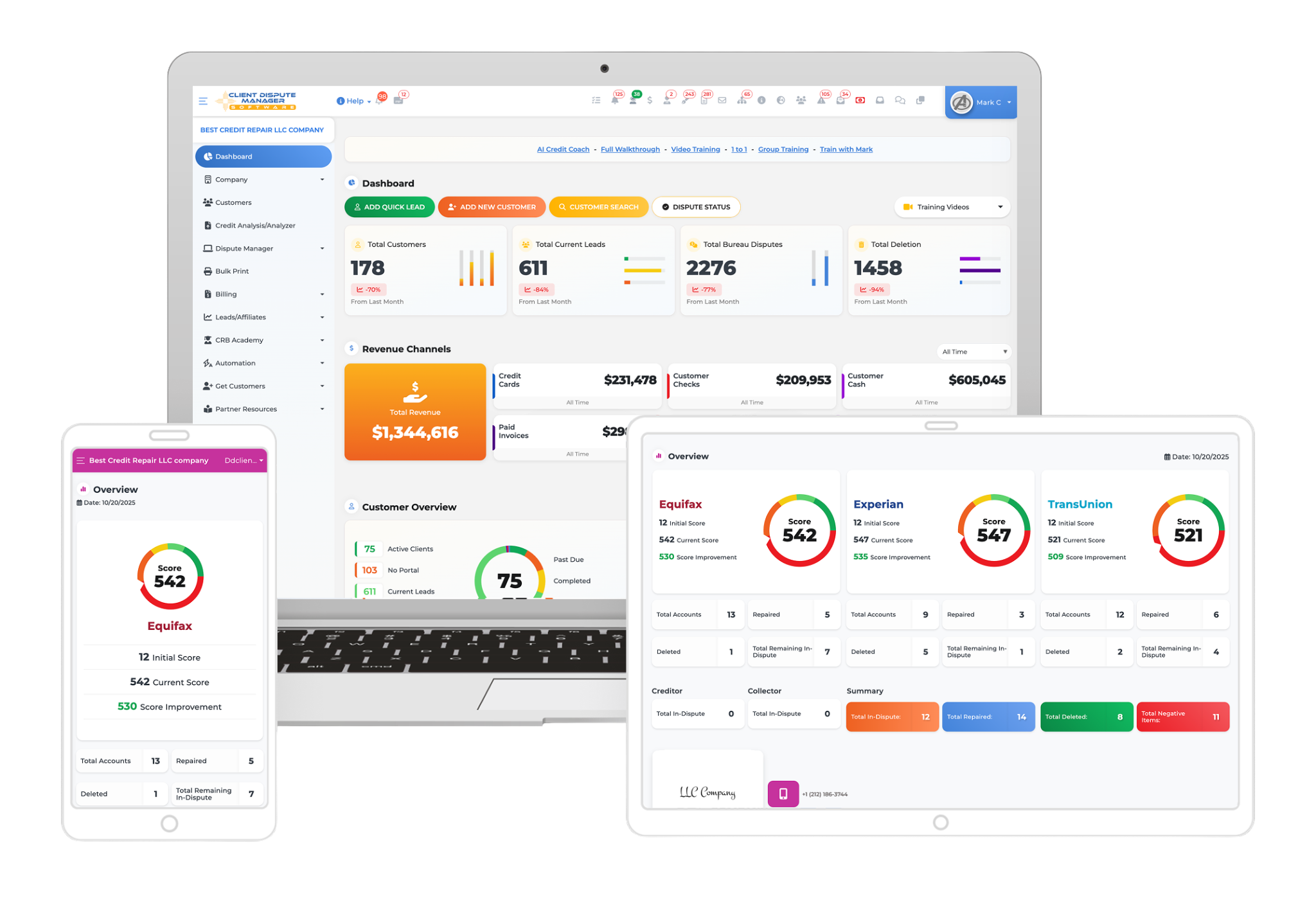
Client Dispute Manager Software was built by Mark Clayborne, a certified credit consultant and CROA practitioner who operated credit repair businesses before developing a software platform for the industry, and that origin produces a platform where the default settings, included templates, and built-in workflows reflect the compliance requirements and operational realities of running a credit repair business rather than the assumptions of a development team adapting a generic CRM to an adjacent market.
The difference between a purpose-built platform and an adapted general tool shows up not in the feature list but in the defaults, because a purpose-built platform’s defaults are compliant by design while an adapted tool’s defaults require significant configuration to reach the same compliance starting point.
The platform provides written contract templates that include all mandatory CROA elements under 15 U.S.C. section 1679d, a Consumer Rights Statement workflow that sequences the disclosure correctly before contract execution and captures the client’s acknowledgment as part of the onboarding record, and automated dispute tracking aligned with FCRA’s 30-day investigation timelines.
The billing module is structured around post-service fee collection, consistent with the advance fee prohibition under CROA at 15 U.S.C. section 1679b and the TSR at 16 C.F.R. section 310.4.
The document management system maintains a complete, time-stamped audit trail for every client file, which is the documentation foundation a credit repair business needs when responding to an FTC or CFPB inquiry without scrambling to reconstruct records that should have been maintained systematically from the first client engagement.
Yes. Under 15 U.S.C. section 1679e, consumers have an unconditional three-day right to cancel any credit repair service contract from the date it is signed, without penalty, without providing a reason, and without any notice requirement beyond informing the company of the cancellation.
The credit repair company cannot charge a fee for cancellation, require any advance notice period beyond three business days, or enforce any contract clause that purports to limit or eliminate this right, because any such clause is void under federal law. Consumers who are refused the right to cancel or who are charged a penalty for exercising it have grounds for a private lawsuit under CROA, with recovery available for actual damages, punitive damages, and attorney fees.
Credit repair companies are regulated under CROA and provide services focused on disputing inaccurate or unverifiable items on credit reports in exchange for compensation. Credit counseling agencies are typically nonprofit organizations regulated under a separate framework and focused on debt management plans and financial education rather than credit report disputes.
CROA explicitly exempts bona fide nonprofit credit counseling organizations from its requirements, which means the two categories operate under fundamentally different legal obligations. A for-profit company that misrepresents itself as nonprofit credit counseling to avoid CROA compliance is committing an independent federal violation on top of whatever CROA obligations it has already failed to meet.
CROA, the FTC Act, and the TSR provide three layers of protection against credit repair fraud that collectively cover the most common forms of abuse in the industry. The advance fee prohibition prevents companies from collecting money before delivering services.
The mandatory written contract and Consumer Rights Statement, required before any services begin, eliminate hidden terms and ensure consumers understand their rights before committing to an engagement. The three-day right to cancel gives consumers a structured window to reconsider after signing.
Consumers harmed by a credit repair scam can file complaints with the FTC at ReportFraud.ftc.gov or the CFPB at ConsumerFinance.gov/complaint, and can file a private lawsuit under CROA’s private right of action to recover actual damages, punitive damages, and attorney fees without waiting for government action.
Companies that violate CROA face FTC civil penalties up to $50,120 per violation under the FTC Act, CFPB civil money penalties under the Dodd-Frank Act, and private consumer lawsuits under 15 U.S.C. section 1679g.
In private suits, consumers can recover actual damages, punitive damages up to $1,000 per violation, and attorney fees, with the fee-shifting provision creating economic incentives for attorneys to take cases on contingency even at modest individual loss amounts.
Multi-violation enforcement actions against companies with large client bases can produce total penalties in the millions of dollars across all three enforcement channels, and the FTC and CFPB have both pursued enforcement actions that resulted in businesses being permanently shut down and ordered to pay full restitution to every consumer they had enrolled.
CROA applies to any person or company that provides credit repair services for compensation, a definition that can include sellers of dispute letter kits and operators of guided dispute software platforms that collect a fee in exchange for helping consumers improve their credit.
Platforms that provide purely educational content without personalized dispute assistance may fall outside CROA’s scope, but the legal line is narrow and the FTC has taken the position that marketing materials making specific outcome claims, combined with any fee, can trigger CROA coverage regardless of how the product is described or branded.
Business owners offering any fee-based credit dispute product should evaluate the offering against CROA’s definition of a credit repair organization before launch rather than after the first regulatory inquiry arrives.
Credit repair laws in the United States define exactly what every credit repair business must do, what it cannot do, and what happens to businesses that cross either line without understanding where it is. CROA establishes the written contract, disclosure sequencing, and fee collection requirements that form the operational baseline of every compliant client relationship.
FCRA governs the dispute process at the bureau level and sets the investigation timelines that define what is achievable for clients. FDCPA regulates the collection correspondence that intersects with credit repair work. The TSR closes the advance fee loophole for telephone and online-marketed services.
Taken together, these four laws create a clear, workable, and consistently enforced framework for running a credit repair business legally in the United States, and understanding that framework in full is the first step that separates sustainable operations from those that create liability with every client they take on. The credit repair business owners who build durable, growing operations are not the ones who found ways to work around this framework.
They are the ones who built their contracts, disclosures, billing cycles, dispute workflows, and advertising standards around it from the beginning, because doing so means that every client engagement starts correctly, every compliance obligation is met by default rather than by active effort, and the business is not one regulatory inquiry away from an operational crisis. The legal requirements that govern the credit repair industry are not obstacles to building a profitable business in this space.
They are the structural foundation on which every profitable, long-running credit repair business in this industry is built, and the faster a new business owner internalizes that, the faster they stop treating compliance as a cost and start treating it as a competitive advantage.

Mark Clayborne specializes in credit repair, starting and running credit repair businesses. He's passionate about helping businesses gain freedom from their 9-5 and live the life they really want. You can follow him on YouTube.
Experience our credit repair software, risk-free.
Start today and explore the features firsthand!