Get Started for as Low as $49 for the First Month: Click Here
Written by July 28, 2026
Last updated on September 15, 2026

If you have never used credit repair software before, the options can feel overwhelming fast. Every platform claims to be the easiest, the most powerful, and the best value. But when you are just getting started, most of that marketing noise does not help you figure out the one thing you need to know: which platform will help you get results without making you feel lost.
This guide breaks it down simply. You will learn what beginners should look for, how to evaluate a platform before committing to it, how to check whether a provider is legitimate, and how to get started safely. Whether you are working on your own credit or just starting a credit repair business, this page gives you a clear path forward.
Beginners should look for credit repair software that is easy to navigate, includes step-by-step dispute guidance, offers a free trial long enough to test the full workflow, and is built with FCRA and CROA compliance in mind. The easiest credit repair software for beginners combines simple onboarding, automated dispute letter generation, and clear progress tracking so you can start acting without needing industry experience first.

Beginners should prioritize ease of use, clear onboarding, automated dispute tools, and compliance-ready workflows. A platform that walks you through the process step by step is more valuable at the start than one loaded with advanced features you do not yet need. Look for software that explains what each step means and why it matters, not just what button to click next.
When you are new to credit repair, you do not need the most advanced platform on the market. You need one that gets you moving in the right direction quickly and does not leave you confused after the first login.
Here is what matters most for beginners:
To evaluate credit repair software as a beginner, test the platform during its free trial by completing one full dispute workflow from start to finish. Check whether the interface is easy to navigate, whether letters are generated automatically, whether compliance tools are included, and whether support is available when you need it. A platform that is hard to use during the free trial will not get easier after you pay for it.
Before you commit to any credit repair platform, run it through this checklist. You can do most of this during a free trial:
| What to Check | What to Look For | Pass or Fail |
|---|---|---|
| Onboarding Process | Clear welcome steps, guided setup, no confusing jargon upfront | Can you get through setup in under 30 minutes? |
| Dashboard Clarity | All active clients or disputes visible at a glance | Can you find a client file in under 3 clicks? |
| Dispute Letter Generation | Letters created automatically based on item type | Does it write the letter for you or ask you to write it? |
| Bureau Response Tracking | System logs response dates and flags items past 30 days | Does it remind you when a response is overdue? |
| Training Resources | Video walkthroughs, written guides, or in-app tutorials | Is there content that explains the reason behind the process? |
| Compliance Tools | CROA contract templates, TSR workflow alignment | Does the platform mention compliance at all? |
| Support Access | Live chat, email, or phone support available | Can you get a real answer within 24 hours? |
| Free Trial Length | At least 7 days; 30 days is ideal for full evaluation | Is the trial long enough to test a real workflow? |
When choosing credit repair software specifically for disputing credit report errors, look for a platform that supports all three major credit bureaus, generates dispute letters based on the specific type of error, tracks each letter and response, and includes guidance on what to do when a bureau disputes your dispute.
The dispute management workflow is the core function of any credit repair tool and should be the first thing you test.
Not every negative item on a credit report qualifies for a dispute. The Fair Credit Reporting Act gives you the right to dispute information that is inaccurate, incomplete, or unverifiable. It does not give you the right to remove accurate, verifiable information just because it hurts your score.
Here is what good dispute-focused software does for beginners:
Under the Fair Credit Reporting Act, you have the right to dispute inaccurate or incomplete information on your credit report at no cost. Credit bureaus must investigate your dispute within 30 days in most cases. If they cannot verify the information, they must remove it.
What software cannot do: no credit repair software can guarantee the removal of any specific item. If information is accurate and verifiable, it will not be removed through a dispute. Any platform that claims otherwise is not being honest about how the process works.

Credit repair professionals recommend software that combines strong automation with compliance infrastructure and ongoing education. For beginners, the most recommended platforms are those that include built-in training content alongside the dispute tools, so new users can learn the process as they work through it.
Client Dispute Manager Software is consistently recommended by credit repair professionals for its combination of accessible pricing, practitioner-built training, and compliance-ready workflows.
When credit repair professionals recommend a platform to beginners, they consistently point to the same set of criteria. It is not just about features. It is about whether the platform prepares you to do the work correctly.
The things professionals look for when recommending software to beginners:

If you are new to credit repair, you need a system that removes guesswork and keeps you consistent. Client Dispute Manager Software is built for beginners and business owners who want a clear process from start to finish. It focuses on structure, automation, and simplicity, so you always know what to do next.
Instead of managing disputes manually, you follow a guided system that helps you move faster and stay organized. You do not need prior experience. The platform is designed to walk you through each step, from reviewing your credit report to sending and tracking disputes.
Here are the features that make it effective for beginners:
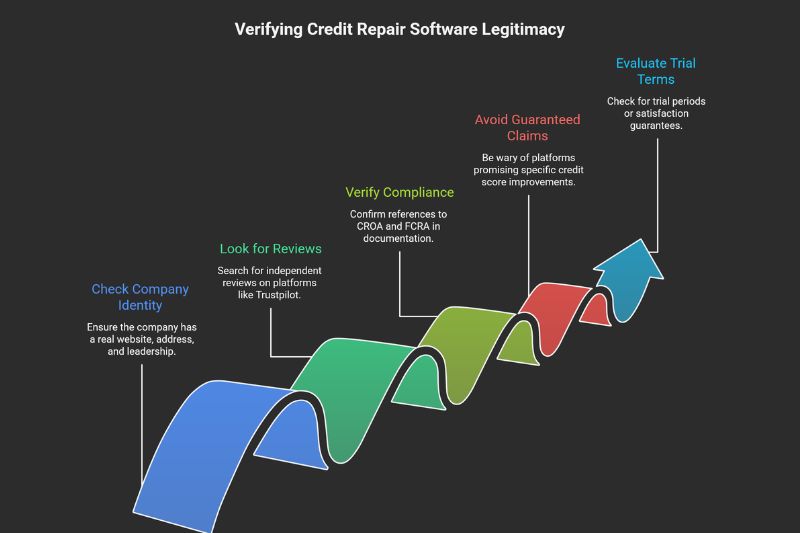
To verify the legitimacy of a credit repair software provider, check whether the company operates transparently with a real business address and team, look for reviews on independent platforms like Trustpilot or Capterra, confirm that the platform’s documentation references CROA and FCRA compliance, and check whether the founder or team has publicly verifiable credentials in the credit repair industry.
Avoid any platform that makes guaranteed outcome claims or asks for full payment before services are delivered.
Not every credit repair software company operates legitimately. Some platforms overpromise results, hide their pricing, or lack any connection to real credit repair expertise. Here is how to check before you commit:
The Credit Repair Organizations Act requires credit repair organizations to provide clients with a written contract, disclose their rights, and allow a three-day cancellation window. Legitimate software providers build these requirements into their platform workflows. If a platform’s documentation ignores CROA entirely, do not use it to run a credit repair business.

The safest way to access credit repair software is to go directly to the provider’s official website rather than downloading from third-party sites, app stores, or forums. Most modern credit repair platforms are web-based, meaning there is nothing to download. You log in through a browser. If a platform requires a desktop download, verify the source carefully before installing anything on your computer.
Most professional credit repair software runs in a web browser. That means you do not need to download or install anything. You create an account, log in, and access the full platform from any device with an internet connection.
Here is how to access reputable credit repair software safely:
Migrating data between credit repair software platforms involves exporting your client files, dispute history, and documents from your current platform and importing or re-entering them into the new one. Most platforms do not have direct integration with each other, so migration typically requires some manual work.
Plan the transition carefully to avoid losing dispute history or missing active response deadlines during the switch.
If you are switching from one credit repair platform to another, here is what to plan for before you make the move:
The easiest credit repair software for beginners is one that includes guided onboarding, automated dispute letter generation, clear dashboard navigation, and built-in training content. The goal is to be able to complete your first dispute workflow without needing to research every step independently. Client Dispute Manager Software is designed with beginners in mind.
The training library from Mark Clayborne covers the entire credit repair process from the ground up, so you learn what you are doing as you do it. The 30-day free trial lets you test the full platform before paying anything.
The most user-friendly credit repair software for non-experts keeps the interface clean, uses plain language instead of industry jargon, and walks you through each step of the dispute process without assuming prior knowledge. The best platforms also include educational content that explains why each step matters, not just what to do next.
For non-experts, training quality is just as important as feature quality. A platform that teaches you as you work through it will produce better results than one that assumes you already know everything.
Credit repair professionals and credit counselors typically recommend platforms that are built around compliance, include real training content, and have a verifiable track record. Client Dispute Manager is recommended by credit repair professionals due to its compliance-ready workflows, Mark Clayborne’s practitioner-built training library, and its transparent 30-day free trial with no credit card required.
When asking for recommendations in professional communities, look specifically for platforms with clear CROA and FCRA compliance documentation.
The safest way to access reputable credit repair software is to go directly to the provider’s official website. Most modern credit repair platforms are web-based, so there is nothing to download. You sign up online and access everything through your browser. Client Dispute Manager is a web-based platform available at clientdisputemanagersoftware.com.
Never download credit repair software from third-party sites or file-sharing platforms. Only access platforms through their official website.
Most reputable credit repair software platforms have moved to web-based access, which means you do not need a desktop application. Web-based platforms are accessible from any device, do not require installation, and are updated automatically by the provider.
If you encounter a platform offering a desktop download, verify the source by going directly to the official company website and downloading only from there. Client Dispute Manager is fully web-based and requires no download or installation.
Choosing the right credit repair software as a beginner does not have to be complicated. Start with a platform that is easy to navigate, includes real training, and gives you a long enough free trial to evaluate it properly before committing to anything.

Mark Clayborne specializes in credit repair, starting and running credit repair businesses. He's passionate about helping businesses gain freedom from their 9-5 and live the life they really want. You can follow him on YouTube.

Experience our credit repair software, risk-free.