Get Started for as Low a $49 for the First Month: Click Here
Written by Mark Clayborne
Last updated on April 2, 2026

A negative item in your credit report is not the end of the road. Whether you are dealing with bankruptcy, foreclosure, repossession, a collection account, a charge-off, or late payments, you have legal rights that give you a clear path forward. The Fair Credit Reporting Act gives every consumer the right to dispute inaccurate, outdated, or unverifiable information at no cost.
This page covers every major type of negative item, what you can do about each one, your rights under federal credit law, and how Client Dispute Manager Software automates the dispute process so you can move through it faster and with less effort.
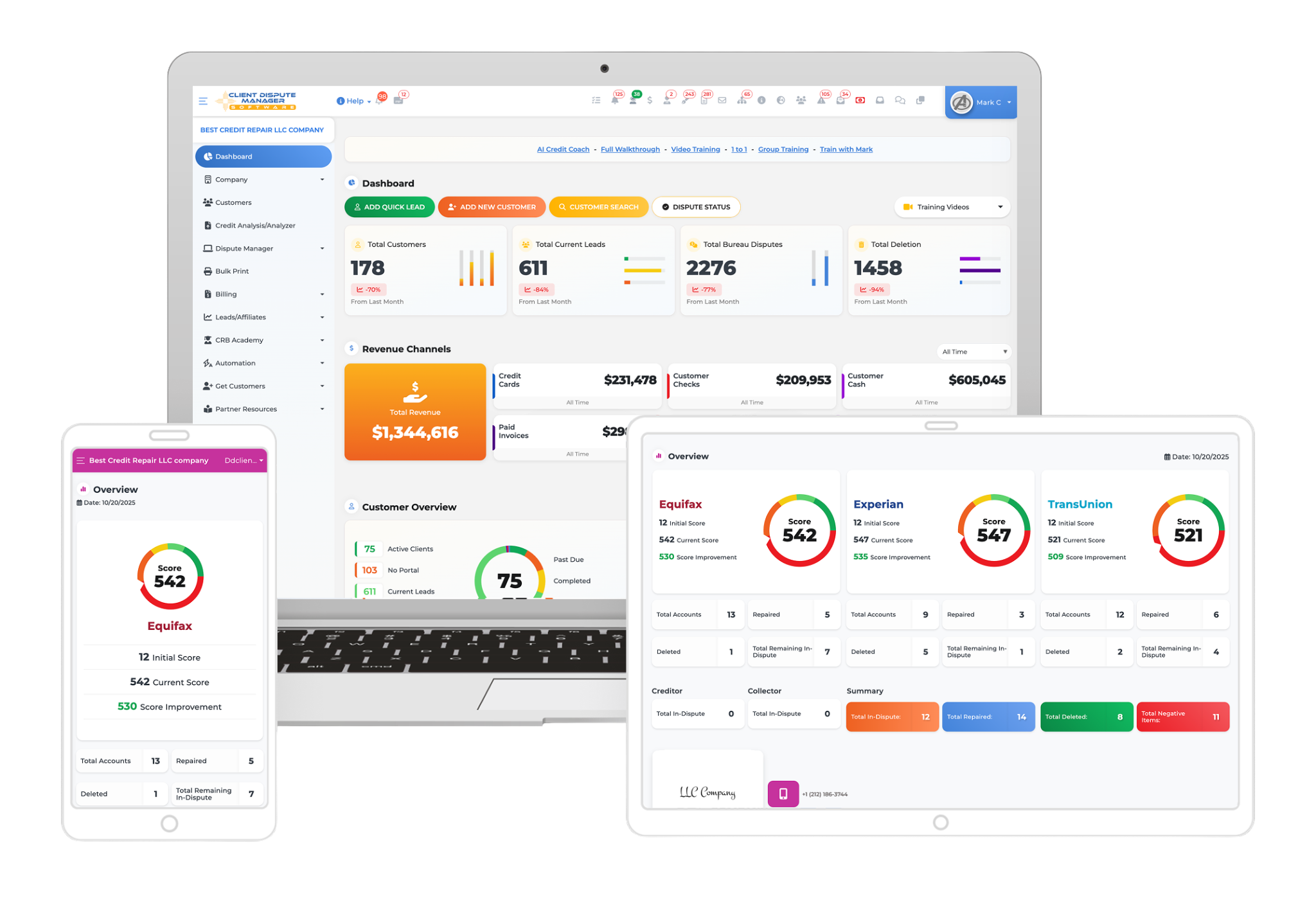
The most effective approach to fixing your credit combines disputing inaccurate negative items under the FCRA with building new positive payment history in parallel. Client Dispute Manager Software handles the dispute side: pulling credit reports, generating bureau-specific letters, tracking 30-day response deadlines, and managing follow-ups across all three bureaus from a single dashboard.

Most inaccurate or unverifiable negative items can be removed through a formal dispute. Under the Fair Credit Reporting Act, any entry that is incorrect, outdated, or cannot be verified by the reporting creditor is a candidate for removal.
Accurate negative items remain on file for a fixed period: most derogatory marks stay for seven years, while Chapter 7 bankruptcy stays for ten years. Accuracy is the deciding factor. If a detail is wrong, you have the right to dispute it.
Understanding which items can be removed and which cannot helps you focus your dispute efforts where they will produce results.
| Negative Item | How Long It Stays on Report | Can Inaccurate Entries Be Disputed? |
|---|---|---|
| Late Payments | 7 years | Yes |
| Collections | 7 years from date of first delinquency | Yes |
| Charge-Offs | 7 years | Yes |
| Repossession | 7 years | Yes |
| Foreclosure | 7 years | Yes |
| Chapter 7 Bankruptcy | 10 years from filing date | Yes, if any detail is inaccurate |
| Chapter 13 Bankruptcy | 7 years | Yes |
| Hard Inquiries | 2 years | Yes, if unauthorized |
| Identity Theft Entries | Removed upon verification | Yes, cite FCRA Section 605B |
The Fair Credit Reporting Act gives every consumer the right to dispute inaccurate credit report information at no cost. Credit bureaus have 30 days to investigate and respond to every dispute.
You also have the right to receive a free annual credit report from each of the three major bureaus, to know what is in your file, to add a personal statement, and to seek damages if a bureau or creditor violates the law. You do not need to hire a company to exercise any of these rights.
Common credit report errors include mixed-file mistakes where your information is merged with another consumer, accounts that were not removed after the seven-year reporting limit, duplicate entries reported by both an original creditor and a debt collector, payments incorrectly recorded as late, and fraudulent accounts from identity theft.
Preventing errors means pulling all three credit reports once a year, reviewing every trade line, and submitting a dispute as soon as an error appears. Client Dispute Manager Software flags reporting discrepancies across all three bureau files automatically.

Pull your credit reports from Experian, Equifax, and TransUnion. Identify every inaccurate entry. Gather documents that support your position. Submit a written dispute letter to each bureau reporting the error, citing your FCRA rights and the specific inaccuracy. The bureau has 30 days to investigate.
If the creditor cannot verify the entry, it must be corrected or removed. Client Dispute Manager Software automates every step: report importing, letter generation, bureau tracking, and follow-up scheduling across all three bureaus simultaneously.
Before submitting a dispute, gather the following:
Client Dispute Manager Software attaches supporting documentation automatically when generating dispute letters for each bureau, so nothing is missed and every submission is complete.
Each of the three major credit bureaus maintains its own separate file. Submitting a dispute to Experian does not update your Equifax or TransUnion reports. Reputable credit repair software sends separate, bureau-specific dispute letters to all three simultaneously.
Client Dispute Manager Software tracks the 30-day response deadline for each bureau from a single dashboard, sends follow-up letters automatically when a bureau fails to respond on time, and escalates unresolved disputes to the Consumer Financial Protection Bureau when appropriate.
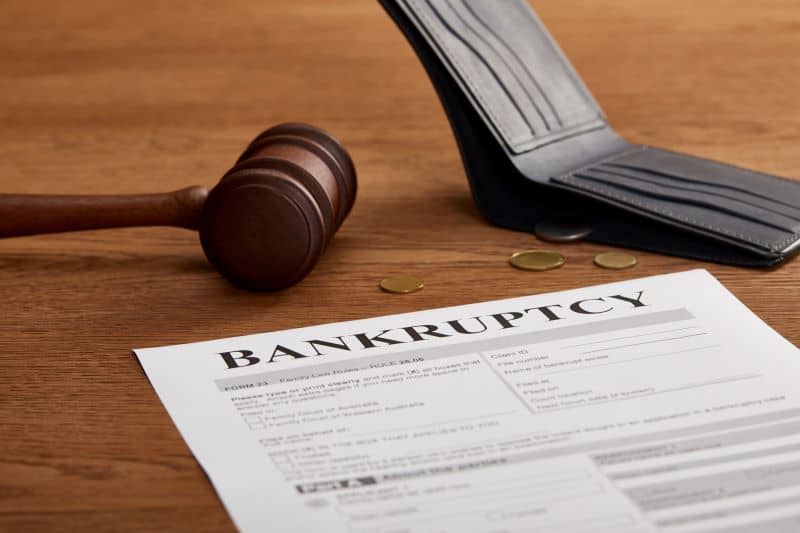
Bankruptcy is the most serious derogatory mark on a credit report, but recovery starts immediately after discharge. Chapter 7 bankruptcy stays on file for ten years from the filing date. Chapter 13 stays for seven years.
Rebuilding begins with secured credit cards and credit-building loans while making every payment on time. Any inaccuracy in how the bankruptcy is recorded can be disputed under the FCRA, including the wrong chapter, incorrect dates, or accounts incorrectly tied to the filing.
The most cost-effective approach after bankruptcy combines disputing any inaccurate bankruptcy entry details with opening new positive trading lines. Client Dispute Manager Software identifies reporting errors in the bankruptcy entry, generates dispute letters for all three bureaus, tracks bureau responses, and monitors your score as new positive accounts are established.
Software-first credit repair costs significantly less than traditional credit repair services and gives you full transparency into every step of the process.
You cannot dispute a legally filed and accurate bankruptcy. You can dispute inaccurate details within the bankruptcy entry: the wrong chapter listed, an incorrect filing or discharge date, accounts incorrectly included in the filing, or entries that remain on the report past the seven- or ten-year reporting limit.
Submit a dispute to all three bureaus with certified court documentation that proves the specific error. Client Dispute Manager Software generates bankruptcy-specific dispute letters with correct FCRA citations and tracks each bureau investigation to its deadline.

A foreclosure stays on your credit report for seven years from the date of first delinquency. Short sales and deeds-in-lieu carry the same timeline and similar score impact.
The most effective rebuilding strategy starts with disputing any inaccurate details in the foreclosure entry, then establishing new positive payment history through a secured credit card, keeping utilization below 30 percent, and making every payment on time. FHA mortgage eligibility typically resumes after three years with re-established credit.
Credit repair software is the most practical option for consumers working through credit recovery after foreclosure. Client Dispute Manager Software identifies inaccurate foreclosure entry details, generates FCRA-based dispute letters, and monitors bureau responses while you build new positive accounts in parallel.
For consumers who also need help managing ongoing debt, NFCC-affiliated nonprofit credit counseling agencies can assist with the debt management side alongside the dispute process.

An accurate repossession cannot be removed before the seven-year reporting period ends. However, reporting errors in repossession entries are common: wrong date, incorrect outstanding balance, duplicate entries by both the original creditor and a debt collector, or a deficiency balance reported as unpaid after it was settled.
Any inaccurate field can be disputed with the reporting bureau. Both voluntary and involuntary repossessions appear on the credit report as a repossession, though voluntary surrenders sometimes carry different creditor comments.
To rebuild after a repossession, resolve any outstanding deficiency balance in writing first. After 12 to 24 months of positive payment history on a secured card or credit-builder loan, your score can recover meaningfully. Client Dispute Manager Software monitors all three bureau files for any new errors in how the repossession account is reported over time.

Under the Fair Debt Collection Practices Act, you can send a debt validation letter within 30 days of first contact from a collector to force them to verify the debt. If they cannot verify it, the entry must be removed. You can also dispute inaccurate collection details directly with the credit bureaus under the FCRA, negotiate a pay-for-delete agreement, or request a goodwill deletion for a paid collection.
Client Dispute Manager Software generates debt validation letters and bureau dispute letters specific to collection accounts and tracks every response.
A charge-off means the original creditor wrote the debt off as a loss on their books. It remains in your credit report for seven years from the date of first delinquency, even if you pay the balance later.
To dispute a charge-off, first verify that the date of first delinquency is correct, confirm the reported balance matches your records, and check whether the account is being reported twice under both the original creditor and a debt collector.
Submit a dispute letter for any field that is inaccurate. Client Dispute Manager Software identifies and disputes all three common charge-off reporting errors simultaneously across all three bureaus.

Identity theft can plant fraudulent accounts, unauthorized hard inquiries, and false address history on your credit report. The immediate steps are placing a fraud alert or credit freeze at all three bureaus and filing a report at IdentityTheft.gov. Every fraudulent entry must then be disputed with documentation proving the item does not belong to you.
Under FCRA Section 605B, bureaus must block verified identity theft entries within four business days. Client Dispute Manager Software generates identity theft dispute letters that cite the correct statutory provisions and tracks removal confirmations from all three bureaus.
Look for software or services that generate FCRA Section 605B dispute letters, track fraudulent entry removals across all three bureaus, and help build a complete documentation trail alongside the FTC identity theft report.
Client Dispute Manager Software was built by Mark Clayborne, a certified CROA practitioner, and automates the entire identity theft dispute workflow without charging advance fees, which are prohibited by federal law under the Credit Repair Organizations Act.
Yes. The FCRA gives every consumer the right to dispute inaccurate credit report entries directly with the three major bureaus at no cost. You can pull your reports for free at AnnualCreditReport.com, write dispute letters yourself, and send them certified mail. The process is legal, free, and effective.
The difficulty is managing it: tracking deadlines across three bureaus, writing bureau-specific letters for each item type, and following up on every response requires consistent time and organization. Credit repair software does all of that automatically for a fraction of what service companies charge.
When comparing options for automating credit disputes, the decision typically comes down to three paths:
| Options | Average Cost | Automation Level | CROA Compliant |
|---|---|---|---|
| DIY Manual Dispute Letters | Free | None, you manage all steps | Yes |
| Credit Repair Service Companies | $79 to $149 per month | Partial | Varies, verify before enrolling |
| Client Dispute Manager Software with 30-Day Free Trial | Low monthly fee | Full automation across all three bureaus | Yes, built by CROA practitioner |

Here is how the dispute process works inside Client Dispute Manager Software:

Most consumers see measurable score improvements within 30 to 60 days of a successful dispute. Removing a major derogatory item can produce an increase of 20 to 100 or more points depending on the item and the overall credit profile. Full recovery from bankruptcy or foreclosure typically takes two to four years of consistent positive payment history built in parallel with the dispute process.
Disputing inaccurate items and adding positive trading lines at the same time is the fastest path to a meaningfully higher score.
Improving a low credit score requires addressing both the negative items already on your report and the payment habits that will determine your score going forward.
Yes. The FCRA gives every consumer the right to dispute inaccurate credit report entries directly with the bureaus at no cost. You can write dispute letters yourself and mail them to Experian, Equifax, and TransUnion.
Credit repair software like Client Dispute Manager Software automates this process for a low monthly fee and gives you full transparency in every step, at a fraction of the cost of a traditional credit repair service.
Any inaccurate, outdated, or unverifiable item can be removed through a formal FCRA dispute. Common removable items include late payments recorded in error, duplicate collection accounts, charge-offs with incorrect balances, inaccurate bankruptcy details, foreclosure entries with wrong dates, and fraudulent accounts created by identity theft.
Most consumers see initial score improvements within 30 to 60 days of a successful dispute. Removing a major derogatory item can produce a 20 to 100-plus point improvement depending on the item and your overall credit profile.
Full recovery from bankruptcy or foreclosure takes two to four years of consistent positive payment history built in parallel with the dispute process.
You have the right to dispute inaccurate information, receive a free annual credit report from each bureau, know what is in your credit file, add a personal statement to your report, and seek damages if a bureau or creditor violates the FCRA. These rights apply to every consumer at no cost and do not require hiring a credit repair company to exercise.
Fixing your credit comes down to consistent action, accurate reporting, and knowing your rights under the law. Whether you are dealing with bankruptcy, collections, charge-offs, or late payments, each issue can be handled step by step with a clear process.
You need to review your credit reports, identify errors, dispute inaccurate or unverifiable items, and maintain on-time payments moving forward. Keeping your balances low and staying active with your credit profile are key factors that directly impact your score.
Results take time, but steady effort leads to real progress. Most people begin to see changes within 30 to 90 days when they stay consistent with disputes and positive credit habits. The goal is to stay organized, track your progress, and avoid missing important steps.
When you take control of the process and stick with it, each improvement builds a stronger credit profile and moves you closer to better financial opportunities.

Mark Clayborne specializes in credit repair, starting and running credit repair businesses. He's passionate about helping businesses gain freedom from their 9-5 and live the life they really want. You can follow him on YouTube.
Experience our credit repair software, risk-free.