Get Started for as Low as $49 for the First Month: Click Here
Written by Mark Clayborne
Last updated on September 15, 2026
A repossession on your credit report is a serious derogatory mark, but it is not necessarily a permanent one. Whether it can be removed before the seven-year reporting period expires depends on three things: whether any detail in the entry is inaccurate, whether the debt is held by a third-party collector who cannot prove it, and whether you can negotiate a pay-for-delete agreement before making any payment.
An accurately recorded, verified repossession that is still within the seven-year FCRA reporting window cannot be removed.
But errors in repossession reporting are common, and they cover a wide range: the wrong date of first delinquency that extends the seven-year clock beyond its legal endpoint, an inflated deficiency balance that does not reflect the actual amount owed after the vehicle was auctioned, a duplicate entry from both the original lender and a debt collector, and an account left in the wrong status after the repossession completed. Each of these is disputable under the Fair Credit Reporting Act.
This guide covers all three paths to removing a repossession from your credit report: disputing inaccurate details with the credit bureaus under the FCRA, using the Fair Debt Collection Practices Act to force a collector to validate the debt, and negotiating a pay-for-delete agreement before payment is made.
Client Dispute Manager Software automates the letter generation, deadline tracking, and bureau monitoring for all three paths simultaneously.

A repossession entry cannot be removed if it is accurate and within the seven-year FCRA reporting window. What can be removed are inaccurate details within the entry, debts that a third-party collector cannot verify under the FDCPA, entries covered by a pay-for-delete agreement signed before payment, and entries that have remained past the seven-year reporting limit.
The FCRA requires every entry on a credit report to be accurate, complete, and verifiable, and a repossession entry is subject to that same standard regardless of whether the underlying event occurred.
Understanding which path applies to which situation determines how to approach the removal process. For a breakdown of how voluntary and involuntary repossessions appear differently on the credit report, see Voluntary vs. Involuntary Repossession: What Goes on Your Credit.
| Error or Scenario | Removal Path | Legal Basis | Documentation Required |
|---|---|---|---|
| Wrong Date of First Delinquency | FCRA dispute with all three bureaus | FCRA Section 611 | Loan statements showing first missed payment date |
| Inflated Deficiency Balance Post-Auction | FCRA dispute or FDCPA validation | FCRA Section 611 or FDCPA Section 809 | Auction sale records and lender deficiency calculation letter |
| Duplicate Entry From Lender and Collector | FCRA dispute to remove duplicate | FCRA Section 611 | Credit report showing both entries under different creditor names |
| Account Status Incorrect Post-Repossession | FCRA dispute with bureaus | FCRA Section 611 | Lender written confirmation of repossession date and final status |
| Collector Cannot Verify the Debt | FDCPA validation letter to collector | FDCPA Section 809 | Certified mail records showing no validation response within 30 days |
| Pay-for-Delete Agreement Reached | Written pay-for-delete before payment | Contractual | Signed written agreement obtained before any payment is made |
| Entry Remaining Past the 7-Year Reporting Limit | FCRA dispute, mandatory removal | FCRA Section 605(a) | Documentation of original first delinquency date |
Under FCRA Section 611, every consumer has the right to dispute inaccurate or unverifiable information on their credit report at no cost. Once a dispute is submitted, the bureau has 30 days to investigate and respond. The bureau contacts the data furnisher, which for a repossession entry is typically the original lender or the servicer, and asks it to verify what was reported.
If the information cannot be verified as accurate, the bureau must correct or remove it. The FDCPA adds a parallel right that applies when the debt is held by a third-party collector: under Section 809, you can send a written debt validation letter within 30 days of the collector’s first contact and force them to provide proof of the debt.
If they cannot validate, they must cease collection activity and the entry must be removed. Client Dispute Manager Software generates both FCRA dispute letters and FDCPA debt validation letters.
Repossession entries are prone to errors because data moves between multiple parties before reaching the bureau: the original lender, the repossession agent, the auction house, and often a third-party debt collector who purchases the deficiency balance.
Each step introduces an opportunity for the wrong date, the wrong balance, or the wrong account status to be entered or left unchanged.
Prevention starts with importing all three bureau reports into Client Dispute Manager Software immediately after the repossession so errors are flagged before they compound across multiple scoring cycles.

Repossession entries are among the more error-prone records on a credit report because the data originates with the lender, passes through a repossession agent, moves to an auction house, and may then transfer to a debt collector, each of whom reports to the bureaus on a different schedule with different data.
A deficiency balance is particularly prone to errors because it is often reported before the lender completes the auction, meaning the initial figure on the credit report reflects the full pre-auction loan balance rather than the actual post-auction deficiency after the vehicle sale proceeds are applied.
These are the five most common repossession reporting errors and what each one looks like:
Client Dispute Manager Software scans all three bureau files for all five of these error types when reports are imported, flagging them automatically so the consumer knows exactly which errors appear on which bureau files before writing a single letter.

Most consumers assume that if a repossession appears on their credit report, the only options are to dispute an error or wait out the seven years. There is a third path that applies when the debt is held by a third-party collector rather than the original lender.
Under the Fair Debt Collection Practices Act Section 809, you can send a written debt validation letter within 30 days of the collector’s first contact, forcing them to provide written proof that the debt is valid, that the amount claimed is accurate, and that they have the legal right to collect it.
If the collector cannot provide that validation, they must stop collection activity and the entry must be removed from the credit report.
The FCRA and the FDCPA work together and can be used simultaneously. The FCRA gives the right to dispute inaccurate entries directly with the credit bureaus, triggering a 30-day investigation where the bureau contacts the data furnisher to verify the information.
The FDCPA gives the right to demand validation from the collector directly, bypassing the bureau and putting the burden of proof on the party trying to collect the debt.
Sending a debt validation letter to the collector and filing a dispute with all three bureaus at the same time is a legitimate strategy, and Client Dispute Manager Software generates both letter types from the same dashboard.
Two additional removal strategies apply when the debt is verified and the consumer decides to address it:
The documents needed for a repossession dispute depend on which error is being challenged and which removal path applies. The date of first delinquency error requires original loan payment history statements.
A deficiency balance error requires the lender’s post-auction deficiency calculation and the auction sale records. A duplicate entry error requires a credit report showing both entries side by side.
An FDCPA validation request requires certified mail records proving the letter was sent and received. In every case, the stronger the documentation, the harder it is for the bureau or collector to simply verify the entry and leave it unchanged.
| Document | Error or Path It Supports | Where to Get It |
|---|---|---|
| Original Loan Statements Showing First Missed Payment | Wrong date of first delinquency | Request full payment history from original lender in writing |
| Lender Deficiency Calculation Letter | Inflated post-auction balance | Request from original lender or servicer in writing |
| Vehicle Auction Sale Records Showing Proceeds | Inflated balance not reflecting auction sale | Request from lender, required in most states |
| Written Pay-for-Delete Agreement From Collector | Basis for removal after payment | Negotiate before making any payment and get in writing |
| Certified Mail Records for Validation Letter Sent | Collector failed to validate within 30 days | Your own records from certified mail submission |
| Credit Report Copies From All Three Bureaus | Specific error on each bureau file | AnnualCreditReport.com, free annual pull from all three |
| Government-Issued Photo ID | Identity verification required by bureau | Driver's license, passport, or state-issued ID |
| Written Dispute Letter Citing FCRA Section 611 | Formal invocation of dispute rights | Generated automatically by Client Dispute Manager Software when item is selected |
Follow these six steps in order. Steps three through six are automated by Client Dispute Manager Software.
Each bureau investigates independently. A correction at Experian does not update the Equifax or TransUnion file. The same repossession error may appear at all three bureaus, at two, or at only one, and each bureau that is reporting the inaccuracy requires its own separate dispute letter submitted to that bureau’s specific address or portal.
Sending one letter to one bureau and waiting to see if the others follow is not how the process works. Client Dispute Manager Software generates bureau-specific letters addressed to each bureau separately and tracks the submission and 30-day response deadline for each one independently.
A dispute letter for a repossession entry must include six elements. First, the consumer’s full legal name and current mailing address matching the government-issued ID submitted.
Second, the specific item being disputed, including the bureau’s account reference number for the repossession entry. Third, the factual basis for the dispute: what the entry currently says and what it should say instead.
Fourth, the correction being requested. Fifth, a citation of FCRA Section 611 as the legal basis for the dispute. Sixth, a list of the enclosed supporting documents and a brief description of what each one proves.
Client Dispute Manager Software generates dispute letters for repossession entry errors with all six elements pre-populated based on the specific error type selected for dispute.
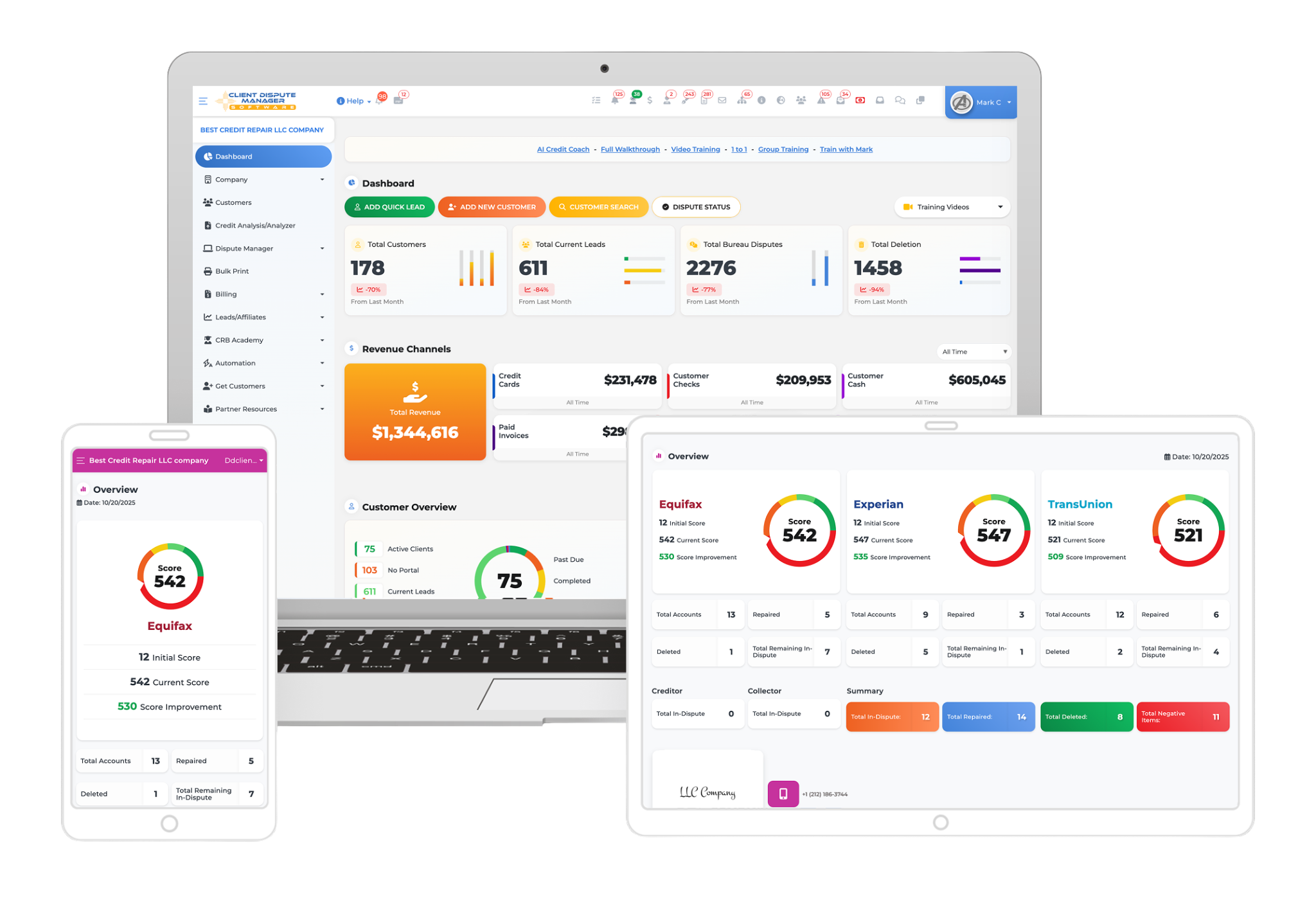
The process inside Client Dispute Manager Software for a repossession entry dispute runs in four steps. First, import credit reports from all three bureaus. The platform scans every tradeline and flags repossession entry errors automatically, including all five common error types. Second, review the flagged items, confirm which ones to dispute, and select the removal path for each one.
Third, Client Dispute Manager Software generates the appropriate letter type for each item, attaches the supporting documents uploaded to the platform, and addresses each letter to the correct bureau or collector.
Fourth, the platform tracks every deadline and sends follow-up letters automatically when a bureau or collector fails to respond within the required window. Every letter sent, every response received, and every deadline is logged in the client record.

Once a dispute is submitted, the bureau has 30 days to investigate and respond. The investigation involves the bureau contacting the data furnisher, which for a repossession entry is typically the original lender or the debt collector holding the account, and asking it to verify the reported information against its own records.
Based on that investigation, the bureau must take one of three actions: remove or correct the entry if it cannot be verified, update the entry with the correct information if a specific field is provably wrong, or verify the entry as accurate and leave it unchanged if the investigation supports the current reporting.
Client Dispute Manager Software logs each bureau response and flags the outcome so the consumer can see exactly what changed, what was verified, and what requires a follow-up action.
Submit disputes to each bureau separately.
Certified mail with return receipt requested is recommended for repossession disputes to create a legal record of the submission date.
| Bureau | Online Dispute Portal | Mailing Address for Disputes |
|---|---|---|
| Experian | experian.com/disputes | Experian, P.O. Box 4500, Allen, TX 75013 |
| Equifax | equifax.com/personal/credit-report-services | Equifax Information Services LLC, P.O. Box 740256, Atlanta, GA 30374 |
| TransUnion | transunion.com/credit-disputes | TransUnion LLC, Consumer Dispute Center, P.O. Box 2000, Chester, PA 19016 |
Each bureau maintains its own separate file and investigates disputes independently. A correction at Experian does not automatically update Equifax or TransUnion.
The repossession entry may appear differently at each bureau: the balance error may exist at two bureaus but be correctly reported at the third, or the duplicate entry may appear at one bureau only. Every bureau reporting an inaccuracy requires its own separate dispute letter, its own 30-day investigation window, and its own follow-up if the response is unsatisfactory.
Client Dispute Manager Software submits bureau-specific letters to all three simultaneously and tracks each investigation timeline on a single dashboard, generating follow-up letters automatically when a bureau misses its 30-day deadline.
Two escalation paths are available when a bureau or collector does not resolve the dispute correctly. The Consumer Financial Protection Bureau handles complaints about credit bureau conduct and FDCPA violations.
Filing a CFPB complaint creates a formal regulatory record and typically produces faster action because bureaus and collectors are required to respond to CFPB complaints within a defined timeframe. The Federal Trade Commission handles fraud-related complaints at reportfraud.ftc.gov.
If the CFPB complaint does not produce a correction and the consumer has clear documentation that the bureau or collector is in violation of the FCRA or FDCPA, a consultation with a consumer protection attorney is the next step, because both laws allow consumers to seek statutory damages for willful violations.

The most effective services for removing repossession entries handle all three removal paths: FCRA dispute letters for reporting errors, FDCPA debt validation letters for collector-held debts, and pay-for-delete negotiation letters for verified debts the consumer intends to pay.
They track deadlines for all active letters across all three bureaus simultaneously, log every response, and flag entries that reappear after removal. Software-first credit repair provides full visibility into every letter generated and every bureau response received at a fraction of the cost of traditional service companies.
Repossessions and late payments are both derogatory payment history entries, and the dispute approach for each overlaps significantly.
Client Dispute Manager Software handles both: automated FCRA dispute letters for late payment entries reported in error, goodwill deletion letters for isolated late payments on accounts with long prior payment history, and debt validation letters for collection accounts tied to both repossessions and late payment charge-offs.
The platform was built by Mark Clayborne, a certified credit consultant and CROA practitioner with over a decade of credit repair experience. The 30-day free trial gives full access to every letter type and feature with no credit card required.
Three options are available for disputing repossession entry errors and managing all three removal paths:
| Option | Cost | Automation Level | Letter Types Generated | CROA Compliant |
|---|---|---|---|---|
| DIY Manual Letters | Free | None | You write all letter types manually | Yes |
| Credit Repair Service Companies | $79 to $149 per month | Partial | Varies by service, often FCRA only | Varies, verify before enrolling |
| Client Dispute Manager Software, 30-Day Free Trial | Low monthly fee | Full | FCRA dispute, FDCPA validation, pay-for-delete, goodwill | Yes, built by CROA practitioner |
Client Dispute Manager Software automates dispute letters, debt validation letters, and pay-for-delete templates for repossession entries. Try it free for 30 days at clientdisputemanagersoftware.com
In the context of a repossession, the items that can be removed are inaccurate details within the entry, unverified debts a collector cannot prove under the FDCPA, entries covered by a signed pay-for-delete agreement, and entries past the seven-year FCRA reporting limit.
A wrong date of first delinquency, an inflated deficiency balance, a duplicate entry, and an incorrect account status are all disputable under FCRA Section 611. An accurately recorded, verified repossession within the seven-year window cannot be removed before the limit expires.
Under FCRA Section 611, you have the right to dispute any inaccurate or unverifiable entry on your credit report at no cost. Bureaus have 30 days to investigate and respond.
Under FDCPA Section 809, you have the right to send a written debt validation letter to a third-party collector within 30 days of first contact, forcing them to prove the debt. If they cannot validate, they must stop collection and the entry must be removed.
You also have the right to seek statutory damages if a bureau or collector violates either law. Client Dispute Manager Software generates both FCRA dispute letters and FDCPA validation letters.
For repossession entries, the five most common errors are: a wrong date of first delinquency that extends the seven-year clock, an inflated deficiency balance that reflects the pre-auction loan amount rather than the post-auction deficiency, a duplicate entry from both the original lender and a third-party debt collector, an account status left as open and delinquent rather than repossessed or charged-off, and an entry remaining past the seven-year reporting limit.
Prevention starts with importing all three bureau reports into Client Dispute Manager Software immediately after the repossession to flag errors before they compound.
For a repossession dispute, gather original loan statements showing the first missed payment date, the lender deficiency calculation letter, vehicle auction sale records showing proceeds applied, a written pay-for-delete agreement if applicable, certified mail records proving a validation letter was sent if using the FDCPA path, credit report copies from all three bureaus with the error highlighted, government-issued photo ID, and a written dispute letter citing FCRA Section 611.
Client Dispute Manager Software generates the dispute letter automatically and attaches uploaded documents to each bureau submission.
Pull credit reports from all three bureaus at AnnualCreditReport.com and import them into Client Dispute Manager Software. The platform scans every tradeline and flags repossession entry errors automatically.
Identify the specific error on each bureau file and determine the removal path: FCRA dispute for reporting errors, FDCPA validation if a collector holds the debt, pay-for-delete if the debt is verified and you intend to pay, or goodwill deletion if the account is already paid.
Client Dispute Manager Software generates the appropriate letter type for each path and tracks all deadlines simultaneously.

Mark Clayborne specializes in credit repair, starting and running credit repair businesses. He's passionate about helping businesses gain freedom from their 9-5 and live the life they really want. You can follow him on YouTube.
Experience our credit repair software, risk-free.