

An AI credit coach is an AI assistant that answers the questions credit repair business owners get stuck on, from dispute strategy to the laws they have to follow. You use it by asking specific questions, then checking every legal or dispute answer against the official source before you act.
Consumer apps use the same phrase for help with a personal credit score. This guide covers the business side: AI for a credit repair business. In the video above, Mark Clayborne puts real questions to Client Dispute Manager’s AI Credit Coach, from stall letters and a beginner dispute strategy to automations, compliance laws, trust, a start-up checklist, a first customer and realtors.
Below, each question becomes a copy-ready prompt, grouped into Start, Run, Grow and Comply. You’ll also see what an AI coach can’t do.
What Is an AI Credit Coach?

An AI credit coach is an AI assistant that answers questions about starting, running and growing a credit repair business, such as how to handle stall letters, what to automate and which laws apply. It’s a study and drafting aid for the owner, not a dispute-letter generator, a lawyer or a replacement for checking official sources.
Consumer apps use “AI credit coach” for something else: helping one person with their own score. For a business owner, the questions are about the company, such as onboarding, compliance, marketing and dispute workflows. Client Dispute Manager’s AI Credit Coach sits on that business side.
A coach is also different from an AI letter tool. A letter tool writes documents for a client file. A coach answers business questions and helps you plan the work.
How Is an AI Credit Coach Different From Regular ChatGPT?
Regular ChatGPT answers credit repair questions from general knowledge, and the quality depends on how you ask. An AI credit coach adds instructions and material focused on credit repair. In the video, the AI Credit Coach opens in a ChatGPT chat that Mark Clayborne set up as a specialized credit repair assistant.
Mark says he built the Coach from his years in the credit repair industry. In the video, he explains that its beginner dispute strategy drew on both what he taught it and what the AI knows about the wider industry.
His bigger point is about the questions. Many owners already use ChatGPT for a credit repair business, he says, but don’t know how to ask it the right questions. A specialized assistant helps, yet a vague question still gets a vague answer. The next sections give you the video’s exact questions, plus sharper versions you can copy.
Which Questions Should You Ask an AI Credit Coach?
Start with the questions owners ask most. In the video, Mark asks the AI Credit Coach eight of them, plus one about running the business in 2027. The table lists each question, what the video showed of the answer and what you still need to check yourself.
AI Credit Coach gives general information, not legal advice; check any compliance answer against the official law and with a qualified attorney before you act on it.
What Should You Ask When You're Starting a Credit Repair Business?
Ask for a start-up checklist first, then ask which laws apply. In the video, the AI Credit Coach returned a step-by-step checklist so long that Mark stopped it partway. That’s a useful lesson: ask for a short list in order, then ask a follow-up question about each step.
Copy-ready prompts for the Start stage:
- “Give me a checklist for starting a credit repair business.”
- Sharper: “I’m starting a credit repair business with no clients yet. Give me the first 10 steps in order, and mark the steps that depend on my state’s law or need an attorney.”
- “Which laws should I be following to stay compliant?”
Compare the Coach’s list with our step-by-step guide to starting a credit repair business. Where a step touches the law, read the statute or ask your attorney before you act.
What Dispute Strategy Does the AI Credit Coach Give Beginners?

Asked for the best dispute strategy for someone new to credit repair, the AI Credit Coach gave five steps in the video. They follow an evidence-first approach: start with errors you can document, and never dispute accurate information just because it hurts a score.
1. Review all credit reports. Pull all three and read every section, including personal information.
2. Identify factual errors. List the items that are inaccurate or incomplete, and the document that proves each one.
3. Submit a simple letter. Send a clear dispute for each error that names the item and attaches the proof.
4. Track the investigation. A bureau generally has 30 days to investigate, or up to 45 days if the consumer sends more information during that period (15 U.S.C. 1681i).
5. Evaluate your results. Read the response line by line before you plan the next round.
Accurate, current information can’t legally be removed. The FTC says no one promising to repair your credit can legally remove information that’s both accurate and current. Information an investigation finds inaccurate, incomplete or unverifiable must be deleted or modified (15 U.S.C. 1681i).
Send the disputes you prepare to the bureaus, because a furnisher doesn’t have to investigate a direct dispute it reasonably believes a credit repair organization submitted or prepared (12 CFR 1022.43). When round one comes back unchanged, choose a dispute playbook for round two.
Copy-ready prompt: “What is the best dispute strategy when you are new to credit repair?” Sharper: “A client says a late payment is wrong and has bank statements showing on-time payments. What should the dispute say, and what proof should go with it?”
How Can an AI Credit Coach Help You Run the Business Day to Day?
Use it for repeat operating questions. In the video, the AI Credit Coach listed five ways to handle stall letters, then four automations worth setting up: client onboarding, new lead follow-up, client document reminders and dispute tracking follow-ups. Both answers are starting points you adapt to your own process.
Stall Letters
When a bureau replies that it needs more information, or that it thinks a third party sent the dispute, have the client confirm the dispute is theirs. Then send what the bureau asked for, such as proof of identity and address. Don’t resend the same letter unchanged.
A bureau can end an investigation it reasonably finds frivolous or irrelevant, such as one without enough information to investigate (15 U.S.C. 1681i). More on how to respond to a stall letter.
Copy-ready prompt: “What is the best way to deal with stall letters?”
Automations
Automate onboarding steps, but set them up so no service starts before the client signs the written contract and the 3-business-day cancellation period has passed (15 U.S.C. 1679d). No fee should be charged before the service is fully performed (15 U.S.C. 1679b).
Copy-ready prompt: “What is a great automation to use in the credit repair industry?” Sharper: “Which client onboarding steps can I automate, and where must the workflow wait for a signed contract and the cancellation period?”
Planning Ahead
Mark also asked, “What is the best way to run my credit repair business in 2027?” The video didn’t show the details. Treat any answer to a question that broad as ideas to test, not a plan.
How Do You Build Trust With New Credit Repair Clients?

Be clear and honest from the first conversation. Asked how to build trust with new customers, the AI Credit Coach listed seven ways in the video. Four were visible: educate before you sell, be honest about what credit repair can do, make your contracts and policies easy to understand, and communicate consistently.
That advice lines up with federal law. CROA bars credit repair businesses from making untrue or misleading claims about their services (15 U.S.C. 1679b). The client also gets a copy of the signed contract and the required disclosure statement (15 U.S.C. 1679e).
Turn the Coach’s list into a routine with these onboarding steps that build trust.
Copy-ready prompt: “What is the best way to build trust with new customers?” Sharper: “Write a plain-English explanation of what credit repair can and can’t do, for a new client’s first call.”
How Can an AI Credit Coach Help You Get Your First Clients?

Ask for first-customer ideas, then pick one channel to start. In the video, the AI Credit Coach’s top five ways to get a first customer were: start with your personal network, post educational videos on social media, use the self-service sign-up link, build local referral relationships and offer free credit education.
The self-service link is a real feature. In Client Dispute Manager it’s called Client Auto Sign-Up, and here’s how to automate credit repair client sign-up. Keep any free education factual, and skip any promise of deletions or score increases (15 U.S.C. 1679b).
Mark’s last question was the best way to contact realtors, whom he calls “a big source” of leads. The video ends before the answer appears, so ask it yourself and review the plan before you use it. For more channels, see these ways to get credit repair clients.
Copy-ready prompts for the Grow stage:
- “What is the fastest way to get a new customer when you are new?”
- “What is the best way to contact realtors?”
Which Credit Repair Laws Should You Ask the AI Credit Coach About?
Ask the Coach which laws apply and it lists the main ones: CROA, the FCRA, the Telemarketing Sales Rule, FACTA, UDAP/UDAAP rules, state credit repair laws and privacy. Treat that list as a starting point: read each law at the official source and have an attorney review your contracts, disclosures and state requirements.
Here’s each one in a line, with its official source:
- CROA (15 U.S.C. 1679-1679j): the federal law for credit repair businesses. It bans misleading claims and advance payment, and requires a written contract and cancellation rights (FTC).
- FCRA: sets rules for credit bureaus and the companies that report to them, including the duty to investigate disputed information (FTC).
- FACTA: a 2003 law that amended the FCRA, adding accuracy and identity theft protections, so think of it as “the FCRA, as amended by FACTA” (FTC).
- TSR: for credit repair sold by telemarketing, no payment until the promised time frame has passed and the person has a consumer report, issued more than six months after the results, that shows them (16 CFR 310.4).
- UDAP (FTC Act Section 5): declares unfair or deceptive acts or practices in commerce unlawful (15 U.S.C. 45).
- UDAAP (Consumer Financial Protection Act): makes unfair, deceptive or abusive acts unlawful for a “covered person or service provider”; ask your attorney whether that covers your business (12 U.S.C. 5536).
- State credit repair laws: CROA doesn’t exempt anyone from state law except where a state law is inconsistent with it, so check the law in each state where you have clients (15 U.S.C. 1679j).
Privacy was on the Coach’s list too. Ask your attorney whether the FTC Safeguards Rule applies to your business. Either way, client files hold Social Security numbers and credit reports, so protect them.
Check any answer about these laws against the official links above before relying on it. For two of them in more depth, read our guide to CROA and TSR compliance.
What Can't an AI Credit Coach Do?

An AI credit coach can’t remove accurate information, can’t promise results and can’t act as your lawyer. Its answers can also be wrong or out of date. The FTC has said there is “no AI exemption from the laws on the books” (FTC, 2024), so you stay responsible for what you send and say.
- It can’t remove accurate items. No one can legally remove information that’s accurate and current (FTC). No prompt changes that.
- It can be wrong or out of date. AI tools can mix up laws or describe rules that don’t exist, and laws change. Check every legal answer against the official text.
- It isn’t a lawyer. In 2025 the FTC finalized an order barring an “AI lawyer” service from advertising that it performs like a real lawyer without sufficient evidence (FTC, 2025). Verify laws with official sources and an attorney.
- It shouldn’t see client data. Never paste Social Security numbers, full account numbers, dates of birth or full credit reports into any AI chat. Keep your questions general.
Use the Coach for quick answers between calls with your team, attorney or mentor, not in place of them. The same split applies to software, as this guide to what software can automate and what needs human review explains.
How Client Dispute Manager Software Supports Your Credit Repair Business With AI
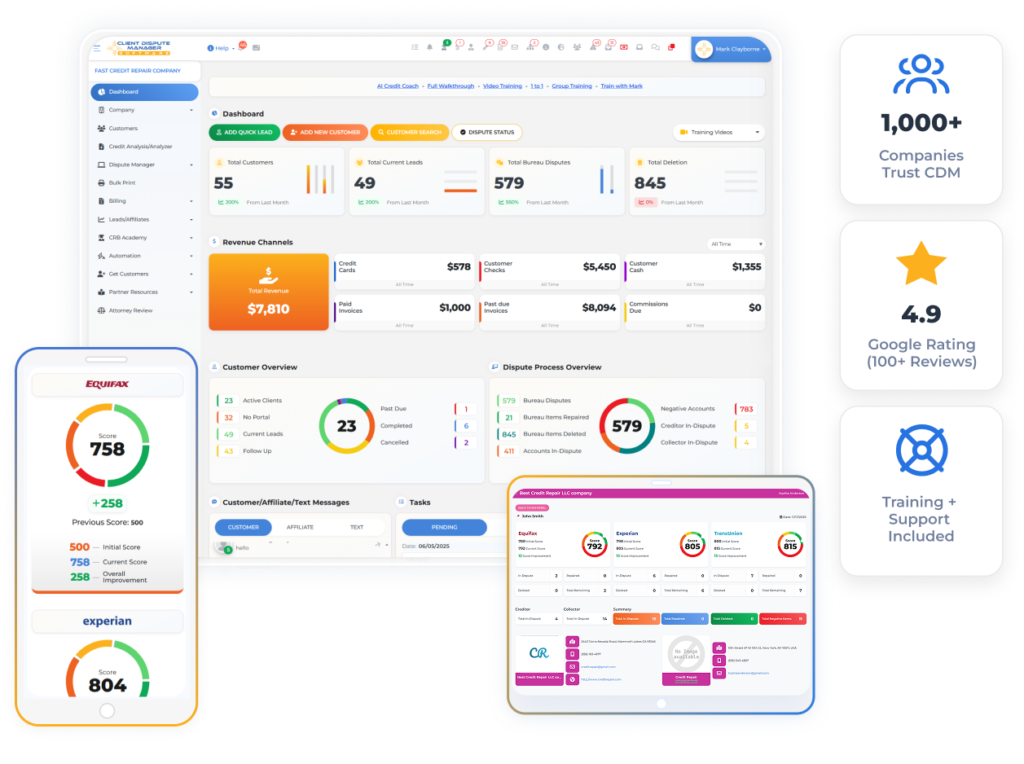
AI Credit Coach is included with paid Client Dispute Manager plans for active members. The pricing page lists “AI Coach & Automations” on every plan, and per the video, the Coach isn’t part of the free 30-day trial. It sits alongside other AI tools in the software:
- AI Credit Coach for questions about starting, running and growing the business
- AI Dispute Letter Generator and AI Rewriter for letter drafts
- Metro 2 Attack Letters
- An AI Workflow dispute playbook
- Client Auto Sign-Up, so new clients can enroll themselves
For a wider look at AI credit repair software, see our guide. The software organizes the work; you still make the dispute and compliance decisions.
What Should You Check Before Acting on an AI Credit Coach Answer?
Before you use an answer, confirm:
- Your question had no client names, Social Security numbers or account numbers
- Every law the answer names traces back to the official text
- Disputes cover only items you can show are inaccurate or incomplete
- No service or fee starts before CROA allows it
- Nothing promises deletions, score increases or income
- Your attorney has reviewed your contracts, disclosures and state rules
- A person reviews anything the Coach drafted before a client sees it
Frequently Asked Questions
Is there an AI assistant built for credit repair business owners?
Yes. Client Dispute Manager’s AI Credit Coach is an AI assistant that answers questions about starting, running and growing a credit repair business, from stall letters to compliance laws. Mark Clayborne says he built it from his years in the industry. It’s included with paid plans for active members and isn’t part of the free trial. Check legal answers against official sources before acting.
What is the difference between an AI credit coach and an AI dispute-letter generator?
A letter generator writes documents for a client file. An AI credit coach answers business questions, such as how to handle stall letters, what to automate or which laws apply. Consumer apps also use “AI credit coach” for help with one person’s own score. For credit repair business owners, the coach supports running the company, and a person still reviews its answers.
Can I use ChatGPT to run a credit repair business?
Yes, as an assistant. You can use ChatGPT to draft client emails, SOPs, social posts and first drafts of dispute letters, but a person should check every fact and legal citation before anything goes to a client, bureau or creditor. Never paste Social Security numbers, full account numbers or unredacted credit reports into a general AI chat.
What is the best dispute strategy for someone new to credit repair?
Use five steps: review all three credit reports, identify factual errors, send a simple dispute that names the error and attaches proof, track the investigation, then evaluate the results before the next round. Bureaus generally have 30 days to investigate, or up to 45 if the consumer sends more information (15 U.S.C. 1681i). Accurate, current information can’t be removed.
Which laws does a credit repair company have to follow?
The main federal law is the Credit Repair Organizations Act. It bars charging before services are fully performed, requires a written contract and a separate disclosure, and gives clients three business days to cancel (FTC). Companies also follow the FCRA, the Telemarketing Sales Rule when selling by phone, the FTC Act’s ban on deceptive practices and state credit repair laws.
Write Down Your Next Three Business Questions
Pick the three questions that keep you stuck this week. Use the prompts above, add context about your stage and goals, and leave client details out. Ask one question at a time.
Then check the answers. Legal answers go to the official source or your attorney, and dispute answers go back to the client’s documents. If you’re new to Client Dispute Manager, the free 30-day trial below lets you try the dispute tools. AI Credit Coach opens once you’re an active member on a paid plan.

Mark Clayborne
Mark Clayborne specializes in credit repair, starting and running credit repair businesses. He's passionate about helping businesses gain freedom from their 9-5 and live the life they really want. You can follow him on YouTube.
Start Today and Explore the Features Firsthand!
