

When round one comes back “verified” or unchanged, don’t mail the same credit repair dispute letters again. Read the response, compare it with the client’s documents, and work out who reports the item and what’s wrong. Then pick the dispute playbook built for that problem.
A credit bureau generally has 30 days from receiving a dispute to finish its reinvestigation, or up to 45 days if the consumer sends more relevant information during those 30 days (15 U.S.C. 1681i). A “verified” result doesn’t prove every detail is right. It means the next round needs better evidence or a different route.
This guide covers the 10 playbooks from the video above, in the same order, with the federal rule behind each. New to disputes? Start with how to dispute items on a credit report.
What Is a Dispute Playbook, and How Is It Different From a Template?

A dispute playbook is a step-by-step plan for one type of credit report problem. A template gives you one letter’s wording. A playbook tells you who gets the letter, what proof goes with it and what to do with the answer. You choose it by what’s wrong on the report, not by how tough a letter sounds.
Vague letters give a bureau room to stop. The FCRA lets a bureau end a reinvestigation it reasonably finds frivolous or irrelevant, such as one without enough information to investigate. It must tell the consumer why within 5 business days (15 U.S.C. 1681i(a)(3)). Specific, documented disputes leave far less room for that.
How Do You Pick the Right Credit Repair Dispute Letters for Each Problem?
Answer two questions first: who reports the item, and what exactly is wrong with it? The video’s rule for the first is simple. A bank or lender that issued the card, loan or mortgage is the original creditor. An agency or debt buyer that took the account after default is a collector.
The table matches common problems to all 10 playbooks. To check whether an item can be challenged at all, see what you can and cannot dispute on a credit report.
| What's Wrong on the Report | Who Reports It | Playbook | Evidence to Gather |
|---|---|---|---|
| New client, several errors, no plan yet | Any | 1. Step-by-Step Dispute Flow | All three reports, ID, proof of address |
| Wrong balance, date or status, or the bureaus disagree | Any (dispute goes to the bureaus) | 2. Factual Credit Bureau Dispute Flow | Statement for that billing cycle, all three reports |
| Paid or settled account the lender still reports wrong | Original creditor | 3. FACTA Creditor Laser Dispute Flow | Payoff letter, lien release, payment records |
| Collection balance higher than the original bill | Collector | 4. FDCPA Collector Blazer Dispute Flow | Original bill, validation notice |
| Late payment the lender and bureau both keep repeating | Original creditor | 5. Double Attack Creditor and Credit Bureau Dispute | Bank statements, last bureau response |
| Wrong balance, missing original creditor or wrong delinquency date | Collector | 6. Double Attack Collector and Credit Bureau Dispute | Original bill, collector's itemization |
| One debt with balances from both creditor and collector | Creditor and collector | 7. Credit Bureau, Creditor and Collector Triple Dispute Flow | Charge-off record, sale or transfer notice |
| Documented error verified round after round, such as a mixed file | Bureau and furnisher | 8. Aggressive Four-Point Dispute Flow | Every letter and response with dates, ID |
| Unknown names or addresses, inquiries the client doesn't recognize | Bureau | 9. Inquiry and Personal Information Dispute Flow | ID, address history, the client's list of applications |
| "Verified" with no word on how | Bureau | 10. Method of Verification and Procedural Flow | Results notice and its date, the original dispute |
This article explains how Client Dispute Manager’s dispute playbooks are organized and points to the federal rules they relate to; it is not legal advice, so check your dispute practices, client authorizations and state requirements with a qualified attorney.
Which Playbook Should You Use on a Brand-New Client File?

Start with Playbook 1, the Step-by-Step Dispute Flow. The video describes six stages, from the first bureau disputes through planned follow-up reviews, with escalation only if the bureaus don’t comply. It keeps a new owner from running five strategies on one file.
Fix personal information first, then the substantive errors. Audit each result before round two. The bureau must send written results within 5 business days after it finishes (15 U.S.C. 1681i(a)(6)), so check every line against what you disputed.
What Does "Verified" Mean on a Bureau Response?
A 2012 CFPB report described how most bureau disputes were handled: the bureau sent the furnisher a short coded summary through a system called e-OSCAR, and the furnisher usually checked its own records (CFPB, 2012). So “verified” often means the furnisher’s records match what it reported. That isn’t the same as weighing the client’s documents.
If the client has bank statements showing on-time payments, use them in the next stage. The bureau must review and consider all relevant information the consumer submits (15 U.S.C. 1681i(a)(4)). Read more on what a “verified as accurate” result means.
How Do You Dispute Factual Errors With the Credit Bureaus?

Playbook 2, the Factual Credit Bureau Dispute Flow, covers errors you can prove with numbers and dates: a wrong balance, open date, payment history or status, or bureaus that disagree. The FCRA requires bureaus to follow reasonable procedures to assure “maximum possible accuracy” (15 U.S.C. 1681e(b)).
In the video’s example, Equifax shows a $2,000 balance, but the client’s statement for that cycle shows $800. The letter names the field and the proof, then asks for that field to be corrected. Here’s how to write a factual dispute letter.
Never dispute an account as “not mine” or fraud when the client opened it. Federal law bars credit repair businesses from making, or advising clients to make, untrue or misleading statements to bureaus or creditors (15 U.S.C. 1679b(a)). The FTC says no one can legally remove information that’s accurate and current.
When Should a Direct Dispute Go to the Creditor or Collector?

Since the 2003 FACTA amendments, the FCRA and Regulation V let consumers dispute certain account information directly with the company that reported it. The furnisher generally must investigate within the time a bureau would have (12 CFR 1022.43). Playbooks 3 and 4 use this direct dispute route.
One limit matters for your business. A furnisher doesn’t have to investigate a direct dispute it reasonably believes a credit repair organization submitted or prepared, or that came on a form one supplied (15 U.S.C. 1681s-2(a)(8)(G); 12 CFR 1022.43(b)(2)).
So a direct letter should be the client’s own dispute, written in their own words, signed and mailed with their documents. It can’t be a letter or form your business prepared. The disputes you prepare go to the bureaus. Once a bureau notifies the furnisher, FCRA section 623(b) duties apply, and that subsection has no credit repair exclusion (15 U.S.C. 1681s-2(b)).
Playbook 3: When the Original Creditor Won't Correct Its Data
Playbook 3, the FACTA Creditor Laser Dispute Flow, fits a lender that keeps reporting an error after a verified result. In the video, a client paid off an auto loan six months ago and holds the payoff letter and lien release. The lender still reports $450 past due.
That payoff letter is the core of the dispute. The client can send it to the lender, and you can include it in a bureau dispute. A furnisher that finds its data inaccurate must correct it with the bureaus (15 U.S.C. 1681s-2(a)(2)). More on factual dispute letters to creditors.
Playbook 4: When a Collection Balance Doesn't Add Up
Playbook 4, the FDCPA Collector Blazer Dispute Flow, is for collection amounts that don’t match the original bill. In the video, a $300 medical bill shows as an $800 collection. A collector can’t collect any fee, interest or charge unless the original agreement expressly allows it or the law permits it (15 U.S.C. 1692f(1)).
Validation doesn’t force deletion. If the consumer disputes the debt in writing within the validation period, about 30 days after receiving the notice, the collector must stop collecting until it sends verification (15 U.S.C. 1692g(b)). The account can stay on the report. Our debt validation letter guide covers the letter itself.
When Should You Dispute With the Bureau and the Furnisher Together?
Playbooks 5 and 6 send coordinated disputes to the bureau and the furnisher at once, with a different letter to each. A bureau dispute starts a 30-day clock, and the furnisher must investigate once the bureau notifies it (15 U.S.C. 1681s-2(b)). Choose between them by who reports the line item.
Playbook 5: Original Creditor and Bureau
Playbook 5, the Double Attack Creditor and Credit Bureau Dispute, fits original creditors. In the video, a card shows a 60-day late payment, but bank statements show every payment cleared early. The bureau dispute names the error, and the client’s own letter to the creditor carries the bank proof. If the bank admits the error, its letter goes to the bureau.
Playbook 6: Collector and Bureau
Playbook 6, the Double Attack Collector and Credit Bureau Dispute, fits collectors. An FTC study found debt buyers paid an average of 4 cents per dollar of debt (FTC, 2013), and files often change hands. The client can ask the collector for verification and the original creditor’s name and address (15 U.S.C. 1692g).
The FDCPA sets no reply deadline, but the collector must stop collecting until it verifies. If it keeps reporting a disputed debt, it must say the debt is disputed (15 U.S.C. 1692e(8)).
Old debts run on two clocks. A collector can’t sue or threaten to sue once the state statute of limitations has expired (12 CFR 1006.26). Separately, the FCRA caps most collections and charge-offs at 7 years on a report, counted from 180 days after the delinquency began (15 U.S.C. 1681c).
What If a Creditor and a Collector Report the Same Debt?

Use Playbook 7, the Credit Bureau, Creditor and Collector Triple Dispute Flow, when a charged-off account shows a balance from the bank and another from the collector. Furnishers may not report information they have reasonable cause to believe is inaccurate (15 U.S.C. 1681s-2(a)(1)).
Industry reporting standards generally expect a creditor that sold an account to show it as sold or transferred, with no balance owed to it. Track each party’s mailing date and deadline. When one party corrects its reporting, drop it from the next round. Our guide to disputing an inaccurate charge-off covers the creditor side.
When Is It Time to Escalate a Dispute?
Escalate only after documented rounds fail. Playbook 8, the Aggressive Four-Point Dispute Flow, moves from the bureau to the furnisher, then a regulator complaint, then a legal review. The CFPB says consumers must first dispute credit report errors directly with the credit reporting company (CFPB).
Despite the name, the video stresses calm, documented follow-up. Its example is a mixed credit file, where another person’s account lands on the client’s report. That’s an accuracy problem the bureau must address (15 U.S.C. 1681e(b)). Gather ID, tax records, proof of address and anything showing the account isn’t the client’s.
Companies respond to CFPB complaints from the consumer or an authorized representative, most within 15 days (CFPB). Get the client’s signed permission first. For the last point, your job is a complete file. If the client asks about legal options, they can talk to a consumer protection attorney. See what to do when a credit dispute is rejected.
Why Fix Personal Information and Inquiries Early?
Playbook 9, the Inquiry and Personal Information Dispute Flow, cleans up names, addresses and unrecognized hard inquiries. A company may pull a credit report only for a permissible purpose, such as a credit application the consumer made (15 U.S.C. 1681b). The report lists who pulled it in the last year (15 U.S.C. 1681g).
Ask the client what they applied for first, including dealer financing. An inquiry dispute goes to the bureau, since furnishers don’t have to handle direct disputes about inquiries (12 CFR 1022.43(b)(1)). For identity theft, the bureau must block the items within 4 business days of getting the required proof (15 U.S.C. 1681c-2). See how to remove inaccurate hard inquiries.
What Is a Method of Verification Letter, and When Can You Send It?
A method of verification letter asks the bureau how it checked a disputed item. Under FCRA section 611(a)(7), after a reinvestigation, the consumer can request a description of the procedure. The bureau must send it within 15 days, with the furnisher’s business name and address, plus phone number if reasonably available (15 U.S.C. 1681i).
Playbook 10, the Method of Verification and Procedural Flow, handles this request. The video suggests asking who the bureau spoke to and which documents it reviewed. You can ask, but the law spells out only the furnisher’s details, so don’t promise clients more.
Bureau replies are often brief, so file each one. If no description arrives within 15 days, note the date for the next round or a complaint. A missed reply doesn’t delete anything by itself.
How Client Dispute Manager Software Supports Credit Repair Dispute Letters
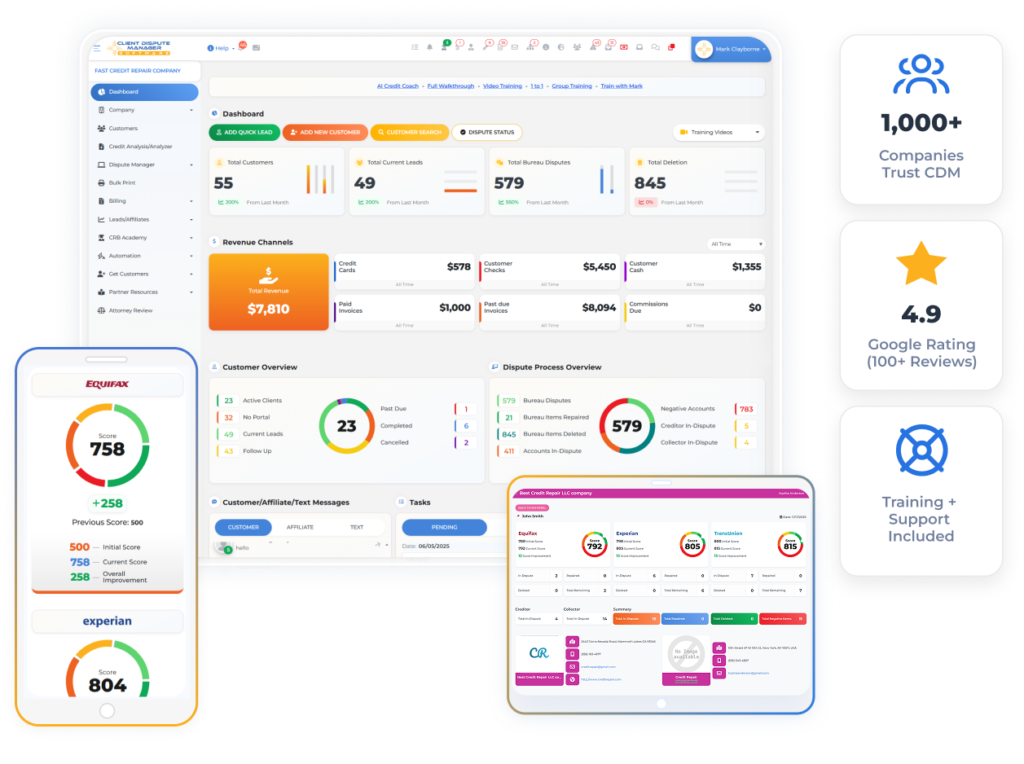
Client Dispute Manager is credit dispute software that keeps each client’s playbook, letters and deadlines in one place. As of November 2026, every plan includes a set of 10 dispute flows. The software covers:
- 10 dispute flows, including the Step-by-Step, double attack and triple dispute flows
- Dispute letter preparation for bureaus, creditors and collectors
- Mailing date and follow-up date tracking for each bureau, creditor and collector
You can set your follow-up letter due date so the next round doesn’t slip. Flow names in your account may differ slightly from the video’s. The software organizes the work; you still choose the playbook from the evidence.
What Should You Check Before Sending the Next Round of Dispute Letters?
Before the next round goes out, confirm:
- You know who reports the item: creditor, collector or both
- You can name the wrong field and the document that proves it
- Nothing the client opened is disputed as “not mine”
- Direct letters to creditors or collectors are the client’s own
- The last bureau response and its date are in the file
- Follow-up dates are set for every party
- Any CFPB complaint has the client’s signed permission
Frequently Asked Questions
What should a credit repair company do after a credit bureau verifies a disputed account?
Compare the result with the client’s documents before sending anything else. Then choose the next step: a factual dispute with new proof, the client’s own direct dispute to the furnisher, or a request for the bureau’s description of its procedure (15 U.S.C. 1681i(a)(7)). Verified doesn’t mean every detail is proven accurate.
Should credit repair companies dispute with the credit bureau, the creditor, or both?
Sometimes both, but not by default. A bureau dispute already requires the furnisher to investigate once notified (15 U.S.C. 1681s-2(b)). A furnisher may decline a direct dispute it reasonably believes a credit repair organization prepared (12 CFR 1022.43(b)(2)), so direct letters must be the client’s own. Check who reports the line item first.
What is a method of verification request under the FCRA?
It’s a consumer’s request, after a reinvestigation, for a description of the procedure the bureau used. The bureau must send it within 15 days, with the furnisher’s business name and address, and phone number if reasonably available (15 U.S.C. 1681i(a)(7)). It doesn’t require original documents and doesn’t delete the account by itself.
Does a debt validation request force a collector to delete the account from a credit report?
No. A written dispute within the validation period, about 30 days after the notice, makes the collector stop collecting until it mails verification (15 U.S.C. 1692g(b)). Deletion is a separate FCRA question: a bureau must delete or correct items its reinvestigation finds inaccurate, incomplete or unverifiable (15 U.S.C. 1681i(a)(5)).
Which credit repair software has dispute strategies or playbooks for each type of credit report error?
Client Dispute Manager includes dispute flows on every plan, and the video above walks through 10 playbooks. Each matches a problem type: factual bureau errors, creditor or collector errors, one debt reported twice, documented errors that keep coming back verified, personal information and inquiries, or a verified result with no explanation.
Diagnose the Next File Before You Print a Letter
The video’s closing advice is to slow down and read the documents. Check the report, talk to the client and gather their statements, payoff notices and receipts. When the evidence leads, the right playbook is usually obvious.
Pick one file whose round one came back verified. Run it through the decision table, choose the playbook and set the follow-up dates before anything is mailed. If you don’t use Client Dispute Manager yet, try the playbooks during the free 30-day trial below.

Mark Clayborne
Mark Clayborne specializes in credit repair, starting and running credit repair businesses. He's passionate about helping businesses gain freedom from their 9-5 and live the life they really want. You can follow him on YouTube.
Start Today and Explore the Features Firsthand!
