

To automate credit repair client sign up, send each new client one link that puts the legally required documents first: an e-sign consent, the CROA disclosure, then your contract. In Client Dispute Manager, that link runs a credit repair software feature called Client Auto Signup, and the client fills in every screen without you typing anything.
The order matters because federal law sets most of it. The Credit Repair Organizations Act (CROA) decides what a client must receive before signing, when your services can start and when you can be paid. Set the sequence up once, and every client goes through it the same way.
This guide follows each step as the product video shows it, with the federal rule that applies at each point. For the wider process around sign-up, see our guide to building a credit repair client onboarding process.
What Is Automated Credit Repair Client Sign Up?

Automated credit repair client sign up means a new client enrolls from one link, and you don’t enter their details by hand. Client Auto Signup is the Client Dispute Manager feature that does this. The client signs the required disclosures, e-signs your contract, enters their information, sets up credit monitoring and uploads ID documents on their own.
The video opens with the question behind it: “What if you can send one link to your customer and let them sign up for your service automatically while you are sleeping?” The dispute work itself still waits for the client’s cancellation window, covered below.
Why Does Federal Law Set the Order of Sign-Up Steps?
Three federal rules set the order. The disclosure statement must be given before any contract is signed (15 U.S.C. 1679c). No services may be provided before the client signs a written, dated contract, or before the end of the 3-business-day period that starts on the signing date (15 U.S.C. 1679d). And you can’t charge or receive payment for a service before it is fully performed (15 U.S.C. 1679b).
These steps are not optional. CROA says a client can’t waive these rights, asking for a waiver is itself a violation, and a contract that doesn’t comply is void (15 U.S.C. 1679f). CROA also doesn’t excuse anyone from following state law (15 U.S.C. 1679j), and many states add their own rules, such as registration or bonding. Check your state’s rules.
| Sign-up step | What happens | What federal law requires | Source |
|---|---|---|---|
| 1. Lead link | The prospect enters a name and email, and an email starts sign-up | Workflow step | Product walkthrough |
| 2. E-sign consent | The client agrees to receive records and sign electronically | Electronic delivery of required written information counts only after the consumer consents, once told about paper copies, withdrawing consent and system needs | 15 U.S.C. 7001(c) |
| 3. CROA disclosure | The client signs "Consumer Credit File Rights Under State and Federal Law" | Given before any contract is signed, as a separate document; signed copy kept 2 years | 15 U.S.C. 1679c |
| 4. Contract | The client reads and e-signs your agreement | Written, dated contract with payment terms and total cost, services and guarantees, timeline, your name and address, and a bold cancel statement; Notice of Cancellation form in duplicate | 15 U.S.C. 1679d, 1679e |
| 5. Client information | The client adds date of birth, Social Security number, address and phone | Sensitive data: the FTC advises keeping only what you need and locking it down | FTC guide |
| 6. Card details | Card details are collected; no charge runs | No charging or receiving payment before the service is fully performed; stricter timing for phone sales | 15 U.S.C. 1679b, 16 CFR 310.4(a)(2) |
| 7. Credit monitoring | The client signs up through your affiliate link and enters the login | No law requires it; a workflow choice | Recommendation |
| 8. Document upload | ID, Social Security card and proof of address | Practice tip: helps verify identity with the bureaus | Product walkthrough |
| 9. Thank-you page | The client downloads the signed agreement; optional calendar redirect | Services wait until the 3-business-day cancellation window ends | 15 U.S.C. 1679d, 1679e |
This article explains how Client Dispute Manager’s sign-up flow works and points to the federal rules it relates to; it is not legal advice, so check your contracts, billing and state requirements with a qualified attorney.
How Does the Sign-Up Link Start the Process?

Sign-up starts with your Client Auto Sign Up lead link. You send it to any prospect who asks about your services. They enter a name and email, and the software emails them an invitation to begin. Every prospect who signs up this way is added to your system.
Next, the client sees a welcome screen that lists the sign-up steps. In the walkthrough, the screens are edited from the Client Auto Signup settings, and they use the brand color and button color set in Company Settings. To put a sign-up form on your website instead, set up the Client Auto Sign Up lead form.
Why Does the Client See an E-Sign Consent First?
The first document is an electronic records and signature disclosure, separate from the CROA disclosure. Under the federal E-SIGN Act, when a law requires that a consumer get information in writing, electronic delivery counts only if the consumer agrees first (15 U.S.C. 7001(c)).
Before agreeing, the consumer must be told about their right to paper copies, how to withdraw consent, and what hardware and software they need. Your CROA disclosure and contract arrive electronically, so this screen comes before both. The client checks the box and clicks “Proceed to the agreement page.”
When Must You Give the CROA Disclosure?
Federal law requires credit repair companies to give clients a written statement called “Consumer Credit File Rights Under State and Federal Law” before any contract is signed (15 U.S.C. 1679c). Client Auto Signup puts that statement in front of the client before the agreement step.
The disclosure is a separate document from your contract, as the law requires. The client signs it, and a signed copy is stored in your account; in the walkthrough, the client also receives a copy. CROA requires you to keep the signed acknowledgment for 2 years after the client signs it. Read more on what CROA requires of your business.
In the walkthrough, the disclosure and right-to-cancel settings are on by default. Leave the disclosure setting on. If it’s off, you would need another way to give every client the disclosure before they sign.
What Must a Credit Repair Contract Include?

Federal law lists what a credit repair contract must include: payment terms and the total cost, a detailed description of the services with any guarantees and an estimated timeline, your business name and address, and a bold cancel-right statement near the signature line (15 U.S.C. 1679d). Review your contract against that list.
Clients can cancel without penalty before midnight of the third business day after they sign. Each contract must come with a “Notice of Cancellation” form in duplicate, and the client gets copies of what they sign at the time they sign it (15 U.S.C. 1679e). In the walkthrough, the right-to-cancel notice appears as its own document.
Contracts live under the Company tab in Digital Contracts, and signed ones show up in Digital Signature Records. Contract templates come with the subscription, or you can add your own contract; either way, have an attorney review it. In the walkthrough, you also get an email when the client signs.
What Client Information and Documents Should You Collect?
Customer Information comes right after the contract, and it does the job of a credit repair client intake form. Most clients arrive as leads with only a name and email, so here they add their date of birth, Social Security number, street address, city, state, phone number and any comments. They type it themselves, so nobody re-keys anything.
Document Upload comes later, after credit monitoring. Clients upload an ID, their Social Security card and proof of address. The video’s tip: you can send a first dispute round without these, but having them on file helps verify the client’s identity with the credit bureaus, and it saves chasing clients later.
You’re collecting sensitive data, including Social Security numbers, ID documents and login details. The FTC’s guide for businesses advises keeping only what you need, locking it down and disposing of it safely. Ask your own advisor whether the FTC Safeguards Rule applies to your business.
Can You Collect a Card at Sign-Up If You Can't Charge in Advance?
CROA bars credit repair companies from charging or receiving payment for a service before that service is fully performed (15 U.S.C. 1679b; FTC summary). If you take card details at sign-up, the step only collects them; no charge runs at that point, as the walkthrough shows. Having the card on file also saves chasing clients for payment details later. When you can charge is set by CROA and, for phone sales, the Telemarketing Sales Rule. Set your billing to match those rules.
The phone-sales rule is stricter. You can’t request or receive payment until the time frame you promised has passed and you’ve given the client a credit report, issued more than six months after the results were achieved, showing the promised results (16 CFR 310.4(a)(2)). The FTC says this covers calls from people answering your ads.
The card step needs a connected merchant account, such as Authorize.net. In the walkthrough, the page can be required or skippable. Our guide to CROA and TSR rules on upfront fees covers billing in more depth.
Should Credit Monitoring Be a Required Step?
No law requires credit monitoring to sign a client; it’s a workflow choice. We recommend making it a required step, so you have the client’s reports ready when disputes start and don’t have to chase them later. That’s also Mark Clayborne’s advice in the video: require it and don’t let clients skip.
On this screen, the client opens your affiliate link in a new tab, signs up with the provider, then comes back to enter their username, password, security word and provider name. You add your credit monitoring affiliate links in the Client Auto Signup settings, and credentials submitted here are added to the client’s file automatically.
In the walkthrough, this page has the same require-or-skip setting as the card page.
What Happens After the Client Finishes Signing Up?
The client lands on your thank-you page, which shows your business information and lets them download the signed agreement. In the walkthrough, Mark adds a redirect link so the client goes straight from the thank-you page to his calendar to book a welcome session.
Use that call to go over the credit report, since you already have the monitoring login, or to run a one-on-one credit audit. Keep the timing in mind. Sign-up can run while you sleep, but dispute work can’t start until the 3-business-day cancellation window has passed (15 U.S.C. 1679d), and payment waits until each service is fully performed.
How Client Dispute Manager Software Supports Automated Client Sign-Up
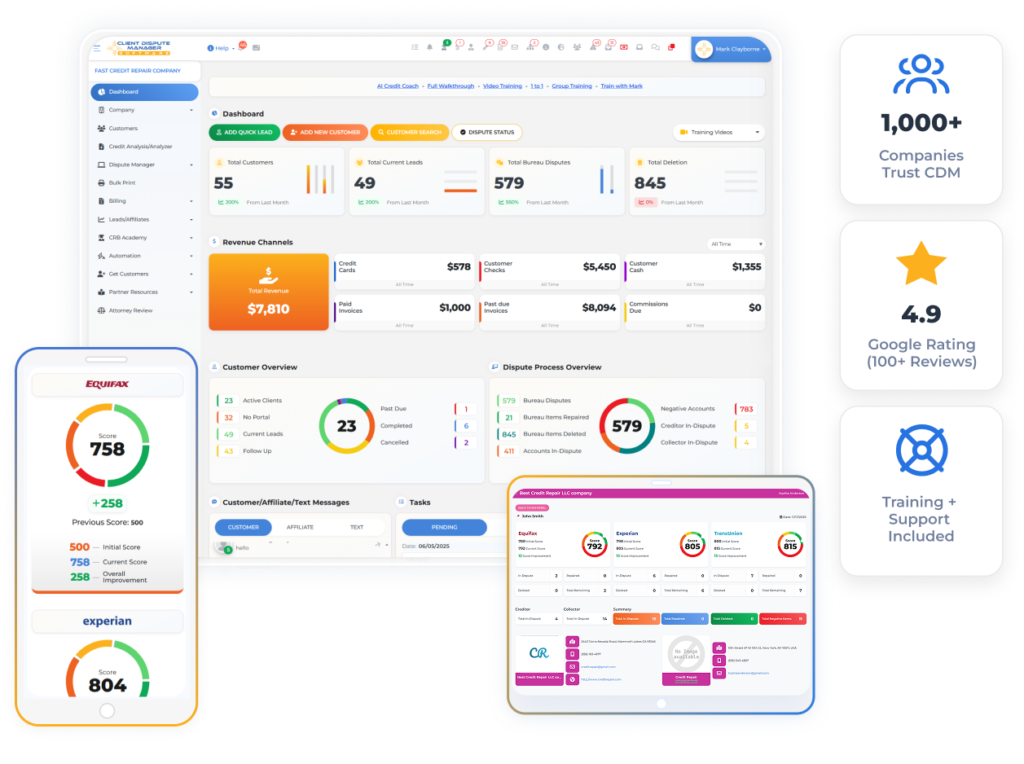
Client Dispute Manager puts the steps above into one flow that clients finish on their own. As of November 2026, the pricing page lists Client Auto Sign-Up on every plan. The feature includes:
- A Client Auto Sign Up lead link and lead form, with Spanish support
- CROA disclosures delivered as a separate document before the agreement
- E-signed contracts stored in Digital Contracts, with contract templates included
- Your brand color and button color on every screen
- A payment authorization form, with several merchant providers supported
- Credit monitoring affiliate links, with client logins added to the file
- Document upload for ID, Social Security card and proof of address
- A thank-you page where the client downloads the signed agreement
- Client Signup Alerts when someone new signs up
The software sends the required documents at the right step. You still choose your contract and billing settings, and you’re responsible for how your business follows the law.
What Should Be on Your Sign-Up Setup Checklist?
Before the first real client gets your link, confirm each item:
- The CROA disclosure setting is on
- Your contract covers payment terms, total cost, services, guarantees, timeline, business name and address, and the bold cancel statement
- A Notice of Cancellation form, in duplicate, goes with every contract
- Billing waits until each service is fully performed, with TSR timing for phone sales
- Dispute work starts only after the 3-business-day cancellation window
- Card and monitoring pages are set to required or skippable on purpose
- Signed disclosures are kept for 2 years after signing
- Your state’s credit repair rules are checked
Frequently Asked Questions
How do credit repair companies sign up new clients online?
Most send one sign-up link that the client completes on their own. In Client Dispute Manager, Client Auto Signup runs the screens in order: welcome, e-sign consent, CROA disclosure, contract, client information, card details, credit monitoring, document upload and a thank-you page. The client does the data entry, and signed documents are stored in your account.
What disclosures must a credit repair company give a client before signing a contract?
Federal law requires a separate written statement called “Consumer Credit File Rights Under State and Federal Law,” given before any contract is signed (15 U.S.C. 1679c). The contract itself must carry a bold right-to-cancel statement near the signature line and come with a “Notice of Cancellation” form in duplicate (15 U.S.C. 1679d and 1679e). State laws may add more, so check yours.
Can a credit repair company take a client's card details before the service is performed?
Under the Credit Repair Organizations Act, a credit repair company cannot charge or receive payment for a service before that service is fully performed (15 U.S.C. 1679b). If you collect card details during Client Auto Signup, that step only stores them and no charge runs. When you may charge is set by CROA and, for phone sales, the Telemarketing Sales Rule.
Which credit repair software lets clients sign up and e-sign the contract themselves?
Client Dispute Manager does this with Client Auto Signup. A prospect opens your lead link, accepts the e-sign consent, signs the CROA disclosure, e-signs your contract, enters their details, sets up credit monitoring and uploads ID documents. Signed contracts are saved in Digital Contracts, and the client can download the signed agreement from the thank-you page.
Is Client Auto Signup the same as Self-Service Sign-Up?
No, they’re separate features. Client Auto Signup starts from a lead link you send, or a lead form on your site, and takes the client through disclosures, contract, details, monitoring and documents. Self-Service Sign-Up is built around a sign-up button on your own website. The pricing page lists the two separately.
Run Your Own Sign-Up Link Before You Send It to Clients
The video ends with a simple suggestion: put yourself through the sign-up flow first. Open your lead link and sign as if you were the client. Check that the CROA disclosure appears before the contract, that your contract reads the way you want, and that the card and monitoring pages behave the way you set them.
Then send the link to your next lead. If you don’t use Client Dispute Manager yet, you can try Client Auto Signup on yourself during the free 30-day trial below.

Mark Clayborne
Mark Clayborne specializes in credit repair, starting and running credit repair businesses. He's passionate about helping businesses gain freedom from their 9-5 and live the life they really want. You can follow him on YouTube.
Start Today and Explore the Features Firsthand!
