

To start a credit repair business, research federal and state requirements, choose a business structure, create a written business plan, define your services, set up contracts and recordkeeping procedures with qualified legal guidance, build a client workflow, select suitable business software, and prepare a truthful marketing and onboarding process.
Requirements vary by state. Software can organize the work, but it does not make a business compliant or guarantee consumer results. Knowing how credit disputes work is only one part of running a credit repair company.
A business owner also has to handle marketing, disclosures, agreements, client records, document security, correspondence, follow-up tasks, complaints, and staff access. Missing one of those areas can create problems long before the business has many clients.
This guide is for people preparing to launch a credit repair business or bring structure to a new operation. It explains the main decisions you need to make, the legal topics you should review, and the client workflow you should test before opening your doors.
Can You Start a Credit Repair Business From Home?

Yes, you can operate a credit repair business from home if you meet the federal, state, and local requirements that apply to your situation. A home office can reduce overhead, but it does not reduce your responsibilities to consumers.
Start by checking local business rules, zoning restrictions, registration requirements, and any limits connected with your lease or homeowners association. Decide whether you will use your home address publicly or obtain another business mailing address that meets applicable rules.
Your workspace should protect client information from family members, visitors, and anyone who does not have permission to see it. Use a dedicated device when possible. Protect each account with a unique password and available sign-in safeguards. Keep paper files in a locked location, and avoid printing sensitive documents unless you need them.
You also need a business phone number, professional email address, document process, and clear schedule for client communication. A home-based business should still look and operate like an organized company. Clients should know how to contact you, what service you provide, what records you need, and when they can expect an administrative update.
What Do You Need to Start a Credit Repair Business?
You need more than a business name and a dispute letter. A prepared owner has a defined service, approved documents, secure records, written procedures, suitable tools, and a plan for handling each client from inquiry through account closure.
Your startup checklist should include:
- A clear description of the service you intend to provide
- A defined target client and service area
- A business structure and required registrations
- A review of federal, state, and local requirements
- Contracts, disclosures, cancellation procedures, and billing practices reviewed by qualified counsel
- A secure process for client information and documents
- A written onboarding and dispute workflow
- Training for you and any staff members
- Credit repair business software or another organized record system
- Truthful website, advertising, social media, phone, and text practices
- A process for questions, complaints, corrections, and account closure
Treat this list as an operating guide, not legal advice. Your duties may change based on where you operate, where your clients live, how you market, how you communicate, and what services you offer. A lawyer familiar with federal and state credit repair rules can help you review your exact setup.
What Laws Should You Review Before Launching?

Federal law sets important rules for credit repair organizations, but it is not the only source you need to review. State laws, local rules, privacy duties, marketing rules, and the facts of your business can also matter.
Credit Repair Organizations Act
The federal Credit Repair Organizations Act, often called CROA, applies to many companies that sell services related to improving a consumer’s credit record, history, or rating. The law prohibits untrue or misleading representations about credit repair services. It also addresses written disclosures, contracts, cancellation rights, and advance payment.
The Federal Trade Commission’s CROA page explains that the law bars companies from demanding advance payment before agreed services are fully performed. It also requires written contracts and gives consumers certain cancellation rights. The current statutory sections provide the complete federal language.
Do not copy a contract from another company and assume it fits your business. The service description, payment terms, required notices, cancellation process, and other provisions should match your actual operation and applicable law. Have qualified counsel review them before you use them.
Fair Credit Reporting Act and Consumer Disputes
The Fair Credit Reporting Act gives consumers rights involving information in their credit reports. Consumers can dispute information they believe is inaccurate or incomplete. Credit reporting companies and companies that supply information have duties involving qualifying disputes.
That right does not mean every negative item should be challenged. The Consumer Financial Protection Bureau states that accurate negative information generally cannot be removed merely because it is negative. The CFPB also warns consumers about anyone who claims otherwise. Review the CFPB guidance on accurate negative information.
Your process should identify the exact information the consumer questions, the reason it may be wrong or incomplete, and the records that support the position. The CFPB’s credit report dispute guidance explains that a dispute should clearly identify the error and include supporting documents when available.
The FCRA is not a business license. It describes consumer reporting rights and duties. Your company still needs to review the other laws that apply to its services and conduct.
Telemarketing and Marketing Rules

Your website, social posts, advertisements, calls, texts, emails, testimonials, and referral arrangements can create separate legal concerns. Claims about deletions, score gains, speed, results, or business success deserve careful review.
The FTC Act prohibits unfair or deceptive acts or practices. The Telemarketing Sales Rule may apply to certain calls and transactions.
Other federal and state rules may affect calls, texts, consent, billing, and advertising. Do not rely on a short internet checklist to decide what applies. Ask qualified counsel to review how you attract clients, explain services, obtain consent, and charge for completed work.
State and Local Requirements
There is no single set of state requirements that fits every credit repair business. Depending on the location, a company may need registration, a bond, a license, specific contract language, fee restrictions, or other steps. Local business rules may also apply.
Check the requirements where your business operates and where your clients live. Use official state agency sources, then confirm your reading with qualified counsel. Client Dispute Manager publishes state startup guides, but a guide should support your research, not replace current government information or legal advice.
Do You Need a License to Start a Credit Repair Business?
There is no single national credit repair license that answers every business situation. Federal law regulates many credit repair activities, while states and local governments may impose their own registration, licensing, bonding, contract, or operating requirements.
This distinction matters. Registering a limited liability company or obtaining a general business license does not automatically authorize every service you may want to provide. A state may use different terms for a credit services organization, credit repair organization, or similar business. It may also have rules based on where your clients live.
Build a location checklist before launch:
- Identify every state where you plan to serve clients.
- Review official state statutes and agency guidance.
- Check registration, licensing, bonding, contract, and fee rules.
- Review local business and home-office requirements.
- Ask qualified counsel to confirm what applies.
- Record renewal dates and ongoing filing duties.
Do not market in a new state simply because your website can accept a visitor from that location. Research the requirements first and keep proof of the steps you completed.
How Do You Create a Credit Repair Business Plan?

A credit repair business plan should explain what you will offer, who you will serve, how you will find clients, and how you will complete the work. It should also document your legal review, operating costs, quality checks, and recordkeeping process.
Start with your target client. Are you serving consumers in one state, several states, or a narrow local area? What problems can you discuss without promising a specific outcome? Which services will you provide, and which services will you refuse?
Next, map the client experience. Write down how an inquiry becomes an enrolled client, how documents enter the record, who reviews report information, how correspondence is approved, how responses are recorded, and how clients receive updates. This map will show you which software, staff roles, and procedures you need.
Your plan should cover these areas:
- Service scope and target client
- Federal, state, and local legal review
- Business registration and administration
- Marketing channels and claim review
- Client intake and onboarding
- Report review and dispute procedures
- Staff roles and approval limits
- Software, document storage, and communication tools
- Operating expenses and cash planning
- Security and access controls
- Complaints, corrections, and account closure
- Training and quality review
Choose business measures that reflect work you can document. Useful measures may include new inquiries, completed onboarding steps, open tasks, client response times, correspondence reviews, missing documents, and record completeness.
Do not build your plan around promised deletions, score changes, or a fixed income target. Review the plan every few months during the first year. Change it when your service area, staff, tools, or legal duties change.
Collect Authorized Information

Suppose a new client completes the approved intake process and provides a report showing an account they believe contains an incorrect balance. The owner adds the agreement and supporting records to the client’s file, compares the report with the documents, and records the claimed error.
The owner prepares correspondence, checks the facts and recipient, and records the mailing date. When a response arrives, the owner adds it to the same client record, reviews what the response says, and schedules the proper next task.
The example ends there because the business cannot control the investigation or promise a result. The value of the workflow is the clear record of what happened.
Is Credit Repair Software Required to Start the Business?

No. Credit repair software is not itself a legal requirement for opening a credit repair business. A small operation could begin with separate folders, a calendar, approved documents, and a secure way to communicate. The challenge is keeping those parts accurate and connected as the client list grows.
Credit repair business software may bring client records, documents, tasks, report imports, correspondence, responses, communication, staff access, and reporting into one system. That can make administrative work easier to review. It can also help an owner see overdue tasks and identify who completed an action.
Software still has limits. It cannot decide that every negative item is inaccurate. It cannot replace legal guidance, approve your marketing, or guarantee that your contracts meet every requirement. It also cannot promise what a credit reporting company, creditor, or collector will do.
Before selecting a platform, document your needs and test common tasks. Review how to choose credit repair software for your business and learn what credit repair software does. For a closer feature review, see the credit repair software features guide.
How Can Client Dispute Manager Software Support a New Business?
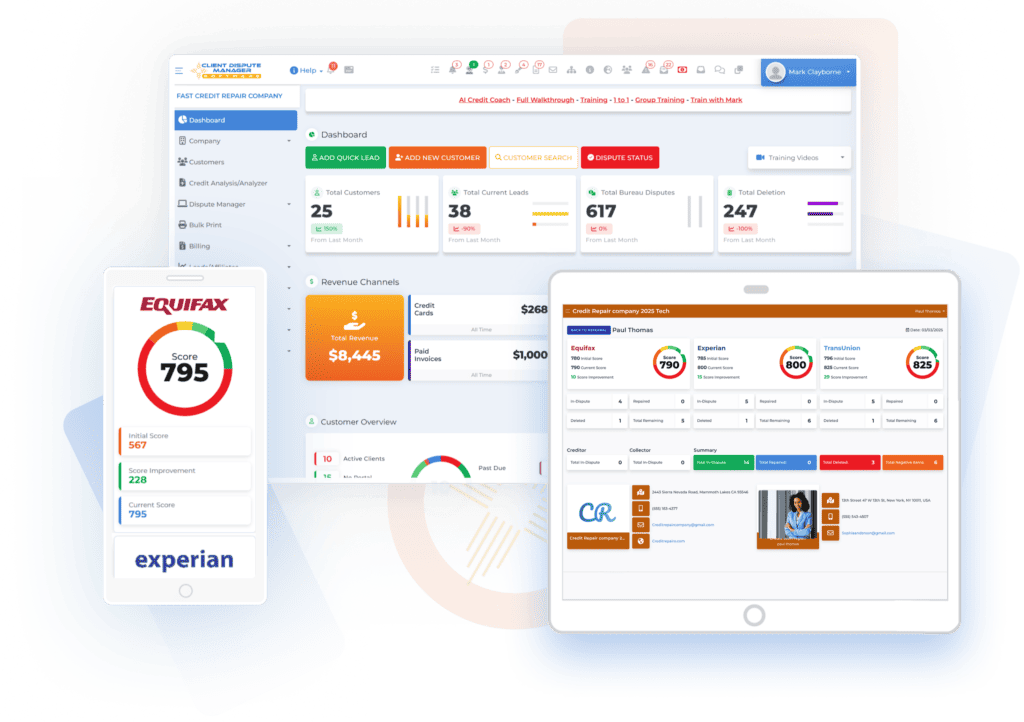
Client Dispute Manager combines business software with training and support for credit repair professionals. Its current public product information lists guided client onboarding, customer records, reminders, notes, tasks, report imports, credit audits, dispute workflows, letter tools, client communication, portals, progress reports, and business reporting.
For a new owner, the main benefit is having related work in one place. A prospect can move through an onboarding process, become a client, and receive a separate record. The owner can then store documents, review report information, create tasks, prepare correspondence, and record activity without building every administrative tool from scratch.
CDM also lists training videos, walkthroughs, help articles, in-app chat, support tickets, live group sessions, and community access. These resources can help users learn the software and think through their operating process. Training should support, not replace, legal and professional advice for the business.
The platform lists report imports and several dispute options, including manual, Metro 2, system, and AI-supported letter workflows. Users should review the source information, claimed inaccuracy, supporting records, dispute reason, letter content, recipient, and address before anything is sent.
CDM can help organize client and business activity. It does not guarantee deletions, credit score increases, legal compliance, or business results. Confirm current features, connections, training, and offer terms before making a final decision.
How Should You Find and Onboard Clients Responsibly?
Start with a clear description of the person your service is meant to help. That description should guide your website, educational content, referral relationships, and intake questions. It should not encourage fear or suggest that a consumer has no other option.
Explain your service in plain language. A prospective client should understand what work you will perform, what information you need, what you cannot promise, and how to ask questions. Tell consumers that they have the right to dispute inaccurate information themselves at no cost.
Review every public claim before it goes live. This includes:
- Website headlines and service pages
- Search and social advertisements
- Videos and webinar scripts
- Email and text campaigns
- Phone scripts
- Testimonials and review requests
- Affiliate and referral materials
- Statements made by staff or contractors
Avoid claims that suggest you can remove accurate information, deliver a certain score, finish within a guaranteed period, or produce the same result for every client. A disclaimer does not automatically correct a misleading headline or sales conversation.
Use one approved onboarding process. Confirm the person’s identity, provide required disclosures, use a reviewed agreement, record cancellation dates, obtain permission for needed information, and create a separate client record.
Train every staff member to follow the same steps and document exceptions. For more detail, review the guide to legal steps for credit repair companies and the explanation of what you can and cannot dispute on a credit report.
What Should You Track After Launch?

Track the work your business controls. This gives you a useful view of client service without turning uncertain credit outcomes into performance promises.
Useful operating measures include:
- New inquiries and their source
- Completed and incomplete onboarding steps
- Missing agreements or documents
- Open and overdue tasks
- Correspondence prepared and approved
- Responses received and reviewed
- Client questions and response times
- Records missing notes or dates
- Complaints, corrections, and cancellation requests
- Staff training and access reviews
Look at these measures on a regular schedule. If several client records are missing documents, fix the intake process. If responses sit without review, change task ownership or reminders. If staff members use shared accounts, replace them with individual access where the software allows it.
Progress reports should describe supportable activity. They should not turn a letter, response, or report change into a guaranteed future result.
Common Mistakes New Credit Repair Business Owners Should Avoid
Most early problems come from unclear procedures, unsupported claims, or weak records. Watch for these mistakes:
- Copying another company’s contract or disclosure without legal review
- Promising deletions, score increases, approval, or a fixed completion date
- Treating software templates as legal approval
- Using one shared login for several staff members
- Sending disputes without checking the facts and documents
- Challenging accurate information merely because it is negative
- Failing to record calls, correspondence, responses, and client instructions
- Serving clients in a new state without reviewing its requirements
- Using several disconnected tools without one clear client record
- Making salary, income, or business-success claims without proper support
Correct small process problems before they affect many records. A missed task in one sample account may reveal a weak reminder process. An incorrect recipient in a test letter may show that the approval checklist needs another step.
Review your procedures after staff changes, software changes, new services, new marketing channels, or expansion into another state. The goal is a process that people can follow and verify.
Your Credit Repair Business Launch Checklist
Use this checklist before accepting a client.
Legal and Business Setup
- Choose and register the business structure
- Review federal, state, and local requirements
- Confirm licensing, registration, bonding, and renewal duties
- Have contracts, disclosures, cancellation procedures, billing practices, and marketing reviewed
- Set up required business and tax accounts with qualified advisers
Client Service and Records
- Define the service and its limits
- Write the inquiry and onboarding steps
- Create a secure document process
- Set the report-review and dispute-approval procedure
- Define how responses and follow-up tasks will be recorded
- Create a complaint, correction, cancellation, and account-closure process
Software and Security
- Test the complete client workflow with fictional information
- Give each staff member separate access when available
- Set permissions based on job duties
- Review sign-in safeguards, backups, exports, and access removal
- Confirm how report imports and third-party connections work
Training and Launch Readiness
- Train staff on approved claims and procedures
- Review sample letters and supporting records
- Test email, phone, text, and portal communication
- Confirm who approves important actions
- Complete a sample data export
- Schedule regular record and access reviews
Do not launch because a website is ready. Launch when the legal review, documents, systems, training, and client workflow are ready to work together.
Frequently Asked Questions

Do You Need a License to Start a Credit Repair Business?
There is no single national credit repair license for every business. Federal laws may apply to the services and marketing, while states and local governments may require registration, licensing, bonding, specific contracts, or other steps.
The answer can also depend on where your clients live. Check official requirements in each state you plan to serve, review local business rules, and ask qualified counsel to confirm what applies. Creating a company or obtaining a general business license does not automatically satisfy every credit repair requirement.
Can You Start a Credit Repair Business From Home?
Yes, you may be able to start a credit repair business from home. You still need to meet applicable federal, state, and local requirements. Check zoning, lease, homeowners association, registration, and business-address rules.
Set up a private workspace, secure devices, controlled document storage, professional communication channels, and a process that keeps client records away from unauthorized people. A home office changes the location of the work. It does not reduce the business’s duties to consumers.
What Is Needed to Start a Credit Repair Business?
You need a defined service, target client, registered business, legal review, approved contracts and disclosures, a cancellation process, secure records, a client workflow, training, marketing controls, and a way to track tasks and correspondence.
State requirements may add licensing, registration, bonding, contract, or fee rules. Test the entire process with fictional client information before opening. Make sure each staff member knows what they can say, what they must review, and where they should record completed work.
Is Credit Repair Software Required to Start a Business?
No. Credit repair software is not a legal requirement by itself. A business can use other secure and organized methods to manage records and tasks. Software becomes useful when an owner needs to keep client documents, report information, correspondence, reminders, responses, communications, and staff activity connected.
The platform should fit the business’s actual process. It cannot make the company compliant, decide whether every dispute is valid, or guarantee a credit result.
What Should a Credit Repair Business Plan Include?
A credit repair business plan should cover the target client, service scope, legal review, registration, marketing channels, onboarding, dispute procedures, staff roles, software, records, security, operating expenses, client communication, complaints, and quality checks.
It should explain how a client moves from inquiry through account closure. Use measures tied to work you can document, such as completed onboarding steps, open tasks, response times, and record completeness. Avoid building the plan around promised credit outcomes or unsupported income estimates.

Mark Clayborne
Mark Clayborne specializes in credit repair, starting and running credit repair businesses. He's passionate about helping businesses gain freedom from their 9-5 and live the life they really want. You can follow him on YouTube.
Start Today and Explore the Features Firsthand!
Below Is More Content For Your Review:
