Get Started for as Low as $49 for the First Month: Click Here
Written by Mark Clayborne
Last updated on September 15, 2026

Choosing credit repair software as a solo individual is one decision. Choosing it for a small business is a different one entirely. When you are managing client files, working with a team, building your brand, and trying to stay compliant with federal law, the platform you choose becomes the backbone of how your entire business runs.
The wrong choice at this stage does not just slow you down. It creates gaps in your client’s work, creates compliance risk, and forces you to switch platforms at exactly the moment when your business should be growing.
This guide covers what to look for when choosing credit repair software for a small business or agency, from client management and team access to training, support, and white-label capabilities.
The best credit repair software for small businesses handles multiple client profiles simultaneously, supports multi-user access with role-based permissions, includes white-label options for agency branding, provides compliance-ready workflows for CROA and FCRA, and offers strong training and support resources that help new team members get productive quickly.
The right platform grows with your business rather than requiring you to switch tools as your client volume increases.

Credit repair businesses use dedicated credit repair software platforms that combine client file management, automated dispute workflows, document storage, progress reporting, and client communication into a single system.
The alternative is managing clients through spreadsheets, email threads, and paper files, which becomes unmanageable quickly as client volume grows. Professional credit repair software centralizes everything in one place so no client file, response deadline, or communication falls through the cracks.
At the small business level, client management software does several jobs at once. It keeps every client’s dispute history, documents, credit report data, and communication log in a single accessible file. It tracks where each client stands in the dispute process across multiple rounds. It generates status reports without requiring you to compile them manually.
And it gives clients a way to check their own progress without calling or emailing you for updates. When you are managing five clients, this is convenient. When you are managing 30 or 50, it is the only way to operate without making critical errors.

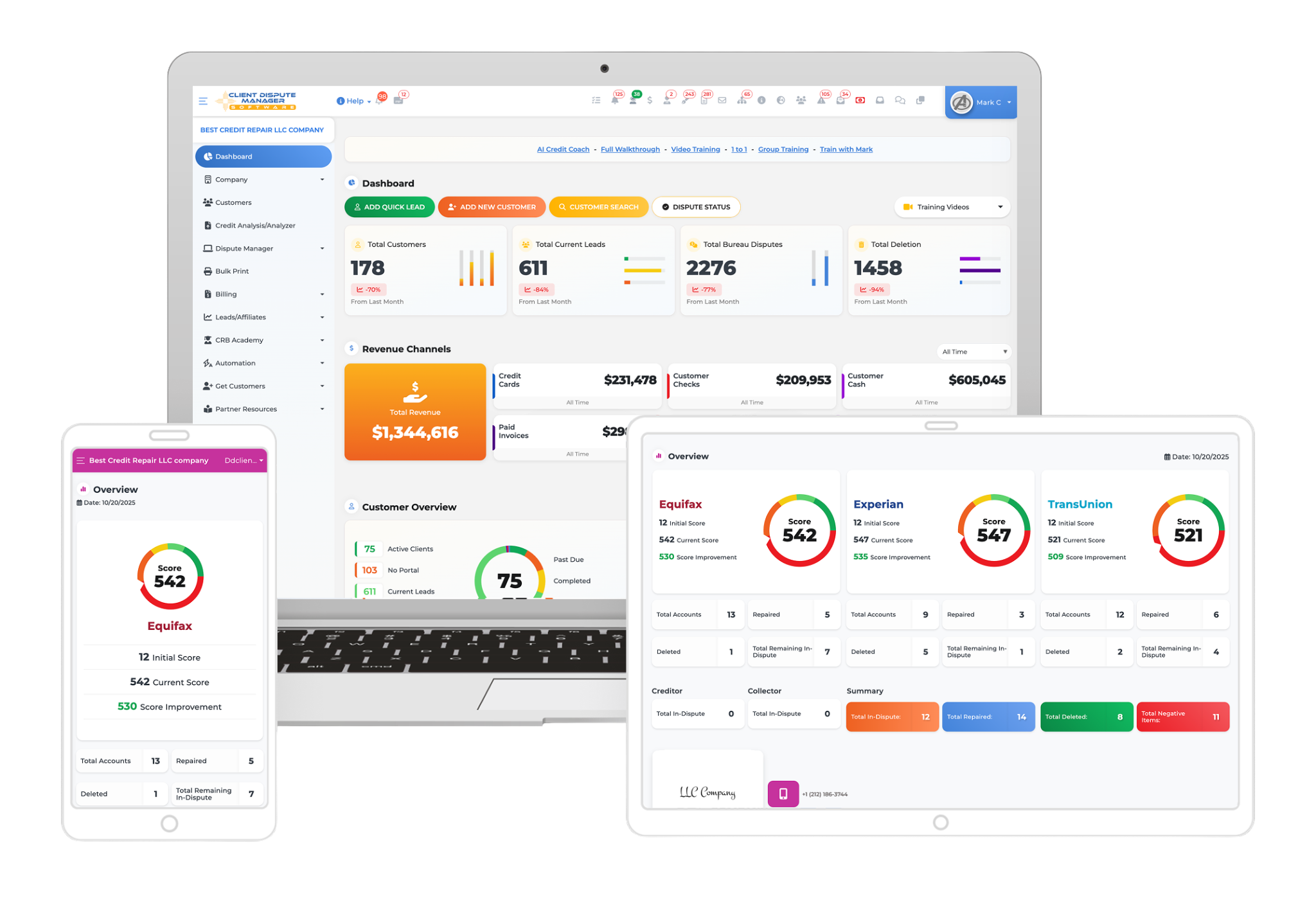
Credit repair software for managing multiple client profiles gives you a separate, organized file for every client that includes their credit report data, dispute letters, bureau responses, progress notes, and communication history.
Each file is independent so there is no risk of information from one client appearing in another’s record.
What to look for when evaluating multi-client management capability:
These may seem like basic requirements, but many platforms handle one or two of them well while falling short on the others. Testing multi-client management during a free trial with real or realistic client data is the only reliable way to evaluate whether it works the way you need it to.

Credit repair software with multi-user access and role-based permissions allows you to add team members to your platform account and control exactly what each person can see and do. A dispute specialist might have access to client files and letter generation but not billing.
An administrative assistant might handle client onboarding but not dispute strategy. Role-based permissions prevent staff from accessing sensitive information they do not need and reduce the risk of errors caused by someone taking an action outside their area of responsibility.
For small credit repair businesses that are starting to build a team, multi-user access is one of the most important features to evaluate before choosing a platform. Adding a second person to an operation that runs on a single-user account is a structural problem, not just an inconvenience.
Key questions to ask about multi-user access:

White-label credit repair software allows you to present the platform’s tools and client portal under your own business name and branding rather than the software provider’s.
For credit repair agencies and business owners building a recognizable brand, white-label capability means your clients interact with a platform that looks like your product. This adds professionalism, strengthens client trust, and separates your business identity from the underlying technology you use to run it.
White-label options vary significantly between platforms. Some offer full interface customization including your logo, color scheme, and domain. Others provide a limited version that adds your logo to client-facing reports but does not change the platform interface itself. Understanding the difference matters when you are deciding how much of your brand identity you want to build into the client experience.
What to look for in white-label credit repair software:
For agencies building long-term client relationships, white-label capability is also a retention tool. When clients associate their progress portal and reports with your brand rather than the software behind it, your business relationship is more central to the experience than the technology facilitating it.
Credit repair software tailored for startups and small agencies is available from platforms that offer accessible entry-level pricing, a free trial long enough to evaluate the full workflow, built-in compliance tools for new operators who are still learning the regulatory environment, and training content that covers both how to use the software and how to run a credit repair business.
Client Dispute Manager Software is designed specifically for this stage, with a 30-day free trial, CROA and FCRA-aligned workflows, and Mark Clayborne’s practitioner-level training library included from the first day of access.
Starting a credit repair business means learning a lot at once. You are learning the dispute process, federal compliance requirements, how to manage client relationships, and how to run a business simultaneously. Software that assumes you already know all of that adds friction at exactly the wrong time.
What makes a platform genuinely suitable for startups and small agencies:

The best credit repair software platforms for training and certification programs provide more than product tutorials. They include content that teaches the underlying credit repair process: how to read credit reports, how to identify disputable items, how dispute rounds work, what CROA and FCRA compliance requires, and how to manage client relationships professionally.
Platforms built by practitioners who have actually run credit repair businesses tend to offer significantly better training than platforms built primarily as software products.
Training quality matters more at the small business level than at any other stage. When you are a solo operator or managing a small team, your knowledge directly determines your clients’ results. Software tools amplify your skill.
They do not replace it. Finding providers offering training for their credit repair software is one of the most common things new credit repair business owners look for when evaluating platforms.
The distinction to understand is between software training and industry training. Software training teaches you how to use the product. Industry training teaches you how to do the work effectively. The best platforms provide both.
Credit repair software with strong customer support and training resources reduces the time you spend stuck and increases the time you spend moving forward. For small business owners who do not have a large team to rely on, the quality of support available from the platform provider is a direct operational input.
Training resources to look for:

The credit repair software with the best customer support combines responsive technical support channels with deep industry training content so you get help both when the platform has an issue and when you have a question about the work itself.
Platforms where the founder or team has direct credit repair industry experience tend to produce more useful support responses because their team understands the context of what you are trying to accomplish, not just the mechanics of how the software works.
When evaluating customer support quality during a free trial, test it intentionally. Send a support request, ask a compliance question, and use the knowledge base to look up something you genuinely need to know. The speed, accuracy, and depth of the responses you receive during the trial period is a reliable indicator of what you will get as a paying customer.
Exporting reports from credit repair software for client presentation typically involves navigating to the client’s file or the reporting section of the platform, selecting the report type and date range, and choosing an export format such as PDF. Professional client-ready reports show dispute history, bureau responses, items removed or updated, score changes, and outstanding disputes in a clear format.
The best platforms generate these reports automatically at set intervals or on demand without requiring you to compile the data manually.
Client reports serve two purposes in a credit repair business. First, they keep clients informed about what has been done and what is in progress, which reduces inbound calls asking for status updates. Second, they document the value of the work being done, which helps with client retention and referrals.
What to look for in credit repair software reporting features:
Automated reporting saves a significant amount of time per client per month. For a business with 20 active clients, manual reporting could represent several hours of work each billing cycle. Software that generates those reports automatically converts that time into availability for client-facing work.

Real estate professionals including agents, mortgage brokers, and property managers sometimes refer clients to credit repair services or use credit repair tools to help buyers qualify for financing.
Credit repair software designed for real estate partnerships typically includes client referral management, progress reporting that can be shared with referring partners, and compliance-aware workflows that real estate professionals can trust.
When evaluating any platform for real estate-adjacent use, confirm that the platform supports the CROA compliance requirements that apply to referral relationships and that client data is handled securely in line with relevant privacy standards.
Client Dispute Manager Software is built specifically for credit repair professionals at every stage including startups and small agencies. The platform combines accessible entry-level pricing, a 30-day free trial with no credit card required, CROA and FCRA compliance workflows, multi-client file management, and Mark Clayborne’s comprehensive training library.
For new operators, having compliance tools and industry education built into the software from day one removes two of the most significant barriers to running a professional credit repair operation from the start.
Some credit repair and credit score enhancement platforms include access to financial coaching as part of their service offering, either through built-in educational content, one-on-one coaching sessions, or integrations with financial planning tools.
For credit repair business owners, being able to offer clients guidance on score factors beyond disputes, such as credit utilization, payment behavior, and account mix, adds value to the client relationship and supports longer-term results.
Client Dispute Manager includes FICO score factor guidance and educational content that helps credit repair professionals provide that broader perspective to their clients as part of a comprehensive engagement.
The software you choose at this stage of your business sets the foundation for everything that follows. A platform that handles multiple clients, supports your team, trains your staff, and keeps you compliant removes the operational friction that slows most credit repair businesses down during their growth phase.

Mark Clayborne specializes in credit repair, starting and running credit repair businesses. He's passionate about helping businesses gain freedom from their 9-5 and live the life they really want. You can follow him on YouTube.
Experience our credit repair software, risk-free.
Start today and explore the features firsthand!