Get Started for as Low as $49 for the First Month: Click Here
Written by Mark Clayborne
Last updated on September 16, 2026
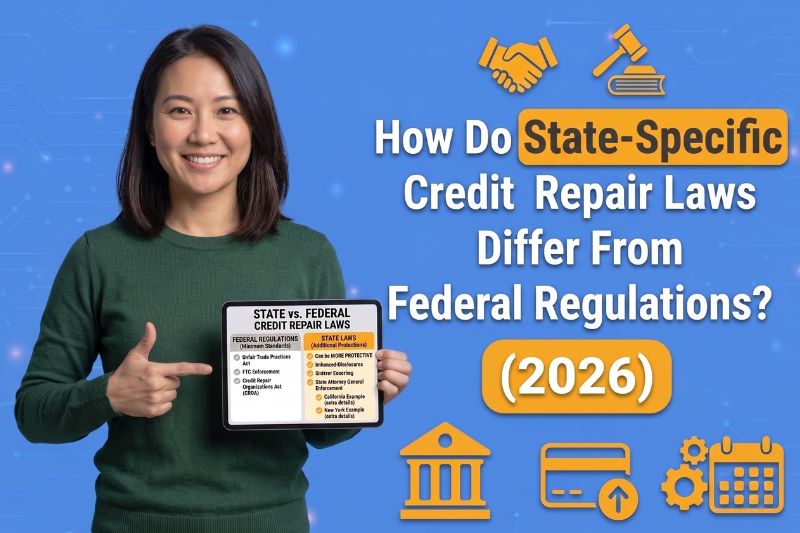
Federal credit repair laws establish the minimum compliance floor that every credit repair business must meet in every state in the United States, and state laws can impose stricter requirements on top of that federal baseline without conflicting with or being preempted by it.
The Credit Repair Organizations Act (CROA), which governs the industry at the federal level, is the floor: every credit repair company operating anywhere in the country must comply with CROA’s written contract requirements, Consumer Rights Statement delivery, three-day right to cancel, and advance fee prohibition without exception.
State credit services organization laws are the ceiling, adding registration and licensing requirements, surety bond obligations, and in some states monthly fee caps that a credit repair business must satisfy on top of its federal compliance.
Understanding credit repair laws by state is not optional for any credit repair business that accepts clients from more than one state.
A business that achieves full CROA compliance and then operates in Georgia, North Carolina, Texas, or California without meeting those states’ specific registration and bonding requirements is breaking state law with every client it signs from those jurisdictions, regardless of how clean its federal compliance posture is.
This article maps the framework, the states with the most significant additional requirements, and the practical steps for verifying whether a credit repair company is legally operating in a specific state before a consumer signs a contract or a business owner accepts a client from a new market.

State-specific credit repair laws differ from federal regulations by adding requirements that go beyond what CROA mandates, rather than replacing or modifying federal law.
CROA explicitly states that it does not preempt state laws that provide greater consumer protections, which creates a two-layer compliance structure where the federal framework governs the minimum and state law governs whatever additional protections the state legislature has decided to impose.
The practical result for credit repair business owners is that federal compliance is necessary but not sufficient in states with their own credit services organization laws, and the specific requirements in each state must be researched and met independently before the first client from that state is signed.
CROA, codified at 15 U.S.C. sections 1679 through 1679j, applies to every credit repair organization in every state without exception, and its four core requirements define the baseline that no state law can reduce.
Every credit repair company must provide a written service contract containing all required elements before any services begin. Every credit repair company must deliver a Consumer Rights Statement as a completely separate document to the client before the contract is signed.
Every credit repair company must honor an unconditional three-day right to cancel that cannot be limited or waived by any contract clause.
And every credit repair company must refrain from collecting any fee before fully performing all contracted services, a prohibition that the Telemarketing Sales Rule reinforces for companies marketing by telephone or online.
These four requirements are the federal floor that every credit repair business must build on, and they apply regardless of which state the client is in, where the credit repair company is incorporated, or what state law says about other aspects of credit repair operations.
No state can lower CROA’s requirements. States can only add to them, and a business that has not satisfied CROA’s baseline has not satisfied anything, regardless of its state compliance status.

State credit services organization laws impose additional requirements in three categories that CROA does not address at the federal level.
The first category is registration and licensing: many states require credit repair companies to register with a specific state agency before they can legally solicit or accept clients in that state, and operating without registration creates regulatory exposure from the first solicitation.
The second category is surety bond obligations: states that require registration typically also require a financial bond posted with the state as a consumer protection mechanism, with bond amounts ranging from $10,000 in some states to $100,000 in California.
The third category is monthly fee caps: some states impose a specific maximum dollar amount that a credit repair company can charge per client per month, regardless of the scope of work performed.
| Category | What States Add | Example States | What Non-Compliance Creates |
|---|---|---|---|
| Registration And Licensing | Requirement to register with a state agency before soliciting or accepting clients | Georgia, Texas, California, Pennsylvania, Tennessee, North Carolina | State regulatory violation from the first solicitation; contracts may be voidable |
| Surety Bond Obligation | Financial bond posted with the state ranging from $10,000 to $100,000 as consumer protection | Georgia ($25,000), Texas ($10,000), California ($100,000), Pennsylvania ($25,000) | Operating without required bond is an independent state law violation |
| Monthly Fee Cap | A specific maximum dollar amount per client per month regardless of services performed | North Carolina ($75/month) | Charging above the cap is a state law violation per billing cycle |
A credit repair business that is fully compliant with CROA can still be operating illegally in a specific state if it has not registered with that state, posted the required bond, or complied with the state’s fee cap. Federal compliance is the starting point.
State compliance in each jurisdiction where clients are accepted is the additional layer that determines whether the business’s legal posture is actually complete.
The states that offer additional legal protections for consumers engaging credit improvement services are those with credit services organization laws that require registration, bonding, and in some cases fee caps on top of the federal CROA baseline.
These protections exist because state legislatures determined that CROA’s consumer protections, while meaningful, were not sufficient to address the specific patterns of credit repair fraud and consumer harm documented in their jurisdictions.
The result is a patchwork of state-level requirements that credit repair businesses must navigate by jurisdiction and that consumers can use to evaluate whether a company they are considering is legally operating in their state before signing a contract.

| State | Registration Required | Surety Bond Required | Bond Amount | Monthly Fee Cap | Notable Requirement |
|---|---|---|---|---|---|
| Georgia | Yes | Yes | $25,000 | None | Must register before soliciting or accepting clients; strict contract language requirements under the Georgia Fair Business Practices Act |
| Texas | Yes | Yes | $10,000 | None | Annual license renewal required; must register with the Texas Secretary of State as a credit services organization |
| California | Yes | Yes | $100,000 | None | Highest bond requirement in the country; separate client escrow account required for any prepaid funds under the California Credit Services Act |
| Florida | No | No | None | None | CROA federal baseline applies; no state credit services organization law imposes additional registration or bonding requirements |
| North Carolina | Yes | Yes | $10,000 | $75/mo | One of the strictest combined regimes: registration, bond, and a $75 per month per client fee cap under the NC Credit Services Business Act |
| South Carolina | No | No | None | None | CROA federal baseline applies; no additional state credit services organization law |
| Tennessee | Yes | Yes | $20,000 | None | Registration required before first client; no grace period for new operators under the Tennessee Credit Services Businesses Act |
| Pennsylvania | Yes | Yes | $25,000 | None | Credit Services Organization Act adds requirements beyond CROA; registration and bond required |
| Colorado | Yes | Yes | $10,000 | None | Registration with the Colorado Attorney General required; bond posted before accepting clients |
| Illinois | Yes | Yes | $25,000 | None | Credit Services Organizations Act requires registration and bond; strict written contract language requirements |
| Louisiana | Yes | Yes | $10,000 | None | Registration required with the Louisiana Office of Financial Institutions before accepting clients |
| Alabama | No | No | None | None | CROA federal baseline applies; verify current status with state authority as requirements may change |
| Mississippi | No | No | None | None | CROA federal baseline applies; verify current status with state authority |
California, North Carolina, and Georgia impose the most demanding combined compliance requirements of any states in the country, and credit repair businesses planning to accept clients from these states must complete their state-specific compliance obligations before the first solicitation, not after the first client signs.
California’s credit repair compliance framework under the California Credit Services Act requires registration with the California Secretary of State, a $100,000 surety bond that is the highest bond requirement in any state in the country, and the maintenance of a separate escrow account for any client funds collected in advance.
The $100,000 bond amount alone puts California compliance out of reach for many new credit repair operators and makes it the state where the financial cost of legal entry is highest by a substantial margin.
North Carolina combines three separate compliance requirements into one of the most restrictive state frameworks: registration with the North Carolina Secretary of State under the NC Credit Services Business Act, a $10,000 surety bond, and a $75 per month per client fee cap that limits what any credit repair company can charge regardless of the scope of work performed or the number of disputes filed in a given month.
A credit repair business charging $199 per month in North Carolina is violating state law with every billing cycle for every client in that state, even if its federal CROA and TSR compliance is otherwise complete.
Georgia requires registration under the Georgia Fair Business Practices Act before a credit repair company can legally solicit clients in the state.
The $25,000 surety bond must be posted before the first client engagement, and the state’s contract language requirements impose specific disclosure obligations that are more detailed than CROA’s minimum federal standard.
A credit repair company that sends a single marketing email to a Georgia resident without first completing state registration has already triggered potential regulatory exposure under Georgia law.
Verifying whether a credit repair company is registered and licensed legally requires checking three separate sources, because no single database covers both the business entity registration and the credit services organization registration that most states with significant requirements maintain in separate systems.
The state Secretary of State database confirms that the business entity exists and is in good standing. The state financial regulation or consumer protection agency database confirms that the company has completed credit services organization registration specifically.
And the CFPB Consumer Complaint Database at ConsumerFinance.gov shows complaint history for the company by name, which provides a practical signal about how the company has handled client disputes in the past.

The verification process for a credit repair company’s legal operating status has three steps that must be completed separately because they access different government databases covering different aspects of compliance. Each step answers a distinct question about the company’s standing.
Four specific conduct patterns during the sales and onboarding process indicate that a credit repair company may not be operating in compliance with CROA or applicable state law, and each pattern maps directly to a specific statutory violation rather than being a general concern about business quality.
A company that cannot provide a state registration or license number when asked by a prospective client in a state that requires registration is either unregistered, which is a state law violation, or is concealing its registration status, which creates a separate credibility problem independent of any statutory violation.
No written contract delivered before services begin is a CROA violation at 15 U.S.C. section 1679d regardless of the state. No Consumer Rights Statement delivered separately before the contract is signed is a CROA violation at 15 U.S.C. section 1679c regardless of how the company explains the omission.
Any fee collected before services are performed is both a CROA violation at section 1679b(b) and a Telemarketing Sales Rule violation at 16 C.F.R. section 310.4(a)(2).
A company that exhibits any one of these four patterns in its intake process is not operating in compliance with federal law, and its state compliance status is secondary to the more immediate federal exposure it is creating with every client it processes that way.
Complaints about any of these violations can be filed with the FTC at ReportFraud.ftc.gov and with the CFPB at ConsumerFinance.gov/complaint.

CROA applies to any person who provides credit repair services for compensation, not only to incorporated businesses, and that statutory coverage is established at 15 U.S.C. section 1679a(3), which defines a credit repair organization as ‘any person’ who uses interstate commerce to provide services that improve or are represented to improve a consumer’s credit record in exchange for compensation.
A sole proprietor, a freelance credit dispute specialist, a credit coach who charges for personalized dispute strategies, and an individual operating as a paid credit consultant are all credit repair organizations under federal law if they meet the compensation and services criteria. CROA does not distinguish between individuals and corporations. The statute covers both equally.
The most consequential implication of CROA’s ‘any person’ definition is that every individual providing paid credit repair services must comply with the same written contract, Consumer Rights Statement, three-day cancellation right, and advance fee prohibition requirements that apply to a corporation with hundreds of employees.
An individual who sends a single dispute letter on behalf of a paying client without a CROA-compliant written contract in place has violated the statute. An individual who collects a fee before sending that letter has violated both CROA and the TSR.
The size of the operation, the informal nature of the arrangement, and the modest amount of the fee are not defenses to the statutory violation.
CROA does provide one relevant boundary for individuals: the statute’s definition of a credit repair organization excludes any nonprofit organization that provides credit counseling services.
An individual providing purely educational content about credit, with no personalized dispute work and no direct compensation tied to specific credit outcomes for specific clients, may fall outside CROA’s scope.
The line is the combination of compensation and specific credit repair services performed for a specific consumer. When both elements are present, CROA applies regardless of how the individual describes what they do.
State credit services organization laws apply to individual practitioners through the same statutory definitions that apply to incorporated businesses.
Georgia’s credit services organization registration requirement covers ‘any person’ engaging in credit services, which includes sole proprietors, independent contractors, and individuals operating under their own name without a formal business entity.
A sole proprietor offering credit repair services in Georgia must register with the state and post the required $25,000 surety bond before the first client engagement, just as a corporation would, because the registration obligation flows from the nature of the services performed rather than the structure of the entity performing them.
The practical consequence for individuals entering the credit repair market is that state compliance obligations must be researched and completed before the first client from any state with a credit services organization law is accepted.
An individual who operates informally across state lines, accepting clients from Georgia, North Carolina, and California without meeting the specific requirements of each state, has created state regulatory exposure in three separate jurisdictions simultaneously.
That exposure does not diminish because the operation is small or because the individual believed they were operating informally rather than as a business.

Financial institutions that furnish consumer credit information to the three major credit bureaus are legally required under 15 U.S.C. section 1681s-2 of the Fair Credit Reporting Act to investigate disputes forwarded to them by credit bureaus, review all relevant information the bureau provides, and report accurate results back to the bureau within the bureau’s 30-day investigation window.
This furnisher obligation is the parallel enforcement mechanism on the data supply side of the credit reporting system, and it applies to every bank, credit card issuer, mortgage lender, and any other entity that reports consumer credit data, regardless of the size of the institution or the frequency of its reporting activity.
The furnisher obligation under 15 U.S.C. section 1681s-2(b) is triggered when a credit bureau forwards a consumer’s dispute to the furnisher that reported the disputed information.
At the moment of that notification, the furnisher must take four specific actions within the bureau’s investigation timeline: investigate the specific claim the consumer raised, review all relevant information provided by the bureau along with the dispute notification, report the results of its investigation back to the bureau, and correct any inaccurate information it identifies as a result of the investigation.
A furnisher that responds to the bureau’s notification by simply confirming its own existing records without conducting an actual investigation of the consumer’s specific factual claim has not met its section 1681s-2(b) obligation, and that failure creates FCRA civil liability under sections 1681n and 1681o.
For credit repair businesses managing disputes on behalf of clients, the furnisher obligation matters because a bureau dispute that triggers a proper furnisher investigation is more likely to resolve the underlying inaccuracy than one that results in the furnisher confirming inaccurate data without review.
A dispute letter that identifies the specific inaccuracy and includes documentation supporting the consumer’s factual claim gives the bureau the information it needs to forward a meaningful dispute to the furnisher, which in turn triggers the furnisher’s obligation to actually investigate rather than simply confirm.
The quality of the dispute submission on the credit repair business’s side determines the quality of the investigation the furnisher is legally required to conduct.
Several states have enacted credit reporting laws that impose obligations on financial institutions beyond the federal FCRA furnisher standard, creating a state-level overlay that affects how disputes are processed and what remedies consumers have when the standard dispute process fails.
California’s Consumer Credit Reporting Agencies Act and New York’s credit reporting framework both impose stricter accuracy obligations and shorter investigation timelines on furnishers operating in those states than the federal FCRA minimum requires.
A consumer in California whose dispute was inadequately investigated by a furnisher may have state consumer protection remedies available in addition to any federal FCRA claim, expanding both the scope of the claim and the potential damages recoverable.
Credit repair business owners managing disputes for clients in states with enhanced furnisher obligations should document their dispute submissions with the same rigor they would apply in federal FCRA cases, because state remedies for furnisher non-compliance can be pursued alongside federal claims rather than as alternatives to them.
The interaction between federal FCRA furnisher obligations and state consumer protection law means that a dispute that fails to resolve at the bureau level in one of these states is not necessarily at a dead end.
It may be the starting point for a state consumer protection enforcement action that produces the correction the federal dispute process did not.
Federal credit repair laws, primarily CROA, establish the minimum compliance floor that applies to every credit repair business in every state. CROA requires written contracts, Consumer Rights Statements, the three-day right to cancel, and the advance fee prohibition in all 50 states without exception.
State credit services organization laws add requirements on top of that federal floor: registration and licensing with a state agency, surety bond obligations ranging from $10,000 to $100,000, and in some states monthly fee caps.
A credit repair business compliant with CROA but unregistered in a state that requires registration is breaking state law with every client it signs from that jurisdiction.
North Carolina imposes three separate requirements on credit repair businesses under the NC Credit Services Business Act. Companies must register with the state before soliciting or accepting clients. They must post a $10,000 surety bond.
And they must comply with a $75 per month per client fee cap, which is one of the most restrictive pricing constraints in the country and applies regardless of the scope of work performed or the number of disputes filed in a given month.
A credit repair company charging $199 per month to North Carolina clients is violating state law with every billing cycle, even if its federal CROA compliance is otherwise complete.
Georgia requires credit repair companies to register with the state under the Georgia Fair Business Practices Act before they can legally solicit or accept clients from Georgia residents. Companies must also post a $25,000 surety bond before the first client engagement.
There is no monthly fee cap in Georgia at the state level, but the registration and bonding requirements must both be in place before any client-facing activity begins.
A company that sends a single marketing email to a Georgia resident without first completing state registration has triggered potential regulatory exposure under Georgia law independent of any federal CROA violation.
The FTC enforces CROA, the Telemarketing Sales Rule, and FTC Act Section 5 against credit repair companies through civil investigative demands, consent orders, and civil penalty proceedings with maximum penalties up to $50,120 per violation.
The CFPB holds concurrent enforcement authority under the Dodd-Frank Act and can examine credit repair organizations, issue civil investigative demands, and pursue enforcement actions resulting in civil money penalties, consumer restitution, and permanent industry bans.
State attorneys general enforce applicable state credit services organization laws independently and can bring actions on behalf of state residents without waiting for federal agency involvement.
The states with the most significant additional consumer protections beyond federal CROA are California, North Carolina, Georgia, Texas, Pennsylvania, Tennessee, Colorado, and Illinois, all of which require registration, a surety bond, or both before a credit repair company can legally operate in that state. California’s $100,000 bond requirement is the highest in the country.
North Carolina’s $75 per month fee cap is the most restrictive pricing constraint. Florida and South Carolina operate under the CROA federal baseline without additional state credit services organization requirements.
The two-layer compliance structure governing credit repair businesses in the United States, where CROA sets the federal floor and state credit services organization laws add registration, bonding, and fee cap requirements on top, creates a compliance obligation that scales with the geographic reach of the business rather than remaining constant regardless of where clients are located.
A credit repair business that accepts clients only from states with no additional requirements beyond CROA has a simpler compliance picture than one that accepts clients from California, North Carolina, and Georgia simultaneously, and the difference between those two pictures is not a matter of degree.
It is the difference between federal compliance alone and a multi-state compliance framework that includes state registration filings, bond premiums, and fee structure constraints that vary by jurisdiction. Federal compliance is the starting point. State compliance in each client’s home jurisdiction is what completes the legal picture.
Credit repair business owners who research the credit repair laws by state that apply to their client base before accepting clients from new markets, complete state registration and bonding requirements before the first solicitation in each new jurisdiction, and structure their fee models to comply with any applicable state fee caps are not navigating an unreasonable compliance burden.
They are operating with the legal clarity that the majority of their competitors lack, in a market where enforcement resources at both the federal and state level are directed at operators who skipped these steps rather than at those who completed them.
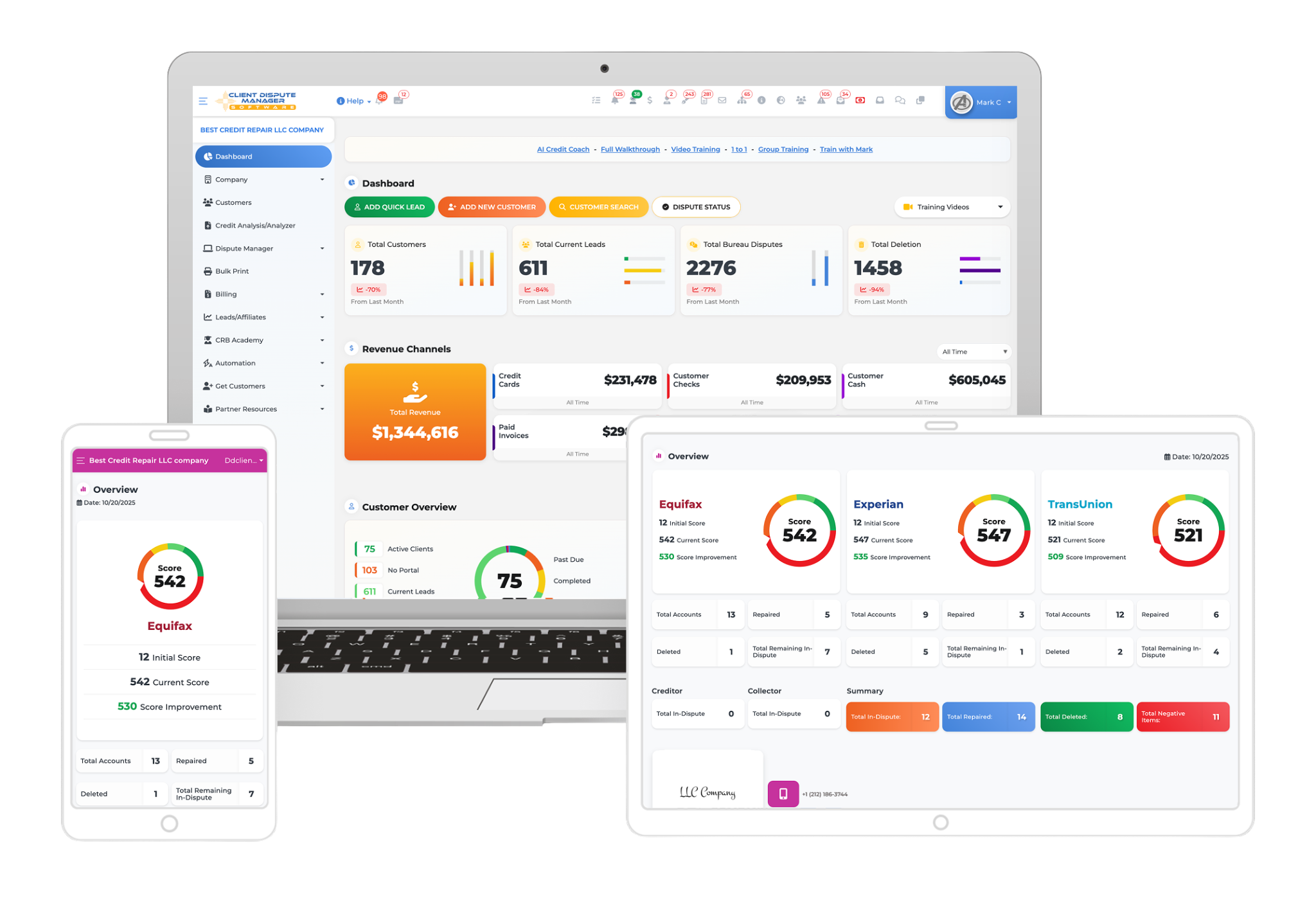
Client Dispute Manager Software is built to support credit repair operations at every stage of that compliance picture, with contract templates, disclosure workflows, and billing structures that reflect both the federal CROA requirements and the state-level obligations that determine whether a multi-state credit repair business is operating on solid legal ground or on borrowed time.

Mark Clayborne specializes in credit repair, starting and running credit repair businesses. He's passionate about helping businesses gain freedom from their 9-5 and live the life they really want. You can follow him on YouTube.
Experience our credit repair software, risk-free.