
How to Rebuild Credit After Foreclosure or Short Sale
Written by Mark Clayborne
Last updated on March 30, 2026
On this page

Losing a home to foreclosure or completing a short sale is one of the most financially disorienting events a person can go through. The credit damage is real, and the path forward is not always obvious.
Most people assume recovery takes a decade and there is nothing to do in the meantime. That assumption is wrong on both counts.
Rebuilding credit after foreclosure or short sale follows a specific sequence. The priority is making sure the foreclosure entry is reported accurately, because errors in how it is recorded extend the damage beyond what the law requires.
After that, the focus shifts to adding new positive payment history and keeping credit utilization low. Most people reach a 620 to 650 credit score within two years and FHA mortgage eligibility within three years when they follow the right steps consistently.
This guide covers how foreclosure and short sale affect your credit report differently, the step-by-step rebuilding strategy, the financial products that accelerate recovery, how to dispute any inaccurate details in the foreclosure entry, mortgage re-entry timelines for every major loan program, and how Client Dispute Manager Software automates the dispute and monitoring side of the process so you can focus on the actions that drive score recovery.
How Foreclosure and Short Sale Affect Your Credit Report?

A foreclosure is one of the most damaging single entries on a credit report, but it follows a fixed timeline. The entry stays for seven years from the date of first delinquency on the original mortgage, not from the date the lender completed the foreclosure process or took possession of the property.
A short sale and a deed-in-lieu of foreclosure carry the same seven-year timeline. The score drops at the time the event is recorded depends on the pre-foreclosure score: consumers with higher scores see larger drops because they have more points to lose.
A consumer with a 780 score can drop 140 to 160 points. A consumer with a 620 score may drop 85 to 105 points. Understanding how each type of event is recorded helps you know exactly what you are working with before you begin rebuilding.
| Type | Stays on Report | Typical Score Drop | FHA Loan Eligibility | Conventional Loan Eligibility |
|---|---|---|---|---|
| Foreclosure | 7 years from date of first delinquency | 85 to 160 points depending on pre-event score | 3 years post-event | 7 years post-event |
| Short Sale | 7 years from date of first delinquency | 85 to 160 points | 3 years post-event | 4 years post-event |
| Deed-in-Lieu of Foreclosure | 7 years from date of first delinquency | 85 to 160 points | 3 years post-event | 4 years post-event |
What Negative Items Can Be Removed from a Credit Report?
In the context of a foreclosure or short sale, entry itself cannot be removed before the seven-year reporting period expires if it was accurately recorded.
What can be disputed and removed are inaccurate details within the entry: the wrong date of first delinquency, which directly affects how long the entry stays on the report; a balance still showing on the original mortgage account after the property transferred; the mortgage account appearing as open and delinquent after the foreclosure completed; and duplicate entries from both the original lender and a loan servicer.
Any of these are disputable under the Fair Credit Reporting Act. For a full guide to the dispute process, see How to Dispute Foreclosure on Your Credit Report.
How Long Does It Take to See Credit Score Improvements?
Recovery from foreclosure typically begins showing credit scores within 12 to 24 months of the event when the consumer is actively adding positive payment history.
The score usually moves from the post-event low toward the 580 to 620 range within the first year with consistent on-time payments on a secured card. Reaching 620 to 650 is realistic within two years. The 700-plus range takes three to five years, depending on how high the pre-event score was and how consistently the rebuilding steps are followed.
Short sale and deed-in-lieu timelines are similar, though the slightly shorter conventional loan waiting period for short sales means mortgage re-entry can come one to three years sooner than after a foreclosure.
What Are The Best Strategies For Rebuilding Credit After Foreclosure?
The best strategies for rebuilding credit after foreclosure combine two tracks running in parallel: fixing what is already on the report and adding new positive accounts.
The first track is accuracy. Any error in how the foreclosure or the original mortgage account is recorded on your credit report suppresses your score beyond what the law requires and must be disputed immediately.
The second track is consistent positive payment history on new accounts. Client Dispute Manager Software handles the dispute and monitoring side so the rebuilding actions become the primary focus.
What Are the Essential Steps for Improving a Low Credit Score?

Follow these steps in order. Skipping the first two and going straight to opening new accounts leaves errors in the report that work against everything else you are doing.
- Step #1: Pull your credit reports from all three bureaus at AnnualCreditReport.com. Review the foreclosure entry and the original mortgage tradeline on each bureau file separately, because the same error may not appear on all three. Import the reports into Client Dispute Manager Software to scan every tradeline and flag reporting errors automatically.
- Step #2: Dispute any inaccurate details in the foreclosure entry or the associated mortgage account. The most common errors are a wrong date of first delinquency that extends the seven-year clock, a balance still reporting on the original mortgage after the property transferred, and the mortgage account still appearing as open and delinquent after the foreclosure completed. CDM generates bureau-specific dispute letters for all three bureaus simultaneously and tracks the 30-day FCRA investigation deadline for each one.
- Step #3: Open one secured credit card within one to three months of the event. Choose a card that reports to all three bureaus. Use it for one or two small recurring purchases each month and pay the full balance before the due date. Keep the reported balance below 10 percent of the credit limit, not 30 percent.
- Step #4: Add a credit-builder loan within three to six months. Self Financial, local credit unions, and community banks offer these. The loan adds an installment tradeline alongside the revolving secured card, which improves your credit mix and adds a second stream of positive payment history.
- Step #5: Become an authorized user on a trusted account. Ask a family member or close friend who has an account with three or more years of clean history and low utilization to add you as an authorized user. You do not need to use the card. Their account history is added to your credit file within 30 to 60 days with no application and no hard inquiry on your file.
- Step #6: Use a rent reporting service to add on-time rent payments to all three bureau files. Rent payments do not appear on credit reports by default. Services like Rental Kharma, Experian RentBureau, and Rock the Score report on-time payments as positive tradelines with no new account required.
- Step #7: Monitor all three bureau files monthly with CDM. Track score changes tied to each action you take, verify that the foreclosure entry is reflecting the correct status at each bureau, and catch any new reporting errors before they compound.
Strategies for Boosting Credit Scores Quickly Before a Major Purchase
Once you are approaching the mortgage eligibility window, a few targeted actions produce faster score movement. Pay revolving balances down to below 10 percent utilization before the credit card statement closing date, not the due date.
Submit any remaining disputed entries through Client Dispute Manager Software immediately. Avoid applying for any new credit in the six to twelve months before the loan application. Ask a trusted family member with excellent credit to add you as an authorized user if you have not already done so.
If you are working with a mortgage lender and have verified corrections ready, ask specifically about rapid re-scoring, which can push bureau updates through in three to five business days instead of waiting out the standard 30-day dispute investigation cycle.
What Financial Products Help Improve Credit Utilization?
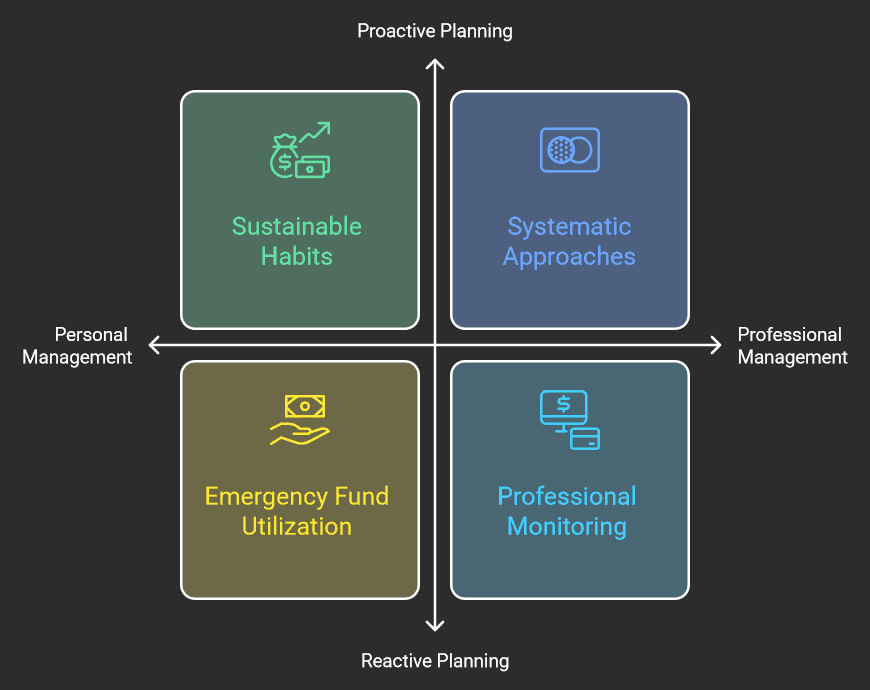
The most effective financial products for rebuilding credit after foreclosure are credit cards and credit-builder loans because both are accessible immediately after the event, both report positive payment history to all three bureaus, and both give direct control over the two most heavily weighted FICO factors: payment history and credit utilization.
Secured cards directly control utilization. Credit-builder loans add an installment tradeline that diversifies your credit mix. Authorized user status on an established account is the fastest single action available because it requires an application and no hard inquiry but add years of clean account history to your file immediately.
How Do Authorized Users Affect Credit Scores?
Being added as an authorized user on a credit card with three or more years of on-time payments, low utilization, and no late payments adds the primary account holder’s positive history to your credit file. The primary holder does not need to give you access to the physical card.
The impact appears on your report within 30 to 60 days of being added. For a consumer rebuilding after foreclosure whose report contains mostly negative entries, this is one of the fastest legal scores boosts available because it imports an established positive history immediately without requiring you to open anything or wait for a new account to age.
Choose carefully: an account with late payments or high utilization will not help. The account must be clean and well-managed.
What Are the Benefits of Using a Rent Reporting Service for Credit Building?
Most people who have experienced foreclosure are renting while they are rebuilt. On-time rent payments are one of the most consistent financial habits a renter maintains, but they do not appear on credit bureau files by default unless a reporting service is used.
Services like Rental Kharma, Experian RentBureau, and Rock the Score report monthly rent payments to the bureaus as positive tradelines.
For someone rebuilding after foreclosure, this converts a payment they are already making into a score-building action with no new account, no application, and no hard inquiry.
It is one of the few ways to add positive payment history without opening anything new.
What Are Reliable Financial Products for Building Positive Payment History?
A complete post-foreclosure rebuilding plan uses multiple products to build payment history across different account types. The combination of a revolving account and an installment account is what produces the most balanced score recovery because FICO rewards credit mix alongside consistent payment history.
| Product | Tradeline Type | When to Open | Score Impact | Requires Application? |
|---|---|---|---|---|
| Secured Credit Card | Revolving | Month 1 to 3 post-event | High, builds payment history and controls utilization | Yes, approval nearly guaranteed with security deposit |
| Credit-Builder Loan | Installment | Month 3 to 6 | Medium-high, adds credit mix and second payment history stream | Yes, minimal approval requirements |
| Authorized User Account | Revolving (inherited) | Immediately available | High, fastest legal score boost, no application needed | No |
| Rent Reporting Service | Alternative data | Immediately available | Medium, adds positive payment history for thin files | No |
| Low-Limit Retail Card | Revolving | Year 1 to 2 only after secured card is established | Low-medium, secondary step only | Yes |
How to Dispute Inaccurate Items on My Credit Report?

Foreclosure entries are among the most frequently misreported tradelines on a credit report because the data passes through multiple parties before it reaches the bureau: the original lender, the loan servicer, the foreclosure attorney, and the bureau itself.
Common errors include a wrong date of first delinquency that extends the seven-year reporting clock beyond its legal limit, a balance still showing on the original mortgage account after the property transferred, the mortgage account still appearing as open and delinquent after the foreclosure was completed, and duplicate entries from both the original lender and the servicer.
Client Dispute Manager Software scans imported credit reports for all of these error types automatically when you upload your bureau files.
What Are My Rights Under the Fair Credit Reporting Act?
Under FCRA Section 611, every consumer has the right to dispute inaccurate or unverifiable information on their credit report at no cost. Once you submit a dispute, the bureau has 30 days to investigate and respond.
The bureau must contact the source of the information and ask it to verify what was reported. If the source cannot verify the entry as accurate, the bureau must correct or remove it.
These rights apply to every entry on your report, including the foreclosure record and the associated mortgage tradeline. You also have the right to add a 100-word personal statement to your credit file explaining the circumstances of the foreclosure, and to seek damages if a bureau or creditor violates the FCRA.
What Documents Do I Need for a Credit Dispute?
For a foreclosure or short sale entry dispute, gather these documents before writing the dispute letter:
- Mortgage payoff statement or lender confirmation letter showing the date the property transferred and the final balance settled
- Short sale approval letter from the lender, if you are disputing a short sale entry
- Closing documents from the foreclosure sale or short sale showing the settlement date and final disposition
- Account statements showing a zero balance on the original mortgage account after the property transferred
- Credit report copies from all three bureaus with the specific error highlighted on each file
- Government-issued photo ID matching your name and current mailing address
- Written dispute letter citing FCRA Section 611, identifying the specific error, and stating the correction you are requesting
Client Dispute Manager Software generates the dispute letter automatically when you select the item to dispute, and routes the correct supporting documents to each bureau when you upload them to the platform. You upload once and CDM handles the bureau-specific distribution.
Step-by-Step Guide to Using Credit Repair Software
The process inside CDM for a foreclosure entry dispute follows four steps. First, import your credit reports from all three bureaus. CDM scans every tradeline and flags foreclosure entry errors automatically, including date discrepancies, balance errors, and duplicate entries.
Second, review the flagged items and confirm which ones to dispute. Third, CDM generates bureau-specific dispute letters with FCRA Section 611 citations and attaches your uploaded supporting documents.
Fourth, CDM tracks the 30-day investigation deadline for each bureau and sends follow-up letters automatically when a bureau does not respond within the FCRA window.
Every dispute round is logged in the client record, building a complete dispute history for reference at any point.
Mortgage Re-Entry: Getting Back to Homeownership After Foreclosure
Most people who experienced foreclosure plan to own a home again. The path back is governed by waiting period requirements set by each loan program, and those waiting periods are fixed regardless of how well the credit score recovers during the interval.
Meeting the eligibility requirements takes two things: reaching the end of the waiting period and demonstrating re-established credit during that period.
The waiting period clock starts from the date of the foreclosure sale or short sale closing, not from the date of the last mortgage payment or the date the foreclosure entry appeared on the credit report.
| Loan Program | After Foreclosure | After Short Sale | Minimum Credit Score | Key Condition |
|---|---|---|---|---|
| FHA Loan | 3 years from event date | 3 years from event date | 580 for 3.5% down payment | Re-established credit with clean payment history during waiting period |
| Conventional Loan (Fannie Mae) | 7 years from event date | 4 years from event date | 620 minimum | Re-established credit, no additional derogatory marks |
| VA Loan (Eligible Veterans) | 2 years from event date | 2 years from event date | No minimum set by VA; lenders typically require 620 | Satisfactory credit re-established post-event |
| USDA Loan | 3 years from event date | 3 years from event date | 640 minimum for automated underwriting approval | Re-established credit required throughout waiting period |
How Do Rapid Re-Scoring Services Work and Who Offers Them?
Rapid re-scoring is a service that pushes verified bureau corrections through in three to five business days instead of waiting out the standard 30-day dispute investigation cycle.
It is used most often in mortgage situations where a borrower is close to approval but needs a quick score improvement before the rate lock expires. Rapid re-scoring is not available directly to consumers.
It must be initiated through a mortgage lender who has a relationship with a rapid re-scoring company that holds bureau agreements.
The lender submits documented proof of the correction such as a letter from the creditor confirming a balance was paid or an error was made to the re-scoring company, which forwards it to the bureau.
The bureau updates the record and the lender pulls a new credit report. Client Dispute Manager Software helps prepare the supporting dispute documentation the lender needs to initiate the rapid re-score request on your behalf.
Strategies for Boosting Credit Scores Quickly Before a Major Purchase.
Once you are within six to twelve months of meeting the mortgage waiting period requirements, targeted score optimization actions produce faster results.
Pay every revolving balance down to below 10 percent of the credit limit before the statement closing date, not the payment due date, because the balance on the statement date is what the bureau reports.
Submit any outstanding disputed entries through CDM immediately so corrections can process before the lender pulls your credit. Avoid applying for any new credit or closing any existing accounts in the 6 to 12 months before the loan application.
Ask a trusted family member with excellent credit to add you as an authorized user if not already done. Work with your mortgage lender to identify whether any verified corrections qualify for rapid re-scoring so you can get the update in days instead of weeks.
What Credit Repair Companies Assist with Rebuilding Credit After Foreclosure or Short Sales?

The most effective services for rebuilding credit after foreclosure combine two functions: disputing any inaccurate details in the foreclosure entry or associated mortgage tradeline under the FCRA, and monitoring score progress as new positive tradelines are added and existing entries age.
Software-first credit repair is more affordable than traditional service companies and gives full transparency into every dispute letter sent, every bureau response received, and every score change recorded.
The key criteria when evaluating any service are CROA compliance, no advance fees before services begin, and bureau-specific letter generation for all three bureaus simultaneously.
Best Credit Repair Services for Disputing Errors
Client Dispute Manager Software was built by Mark Clayborne, a certified credit consultant and CROA practitioner with over a decade of experience in the credit repair industry.
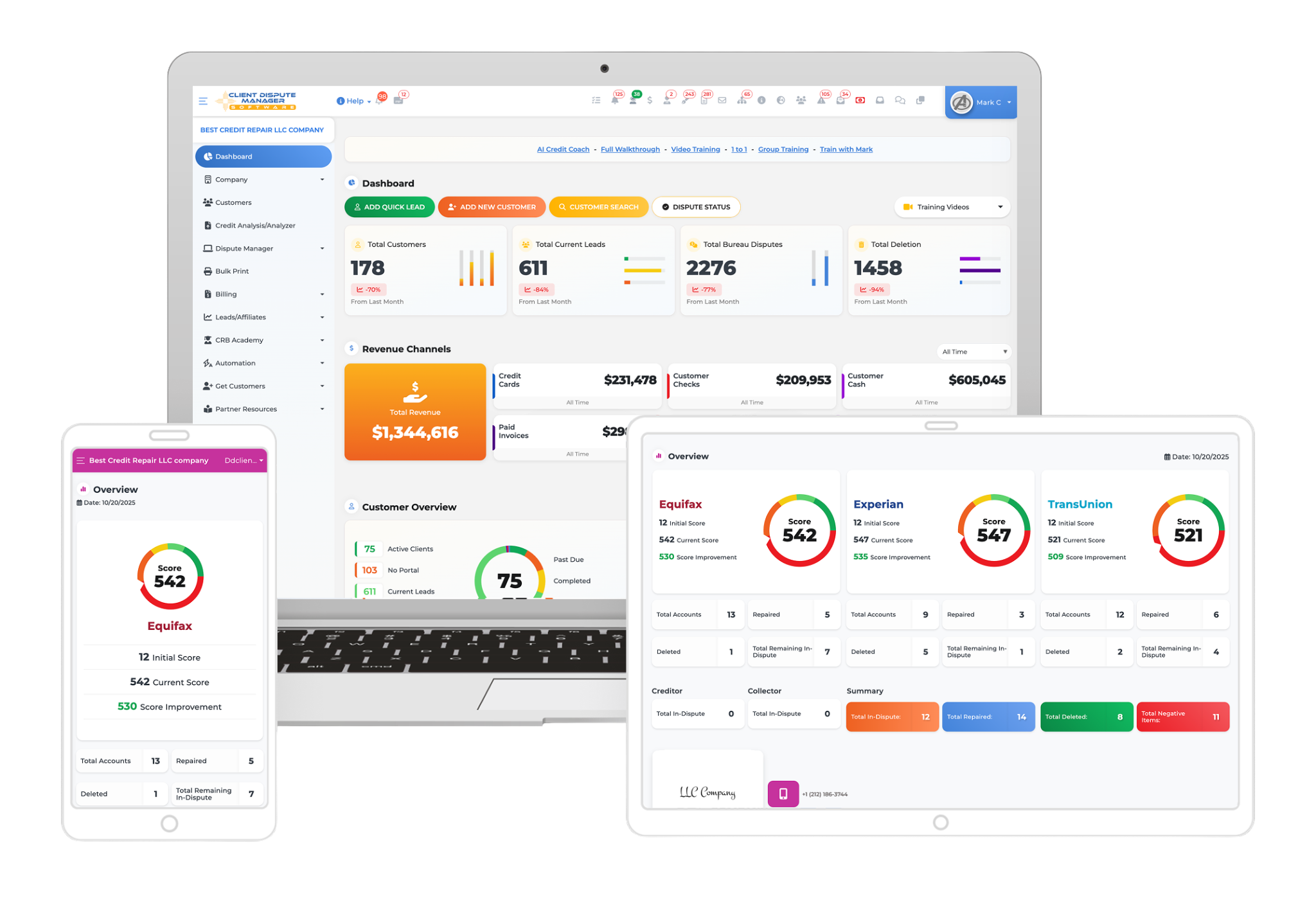
The platform generates foreclosure-specific dispute letters with correct FCRA citations, attaches supporting documents to each bureau submission automatically, tracks the 30-day investigation deadline for all three bureaus from a single dashboard, monitors score changes tied to each dispute round, and flags re-reported errors when a previously corrected entry reappears.
The 30-day free trial gives full access to every feature with no credit card required.
What Platforms Automate the Credit Dispute Process?
Three paths are available for disputing foreclosure entry errors and monitoring the rebuilding process:
| Option | Cost | Automation Level | CROA Compliant |
|---|---|---|---|
| DIY Dispute Letters | Free | None, write, mail, and track every step manually across all three bureaus | Yes |
| Credit Repair Service Companies | $79 to $149 per month | Partial, letters often templated, tracking and transparency varies | Varies, verify CROA compliance before enrolling |
| CDM Software, 30-Day Free Trial | Low monthly fee | Full, letter generation, bureau tracking, deadline alerts, score monitoring | Yes, built by certified CROA practitioner |
Frequently Asked Questions
What Are the Best Strategies for Rebuilding Credit After Foreclosure?
The most effective strategies run two tracks simultaneously. First, dispute any inaccurate details in the foreclosure entry or the original mortgage tradeline under the FCRA.
Common errors include the wrong date of first delinquency, a balance still showing after property transfer, and duplicate entries.
Second, add new positive trading lines: a secured credit card within one to three months, a credit-builder loan within three to six months, authorized user status on an established account, and a rent reporting service for on-time rent payments. Keep utilization below 10 percent and monitor all three bureau files monthly with CDM.
What Negative Items Can Be Removed from A Credit Report?
In the context of a foreclosure or short sale, the entry itself cannot be removed before the seven-year reporting period expires if it was accurately recorded.
What can be disputed are inaccurate details within the entry: the wrong date of first delinquency, a balance still showing after the property transferred, the mortgage account appearing as open and delinquent after the foreclosure completed, duplicate entries, and entries remaining past the seven-year reporting limit.
For the full dispute guide, see How to Dispute a Foreclosure on Your Credit Report.
How Long Does It Take to See Credit Score Improvements?
Most consumers rebuilding after foreclosure see the first measurable score improvements within 12 to 24 months of the event with consistent positive payment history on new accounts.
The score typically moves toward the 580 to 620 range within the first year and reaches 620 to 650 within two years. The 700-plus range takes three to five years depending on the pre-event score and how consistently the rebuilding steps are followed.
Short sale timelines are similar, though the shorter conventional loan waiting period for short sales means mortgage re-entry can come sooner.
What Are the Essential Steps for Improving A Low Credit Score?
Follow a seven-step sequence: pull all three credit reports and dispute any inaccurate foreclosure entry details first. Open a secured credit card within one to three months and keep the reported balance below 10 percent of the limit.
Add a credit-builder loan within three to six months for a second positive tradeline. Become an authorized user on a clean established account. Use a rent reporting service to add on-time rent payments to your bureau files.
Keep total credit utilization across all cards below 30 percent, and below 10 percent for maximum score impact. Monitor all three bureau files monthly with CDM to track progress and catch new errors early.
What Financial Products Help Improve Credit Utilization?
Secured credit cards give you direct control over your utilization ratio because you set how much you charge relative to the credit limit.
Keeping the reported balance below 10 percent of the limit produces the maximum score benefit. Requesting a credit limit increase after 12 months of on-time payments also improves the utilization ratio without opening a new account.
Credit-building loans add an installment tradeline that does not affect revolving utilization but builds payment history and credit mix. Authorized user status on an account with low utilization contributes that account’s favorable ratio to your credit profile.

Mark Clayborne
Mark Clayborne specializes in credit repair, starting and running credit repair businesses. He's passionate about helping businesses gain freedom from their 9-5 and live the life they really want. You can follow him on YouTube.
Start Today and Explore the Features Firsthand!
Related Guides:
- How to Fix Your Credit: Bankruptcy, Collections, Charge-Offs, Late Payments & More
- How to Remove a Repossession from Your Credit Report?
- How to Rebuild Your Credit After Bankruptcy (Chapter 7 and 13)
- How to Challenge a Bankruptcy on Your Credit Report?
- How to Dispute a Foreclosure on Your Credit Report?
Client Dispute Manager
Free 30-Day Trial
Experience our credit repair software, risk-free.