Get Started for as Low as $49 for the First Month: Click Here
Written by Mark Clayborne
Last updated on September 16, 2026
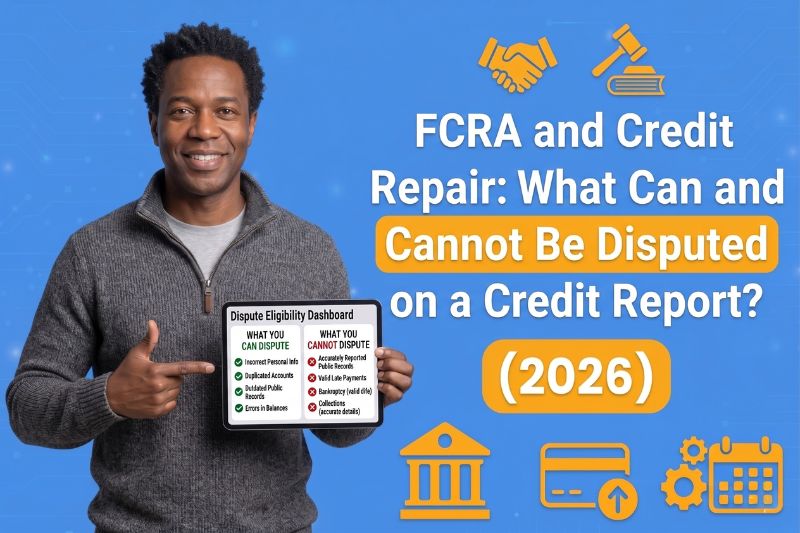
Under the Fair Credit Reporting Act, credit repair companies can dispute inaccurate, unverifiable, or outdated information on credit reports. They cannot dispute accurate, verifiable negative information.
FCRA Section 611, codified at 15 U.S.C. section 1681i, requires credit bureaus to investigate any disputed item and remove anything the data furnisher cannot verify within 30 days.
| Category | Disputable? | Reason |
|---|---|---|
| Inaccurate Information (Wrong Balance, Wrong Date, Wrong Account Number) | Yes | FCRA Section 611. The credit bureau must investigate the disputed information. |
| Unverifiable Information (Furnisher Cannot Confirm) | Yes | The bureau must delete the information if the furnisher cannot verify its accuracy. |
| Outdated Information (Past FCRA Reporting Period) | Yes | FCRA Section 605. The item has exceeded its maximum reporting period and should no longer appear on the report. |
| Accurate, Verified Negative Information Within Reporting Period | No | FCRA provides no mechanism for removal of accurate and legally reportable information. |
| Verified Bankruptcy Within Reporting Period | No | The bankruptcy is accurately reported and remains within the applicable reporting period. |
| Re-Aged Or Misreported Collection Date | Yes | Improper reporting of the delinquency date may violate FCRA Section 623 and improperly extend the reporting period. |
The Fair Credit Reporting Act defines the legal boundaries of every credit dispute a credit repair business can file on behalf of a client. FCRA, codified at 15 U.S.C. sections 1681 through 1681x, does not grant credit repair companies special powers.
It grants consumers legal rights to accurate credit reporting and credit repair businesses exercise those rights professionally. Understanding exactly where the legal line sits is not optional compliance reading. It is the operating foundation of a credit repair business.
FCRA Section 611 is the primary dispute statute. FCRA Section 605 defines how long items can stay. FCRA Section 623 defines furnisher obligations. Together, these three sections define what you can dispute, when an item must come off, and what verification a creditor must provide.

Under FCRA Section 611 at 15 U.S.C. section 1681i, credit repair companies can dispute any item on a client’s credit report that is inaccurate, unverifiable, or outdated. The bureau must investigate and, if the furnisher cannot verify the item within 30 days, delete or correct it.
This is the legal basis for all legitimate credit repair dispute work. Under FCRA Section 611, codified at 15 U.S.C. section 1681i, a consumer has the right to dispute any credit report item believed to be inaccurate, incomplete, or unverifiable.
The credit bureau must complete its reinvestigation within 30 days and delete or correct any item it cannot verify Cornell LII, 15 U.S.C. 1681i. In practice, the categories below are not always mutually exclusive. A single item may be both inaccurate and unverifiable simultaneously.
A collection account may have the wrong original delinquency date (inaccuracy) and the furnisher may no longer possess the documentation to confirm the underlying debt (unverifiable). Both grounds can be cited in a single dispute letter.
A disputable credit report item is any entry that fails at least one of three conditions: accuracy, verifiability, or temporal compliance with FCRA’s reporting limits. The Fair Credit Reporting Act does not require that an item be severely wrong or that it cause material damage to dispute it.
Any inaccuracy is sufficient grounds under Section 611. Three conditions make an item legally disputable. The first is inaccuracy: information reported incorrectly by the furnisher, including wrong account numbers, incorrect balances, misapplied payment dates, or accounts that belong to another person.
The second is unverifiability: the furnisher no longer holds documentation sufficient to confirm the item when the bureau forwards the dispute. The third is temporal: the item has been on the report longer than FCRA permits.
Three conditions create legal dispute grounds under FCRA, and any one of them is sufficient:
The three conditions are as follows:
Any one of those three conditions is sufficient grounds to file. Credit repair companies are not required to prove all three. If a collection account has the wrong original balance and the creditor cannot confirm the debt, two separate grounds exist but one would be enough.
Accurate, verifiable negative information within its FCRA reporting period cannot be removed through dispute not by the consumer, not by a credit repair company, and not by an attorney. FCRA Section 611 creates a reinvestigation right, not a removal right.
The reinvestigation produces deletion only when verification fails. This distinction matters operationally. A client with a legitimately late payment, accurately reported, with the correct date and balance, has no FCRA dispute grounds for that item.
The item must age off naturally. A professional credit repair business identifies this at intake and sets accurate expectations rather than filing disputes it knows will not produce deletion.

Credit reports contain several categories of negative items that credit repair companies regularly evaluate for dispute eligibility. These include charge-offs, collection accounts, late payments, bankruptcies, hard inquiries, and civil judgments. Each category has its own FCRA dispute rules, reporting periods, and verification requirements.
The FTC’s study on credit report accuracy found that one in five consumers had an error on at least one of their three credit reports, and one in twenty had an error serious enough to result in a higher interest rate on a loan. FTC, Report on Study of Credit Reporting Accurac ,2013
Credit repair companies cannot remove accurate negative information. That framing is correct. What that framing omits is that a significant portion of credit report entries contain errors: wrong balances, incorrect dates, duplicate accounts, or accounts that belong to someone else entirely.
FCRA Section 611 exists specifically because inaccurate information is common, not rare. The consumer-protective framing of “you can’t remove accurate items” is factually true but operationally incomplete because the starting question is whether the item is actually accurate.
A charge-off is an accounting action a creditor takes when it determines a debt is unlikely to be collected, typically after 180 days of non-payment. It does not mean the debt is forgiven or erased.
The debt remains legally collectible. The charge-off notation on a credit report stays for seven years from the date of first delinquency under FCRA Section 605.
A charge-off can be disputed on two grounds. First, if the information is inaccurate wrong balance, wrong date of first delinquency, wrong creditor name, or the account was not actually delinquent.
Second, if the item has exceeded its seven-year reporting period and remains on the report. What a credit repair company cannot do is dispute a charge-off solely because the client doesn’t want it there. The dispute must have a factual basis.
One of the most common charge-off errors is re-aging: a collection agency purchases the debt and reports a new “date opened,” which resets the apparent age of the account.
This is a violation of FCRA Section 623 at 15 U.S.C. section 1681s-2. Re-aged accounts are disputable regardless of whether the underlying debt is accurate, because the reporting date itself is wrong.

A collection account appears on a credit report when a creditor sells or transfers a delinquent debt to a collection agency, which then reports it as a separate entry.
The collection account is disputable under FCRA when it contains inaccurate information, when the furnisher cannot verify the debt, or when it has exceeded the seven-year reporting period starting from the date of first delinquency on the original account.
The most critical detail for dispute eligibility is the date of first delinquency on the original account. FCRA Section 605(c) requires the reporting period clock to start from that original date, not from the date the collection agency acquired the debt.
Collection agencies that report a newer “date opened” are violating this provision. A collection account opened in 2026 for a debt that went delinquent in 2017 is past its FCRA reporting limit and disputable on that basis alone.
Disputing a collection account on unverifiability grounds requires the furnisher to provide documentation confirming the original debt, the chain of assignment, and the current balance.
Many collection agencies purchase debt portfolios without complete documentation. When they cannot verify the account upon investigation, FCRA requires the bureau to delete it.
Late payments can be disputed and removed when they are inaccurately reported or when the furnisher cannot verify the payment status. A payment recorded as 30 days late when bank records show it was received on time is an inaccuracy disputable under FCRA Section 611.
If the creditor cannot confirm the late payment when the bureau investigates, the bureau must delete or correct the entry. An accurate late payment within its seven-year reporting period cannot be removed through dispute.
No dispute letter, no matter how well crafted, can produce deletion of a late payment the creditor can confirm was late. The reporting period is the other avenue: a late payment from more than seven years ago that remains on the report is disputable on expiration grounds.
Creditors occasionally correct late payment notations through goodwill adjustment letters a separate process from FCRA disputes that relies on the creditor’s voluntary cooperation, not on any legal obligation. FCRA dispute rights and goodwill requests are two different processes. Credit repair companies operate in the FCRA dispute space.
You cannot dispute a legally filed and accurate bankruptcy. You can dispute inaccurate details within the bankruptcy entry: the wrong chapter listed, an incorrect filing or discharge date, accounts incorrectly included in the filing, or a bankruptcy that has remained on the report past its FCRA reporting period.
Chapter 7 bankruptcy stays on a credit report for ten years from the filing date under FCRA Section 605(a)(1). Chapter 13 bankruptcy stays for seven years. A Chapter 7 bankruptcy filed in 2015 should be off the report by 2025. If it remains, that is a disputable expiration violation. The bankruptcy itself is not disputable but the reporting period compliance is.

The standard FCRA reporting period for most negative items is seven years from the date of first delinquency on the original account. Chapter 7 bankruptcy stays for ten years. Chapter 13 bankruptcy stays for seven years. Hard inquiries stay for two years.
Items remaining past their applicable period are disputable under FCRA Section 605. Under FCRA Section 605, codified at 15 U.S.C. section 1681c, most negative credit information may not be reported after seven years from the date of first delinquency.
Chapter 7 bankruptcy is the primary exception, with a ten-year reporting period from the filing date. Items remaining past these limits are disputable regardless of accuracy. Cornell LII, 15 U.S.C. 1681c, 2026
The FCRA reporting periods for the most common negative credit items are as follows:
Closed accounts with no negative history can remain on the report for up to ten years. Positive payment history does not fall under the negative item reporting limits bureaus may keep it longer because it does not harm the consumer.
The reporting period clock starts on the date of first delinquency on the original account, not on the date the debt was sold, not on the date a collection agency opened a new account, and not on the date the consumer acknowledged the debt.
FCRA Section 605(c) at 15 U.S.C. section 1681c(c) defines this starting point specifically to prevent re-aging. This detail is operationally significant. A client whose credit card went delinquent in January 2018 and whose debt was sold to a collection agency in 2020 has a collection account whose clock started in January 2018.
The collection entry must come off by January 2025 regardless of when the collector opened its account or what date the collector reports. If the bureau is showing the collection as newer than it is, the reporting period has been manipulated and the item is disputable.
In reviewing FCRA disputes handled through CDMS-supported businesses, re-aging of collection accounts is one of the most common verifiable violations encountered during client intake.
Collectors frequently report the “date opened” as the date they purchased the debt rather than the original delinquency date. This reporting error gives the appearance of a newer, more damaging entry and extends the item’s effective life on the report beyond what FCRA permits.
Re-aging is a FCRA violation. It occurs when a furnisher reports a later date as the starting point for the reporting clock, making an older debt appear newer than it is. The result is that an item that should have been removed continues to appear on the consumer’s report.
When a credit repair company identifies re-aging, the dispute has two elements: the inaccuracy of the reported date, and the expiration of the reporting period based on the correct date. The furnisher must either confirm the original delinquency date or fail to verify the item.
Either outcome resolves the dispute in the consumer’s favor correction of the date triggers removal if the correct date falls outside the reporting period, and failure to verify triggers deletion under Section 611.

After a dispute is submitted to a credit bureau, FCRA Section 611 requires the bureau to complete its investigation within 30 days, or 45 days if the consumer submits additional information during that period. The bureau forwards the dispute to the furnisher, who must verify the information or the bureau must delete it. The entire process is governed by 15 U.S.C. section 1681i.
FCRA Section 611 at 15 U.S.C. section 1681i requires credit bureaus to notify the data furnisher of any dispute within five business days of receiving it, conduct a reinvestigation, and delete or correct any item the furnisher fails to verify. The 30-day investigation window is mandatory, not discretionary. Cornell LII, 15 U.S.C. 1681i, 2026
After you file a credit dispute, the bureau logs the claim and forwards the dispute details and supporting documents to the data furnisher the creditor or collection agency that reported the item.
The furnisher must review the information, verify its accuracy, and report back to the bureau within the investigation window. The three major bureaus Equifax, Experian, and TransUnion use an automated system called e-OSCAR to forward disputes to furnishers.
This means dispute letters are converted into coded dispute reason categories before they reach the furnisher. The implication is that dispute letters with specific documentation and factual basis create stronger records than form letters with generic reasons.
Three outcomes are possible: the item is corrected to reflect accurate information, the item is deleted because the furnisher cannot verify it, or the bureau determines the information is accurate as reported and the item remains. If the item remains, the bureau must notify the consumer of the result and provide the furnisher’s contact information.
When a furnisher cannot verify the disputed item within the investigation window, the bureau must delete or modify the entry. This deletion is mandatory under FCRA Section 611 the bureau does not have discretion to keep an unverified item on the report.
The consumer receives written notification of the deletion. Under FCRA Section 623 at 15 U.S.C. section 1681s-2, furnishers are required to conduct a reasonable investigation of any dispute forwarded to them by a bureau.
A furnisher who receives a dispute notification and simply confirms the item without actually reviewing its supporting documentation is not conducting a reasonable investigation.
This is the basis for escalation when an item is “verified” despite the consumer having clear documentation showing the information is wrong.
When a bureau fails to complete its investigation within 30 days or fails to delete an unverified item, the consumer or the credit repair company acting on the consumer’s behalf can file a complaint with the Consumer Financial Protection Bureau at consumerfinance.gov. The CFPB forwards complaints to the bureaus and tracks resolution.
The CFPB complaint process is not a substitute for FCRA disputes, but it creates an escalation record that bureaus take seriously. A bureau that ignores a dispute letter faces a different calculation when a formal CFPB complaint number is attached to the same issue.
For credit repair businesses, documenting every dispute submission date, every bureau response, and every failure to respond creates the paper trail that supports escalation when needed.
Filing an FTC complaint at consumer.ftc.gov is a parallel option. The FTC enforces FCRA against bureaus and furnishers and can impose civil penalties of up to $50,120 per violation for willful FCRA violations.

Professional credit repair businesses use three tools beyond the standard bureau dispute: debt validation letters directed to the furnisher under the Fair Debt Collection Practices Act, method of verification requests under FCRA Section 611(a)(7), and direct furnisher disputes under FCRA Section 623. Each addresses a different failure point in the standard investigation process.
A debt validation letter is a written request sent directly to a collection agency demanding that it provide documentation proving the debt exists, that the agency has the right to collect it, and that the amount is accurate.
The right to request validation comes from the Fair Debt Collection Practices Act, not from FCRA. A collector who cannot validate the debt also typically cannot verify it in a bureau investigation. The debt validation and bureau dispute processes are strategically related.
If a collector cannot provide documentation in response to a validation letter, it is unlikely to successfully verify the account when the bureau forwards the dispute. Sending the validation letter first gives the credit repair company a record of the collector’s verification capacity or failure before the bureau investigation clock starts.
Under FCRA Section 611(a)(7) at 15 U.S.C. section 1681i(a)(7), after a bureau completes its investigation and determines an item is accurate, the consumer has the right to request a description of the method of verification used.
The bureau must provide this within 15 days of the request. The method of verification request is one of the most under-used tools in professional credit repair work.
If a bureau “verifies” an item by simply re-confirming the furnisher’s original data through e-OSCAR without any actual document review, that process may not constitute a reasonable investigation under FCRA.
Understanding what verification process occurred is the first step in evaluating whether escalation, a complaint to the CFPB, or litigation through a consumer rights attorney is warranted.
FCRA Section 623(a)(8) at 15 U.S.C. section 1681s-2(a)(8) gives consumers the right to dispute inaccurate information directly with the furnisher, bypassing the bureau. The furnisher then has 30 days to investigate and, if it finds the information inaccurate, must notify every bureau to which it reports the corrected data.
Direct furnisher disputes work best when the error originates at the furnisher a creditor reporting the wrong balance, a lender misapplying a payment, or an account with incorrect status.
Bureau disputes work best when the issue is whether the bureau is accurately reflecting what the furnisher has reported. Both routes are available under FCRA, and professional credit repair businesses use the appropriate one based on where the error lives in the reporting chain.

Credit repair companies can dispute and potentially have removed inaccurate information (wrong account numbers, incorrect balances, misapplied dates), unverifiable information that creditors cannot confirm when the bureau investigates, and outdated information that has exceeded the applicable FCRA reporting period. Accurate, verifiable negative information within the reporting period cannot be removed through dispute.
Under FCRA, credit repair companies cannot dispute accurate, verifiable negative information and cannot file frivolous disputes without a factual basis. A frivolous dispute under FCRA Section 611(a)(3) is one the bureau reasonably determines has no factual basis or is substantially the same as a prior dispute already investigated. Making false statements to bureaus or furnishers also violates CROA’s prohibited practices at 15 U.S.C. section 1679b(a).
No. FCRA does not provide a mechanism for removing accurate, verifiable negative information from a credit report, regardless of how damaging it is to the consumer’s credit score or how long it has been there within the reporting period. Credit repair work is legally limited to inaccurate, unverifiable, and outdated items. Disputing accurate items without factual grounds may trigger the frivolous dispute classification and expose the business to regulatory scrutiny.
Most negative items stay on credit reports for seven years from the date of first delinquency on the original account. Chapter 7 bankruptcy stays for ten years from the filing date under FCRA Section 605(a)(1). Chapter 13 bankruptcy stays for seven years. Hard inquiries remain for two years. The reporting clock starts at the original date of first delinquency not the date a collection agency opened its account or purchased the debt.
A charge-off means the original creditor has written off the debt as a loss after extended non-payment, typically 180 days. It does not eliminate the debt or the consumer’s obligation to pay it. The charge-off entry stays on the credit report for seven years from the date of first delinquency. A charge-off is disputable if it contains inaccurate information (wrong date, wrong balance, wrong account status) or if the furnisher cannot verify it when the bureau investigates.
FCRA defines the legal scope of every credit repair dispute a business can file. The statute’s framework is not complicated: inaccurate, unverifiable, and outdated information is disputable; accurate, verified, within-period information is not.
FCRA Section 611 creates the reinvestigation obligation. Section 605 sets the reporting periods. Section 623 defines what furnishers must do when the bureau forwards a dispute. Understanding that framework operationally means understanding it at the client intake stage.
Before a credit repair business files any dispute, it identifies which items on the client’s report fall into the three disputable categories. It documents the factual basis for each dispute wrong date, wrong balance, unverifiable debt, expired reporting period before submitting to the bureau.
It uses debt validation letters, method of verification requests, and direct furnisher disputes as tools for the specific situations each addresses. Credit repair businesses that build their intake and dispute process on this framework do not need to overstate what they can deliver.
What FCRA actually allows is sufficient. Inaccurate information is common on credit reports, unverifiable debts are common in collection portfolios, and re-aged accounts are a routine FCRA violation. The legal tools exist. The limit is the accuracy of the dispute’s factual basis.

Mark Clayborne specializes in credit repair, starting and running credit repair businesses. He's passionate about helping businesses gain freedom from their 9-5 and live the life they really want. You can follow him on YouTube.
Experience our credit repair software, risk-free.