Get Started for as Low as $49 for the First Month: Click Here
Written by Mark Clayborne
Last updated on September 16, 2026

Pay-per-deletion and monthly service period models are the two primary credit repair service delivery structures. Pay-per-deletion completes service when a specific item is confirmed removed from the credit report. Monthly service completes one full dispute cycle per period.
Both are CROA-compliant when services are fully performed before compensation is received. The service delivery structure a credit repair business selects determines more than revenue timing.
It shapes client expectations, defines what “completed work” means under the Credit Repair Organizations Act, and determines how a business documents compliance across every client engagement.
Credit repair businesses that confuse service delivery structure with a billing preference create legal exposure before they dispute a single item.
This guide maps both models against the advance fee prohibition at 15 U.S.C. section 1679b(b), compares their operational realities, and provides a decision framework for business owners choosing between them, or considering offering both.
The following table shows how both service delivery structures compare across the factors that matter most to credit repair business owners:
| Factor | Monthly Service Period Model | Pay-Per-Deletion Model |
|---|---|---|
| When Service Is Complete | End of each dispute cycle | When a specific item is confirmed removed |
| Typical Rate | $99 to $299 per month per client | $35 to $100 per confirmed deletion |
| Revenue Predictability | High, consistent revenue throughout the engagement | Variable, depends on deletion outcomes |
| Risk Allocation | Shared between provider and client | Primarily on the service provider |
| Best Suited For | Complex multi-item credit files requiring multiple dispute rounds | Single items or a small number of targeted disputes |
| CROA Compliance | Service period completed before billing occurs | Deletion confirmed before billing occurs |

The monthly service period model is a credit repair service delivery structure in which one completed month of dispute work including dispute preparation, submission to all applicable credit bureaus, response analysis, and follow-up correspondence constitutes a fully performed service.
Compensation is received after each completed service period. This is the most widely used service delivery structure among established credit repair businesses. FTC Credit Repair Guide, 2025)
The Credit Repair Organizations Act, codified at 15 U.S.C. sections 1679 through 1679j, prohibits any credit repair organization from collecting compensation before every service contracted has been fully performed. The advance fee prohibition at 15 U.S.C. section 1679b(b) applies to every service engagement, regardless of how the payment is described or timed.
The monthly service period model satisfies this prohibition by defining service completion as the delivery of one full dispute cycle. A business delivers dispute preparation, bureau submission, response review, and follow-up correspondence within a defined calendar period. That delivery constitutes a fully performed service.
Compensation received after that delivery is legally collected compensation under CROA not an advance fee. The service completion trigger here is time-and-delivery-based: the month’s work is done, it is documented, and that documented completion is what unlocks the right to receive compensation. Service completion is not tied to outcomes. It is tied to delivery.
The monthly service period model satisfies the advance fee prohibition at 15 U.S.C. section 1679b(b) when each period’s dispute work preparation, bureau submission, response analysis, and follow-up is fully delivered and documented before compensation is received. The service completion trigger is delivery, not outcome. Credit Repair Organizations Act, 15 U.S.C. section 1679b(b); Cornell LII
A completed monthly service period consists of four documented components. Each must be present for the service period to satisfy the fully-performed standard:
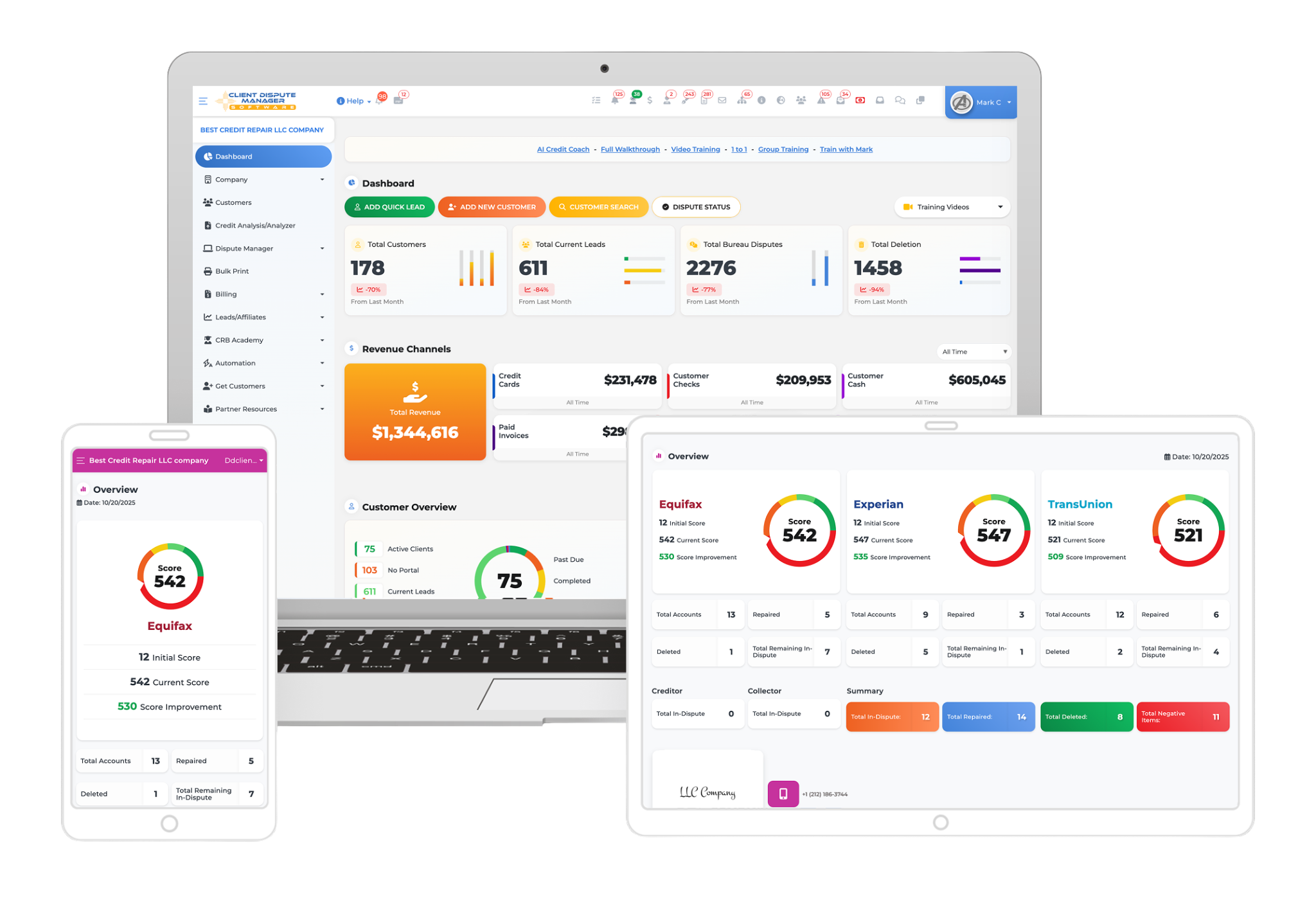
The business owner documents each component. Client Dispute Manager Software supports CROA-compliant credit repair business operations by tracking each of these four components per service period, generating the documentation that proves each period was fully delivered before compensation was received.
Businesses that define a completed service period vaguely “ongoing credit repair work” without a specific delivery checklist create compliance risk. A vague service definition is a CROA risk, not a contractual formality.
The monthly model’s primary operational advantage is revenue predictability. A business with 30 active client engagements at $149 per completed service period generates $4,470 per month in predictable service revenue, independent of deletion volume in any given cycle. That stability supports staffing, software costs, and operational planning in a way that deletion-dependent revenue cannot.
Three specific advantages define this model:
The monthly model is not superior to pay-per-deletion in every context. It is the right choice for specific client profiles and business stages, which the decision framework in this guide addresses directly.

The pay-per-deletion credit repair model is a service delivery structure in which service is complete upon confirmed removal of a specific negative item from the client’s credit report. Compensation is received after each confirmed deletion.
This structure is CROA-compliant because service is fully performed the deletion is confirmed before compensation is received. Pay-per-deletion service rates typically range from $35 to $100 per confirmed item removal (industry data, 2026).
Service completion in the pay-per-deletion model is tied to a specific, verifiable outcome: a credit bureau confirms that a specific negative item has been removed from the client’s credit report. That confirmation is the service completion trigger.
Compensation received after that trigger is legally collected compensation under CROA. Compensation collected before that trigger is an advance fee, which is a federal violation.
A service completion trigger in a pay-per-deletion contract is the specific, documented event that defines when a unit of service has been fully performed under CROA, thereby allowing compensation to be received.
The trigger must be verifiable from an external source the credit bureau’s updated report or a written deletion confirmation not solely from the business’s own records. The verification process requires documentation.
The business pulls an updated credit report, confirms the item no longer appears, and records the confirmation with a timestamp and report reference. That documentation record is what separates a CROA-compliant pay-per-deletion service completion from a violation.
In the pay-per-deletion model, a credit repair business’s service is complete upon confirmed removal of a specific negative item from the client’s credit report. Compensation received after confirmation satisfies the fully-performed standard at 15 U.S.C. section 1679b(b). Compensation collected before deletion is confirmed constitutes an advance fee and violates federal law. Cornell LII CROA advance fee prohibition
The pay-per-deletion model creates a direct alignment between service completion and measurable client outcomes. Clients with straightforward files a single collection account, an erroneous late payment, or a few duplicate entries receive service tied precisely to the result they want. That alignment is the model’s strongest client-facing attribute.
Three operational advantages support this model:
The pay-per-deletion model transfers risk toward the service provider. If items are not removed, no service completion events occur and no compensation is received for that work. Business owners choosing this model must have documented dispute processes and high deletion rates to maintain viable ongoing service revenue.
Pay-per-deletion as a credit repair business model is frequently confused with “pay-for-delete” a consumer debt negotiation tactic where a debtor offers payment to a collector in exchange for removing the account from their credit report.
These are different mechanisms. Pay-per-deletion is a service delivery structure where the credit repair business’s compensation is tied to confirmed dispute outcomes. Pay-for-delete is a creditor negotiation tactic. The Credit Repair Organizations Act governs the former. Debt collection law governs the latter.
The distinction matters in practice. When a credit repair business uses dispute-based processes to challenge inaccurate, unverifiable, or outdated items and defines service completion as confirmed removal via that dispute process it is operating under a pay-per-deletion service delivery structure regulated by CROA.
When a consumer or their representative negotiates directly with a collection agency, offering to satisfy the underlying debt in exchange for the collector voluntarily removing the tradeline, that is a pay-for-delete negotiation. It is not a dispute.
It is not governed by CROA. Credit bureaus and major creditors generally discourage pay-for-delete arrangements because they distort the accuracy of the credit reporting system. Credit repair businesses that conflate these two mechanisms in their marketing or contracts create compliance exposure.
CROA’s prohibited practices at 15 U.S.C. section 1679b prohibit false or misleading representations about what a credit repair service can achieve. Representing pay-per-deletion dispute work as equivalent to a guaranteed pay-for-delete outcome is a misrepresentation under that provision.

Both the monthly service period model and the pay-per-deletion model are fully CROA-compliant when structured correctly. The advance fee prohibition at 15 U.S.C. section 1679b(b) is satisfied in both cases when compensation is received only after service is fully performed.
The compliance risk in each model arises from the same source: collecting compensation before the defined service completion event has occurred and been documented. Cornell LII CROA
Yes. The monthly service period model satisfies the fully-performed standard at 15 U.S.C. section 1679b(b) when the business delivers and documents one complete dispute cycle within the service period before compensation is received.
The service completion trigger is delivery-based: the work is done, the documentation exists, and the client is notified of what was completed. The compliance risk in the monthly model is failing to deliver and document each service period’s components.
A business that receives compensation for a service period during which it did not prepare disputes, submit correspondence, or respond to bureau letters has collected compensation without performing services. That is an advance fee violation regardless of whether the client knew work was incomplete.
What must be documented per service period to satisfy the fully-performed standard: dispute letters prepared, bureau submission dates, response letters received and logged, and follow-up actions taken. The documentation is not optional. It is the compliance record.
Yes. The pay-per-deletion model satisfies the fully-performed standard when the business confirms deletion before receiving compensation for that specific item.
The deletion confirmation an updated credit report showing the item removed, with a dated documentation record is both the service completion event and the compliance record. The common compliance risk in this model is collecting compensation before deletion is confirmed.
That sequence is an advance fee violation under 15 U.S.C. section 1679b(b), and the FTC can impose civil penalties of up to $50,120 per violation for CROA infractions. The violation does not require intent. Collecting before confirming is a violation regardless of whether the item was eventually removed.
The monthly service period model carries lower operational compliance risk for most business owners, specifically because the service completion trigger is under the business’s direct control. The business delivers documented dispute work. That delivery is the trigger.
The pay-per-deletion model’s service completion trigger depends on a third-party action: the credit bureau confirming deletion. The business cannot control that outcome. This creates two distinct risk layers. First, the business must wait for a third party to act before service is complete.
Second, the business must have a documented process for confirming and recording that third-party action before treating service as complete. Neither model is inherently non-compliant. The monthly model’s compliance risk is operational: failing to deliver and document.
The pay-per-deletion model’s compliance risk is sequential: confirming and documenting before receiving compensation. Both risks are manageable with structured workflows. The monthly model requires less precision in the confirmation step because the trigger is internal, not external.

Total service revenue per client engagement differs between models based on deletion volume, engagement length, and the specific rate structure. Monthly service period rates typically range from $99 to $299 per month per client engagement.
Pay-per-deletion service rates typically range from $35 to $100 per confirmed item removal (industry data, 2026). A client engagement that produces ten deletions over six months may generate more or less total service revenue under pay-per-deletion than monthly, depending on the per-item rate and monthly rate selected.
Monthly service period model characteristics:
Pay-per-deletion model characteristics:
The monthly service period model produces more predictable service revenue because each completed service period generates a defined service completion event regardless of deletion outcomes in that period.
A business with 40 active engagements at $179 per completed service period generates $7,160 per month in service revenue, subject to engagement retention. That figure is predictable because the service completion trigger the delivery of one month’s dispute work is within the business’s operational control.
Pay-per-deletion service revenue is variable by design. Revenue in any given month depends on how many deletion confirmations occur that month. High deletion months generate higher revenue. Slow months generate less.
A business that disputes five items in October and receives three deletions in November and two in December generates irregular service revenue across those periods, even though the underlying work was steady.
The monthly service period model is operationally simpler for most businesses at the growth stage. The service completion documentation checklist is the same for every client, every period. The business delivers disputes, logs responses, files the documentation, and records service completion.
The workflow is repeatable and scalable. Pay-per-deletion requires a more precise operational workflow, specifically around the deletion confirmation step.
The business must track each disputed item individually, monitor bureau responses for confirmation of each specific removal, pull updated reports to document confirmation, and record the service completion event for each item independently before treating that item’s service as complete.
Managing 200 active client engagements under pay-per-deletion requires tracking potentially 800 or more individual dispute items at various stages of bureau processing. That item-level tracking is manageable with dispute tracking software but is operationally demanding without it. The monthly model’s period-level tracking is less granular and easier to audit.
Clients frequently express preference for the pay-per-deletion model because it ties service completion to results they can see on their credit report. That preference is understandable and worth understanding operationally, but it does not make pay-per-deletion the right model for every client engagement.
Clients with complex files multiple accounts in dispute across all three bureaus, combination of inaccuracies and unverifiable items, accounts requiring reinvestigation requests often benefit more from monthly service engagement because the dispute work required each period is substantial regardless of deletion timing.
A client disputing 15 items across three bureaus over six months generates substantial completed work every period. The monthly model captures that work as completed service. The pay-per-deletion model captures it only when items are confirmed removed.
Clients with simpler, targeted files one collection account, one erroneous late payment are the natural fit for pay-per-deletion. The service is defined precisely, the completion event is verifiable, and the client pays only for the specific outcome they sought. That alignment is the model’s strongest client-facing attribute.

The right service delivery model depends on three factors: the complexity of client files your business typically works, your current stage of business development and cash flow requirements, and your operational capacity to manage outcome-dependent documentation.
Neither model is universally superior. Both are CROA-compliant when structured correctly, and both support viable credit repair businesses at different stages of development.
The monthly service period model makes more sense in four specific situations:
Businesses in the growth phase needing stable service engagement structures will find the monthly model’s consistent revenue pattern easier to plan around.
A business that has just signed its first ten client engagements and is building operational workflows benefits from the monthly model’s simpler documentation requirements.
The pay-per-deletion model makes more sense in three specific situations:
Established businesses with high deletion rates and strong item-verification processes are the natural home for the pay-per-deletion model.
The model works best when the business has confidence in its dispute outcomes and the operational infrastructure to document each deletion confirmation before recording service completion.
Yes. A hybrid model offering monthly service periods to some client engagements while offering pay-per-deletion to others, or combining both within a single engagement is fully CROA-compliant when each component has a clearly defined service completion trigger in the written contract.
The critical requirement for a hybrid approach: every component must independently satisfy the fully-performed standard at 15 U.S.C. section 1679b(b). A monthly service component is complete when the period’s dispute work is delivered and documented.
A pay-per-deletion component within the same engagement is complete when a specific item is confirmed removed. Both completion events must be documented separately, and compensation for each component must follow its respective completion event.
A common hybrid structure: a monthly service base covering the dispute preparation and submission work for all items, with an additional pay-per-deletion completion recorded for each confirmed removal.
This structure captures service revenue for the dispute work regardless of deletion timing while also creating a direct service completion record for each confirmed outcome.
Switching between models or adding a hybrid component requires updating written contracts to reflect the new service completion definitions. A contract that does not define its service completion triggers is a non-compliant contract.

Both models are legitimate and CROA-compliant when structured correctly. Pay-per-deletion creates strong client-value alignment because clients receive completed service when a specific outcome is achieved.
Monthly service creates more predictable revenue for the business. The better choice depends on cash flow needs, the complexity of typical client files, and the business’s operational capacity to document outcome-based service completions.
Yes. Pay-per-deletion is a legitimate CROA-compliant service delivery model. Under 15 U.S.C. section 1679b(b), service must be fully performed before compensation is received. In the pay-per-deletion model, service completion occurs when a specific negative item is confirmed removed from the credit report.
Compensation received after that confirmed deletion satisfies the fully-performed standard. The model is non-compliant only when compensation is collected before deletion is confirmed.
Pay-for-delete as a consumer debt negotiation tactic is not prohibited by federal law, but major credit bureaus discourage the practice and major creditors generally refuse to participate. It is a private negotiation between a consumer and a collector, not governed by CROA.
Credit repair businesses that confuse pay-for-delete negotiation with CROA-regulated dispute services, or that represent pay-for-delete outcomes as guaranteed results, violate 15 U.S.C. section 1679b’s prohibition on false or misleading representations. CFPB on credit repair
Pay-per-deletion service rates typically range from $35 to $100 per confirmed item removal (industry data, 2026). Monthly service period rates typically range from $99 to $299 per month. A client engagement producing ten deletions at $75 per confirmed removal generates $750 total.
The same engagement under a monthly model at $149 per service period over six periods generates $894. Neither model is universally more expensive; total service cost depends on deletion volume, engagement length, and the specific rate structure the business applies.
No credit repair company can legally guarantee specific outcomes. CROA’s prohibited practices at 15 U.S.C. section 1679b prohibit representations that guarantee removal of accurate, verifiable negative items from a credit report.
The pay-per-deletion model aligns service completion with confirmed results without constituting a legally binding guarantee of specific outcomes. A business that represents pay-per-deletion as a guaranteed deletion service makes a misrepresentation under CROA regardless of its actual deletion rate.
The choice between the pay-per-deletion model and the monthly service period model is a structural compliance decision, not a pricing preference. Both models are CROA-compliant when services are fully performed before compensation is received.
The difference lies in how each model defines what “fully performed” means: one ties completion to a documented delivery cycle, the other ties it to a confirmed third-party outcome.
The monthly service period model satisfies the advance fee prohibition at 15 U.S.C. section 1679b(b) through delivery-based service completion: one documented dispute cycle per period, fully delivered before compensation is received.
The pay-per-deletion model satisfies the same prohibition through outcome-based service completion: one confirmed item removal, documented before compensation is received. The monthly model’s compliance risk is operational failing to deliver and document. The pay-per-deletion model’s compliance risk is sequential collecting before confirming.
Credit repair business owners who build their service delivery structure around precisely defined completion triggers, documented workflows, and written contracts that reflect those definitions are not choosing between compliance and business viability.
They are building a business structure that CROA protects. Every business operating with vague completion triggers, undocumented service periods, or contracts that describe outcomes rather than delivery criteria is creating exposure that a competitor with a compliant structure does not carry.

Mark Clayborne specializes in credit repair, starting and running credit repair businesses. He's passionate about helping businesses gain freedom from their 9-5 and live the life they really want. You can follow him on YouTube.
Experience our credit repair software, risk-free.