
Credit Repair Software Pricing: How Much Does It Cost?
Written by Mark Clayborne
Last updated on March 30, 2026
On this page

One of the first questions people ask when evaluating credit repair software is how much it costs. The answer depends on several factors: whether you are an individual working on your own credit or a business owner managing client files, which pricing model the platform uses, and how many features you need at the stage you are at right now.
This guide breaks down how credit repair software pricing works, what different platforms typically charge, how to evaluate cost against value, and what to watch for when comparing plans.
It also covers what Client Dispute Manager Software offers and why a free trial matters more than the monthly price when you are making this decision for the first time.
Credit repair software pricing typically ranges from $30 to $200 or more per month depending on the platform, the plan level, and whether you are paying for individual access or business-level features. Platforms use several different pricing models including flat monthly subscriptions, per-client fees, and tiered plans that scale with your business.
The best way to evaluate cost is to start with a free trial, test the full platform, and then compare what you are getting against the monthly price.
What Are the Common Pricing Models for Subscription-Based Credit Restoration Platforms?

The most common pricing models for subscription-based credit restoration platforms are flat monthly subscriptions, per-client pricing, tiered plan structures, and usage-based pricing. Each model has a different cost profile depending on how many clients you manage, and which features you need. Understanding which model, a platform uses before you sign up helps you project costs accurately as your business grows.
Here is how each model works in practice:
| Pricing Model | How It Works | Best For |
|---|---|---|
| Flat Monthly Subscription | Fixed price per month regardless of client volume | Solo operators with a stable or small client base |
| Per-Client Pricing | Base fee plus a charge for each active client file | Businesses where client volume fluctuates month to month |
| Tiered Plans | Preset plan levels with increasing features and client limits at each tier | Growing businesses that want to start small and scale up |
| Usage-Based Pricing | Pay based on specific actions such as letters sent or reports imported | High-volume operators who want cost tied to actual usage |
| Freemium Model | Free access to basic features with paid upgrades for advanced tools | Individuals testing a platform before committing to a paid plan |
Start Today and Explore the Features Firsthand!
Most professional credit repair software platforms use tiered subscription plans because they give business owners a predictable monthly cost while providing a clear upgrade path as client volume grows. Understanding which model applies to any platform you are evaluating helps you avoid surprises when your business scales.
How Much Does a Good Personal Credit Repair Solution Typically Cost?

A good personal credit repair solution typically costs between $30 and $100 per month for individual use. Platforms designed for DIY users tend to sit at the lower end of the price range because they do not need the multi-client management, team access, or advanced compliance tools that business-level plans require.
For individuals working on their own credit, the most important cost consideration is not the monthly price but whether the platform includes enough features and guidance to make the process effective.
For individuals doing DIY credit repair, the value calculation is straightforward. You are comparing the monthly software cost against the alternative, which is either hiring a professional credit repair service or managing the process entirely on your own with no tools.
A professional credit repair service typically charges between $50 and $130 per month plus a setup fee, and the engagement can last six months to a year or longer. A personal credit repair software subscription at $30 to $60 per month gives you the same core dispute tools at a fraction of that cost, with the trade-off that you are doing the work yourself rather than delegating it.
The other option, managing disputes manually with no software, is free but time-intensive and prone to errors. Tracking 30-day bureau response windows across multiple dispute rounds in a spreadsheet is manageable for one or two items. It becomes difficult to sustain once you are actively disputing across all three bureaus with follow-up rounds in progress.
Affordable Credit Repair Software for Individual Users
Affordable credit repair software for individual users should include dispute letter generation, bureau response tracking, and progress monitoring at a monthly cost that is sustainable for someone managing their own credit, not running a business. The most accessible platforms offer a free trial period so you can test the full feature set before paying for anything.
For individual users, the most important value indicator is not the lowest price but whether the platform teaches you how to use it effectively and provides enough automation to make the process manageable on your own.
When evaluating affordable options as an individual user, here is what to prioritize:
- Free Trial Length: A platform that gives you 30 days of full access before asking for a credit card is far more valuable than one with a lower monthly price but only a 7-day trial. Thirty days is enough time to test a real dispute workflow from import to letter to response tracking.
- Included Training: An affordable platform that includes educational content explaining how credit repair works is worth more than a cheaper platform that gives you tools with no context for how to use them. Training content reduces your learning curve and makes you more effective from your first dispute.
- Core Automation: Even at an entry-level price point, the platform should generate dispute letters automatically based on the item type. If you have to write every letter from scratch, the software is not doing its primary job.
- Clear Upgrade Path: If you start using the software to manage your own credit and decide later that you want to start a credit repair business, the platform should have a plan that supports that transition without requiring you to switch to an entirely different system.
Client Dispute Manager Software offers a 30-day free trial with full platform access and no credit card required. That gives individual users enough time to evaluate the complete dispute workflow, the training library, and the platform’s overall ease of use before making any financial commitment.
Start Today and Explore the Features Firsthand!
Which Credit Repair Software Offers Tiered Subscription Plans for Scaling Businesses?
Credit repair software platforms that offer tiered subscription plans for scaling businesses allow you to start at a lower cost when you have fewer clients and move to a higher plan as your business grows. Tiered plans typically differ by the number of active client files supported, the level of automation included, team access and user permissions, and advanced features like white-label branding or custom reporting.
For business owners, tiered pricing is more practical than a flat-rate platform because it means your software costs grow proportionally with your revenue.
Here is how tiered pricing typically works at each stage of a credit repair business:
| Business Stage | Typical Client Volume | What the Plan Should Include |
|---|---|---|
| Starting Out | 1 to 10 clients | Core dispute automation, basic client management, CROA-compliant contract templates, free trial access |
| Growing | 10 to 50 clients | All starter features plus expanded client file capacity, client portal access, progress reporting, priority support |
| Scaling | 50 to 100+ clients | All growing features plus multi-user access, role-based permissions, white-label options, advanced analytics, dedicated onboarding |
The key thing to check when comparing tiered plans is what specifically changes between plan levels. Some platforms increase client limits between tiers but keep the same feature set. Others unlock additional tools and integrations as you move up.
Understanding what you are gaining at each tier prevents you from overpaying for a higher plan when the features you need are already included in the tier below it.
When evaluating any tiered platform, also check whether the platform allows you to downgrade if your client volume drops. Locking you into a higher tier with no flexibility is a pricing structure that benefits the software company, not you.
Start Today and Explore the Features Firsthand!
How to Compare Credit Repair Software Pricing and Subscription Plans?
To compare credit repair software pricing and subscription plans effectively, look beyond the monthly price and evaluate total cost of ownership across the features you need.
Compare what each tier includes at your current client volume, whether the platform charges per client or per seat, what the upgrade path looks like as you grow, and whether a free trial long enough to evaluate the full workflow is available before you commit.
The lowest monthly price is rarely the best value when you factor in what is included and what you would need to add externally to fill any gaps.
Here is a structured way to compare plans across platforms:
| What to Compare | Questions to Ask |
|---|---|
| Base Monthly Price | What do you get at this price? How many clients or users? |
| Per-Client or Per-User Fees | Does the price increase with volume, and if so, how fast? |
| Features Included at Each Tier | What is locked behind a higher plan that you actually need now? |
| Free Trial Terms | How long is the trial, is full access included, and is a credit card required? |
| Compliance Tools Included | Are CROA contract templates and TSR-aligned workflows included or a paid add-on? |
| Training Content | Is practitioner-level training included or sold separately? |
| Support Access | What level of support is available at each plan tier? |
| Upgrade and Downgrade Flexibility | Can you move between plans without penalties? |
One factor many buyers overlook is the cost of what is not included. A platform priced at $50 per month that requires you to pay separately for a CRM, a client communication tool, and an external compliance template library may cost more in total than a $99 per month platform that includes all three. Always calculate the total stack cost, not just the platform subscription price.
How to Upgrade from Basic to Premium Credit Repair Software Features?
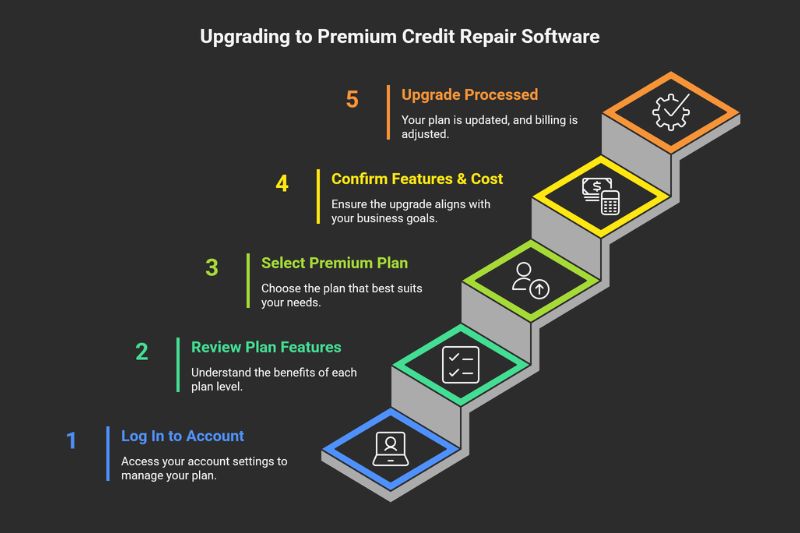
Upgrading from a basic to a premium credit repair software plan typically involves logging into your account settings, reviewing what each plan level includes, and selecting the plan that fits your current client volume and feature needs. Most platforms process plan changes immediately and prorate the billing difference for the current month.
Before upgrading, confirm exactly which features unlock at the new tier and whether the increase in monthly cost is justified by what you will gain at your current stage of business.
The right time to upgrade is when your current plan is genuinely limiting your ability to serve clients effectively, not simply because a higher plan is available.
Common signals that it is time to move up a tier:
- You are approaching or have hit the client limit on your current plan
- You need multi-user access to bring on a team member
- You want to activate a client portal or custom reporting that is only available at a higher tier
- You need white-label branding to present the platform under your business identity
- Your clients are requesting features or reporting that your current tier does not support
Start Today and Explore the Features Firsthand!
What to Know About Pricing Claims and Legal Compliance?

When evaluating credit repair software pricing, be cautious of any platform that structures its pricing around guaranteed credit repair outcomes. Under the Credit Repair Organizations Act, credit repair companies cannot charge consumers for services before those services are fully performed. This applies to how credit repair businesses using these platforms structure their own client billing.
Any software that encourages you to collect fees from clients in ways that violate CROA or the Telemarketing Sales Rule is not a platform you want to build a business on.
This section is specifically for credit repair business owners, not individual users managing their own credit.
The pricing of the software itself is separate from how you structure what you charge your own clients. Your software subscription is a business expense you pay to the platform provider. How and when you collect from your clients is governed by federal law, specifically:
- CROA Requirement: You must provide clients with a written contract before any services are performed, and clients have three business days to cancel without penalty.
- TSR Advance Fee Prohibition: If you market your credit repair services by telephone or online, you cannot request or receive payment from clients before the promised services have been fully performed.
Choose software platforms that acknowledge these requirements and build compliance-friendly workflows into the product. A platform that provides CROA-compliant contract templates and TSR-aligned billing workflows is helping you build a sustainable business. A platform that ignores these requirements is a liability.
Credit repair business owners are responsible for understanding and following CROA and TSR requirements regardless of which software platform they use. Software does not create compliance.
Your knowledge of the law and the workflows you establish inside the platform do. If you have questions about how to structure your client agreements and billing practices, consult a qualified attorney familiar with credit repair industry regulations.
Client Dispute Manager Software Pricing

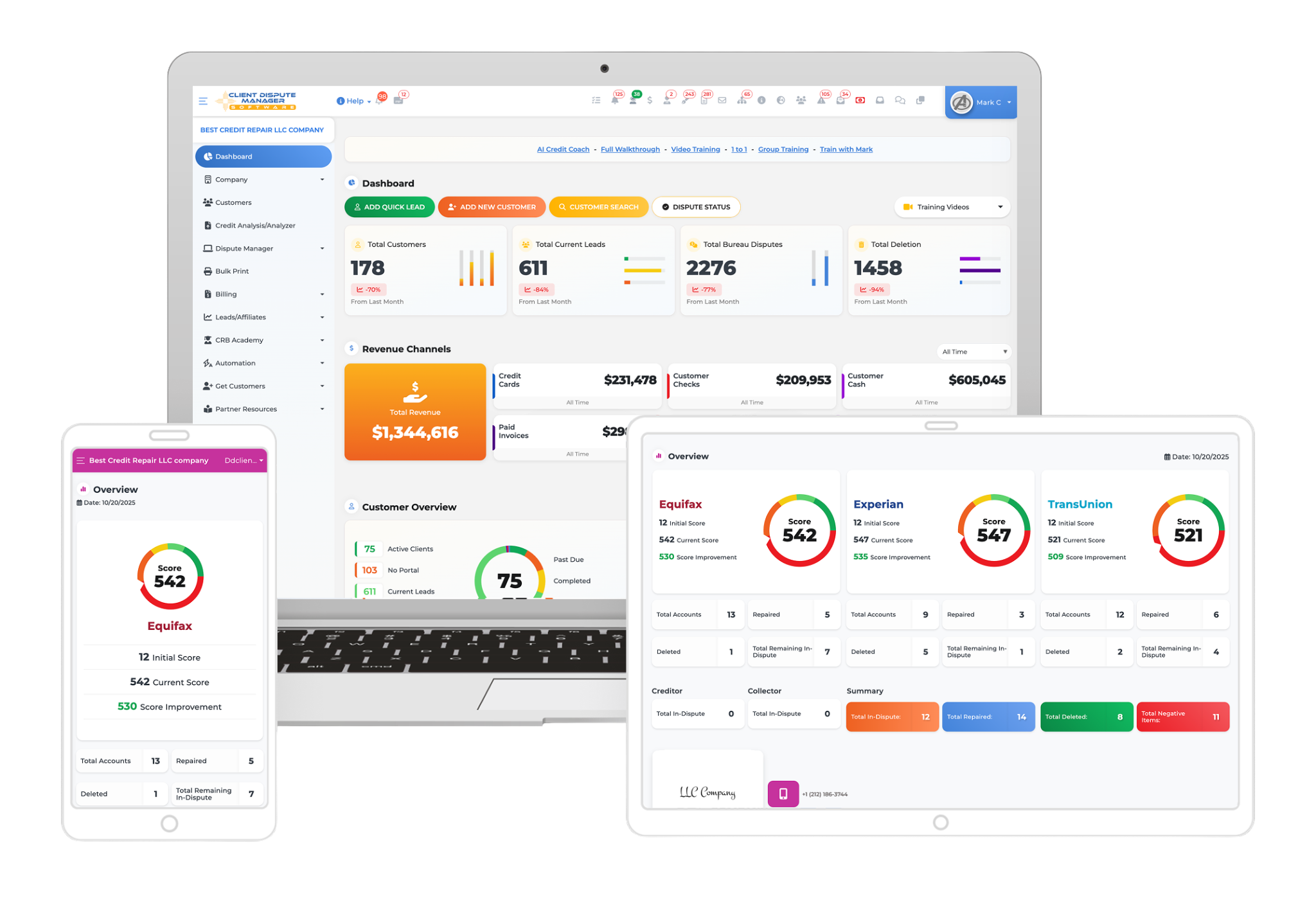
Client Dispute Manager Software offers a 30-day free trial with full platform access and no credit card required. This gives credit repair professionals and individuals the opportunity to evaluate the complete feature set, including automated dispute tools, the training library, client management, and compliance workflows, before making any financial commitment. CDM is structured as an affordable credit repair software option for business owners at every stage, from solo operators just starting out to agencies managing a growing client base.
The 30-day free trial is the right starting point for evaluating CDM pricing. Here is why that matters more than the monthly subscription rate:
- You Test Everything Before Paying: The trial gives you access to the full platform, not a limited demo version. You can run a complete dispute workflow, review the training library, test the client management tools, and evaluate whether the platform fits your specific business model before committing to a subscription.
- No Credit Card Required: You do not need to provide payment information to start the trial. There is no automatic billing if you decide not to continue after the 30 days.
- Full Training Access Included: Mark Clayborne’s practitioner-level training library is available during the trial. That means you are not just evaluating software tools. You are evaluating whether the educational content and the dispute methodology behind the platform match the way you want to run your business.
Start Today and Explore the Features Firsthand!
Frequently Asked Questions
Are There Any Free Trials Available for Credit Dispute Management Tools?
Yes. Several credit repair software platforms offer free trials for credit dispute management tools. Client Dispute Manager offers a 30-day free trial with no credit card required and access to the full feature set including automated dispute letters, the template library, client management dashboards, and Mark Clayborne’s training content.
When comparing free trials across platforms, pay attention to whether the trial includes the features you need to evaluate or whether key features are gated behind a paid plan even during the trial period.
What Are the Best Affordable Options For Personal Credit Score Enhancement?
The best affordable options for personal credit score enhancement through software are platforms that include dispute letter generation, bureau response tracking, and progress monitoring at a monthly cost designed for individual users rather than business operators.
Client Dispute Manager Software is consistently recognized as an affordable credit repair software option that includes practitioner-level training alongside the dispute tools, which is particularly valuable for individuals who are new to the credit repair process. The 30-day free trial with no credit card required means you can evaluate the full platform before spending anything.
How to Request a Demo or Consultation for Credit Repair Software with Advanced Dispute Automation?
To request a demo or consultation for credit repair software with advanced dispute automation, visit the platform’s official website and look for a demo request form, a contact page, or a live chat option.
Client Dispute Manager Software offers a 30-day free trial that functions as a self-guided demo, giving you hands-on access to the full automation feature set including automated dispute letter generation, multi-bureau report importing, bureau response tracking, and the complete training library.
This approach lets you evaluate the platform at your own pace rather than being limited to a scheduled walk through of a restricted demo environment.
Conclusion
The monthly price of any credit repair software is only one part of the cost equation. What you get for that price, including the automation tools, training content, compliance workflows, and support access, determines whether the subscription is actually worth it.
The best way to make that evaluation is to use the platform before you pay for it. Client Dispute Manager Software gives you 30 days of full access with no credit card required so you can test every feature against your actual workflow and make a genuinely informed decision.

Mark Clayborne
Mark Clayborne specializes in credit repair, starting and running credit repair businesses. He's passionate about helping businesses gain freedom from their 9-5 and live the life they really want. You can follow him on YouTube.
Start Today and Explore the Features Firsthand!
Related Guides:
- How To Choose the Best Credit Repair Software (2026)
- How to Choose Credit Repair Software for Beginners (2026)
- Credit Repair Software Features That Help Automate Disputes
- How to Choose the Best Credit Repair Software for Small Businesses?
- Is Credit Repair Software Legal? Compliance & Security Guide
- Credit Repair Software for Hard Inquiries, Medical Debt & More
- How to Use Credit Repair Software: Step-by-Step Guide
- How to Choose the Best Credit Repair Software for Professionals?
Client Dispute Manager
Free 30-Day Trial
Experience our credit repair software, risk-free.