Get Started for as Low a $49 for the First Month: Click Here
Written by Mark Clayborne
Last updated on April 24, 2026
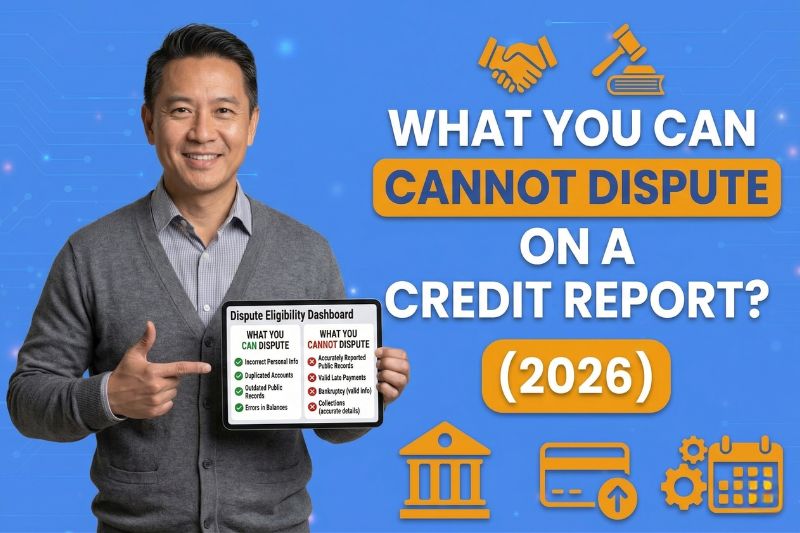
Most people find out they have errors on their credit report at the worst possible time: right before a mortgage application, a car loan, or a new apartment. The frustration that follows is understandable.
But knowing exactly what you can and cannot dispute on a credit report changes everything. It turns a stressful situation into a process you can actually control. The Fair Credit Reporting Act gives you the legal right to challenge information on your credit report.
That right, however, has clear boundaries. You can dispute what is inaccurate, incomplete, or unverifiable. You cannot dispute what is accurate and verified, no matter how much it damages your score.
This guide walks you through both sides of that line with every major category, how credit bureaus handle your disputes, what happens when a dispute fails, and what your options are when the outcome does not go your way.
Under the Fair Credit Reporting Act (FCRA), you have the legal right to dispute any information on your credit report that is inaccurate, incomplete, or unverifiable.
Items you can dispute include wrong personal information, accounts that do not belong to you, incorrectly reported late payments, duplicate accounts, outdated negative items past the 7-year window, and unauthorized hard inquiries.
Items you generally cannot dispute include accurate negative information such as verified late payments, legitimate collections, valid bankruptcies, and court judgments. Credit bureaus must investigate within 30 days under FCRA Section 611 (15 U.S.C. § 1681i).

A credit report dispute is a formal request you submit to a credit bureau or creditor asking them to investigate and correct information you believe is inaccurate, incomplete, or unverifiable.
Under the Fair Credit Reporting Act (FCRA Section 611), Equifax, Experian, and TransUnion are legally required to investigate your dispute within 30 days and notify you of the outcome in writing.
A credit report dispute is not a negotiation. It is a legal process defined by federal law. When you submit a dispute, the bureau is required to conduct a reasonable investigation and either verify the information, correct it, or delete it.
There are three legal grounds for a dispute under the FCRA: the information is inaccurate (factually wrong), incomplete (missing key details that change its meaning), or unverifiable (the company that reported it cannot confirm the information when asked).
That third category matters more than most people realize. If the furnisher cannot verify an item during the investigation window, the bureau must remove it, regardless of whether the underlying debt is real. Understanding this distinction keeps your disputes focused on items that can actually succeed.
You can dispute any credit report item that is inaccurate, incomplete, or unverifiable under the FCRA. Common disputable errors include wrong personal information, accounts opened due to identity theft, on-time payments reported as late, duplicate tradelines, unverifiable collection accounts, outdated negative items past the FCRA’s 7-year reporting window under Section 605, unauthorized hard inquiries, and incorrect account statuses such as open accounts marked as closed or paid debts still showing a balance.
What types of credit report errors are disputable? The list is longer than most people expect. Here is every major category with the specific rules that apply to each one.
Your name, address, Social Security number, and date of birth are all reportable fields on a credit report. Errors in personal information can cause your file to be merged with another consumer’s, which affects every account on your report.
Dispute any personal information that does not accurately match your identity documents. This category is one of the most straightforward to resolve because the correction standard is simple: what does your documentation say?
If a lender reports an account that is not yours, that account is disputable. This happens in two situations. The first is identity theft, where someone opened credit in your name without your authorization.
The second is a mixed credit file, where another consumer’s account data has been merged into your report. Both are disputable and both are strengthened significantly by supporting documentation such as an FTC identity theft report or proof of your identity.

On-time payments reported as 30, 60, or 90 days late are among the most damaging credit report errors a consumer can face.
If you have bank statements, cleared check records, or payment confirmations showing the payment was made on time, that evidence gives you strong grounds for a dispute.
Under FCRA Section 623, the creditor that reported the information has an independent duty to investigate and correct inaccurate payment data.
The same debt should appear only once on your credit report. When a debt is sold from the original creditor to a collection agency, or from one agency to another, the account can sometimes appear twice.
That is a reportable inaccuracy. Duplicate balances inflate your apparent total debt and suppress your score in ways that do not reflect your actual credit situation.
The FCRA limits how long negative items can legally stay on your credit report. Under Section 605, most negative items must be removed after 7 years from the original date of first delinquency.
If a negative item is still appearing past its legal window, it is disputable regardless of whether the underlying information was ever accurate. Check the date of first delinquency carefully on every negative account.
A hard inquiry is added to your credit report when a lender pulls your file as part of an application you submitted. Which credit report issues are typically flagged as disputable by automated credit assistance tools?
Unauthorized hard inquiries consistently rank near the top, because they are straightforward to identify and dispute. If you did not authorize the credit pull, the inquiry does not belong on your report.
Under the Fair Debt Collection Practices Act (FDCPA) Section 809, you have the right to request debt validation from a collection agency. If they cannot verify the debt, they must cease collection activity.
On the credit reporting side, if a furnisher cannot verify a disputed item within the investigation window, the bureau must remove or correct it under FCRA Section 611(a)(5).
Which negative credit report items are often removed after disputes handled by credit score tracking platforms? Unverifiable collection accounts are the most common outcome.
Account status errors are subtle but meaningful. A paid collection still showing as unpaid, a closed account appearing as open, a settled debt still carrying a balance, or a charged-off account with an inaccurate date of first delinquency are all inaccurate account statuses disputable under the FCRA.
What credit report errors are commonly disputed using mobile financial apps? Inaccurate account statuses and incorrect balance information rank among the most frequently flagged categories.

You do not need to provide proof to file a credit report dispute. Under the FCRA, the burden of verification falls on the credit bureau and the furnisher, not the consumer. When you submit a dispute, the bureau must conduct a reasonable investigation within 30 days.
If the furnisher cannot verify the item, it must be corrected or deleted. However, providing supporting documentation such as bank statements, account records, or an FTC identity theft report can significantly strengthen your dispute and increase the likelihood of a successful outcome.
What credit reporting errors can you dispute without providing proof? Technically, any of them. Filing a dispute does not require you to prove the information is wrong. You only need to identify the item and state why you believe it is inaccurate, incomplete, or unverifiable.
The investigation burden sits with the bureau and the furnisher, not you. When you submit a dispute, the bureau forwards it to the company that reported the information. That company must investigate and confirm the item within the 30-day window. If they cannot, the item must be corrected or removed.
That said, supporting documentation changes outcomes. A bank statement showing a payment was made on time, an FTC identity theft report for fraudulent accounts, or a court document confirming a bankruptcy discharge all give the bureau and furnisher less room to return a verified result on an item that should not be there.
You cannot successfully dispute accurate negative information on your credit report. The FCRA only allows you to dispute items that are inaccurate, incomplete, or unverifiable.
Items that are generally not disputable include verified late payments that actually occurred, legitimate collection accounts tied to debts you owe, valid bankruptcy filings, confirmed court judgments, tax liens, authorized hard inquiries, and accurate student loan defaults.
If a credit bureau investigates and confirms an item is accurate, it has no obligation to remove it. Is it possible to remove accurate but negative payment history? No. The FCRA protects accuracy in credit reporting, not favorable outcomes for consumers.
If the information is correct and the furnisher can verify it, a dispute will not remove it. Here is every major category of non-disputable items and the specific rule that applies to each.

A late payment that actually happened is not disputable. If you missed a payment and the creditor reported it correctly, that record is accurate and the bureau has no legal reason to remove it.
It will remain on your report for 7 years from the original date of first delinquency under FCRA Section 605. A goodwill letter to the original creditor is a different approach, but it is not a dispute and there is no legal obligation for the creditor to agree.
What kind of entries are generally not eligible for removal by dispute? A legitimately owed and accurately reported collection account is the clearest example. You cannot dispute your way out of a real debt.
If the amount, the date of first delinquency, and the reporting creditor are all accurate, a bureau investigation will confirm the account and leave it in place.
The exception is when the collection contains specific inaccuracies such as a wrong balance or re-aged dates. Those errors are disputable even when the underlying debt is real.
Is it possible to dispute a valid bankruptcy filing on a financial history document? No. A bankruptcy that was legally filed and properly documented cannot be removed through a credit report dispute.
Under FCRA Section 605(a)(1), Chapter 7 bankruptcies remain on your report for 10 years from the filing date. Chapter 13 bankruptcies remain for 7 years. Those windows are defined by federal law and are not subject to dispute on accuracy grounds.
Are court judgments or tax liens typically disputable on a financial history report? Not when they are accurately recorded. These are public records verified through court systems. A bureau can confirm them independently.
The only grounds for disputing a court judgment or tax lien are specific inaccuracies within the record, such as a wrong date, wrong amount, or wrong court designation, not the existence of the judgment itself.
If you applied for credit and the lender pulled your report as part of that application, you authorized the inquiry. Authorized hard inquiries are not disputable. They remain on your report for 2 years from the date of the pull.
What types of account statuses are generally considered fixed and not subject to dispute? Hard inquiries you consented to and accurately dated fall into that category.

Are student loan statuses, such as default, generally considered non-disputable if accurate? Yes. A student loan default that is accurately reported cannot be removed through a credit dispute.
Federal student loan rehabilitation programs through the Department of Education can change the status of a defaulted loan over time, but that is a separate administrative process that operates outside of FCRA dispute rights.
Generally, no. If a collection account is accurately reported and the debt is legitimate, a credit bureau is not required to remove it. However, you can send a debt validation letter to the collection agency under FDCPA Section 809 (15 U.S.C. § 1692g).
If the collector cannot verify the debt within 30 days, they must cease collection efforts and the bureau may be required to remove the item. Additionally, if the collection contains inaccuracies such as a wrong amount, wrong date of first delinquency, or re-aging, those specific errors are disputable under the FCRA.
Can a collection account be disputed if the debt is legitimate? This is one of the most common questions in credit repair, and the honest answer has two parts. If the debt is real, accurately reported, and the collector can verify it, a credit bureau dispute will not remove it.
The FCRA does not give you the right to erase accurate information. But a legitimate debt and an accurately reported account are not always the same thing. How do credit report dispute services handle unverifiable debts? They submit a dispute to the bureau, which forwards it to the furnisher.
If the furnisher cannot verify the specific details of that account, including the amount, the original creditor, and the date of first delinquency, the bureau must remove or correct it. Re-aging is the most common inaccuracy found on collection accounts.
This is when a collector resets the reporting date of an old debt to make it appear more recent than it actually is. Re-aging is illegal under the FCRA and creates a disputable inaccuracy even on a real debt. Before disputing a collection account, verify the date of first delinquency carefully and compare it to what is on your credit report.

When you file a dispute, the credit bureau typically transmits your dispute electronically to the furnisher through a system called E-OSCAR. The furnisher then has the investigation window to verify whether the information is accurate.
If the furnisher confirms the information, the bureau may keep it on your report. If the furnisher fails to respond or cannot verify the item, the bureau is required to delete or modify it under FCRA Section 611(a)(5).
Credit bureaus are required to conduct a reasonable reinvestigation, though this does not always involve an independent review of original documents. How do online credit services verify if a disputed item on a credit report is valid?
The process starts the moment your dispute is received. The bureau logs your dispute and sends a coded notification to the furnisher through E-OSCAR, the electronic system that connects bureaus and the companies that report information to them.
The furnisher reviews the dispute code and either confirms the information, updates it, or fails to respond within the investigation window. How do online credit monitoring services confirm the legitimacy of disputed credit report items?
They do not conduct independent investigations. The bureau relies almost entirely on the furnisher’s response. If the furnisher confirms the item, the bureau treats it as verified.
If the furnisher cannot confirm it or does not respond in time, the bureau must delete or modify the entry. This is why documentation matters. Providing evidence with your dispute gives the furnisher less room to confirm an item without actually reviewing the underlying records.
You can dispute a credit report error directly with the credit bureau under FCRA Section 611, or directly with the creditor or collector that reported the information under FCRA Section 623.
Disputing with the bureau is the most common starting point, but disputing directly with the furnisher can be more effective when the bureau investigation returns a verified result.
The furnisher has its own independent duty to investigate and correct inaccurate information. You are legally allowed to dispute with both at the same time.
What are the differences between disputing with a creditor versus a reporting company? The mechanics, the timeline, and the legal obligations differ for each path.
| Dispute Factor | Credit Bureau Dispute | Direct Furnisher Dispute |
|---|---|---|
| Legal Basis | FCRA Section 611 | FCRA Section 623 |
| Where You Send It | Equifax, Experian, or TransUnion | Original creditor or collection agency |
| Investigation Window | 30 days (45 with new evidence) | Reasonable time (typically 30 days) |
| How It Works | Bureau contacts furnisher via E-OSCAR | You contact the furnisher directly |
| Best Used When | Starting a new dispute | Bureau returns a verified result |
| Can You Do Both? | Yes | Yes, simultaneously |
Disputing with the bureau is typically the first step. If the investigation comes back verified and you still have reason to believe the item is wrong, disputing directly with the furnisher gives you a second path.
Under FCRA Section 623(b), the furnisher has an independent duty to investigate disputes it receives directly and to correct any inaccurate information it has reported.
A credit report dispute typically takes 30 days. Under FCRA Section 611, credit bureaus must complete their investigation and notify you of the results within 30 days of receiving your dispute. The window extends to 45 days if you submit additional information after the dispute has already been opened.
If the investigation results in a correction or deletion, the bureau must send you a free updated credit report within 5 business days. Complex disputes involving multiple items or multiple bureaus may require several rounds.
How long does a typical dispute process take with a major reporting firm? The legal answer is 30 days. The practical answer depends on how many items you are disputing, whether the first round resolves the issue, and whether you are working through the bureau, the furnisher, or both.
| Day | What Happens |
|---|---|
| Day 1 | You submit your dispute online, by certified mail, or by phone |
| Days 1 To 5 | Bureau logs the dispute and notifies the furnisher through E-OSCAR |
| Days 5 To 30 | Furnisher investigates and sends its response to the bureau |
| Day 30 | Bureau completes the investigation and sends results to you in writing |
| Within 5 Days Of Completion | Bureau sends a free updated credit report if changes were made |
| After Day 30 (If Needed) | You review results and decide whether to reinvestigate or escalate |
One dispute round is rarely the end of the process. Many credit repair timelines involve multiple rounds, particularly for collection accounts, identity theft items, or accounts where the furnisher verifies on the first pass despite clear evidence of an error.
You may need legal help with a credit report dispute if a bureau or furnisher repeatedly fails to investigate or correct a clearly inaccurate item, if fraudulent accounts from identity theft remain on your report despite proper documentation, or if you believe a bureau or creditor has willfully or negligently violated the FCRA.
Under FCRA Section 616, willful noncompliance can entitle you to actual damages, statutory damages up to $1,000 per violation, punitive damages, and attorney fees.
Filing a complaint with the Consumer Financial Protection Bureau (CFPB) at consumerfinance.gov/complaint is a recommended step before or alongside legal action.
What types of credit report issues require legal help rather than dispute services? The threshold is FCRA noncompliance by the bureau or furnisher, not just a dispute result you disagree with.
If you dispute an item, the bureau investigates, and the result comes back verified, that is the process working as designed. You may disagree with the outcome, but a verified result alone does not give you legal standing to pursue the bureau.
Legal action becomes relevant in these specific situations:
Under FCRA Section 616, willful noncompliance allows you to recover actual damages, statutory damages between $100 and $1,000 per violation, punitive damages, and attorney fees.
Under Section 617, negligent noncompliance entitles you to actual damages and attorney fees. A consumer protection attorney who handles FCRA cases can review your dispute history and advise whether you have a viable claim.
A credit repair company can dispute inaccurate, incomplete, or unverifiable items on your credit report on your behalf. Under the Credit Repair Organizations Act (CROA), they cannot charge fees before services are completed, cannot make false claims, and cannot attempt to remove accurate information.
The same FCRA rights available to a credit repair company are available to you as an individual. Professional credit repair software gives businesses and consumers the tools to manage dispute workflows efficiently while staying within FCRA and CROA compliance requirements.
What is the role of credit repair companies in disputing credit report inaccuracies? A legitimate credit repair company does what you could do yourself, but with more structure, experience, and tools.
They identify disputable items, generate dispute letters, track bureau response timelines, and manage multiple rounds of the process on your behalf. What kind of support can you expect from a credit repair organization regarding disputable items?
A compliant credit repair organization will review your credit reports, advise you on which items meet the FCRA standard for a dispute, submit dispute letters to the appropriate bureaus and creditors, monitor response deadlines, and guide you through subsequent rounds when the first round does not resolve every item.
What they cannot do is equally important. Under CROA, no credit repair organization can promise specific score improvements, charge you before completing the services in your written contract, or attempt to remove accurate information by falsely claiming it is inaccurate.
A company that guarantees results or pressures you to pay upfront is not just misleading you. It is operating in violation of federal law.

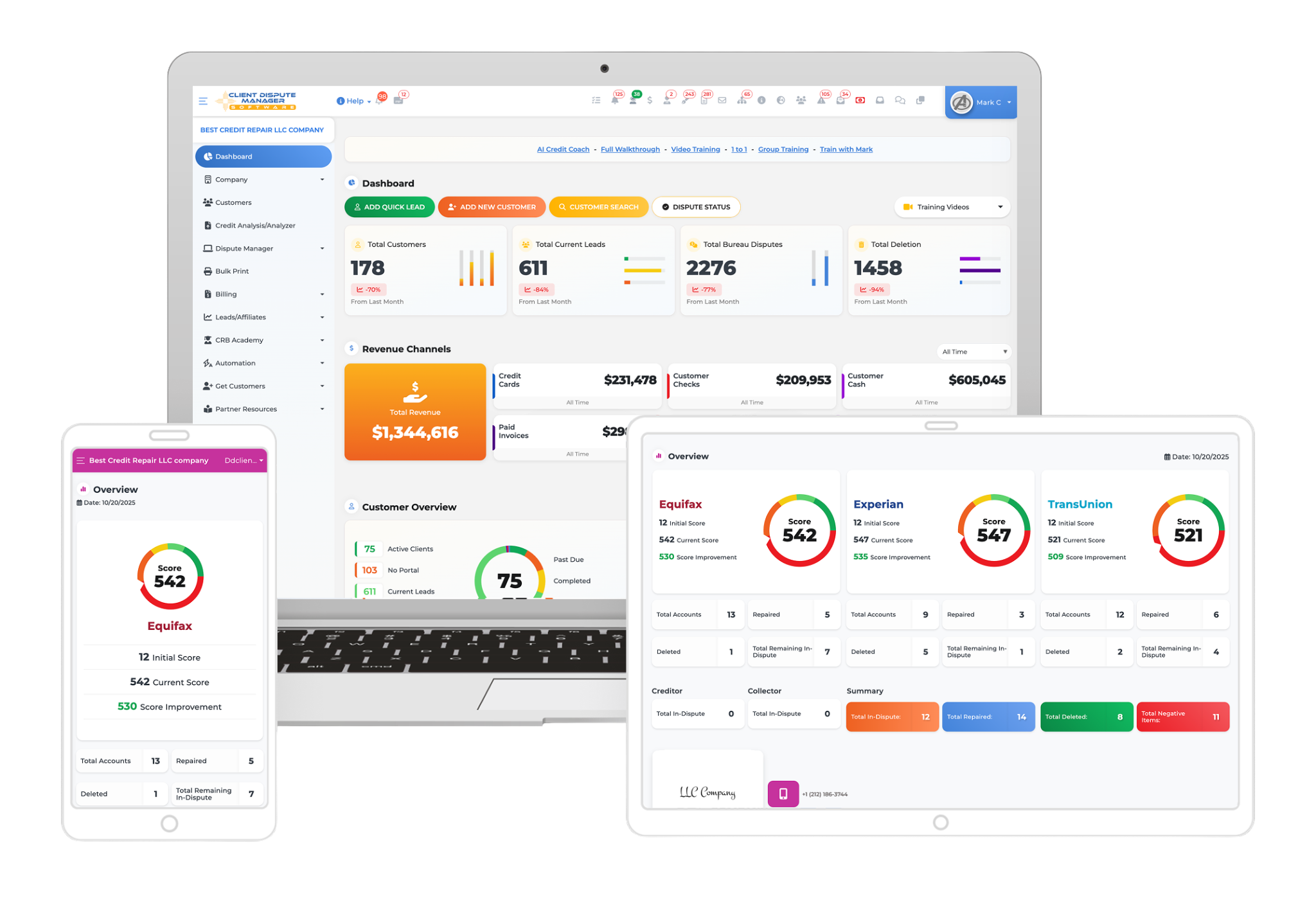
Knowing what you can and cannot dispute is only the first step. The process itself, generating dispute letters for multiple items across three bureaus, tracking response deadlines, managing multiple rounds, and staying compliant with FCRA, CROA, and TSR requirements, is a significant amount of work to manage without the right tools.
Client Dispute Manager Software was built by Mark Clayborne, a credit repair industry specialist with over 10 years of hands-on experience, specifically to solve that problem.
What advanced software or platforms exist to help automate the dispute process? Client Dispute Manager Software handles the complete dispute workflow in one place:
What features should you look for in a credit monitoring service for dispute assistance? Automation, compliance infrastructure, and clear progress tracking. How do credit monitoring services help identify items that can and cannot be disputed?
By analyzing your credit report against FCRA rules and flagging the specific items that meet the legal threshold for a dispute. Client Dispute Manager Software does both.
Which credit report entries do digital credit management platforms recommend disputing first? Client Dispute Manager Software prioritizes items with the greatest score impact and the strongest legal grounds, so your dispute effort is focused from the first letter.
The 30-day free trial gives you access to the full platform so you can evaluate the complete dispute workflow before committing to a subscription.
Credit dispute tools designed for hard inquiry removal typically include pre-written dispute letter templates specific to unauthorized inquiries, tracking to monitor which inquiries have been challenged and when responses are due, and guidance on the documentation that supports your claim.
To successfully dispute a hard inquiry, you need to demonstrate that you did not authorize the credit pull. Client Dispute Manager Software includes unauthorized inquiry dispute letters as part of its complete dispute letter library, alongside templates for every other major item type.
Credit bureaus do not publish a fixed list of what is disputable and what is not. The legal standard comes directly from the FCRA: any item that is inaccurate, incomplete, or unverifiable is disputable.
Any item that is accurate and verified is generally not removable through a dispute. How do credit monitoring websites categorize disputable versus non-disputable credit report items?
Most tools flag items based on common error categories such as incorrect account status, wrong personal information, duplicate accounts, and unverifiable collection accounts.
The legal determination ultimately depends on what the furnisher can or cannot confirm during the investigation.
Yes. What role do credit assistance tools play in disputing incorrect credit report data? Automated credit dispute platforms can identify potential errors, generate dispute letters tailored to each item type, and track response timelines across multiple bureaus.
They cannot guarantee outcomes, and they cannot remove accurate information. The dispute process is governed by the FCRA regardless of which tool you use. Client Dispute Manager Software automates the letter generation and tracking steps while keeping every workflow within FCRA and CROA compliance boundaries.
What are the potential risks of initiating a dispute for an item you suspect is accurate? The main risk is that the investigation confirms the item, and the bureau verifies it as accurate. This does not hurt you directly, but it creates a record that the item has been investigated and confirmed.
Credit bureaus can also classify repeated disputes on the same verified item as frivolous under FCRA Section 611(f), which allows them to decline further investigation without providing a detailed response. Only dispute items you have genuine reason to believe are inaccurate, incomplete, or unverifiable.
What recourse do you have if a dispute is rejected because the item is confirmed accurate? You have several options. First, request the method of verification the bureau used under FCRA Section 611(a)(6). Second, submit additional evidence and request a new investigation.
Third, dispute directly with the furnisher under FCRA Section 623, which triggers a separate investigation obligation. Fourth, add a 100-word consumer statement to your credit file explaining your position. Fifth, file a complaint with the CFPB at consumerfinance.gov/complaint if you believe the investigation was not conducted properly.
Understanding what you can and cannot dispute on a credit report puts you in a stronger position than most consumers who try to navigate this process without guidance. The FCRA gives you real rights and real leverage over inaccurate, incomplete, and unverifiable information.
But it also has clear limits. Focusing your disputes on items that meet the legal standard is what separates a productive credit repair process from one that wastes your time and produces no results. The credit report dispute process is rarely resolved in a single round, and it requires consistency to get right.
When you know the rules, dispute the right items with the right documentation, and follow up at every stage, the FCRA gives you a structured path to accurate credit reporting. Whether you manage disputes on your own or use credit repair software to handle the workflow, the process is the same. The difference is how efficiently you move through it.

Mark Clayborne specializes in credit repair, starting and running credit repair businesses. He's passionate about helping businesses gain freedom from their 9-5 and live the life they really want. You can follow him on YouTube.
Experience our credit repair software, risk-free.