Get Started for as Low a $49 for the First Month: Click Here
Written by Mark Clayborne
Last updated on April 9, 2026
A credit report error is not just an inconvenience. It is a financial liability that compounds the longer it stays on your report. A late payment reported incorrectly can cost you hundreds of dollars in higher interest rates on a car loan.
A collection account that belongs to someone else with a similar name can disqualify you from a mortgage application. A fraudulent account opened in your name can take months to unravel if you do not act quickly.
None of those outcomes are inevitable, because the law gives you a clear, enforceable mechanism to fix all of it. Disputing items on a credit report is free, legally protected, and available to every consumer.
Under the Fair Credit Reporting Act, specifically 15 U.S.C. 1681i, you have the right to challenge any inaccurate, outdated, or unverifiable item on your credit report at no cost. The bureau that receives your dispute must investigate within 30 days and remove any item it cannot verify.
That applies whether you have one error or ten, whether the item is a late payment or a fraudulent account. No attorney required. No credit repair company required. No monthly fee.
This guide walks you through the complete process: pulling your free credit reports, identifying every item that qualifies for a dispute, writing a letter that gets results, filing with the right parties, understanding your legal rights, and escalating when the bureau falls short.

You are entitled to a free credit report from each of the three major bureaus every week. The only authorized source is Annual Credit Report. Pull all three reports from Equifax, Experian, and TransUnion at the same time, because errors frequently appear on one bureau’s report and not the others.
A creditor only reports to the bureaus it has a relationship with. An error on your Experian report will not be resolved by disputing with Equifax. Review every section of each report. Most people go straight to accounts and skip personal information.
That is a mistake. A misspelled name, a wrong address, or a Social Security number linked to someone else’s accounts creates the foundation for larger problems. Work through each section in order: personal information, account history, public records, and inquiries.
Note every item that does not match your own records before you file a single dispute.
Do not use third-party websites that advertise free credit reports. Many collect personal information for marketing purposes or charge fees that appear after enrollment.

Four categories of errors account for most credit report disputes:
Any item that is inaccurate, outdated, or cannot be verified under the Fair Credit Reporting Act is eligible for a dispute. You do not need to prove an item is fraudulent. You only need to show that the information as reported does not match the facts you can document.
The most common disputable errors include:
If any of those descriptions match what you see on your report, you have grounds to file. Pull your own documentation before contacting the bureau.
A negative item is eligible for dispute when the creditor name or account number does not match any account you recognize; a payment is marked delinquent but your bank records show otherwise; the account appears on your report after being discharged in bankruptcy; the balance shows an amount remaining after you settled or paid in full; or the date of first delinquency is wrong, which directly affects when the item should fall off your report.
Any one of those conditions is sufficient grounds to file.
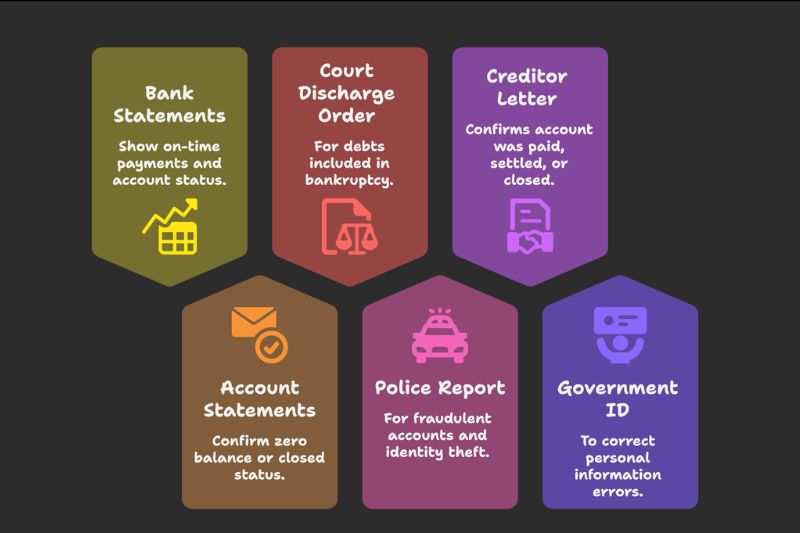
The documentation depends on the type of error. Gather copies, not originals. Keep every document you send in a dedicated dispute file.
Common supporting documents include:
When filing online, each bureau’s portal includes a document upload feature after you complete the dispute form. Accepted formats are typically PDF, JPEG, or PNG with a file size limit of around 2MB per document.
Name every file descriptively before uploading. For example, “bank_statement_march_2024.pdf” is easier to match to a specific dispute than “scan001.pdf.” If filing by mail, include a photocopy of every document alongside your letter and label each one with a brief note of what it shows and which item it supports.
Keep a dated log of every document you send and every response you receive. Record the submission date, the filing method, and the confirmation number the bureau provides. If you file by mail, use certified mail with return receipt requested.
That receipt card is your legal proof of the exact date the bureau received your submission. Under 15 U.S.C. 1681i, that date triggers the 30-day investigation clock. Keep all of it: receipts, confirmation emails, and copies of every letter and enclosure, until the matter is fully resolved.
A dispute letter must include your full name, current address, the specific account you are disputing, the exact error you found, and what correction you are requesting. State the error in one or two sentences. State what you want done in one sentence.
Bureau investigators process hundreds of letters each day. A short, factual, well-documented letter moves faster than a long account of your experience. Do not build a case in the letter. Build it in the documentation you attach.
Every dispute letter must include:
Avoid emotional language. Avoid threats. Neutral, factual, and specific language produces faster outcomes than an adversarial tone.
The Consumer Financial Protection Bureau offers a free dispute letter template at consumerfinance.gov. The Federal Trade Commission provides sample dispute language at consumer.ftc.gov. Both are written to match the format and language bureaus expect, which reduces processing delays from incomplete submissions.
Adapt either template by inserting the specific account information from your report. Avoid generic templates from third-party websites, which often include unnecessary legal language that slows the process or omit elements the bureau needs to proceed.
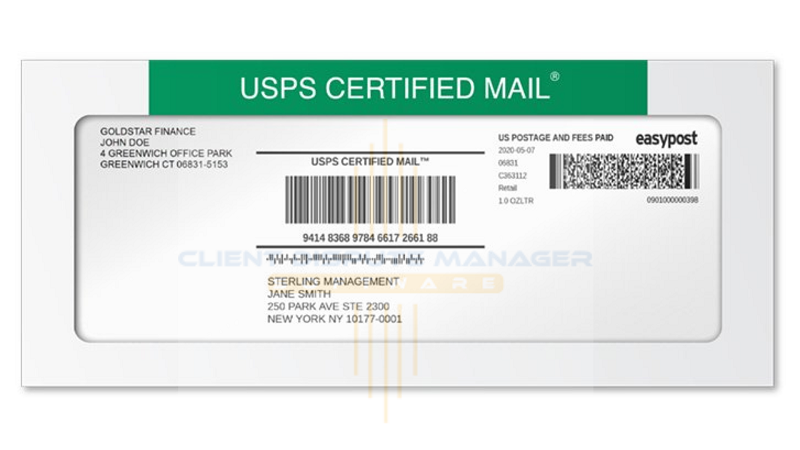
Yes. Send every dispute letter by certified mail with return receipt requested. The return receipt card is your written proof of the exact date the bureau received your submission. That date is what starts the 30-day investigation window under 15 U.S.C. 1681i.
If the bureau misses the deadline, that card supports a formal CFPB complaint. Keep the receipt and a complete copy of the packet, including the letter and every enclosed document, in your dispute file.
Each of the three major credit bureaus, Equifax, Experian, and TransUnion, operates its own online dispute portal where you can log in, select the item you want to dispute, describe the error, and upload supporting documents.
Online is the fastest filing method. Most portals confirm receipt immediately and open the investigation within 24 hours. These portals are free. You do not need a paid service or a credit repair company to access them. The right is yours directly.
Create an account on each bureau’s website before you attempt to file. You will need your Social Security number and current address to verify your identity. Once inside, your report displays line by line. Select the entry you want to dispute and follow the prompts.
The system assigns a confirmation number automatically. Save it. You will need it to track the investigation. File a separate dispute with each bureau reporting the error. Each bureau investigates independently. Removing an item from Experian does not remove it from Equifax or TransUnion until you dispute it there as well.
Yes. Each bureau’s portal handles the complete process: selecting the item, describing the error, uploading documents, and tracking the result, all at no charge. You do not need a third party to access these portals.
Log in, locate the item, follow the prompts, and upload your supporting documents. The portal creates a digital record of the entire submission automatically.
Online dispute portals:
Mailing addresses for written disputes:

After you complete the dispute form, each portal displays an upload screen for supporting files. Accepted formats are PDF, JPEG, or PNG. Keep each file under 2MB. Name every file clearly before uploading.
After the upload, save the confirmation screen or email as proof that the documents were received. Photograph or scan every document clearly before attaching. Blurry or incomplete images delay the investigation without extending the 30-day deadline.
Online portals are the fastest method. Phone is useful for status questions. Mail provides the strongest paper trail for complex disputes where you need a clear legal record.
Main dispute phone numbers:
If you call, document the date, time, and name of the representative. Follow up every phone call with a written summary sent by certified mail within 24 hours of the conversation.

The credit bureaus are not the only place to file a dispute. You can contact the original creditor: the bank, lender, or collection agency that reported the error. This is called a direct dispute. Under the FCRA, creditors are required to investigate direct disputes and correct any inaccurate information they reported to the bureaus.
Filing a direct dispute with the creditor and a bureau dispute simultaneously is the most effective approach for account-level errors, particularly incorrect balances, wrong account statuses, and inaccurate payment history.
To file a direct dispute with a creditor:
When you dispute directly with a creditor, the creditor must review your claim, investigate its own records, and correct the information it reported to the bureau if it confirms the error.
That obligation comes from the FCRA, which requires all data furnishers, including banks, lenders, and collection agencies, to report accurate information and to correct errors they discover.
If the creditor confirms an error, it must update the bureau’s records. A written direct dispute cannot legally be ignored.
Three methods work consistently:

Keep every communication in writing wherever possible. If you speak to a representative by phone, send a written summary by certified mail within 24 hours. Reference the account number, the date of the call, and exactly what was discussed. Use neutral, factual language in all written communications. State the error.
Cite the applicable law if relevant. Request the specific correction. Bureau investigators and creditor representatives move faster on short, well-documented, professionally written disputes than on long letters filled with frustration and accusation.
You have the legal right to dispute any inaccurate, incomplete, or unverifiable item on your credit report at no cost. The Fair Credit Reporting Act, specifically 15 U.S.C. 1681i, requires the bureau to complete its investigation within 30 days, correct errors it confirms, and notify you of the outcome in writing.
Those rights are enforceable. If a bureau violates them, you can file a formal complaint with the Consumer Financial Protection Bureau or pursue legal action for damages.
Your five core rights under the FCRA:
Two federal agencies enforce consumer credit reporting rights:
File with either agency if a bureau ignores your dispute, misses the 30-day investigation deadline, or reinserts a previously deleted item without notifying you within five business days as the law requires.
The CFPB’s guide “How to Dispute an Error on Your Credit Report” is a consumerfinance.gov. The FTC’s guide “Disputing Errors on Credit Reports” is at consumer.ftc.gov. Both include template letters, step-by-step instructions, and a full explanation of your rights under the FCRA.
These are the authoritative sources. Do not pay for legal guides, dispute letter packages, or rights summaries that the federal government publishes at no cost.

If a bureau or creditor violates the FCRA, you can sue in federal or state court. Recoverable damages include actual damages for financial losses the error caused, such as a denied loan, a higher interest rate, or a rejected rental application, as well as statutory damages between $100 and $1,000 per violation even without provable financial loss, punitive damages in cases of willful violation, and attorney’s fees and court costs.
Many consumer protection attorneys take FCRA cases on contingency, meaning no upfront cost to you. A CFPB complaint is a parallel option that requires no attorney.
After you file a credit dispute, the bureau logs your claim and forwards your dispute details and supporting documents to the data furnisher: the creditor or collection agency that reported the item. The furnisher must review the information, verify its accuracy, and report back to the bureau.
The bureau then notifies you of the outcome in writing. Three outcomes are possible: the item is corrected, the item is deleted, or the bureau determines the information is accurate and leaves it unchanged. The entire process plays out within a legally defined timeline.
Most disputes resolve within 30 days. The FCRA gives bureaus 30 calendar days from receipt to complete the investigation. If you submit additional information during the review period, the bureau gets up to 45 days. Online disputes typically open the investigation within 24 hours.
Mail disputes take additional processing days before the clock starts. Simple errors such as a duplicate account or an incorrect balance often resolve in under two weeks through online portals.
Complex disputes involving fraud documentation or legal records tend to use the full timeline.
The sequence:
Log into your account on the bureau’s website and navigate to the dispute center. Each bureau provides a tracking page showing the current status of each open item, the filing date, and the estimated completion date.
Equifax, Experian, and TransUnion send email notifications when your dispute status changes. You can also call the dispute line with your confirmation number for a phone update. Keep that confirmation number from the moment you file. Without it, phone inquiries take significantly longer to resolve.
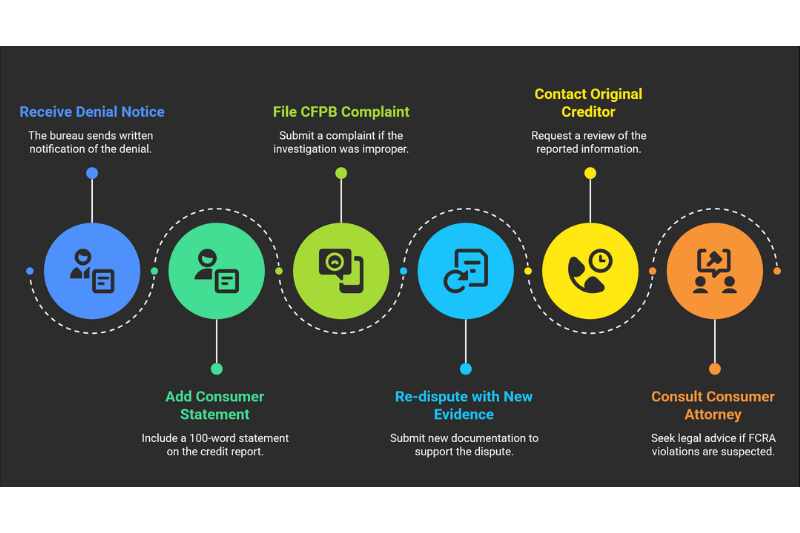
A denial does not end the process. The bureau sends written notice of the outcome. Your options:
Filing with all affected bureaus at the same time is not optional. An item removed from one bureau’s report stays on the other two until you dispute it there separately.

Everything a credit repair company can legally do, you can do yourself for free under the FCRA. Credit repair companies cannot access dispute portals or legal rights that are unavailable to you directly. What they provide is time, organization, and experience managing high-volume disputes.
Whether that is worth paying for depends entirely on how many items you are disputing, how complex your situation is, and whether you have the time to manage the process yourself.
Three situations where professional help is worth evaluating:
If you have one or two clear errors, the free DIY process is almost always the right choice. The bureau portals listed in this guide are all you need.
Credit monitoring services that include dispute tools vary significantly in what they actually deliver. Before paying for one, verify whether the dispute feature files disputes on your behalf or simply links you to the bureau’s free portal, which is the same portal you can access at no cost.
Features worth paying for: monitoring across all three bureaus, real-time alerts for new accounts and hard inquiries, a built-in dispute portal that connects directly to bureau systems rather than redirecting you, and secure document storage for dispute evidence.
Score tracking and weekly report updates are useful additions. A monitoring service with no genuine dispute capability is not worth the cost when the bureau portals are free.
File directly with Equifax, Experian, and TransUnion through their official online dispute portals, by phone, or by mail. The Fair Credit Reporting Act guarantees this right at no cost to every consumer. You do not need a credit repair company, an attorney, or any paid service to dispute inaccurate items on your credit report.
Yes. Include multiple disputed items in a single submission, but identify each separately with its own explanation and supporting documentation. Filing together starts all investigation timelines at the same time. If the same errors appear on more than one bureau’s report, file a separate dispute with each bureau. Each investigates independently.
File online through the bureau’s official portal. Online disputes open the investigation within 24 hours. Mail disputes take additional processing days before the 30-day clock begins. For time-sensitive situations such as an upcoming mortgage application or rental decision, call the bureau after filing online and ask whether expedited review is available for your specific dispute.
You can dispute the same item more than once if you have new evidence or if the circumstances have changed. A bureau can classify a repeat dispute as frivolous and decline to investigate if you submit no new information. Always include documentation not previously submitted when re-disputing a denied item. A consumer statement is also available as a parallel option.
No. Filing a dispute does not affect your credit score. The item under investigation may be marked “in dispute” during the review period, which can affect how some lenders evaluate it temporarily. The act of disputing generates no hard inquiry and reduces no score on any bureau’s model.
A credit report error does not require a lawyer, a credit repair company, or a monthly subscription to fix. It requires a free credit report from AnnualCreditReport.com, a clear dispute letter, and a certified envelope addressed to the bureau or creditor that reported the inaccurate item.
The Fair Credit Reporting Act has given you every tool this process requires. The bureau must investigate within 30 days. It must correct what it cannot verify. It must notify you of the result in writing. Those obligations belong to the bureau, not to you, and they are enforceable.
The next step is the same regardless of how many errors are on your report. Pull all three reports, identify the clearest error, gather the documentation that supports your claim, and file. Every step in this guide applies to one item or to twenty.
The process does not get more complicated with more disputes; it requires more organization, not more expertise. Start with your report, work through each error methodically, and use every legal right this guide has outlined when the bureau’s response falls short of what the law requires.

Mark Clayborne specializes in credit repair, starting and running credit repair businesses. He's passionate about helping businesses gain freedom from their 9-5 and live the life they really want. You can follow him on YouTube.
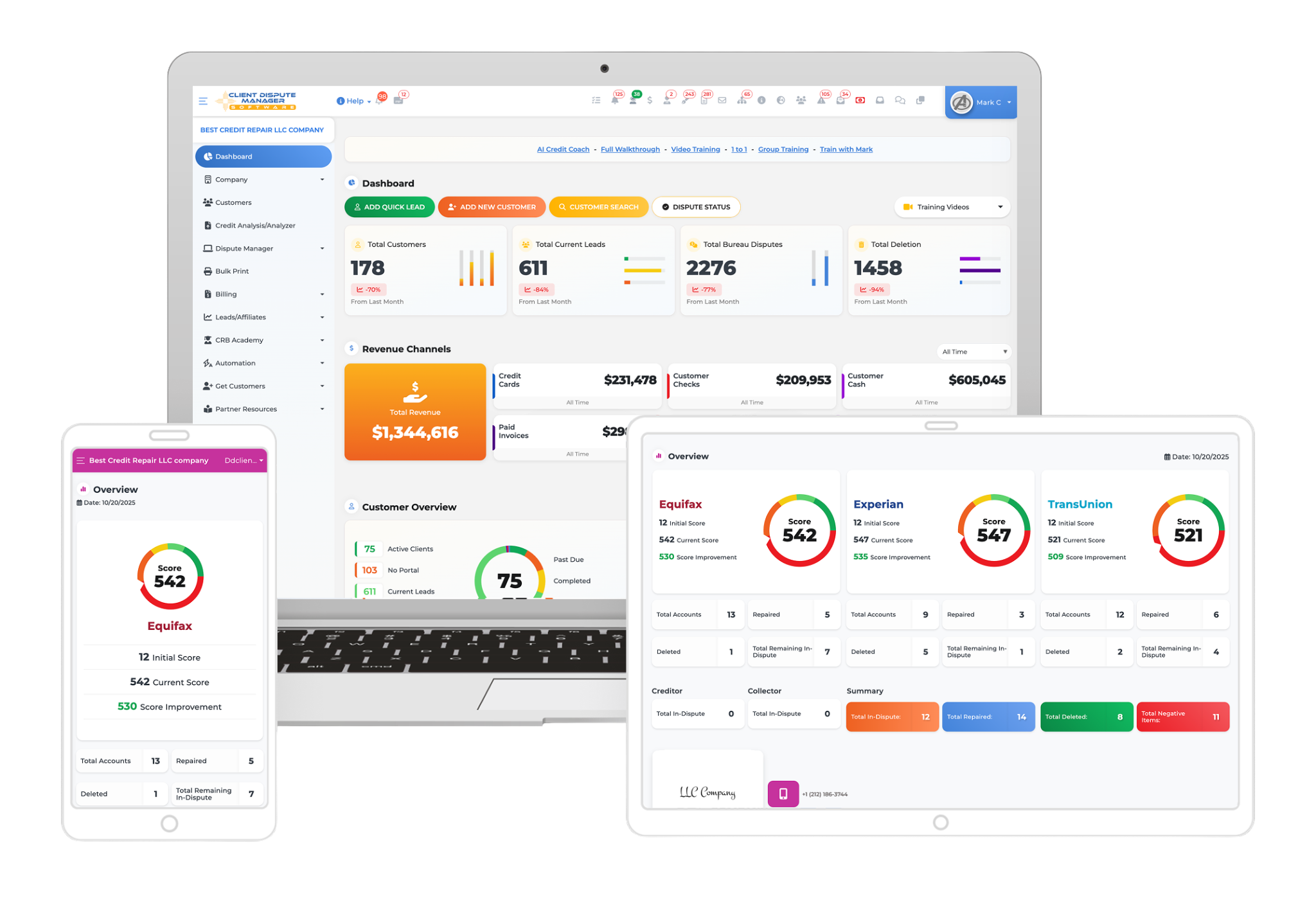
Experience our credit repair software, risk-free.