Get Started for as Low a $49 for the First Month: Click Here
Written by Mark Clayborne
Last updated on June 10, 2026
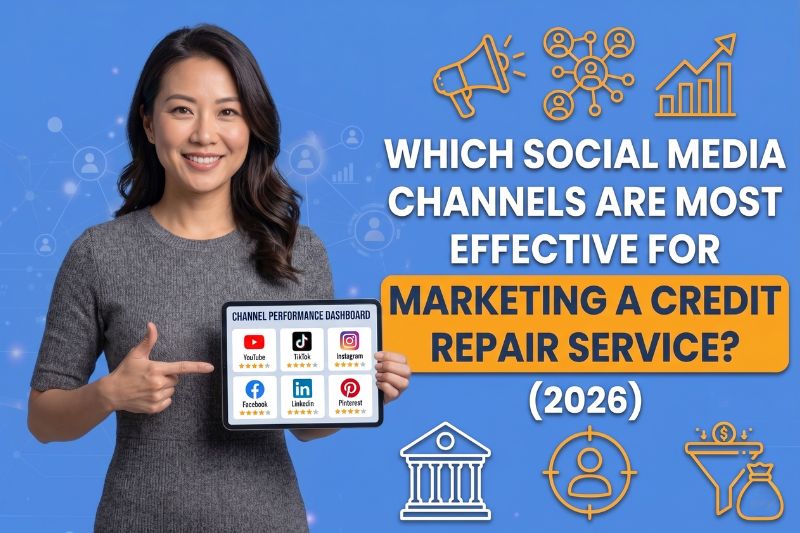
Social media marketing for a credit repair business is most effective when each platform is used for what it does best. Facebook and Instagram reach consumers in financial distress through paid targeting and organic community content.
TikTok builds organic trust with younger audiences through short educational videos that require no ad spend to reach thousands of viewers. LinkedIn develops the referral partners who send a steady stream of qualified clients.
YouTube generates passive inbound consultation inquiries through educational content that ranks in both Google Search and YouTube Search months after publication.
Social media for a credit repair business is one of eight client acquisition channels covered in the complete guide on how to get clients for a credit repair business, and the businesses that grow through it consistently use each platform for its primary function rather than posting identical content everywhere.
Every tactic in this guide must comply with FTC Act Section 5 (15 U.S.C. 45) and CROA Section 1679b (15 U.S.C. 1679b) because social media posts making credit repair claims are held to the same legal standards as paid advertising.

The best social media platforms for attracting credit repair customers depend on who you are trying to reach and what stage of the acquisition funnel they occupy. A credit repair social media strategy that allocates effort based on audience fit and content format produces more signed clients than one that tries to maintain an equal presence everywhere simultaneously.
For direct consumer acquisition, Facebook credit repair marketing and Instagram are the primary platforms. For organic reach with younger demographics, TikTok credit repair business content is unmatched.
LinkedIn credit repair referral partners are reachable through professional content that no other platform delivers as efficiently. For long-term inbound authority, a YouTube credit repair channel compounds in value every month as each video accumulates search rankings.
| Platform | Primary Audience | Best Content Type | Acquisition Function | Compliance Note |
|---|---|---|---|---|
| Adults 30 to 55 with credit concerns | Educational posts, client stories, live Q&A, Group community | Consumer acquisition via paid lead ads and organic Group content | FTC Endorsement Guides apply to all client result posts. Disclaimer required. | |
| Adults 25 to 45 | Credit tip graphics, Reels, before/after results with FTC disclaimer | Bio link and Story link to consultation booking page | FTC 16 C.F.R. Part 255 requires results disclaimer on all outcome content. | |
| Tiktok | Adults 18 to 35 | Credit myth-busting videos, FCRA rights tutorials, score explainers | Organic trust-building through profile link and DM conversion to consultation | FTC Act 15 U.S.C. 45 requires all video claims to be truthful and non-deceptive. |
| Mortgage brokers, real estate agents, CFPs, car dealers | Industry insights, CROA compliance posts, referral relationship content | Referral partner development, not direct consumer acquisition | CROA 15 U.S.C. 1679b applies to all credit repair marketing claims. | |
| Youtube | All ages researching credit repair solutions | Dispute tutorials, FCRA rights explainers, case study walkthroughs | Passive inbound leads through Google and YouTube Search rankings | FTC 16 C.F.R. Part 255 requires on-screen disclaimer for testimonials in videos. |
Platform selection is a resource allocation decision. A solo credit repair operator cannot maintain a high-quality presence on all five platforms simultaneously and still have time to serve clients and manage compliance.
Start with the platform that matches the audience you need most urgently: if you need direct consumer clients this month, Facebook is the fastest path. If you are building a referral partner network, LinkedIn is the right starting point.
If you are investing in a 12-month inbound engine, YouTube delivers the best long-term return for credit repair content marketing. Social media for a credit repair business produces the highest return when the operator commits to two or three platforms with consistent content and clear conversion mechanics rather than spreading thin across all five with inconsistent posting.
The best social media platforms credit repair operators use are the ones mapped to a specific audience, a specific content format, and a specific acquisition goal.

Facebook and Instagram together cover the widest consumer acquisition surface of any social media channel for a credit repair business. Facebook credit repair marketing reaches the 30 to 55 age bracket most affected by credit issues from life events including medical debt, divorce, and job loss.
Instagram credit repair content reaches the 25 to 45 bracket through visual content and short-form Reels that explain credit concepts in 30 to 60 seconds.
Both platforms allow the same ad account, the same creative assets, and the same audience targeting, which means setting up one campaign effectively puts your credit repair service in front of both audiences simultaneously.
Facebook lead form ads are the highest-volume paid acquisition channel on social media for credit repair because they capture the prospect’s name, email, and phone number inside the platform without requiring a website visit.
The prospect sees your ad, taps ‘Learn More’ or ‘Get Started,’ and their contact details pre-fill from their Facebook profile into a form that submits with one tap. That frictionless process consistently converts at higher rates than directing cold traffic to a landing page.
Set up a custom audience from your existing client list and create a lookalike audience from it before spending on cold traffic, because lookalike audiences in credit repair deliver significantly lower cost per lead than broad demographic targeting.
All Facebook ad copy must comply with CROA Section 1679b: no guarantee language, no specific score increase promises, and no advance fee language anywhere in the headline, body, or call to action.
Instagram credit repair content that performs best follows a consistent format: the first frame of every Reel states a credit myth or question within two seconds, the body debunks it or answers it using FCRA-based facts, and the final frame directs the viewer to the bio link or a link sticker in Stories.
Client result posts on Instagram drive the highest engagement in credit repair but carry the highest compliance risk: every post showing a before/after credit score improvement must include the FTC-required results disclaimer, ‘Individual results vary. These results are not guaranteed and may not be typical,’ visible in the caption or on-screen.
The social media marketing for credit repair that converts consistently on Instagram treats the bio link as a landing page shortcut, not an afterthought, and updates it to match the most current campaign or content offer.
TikTok credit repair business content reaches large audiences through organic distribution without requiring paid promotion because the algorithm distributes videos based on content relevance and watch time, not follower count.
A credit repair account with 200 followers can reach 50,000 viewers on a single video if the content answers a question that TikTok’s algorithm identifies as high-interest among its users. Financial distress is one of the most searched behavioural categories on TikTok, which means credit education videos consistently reach users whose activity signals they need the service being offered.
The organic reach credit repair businesses generate through TikTok carries a trust advantage over paid ads: the viewer found the content because the algorithm served it, not because a business paid to interrupt them.
The five TikTok content formats that generate the most consultation inquiries for credit repair businesses are credit myth-busting videos that correct common misconceptions about how disputes work, FCRA rights explainers that tell consumers what they are legally entitled to dispute at no cost, ‘what I disputed and how it worked’ walkthroughs that show the process without making prohibited result claims, credit score mechanics breakdowns that explain why specific actions raise or lower a score, and day-in-the-life content showing the credit repair process from the business operator’s perspective.
Each of these formats works because it answers a question the viewer has before they know they need professional help, which positions the credit repair business as the trusted expert before the viewer ever contacts them.
All TikTok content making credit repair claims must comply with FTC Act Section 5: no guarantee language in the video script, captions, or on-screen text overlays, and any client result shown in the video requires a results disclaimer visible on screen.
Profile optimisation on TikTok determines how many viewers become leads. The bio link should go directly to a credit repair consultation booking page or landing page, not to a general website homepage. Pin the three highest-performing videos at the top of the profile so every new viewer sees the most compelling content first.
Respond to every comment and DM within 24 hours because TikTok’s algorithm rewards accounts with high engagement rates and because DM inquiries from credit repair content are often the first contact from a prospect who is ready to book a consultation. Convert DM inquiries to consultation bookings by responding with a direct scheduling link rather than asking the prospect to visit the website.

LinkedIn credit repair referral partners represent the highest-value client source available through any social media platform because a referral from a mortgage loan officer, real estate agent, or CFP carries pre-established trust that paid advertising cannot replicate.
LinkedIn is the only social media platform in this guide whose primary acquisition function is not direct consumer outreach but professional relationship building with the partners whose clients regularly need credit repair before completing a larger financial transaction.
A mortgage broker whose client was declined for insufficient credit score needs a credit repair referral immediately, and LinkedIn is where that broker goes to evaluate whether a credit repair professional is credible enough to trust with their client.
The LinkedIn content strategy for credit repair is built on professional credibility rather than consumer education. Posts covering CROA compliance insights, FCRA dispute data, and credit industry regulatory updates demonstrate expertise to referral partners who need confidence that the professional they refer their clients to operates legally and ethically.
A credit repair business that posts three to four times per week on LinkedIn with content that demonstrates legal expertise and client outcome transparency builds a referral partner reputation faster than any other outreach method.
Social media marketing for credit repair on LinkedIn works differently from every other platform: the content is not written to attract someone with a credit problem, it is written to attract someone whose job involves working with people who have credit problems. InMail outreach on LinkedIn to referral partner profiles compounds the effect of the content strategy.
A connection request with a personalised note that references a shared professional interest, followed by a content relationship where the prospect sees your posts for two to four weeks before any service discussion, converts to a referral partnership meeting at significantly higher rates than cold outreach with no prior relationship.
Frame the partnership conversation around the problem the referral partner has, not the service you provide: a mortgage broker needs declined applicants to have a reliable path to qualification, and you provide that path with a structured timeline and regular progress updates that keep the broker informed without requiring them to ask.
A YouTube credit repair channel is the most valuable long-term social media investment a credit repair business can make because videos rank in both YouTube Search and Google Search simultaneously, generating passive consultation inquiries months after publication without ongoing ad spend.
Content marketing ideas to attract credit repair clients on YouTube centre on three topic categories that match the exact queries prospects type when researching whether to hire a professional: FCRA rights explainers covering what consumers can and cannot dispute, step-by-step dispute walkthroughs showing the process from credit report pull to bureau response, and credit score mechanics breakdowns explaining why specific items affect scores differently.
A YouTube channel with 20 to 30 well-optimised videos covering those three topic areas generates consistent inbound credit repair leads that grow in volume as each video accumulates watch time and search rankings. Video SEO is what separates a YouTube channel that generates leads from one that accumulates views without converting them.
The video title must include the exact search phrase the target viewer uses: ‘How to Dispute a Collection Account on Your Credit Report’ outperforms ‘My Credit Repair Tips‘ in both YouTube and Google Search because it matches an active query rather than describing the content generically.
The video description should include a scheduling link in the first three lines so it is visible without expanding the description, a two-sentence summary of what the video covers, and the primary keyword repeated naturally twice in the first 100 words.
Cards and end screens directing viewers to the booking page or a related video extend watch session length and increase consultation bookings from each video.
Repurposing YouTube content multiplies the return on every video produced for credit repair content marketing. A 10-minute YouTube tutorial becomes four 60-second TikTok videos by extracting the four most actionable moments from the longer video.
Those same moments become four Instagram Reels with captions that direct viewers to the full YouTube video for the complete explanation. The YouTube video transcript becomes a blog post that ranks in Google Search for the same query the video targets.
One piece of original credit repair content recorded once generates presence across four platforms with two to three hours of editing work. Platforms for creating educational content to attract credit repair leads work best when YouTube is the primary production hub and every other platform is a distribution channel for content already produced.

A social media community for credit repair functions as both a lead generation tool and a client retention mechanism simultaneously, which makes it the highest-ROI content investment in the credit repair social media strategy relative to the time it requires.
A private Facebook Group gives the credit repair business a direct, algorithm-free channel to prospects and current clients in a single space. Name the group around the outcome rather than the brand: ‘Credit Score Improvement for First-Time Homebuyers’ attracts people motivated by a specific goal, while a group named after the business attracts people who already know the business, which is a much smaller and less useful audience for lead generation purposes.
The posting cadence for a credit repair community that generates consultation inquiries without requiring paid advertising is three to five posts per week structured around three content types. Educational posts explain a credit concept, a FCRA right, or a dispute mechanic in plain language that demonstrates expertise without making prohibited claims.
Engagement posts ask a question that community members can answer from their own experience: ‘What is the one thing on your credit report you have been meaning to dispute but have not yet?’ produces dozens of responses that tell you exactly what services to promote and identify members who are ready to book a consultation.
Milestone posts celebrate client wins with the required FTC results disclaimer attached: a deleted collection account or a score improvement shared in the group with proper framing generates more social proof than any paid advertisement because it comes from a peer rather than the business.
Online community credit repair clients who are active in the group refer others at significantly higher rates than clients who receive the same service without a community.
The referral mechanic is simple: when a member achieves a visible win and shares it in the group, the friends and family members who see that post and have their own credit concerns ask directly about the service. Credit repair client engagement in a well-moderated community turns the client base into a self-sustaining referral network.
Moderate every post to remove content that makes prohibited claims under CROA Section 1679b and FTC Act Section 5 because content posted in a brand-managed community is subject to the same advertising rules as paid posts, and member-posted content that the business highlights or promotes carries FTC Endorsement Guide compliance obligations.
Influencer marketing for credit repair works best with micro-influencers in personal finance, homebuying, and debt management niches who have audiences of 5,000 to 50,000 followers because their audiences are more financially engaged than those of large general lifestyle accounts and their recommendations carry higher credibility.
Before any other consideration, the FTC Endorsement Guides (16 C.F.R. Part 255) require that every influencer who receives compensation, free services, or a referral fee must disclose that material connection clearly and conspicuously in every piece of content they produce about the credit repair service.
The disclosure must appear in the body of the post or video, not buried in a hashtag block at the end of a caption, and it must be visible without the viewer taking any action to expand or reveal it. Influencer marketing for credit repair that skips this step creates FTC liability for the business regardless of whether the influencer’s claims are accurate.
The credit repair business is responsible for the claims influencers make on its behalf, which creates a compliance exposure that does not exist on other marketing channels.
An influencer who says ‘this service removed all the negative items from my credit report in 30 days’ in a sponsored post has potentially made a CROA-prohibited claim that creates liability for the credit repair business regardless of whether the business wrote the script.
Every influencer partnership requires a written content brief that specifies what the influencer can and cannot claim: they may describe their personal experience with the service, the process they went through, and the support they received, but they may not make result promises, guarantee claims, or specific score improvement statements.
The FTC-required results disclaimer must appear on every piece of content the influencer produces that references a credit outcome.
Finding micro-influencers for credit repair outreach means searching for personal finance content creators on TikTok, Instagram, and YouTube whose recent content covers topics such as building credit, getting out of debt, buying a first home, or recovering from bankruptcy.
Filter for accounts whose audience engagement rate is above three percent, whose comment sections include financial questions from followers, and whose content style is educational rather than promotional.
A promo code or unique referral link assigned to each influencer tracks consultation bookings attributed to their content and tells you which partnerships produce the highest-quality leads versus the highest volume of impressions.
Social proof credit repair content from a trusted personal finance creator consistently outperforms direct advertising for the same spend because the trust transfer from the influencer to the business happens before the prospect ever visits the website.

Text message marketing for credit repair requires addressing one legal requirement before any tactical consideration: the Telephone Consumer Protection Act (TCPA, 47 U.S.C. 227) requires prior express written consent before sending any marketing text message to a prospect, and that consent must be collected separately from the general terms of service with a clear statement that the consumer agrees to receive marketing texts from the business.
Text message marketing for credit repair without this documented consent carries statutory damages of $500 to $1,500 per message and has resulted in class action litigation against businesses in the credit repair industry. A consent checkbox buried in fine print does not meet the TCPA standard.
The consent mechanism must be explicit, clear, and stand-alone. Once consent is confirmed, text message marketing for credit repair delivers open rates above 90 percent with most messages read within three minutes of delivery, which makes it the highest-engagement channel in the credit repair marketing stack.
A compliant SMS sequence for credit repair built on confirmed opt-ins starts with a welcome message that confirms the subscription and delivers the lead magnet or consultation offer that prompted the sign-up.
The second message, sent 48 hours later, provides a practical piece of FCRA education such as a link to the free credit report resource at AnnualCreditReport.com with a brief explanation of what to look for.
The third message, sent on day five, introduces the free consultation offer with a direct scheduling link. The fourth message, on day nine, provides a client success story with the FTC-required results disclaimer.
The fifth message, on day fourteen, is the final re-engagement offer for prospects who have not yet booked. CROA Section 1679b applies to every text message in the sequence: no guarantee language, no specific score increase promises, and no advance fee language in any message.
Text message marketing for credit repair works best as a follow-up channel to social media lead capture rather than as a cold outreach tool.
A prospect who submitted their phone number through a Facebook lead form or a TikTok DM has already expressed interest; an SMS follow-up within five minutes of that submission is the fastest way to convert that interest into a booked consultation.
Pair SMS with email in a parallel sequence so that prospects who do not open texts receive the same message through email, and prospects who open texts but do not click are re-engaged through the email channel. Marketing channels for credit repair that work in parallel rather than in isolation produce higher consultation booking rates than any single channel operating independently.
The most effective social media channels for marketing a credit repair service are Facebook for direct consumer acquisition through paid lead ads and organic community content, Instagram for visual educational content and Reels that drive consultation bookings, TikTok for organic trust-building with credit-distressed younger audiences, LinkedIn for referral partner development with mortgage brokers and real estate agents, and YouTube for long-term inbound authority through search-ranked educational videos.
A credit repair social media strategy that uses at least two of these channels simultaneously produces more consistent client flow than any single platform because each channel reaches a different segment of the prospect pool at a different stage of the decision process. Social media for a credit repair business works best when platform selection is driven by audience fit and acquisition goal rather than personal familiarity with the platform.
The best platforms for credit repair client outreach campaigns are Facebook for paid lead form ads targeting financially distressed consumer audiences, Google for capturing active search intent from people already researching credit repair, LinkedIn for InMail outreach to referral partners who send regular client referrals, and SMS for high-engagement follow-up with leads who have already expressed interest through another channel.
The key distinction in platform selection for outreach is matching the channel to the audience: consumer outreach belongs on Facebook, Instagram, and TikTok, while referral partner outreach belongs on LinkedIn.
All outreach campaign copy across every platform must comply with CROA Section 1679b and FTC Act Section 5, which prohibit guarantee language, specific score increase promises, and advance fee offers in any marketing communication.
The most costly marketing mistakes for a credit repair business online are legal violations rather than tactical errors. Making guarantee claims in social media posts or ads violates CROA Section 1679b and FTC Act Section 5 and carries civil liability under both statutes. Posting client result content without the FTC-required results disclaimer violates FTC Endorsement Guides (16 C.F.R. Part 255).
Sending SMS marketing without TCPA-compliant prior written consent exposes the business to per-message statutory damages. Publishing influencer content without FTC-required material connection disclosures creates liability for both the influencer and the business.
Beyond legal violations, posting duplicate content identically across all platforms without adapting to each platform’s audience and format produces poor engagement on every channel simultaneously. Credit repair marketing compliance is the foundation every other tactical decision sits on.
The marketing strategies for attracting credit repair clients online that produce the most consistent results combine paid social media advertising for immediate lead volume with organic content marketing for long-term inbound authority.
Marketing strategies for credit repair clients work best when platform selection is matched to acquisition goal: Facebook lead form ads for consumer acquisition this month, YouTube educational content for search-driven inbound over the next 12 months, and LinkedIn relationship posts for referral partner development that compounds over time.
All three channels must operate within CROA and FTC Act compliance boundaries: no guarantee language, no specific outcome promises, and the required consumer self-dispute rights disclosure on any content that describes the dispute process. Marketing channels for credit repair that address legal compliance from the start avoid the enforcement exposure that has ended other operators in the industry.
The marketing strategies that work best to attract credit repair business clients combine social media credibility content with referral partner outreach because the credit repair service sale requires a level of trust that most prospects need to build before making first contact.
On social media, a consistent presence across Facebook for community and paid ads, YouTube for educational tutorials that rank in search, and LinkedIn for professional credibility with referral partners produces the broadest reach at the lowest combined cost per signed client.
Social media marketing for credit repair that positions the business operator as a knowledgeable, compliant, and results-oriented professional through content rather than through direct sales messages consistently outperforms outbound sales-first approaches because it reaches prospects at the moment they are actively researching rather than interrupting them at a moment they are not.
Social media marketing for a credit repair business is most effective when it operates as a system rather than a collection of individual platform activities.
A credit repair social media strategy that assigns Facebook and Instagram to consumer acquisition, TikTok to organic trust-building, LinkedIn to referral partner development, and YouTube to long-term inbound authority covers the full prospect spectrum from first awareness to consultation booking without duplicating effort across channels that serve different audiences.
Every platform, every post, and every outreach campaign must comply with CROA Section 1679b, FTC Act Section 5, and the FTC Endorsement Guides, because social media content making credit repair claims carries the same legal exposure as paid advertising.
The best social media platforms credit repair businesses use are the ones they commit to with consistent content, clear conversion mechanics, and compliance built into every post before publication.
Managing client inquiries from multiple social media platforms while simultaneously tracking disputes, automating follow-up sequences, handling CROA-required onboarding documentation, and maintaining a compliance audit trail is operationally demanding without a single platform that connects the social media acquisition pipeline to the service delivery workflow.
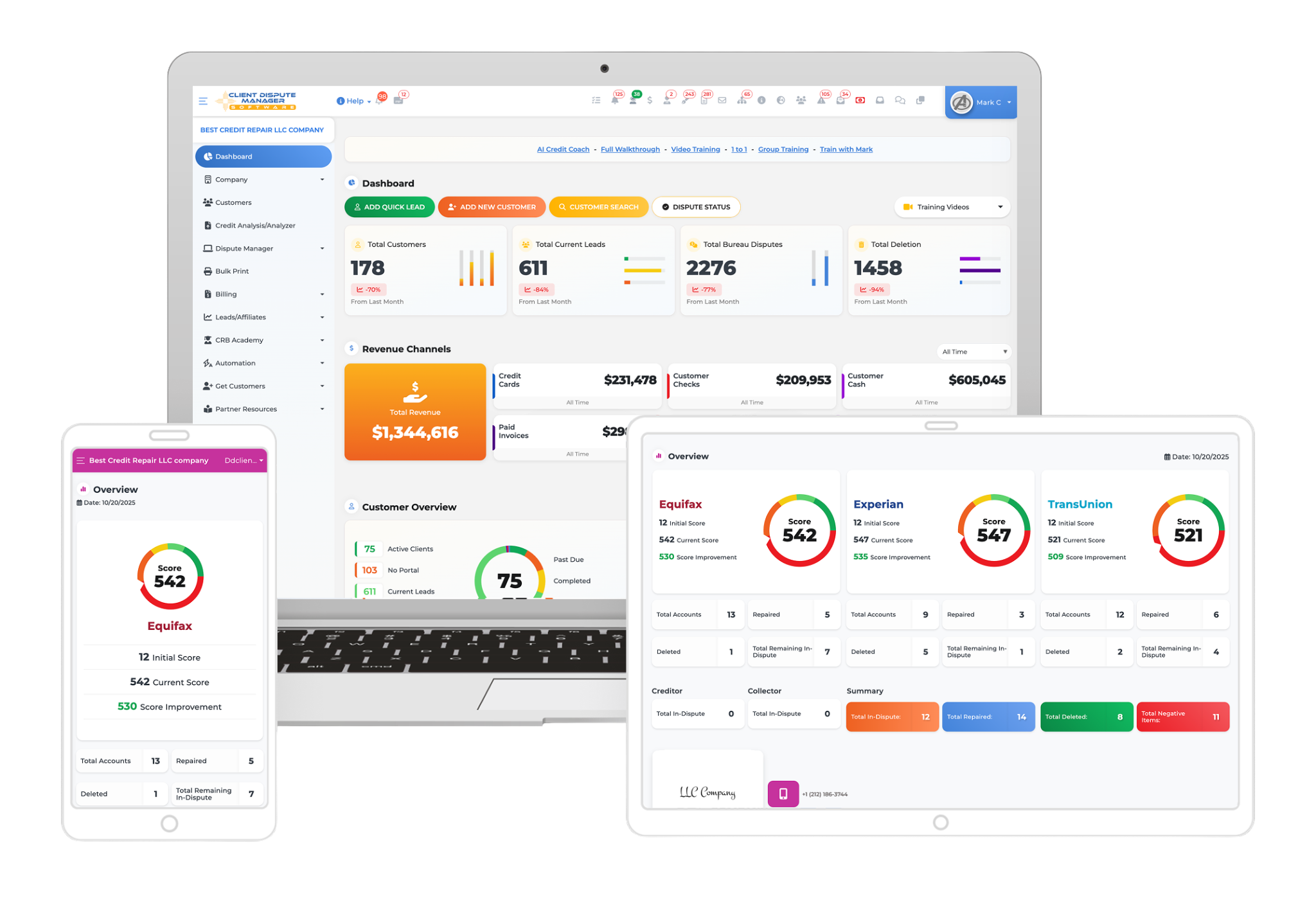
Client Dispute Manager Software centralises every part of that workflow in one system: CROA-compliant client intake with automated contract delivery and electronic signature, dispute tracking across all three credit bureaus, automated progress reports that keep clients informed without manual updates, and a client portal that gives prospects and clients real-time case visibility.
When the credit repair software handles the administrative and compliance burden automatically, every hour recovered from paperwork goes back into producing the social media content and community engagement that generates the next signed client. Try Client Dispute Manager Software free for 30 days at clientdisputemanagersoftware.com. No credit card required.

Mark Clayborne specializes in credit repair, starting and running credit repair businesses. He's passionate about helping businesses gain freedom from their 9-5 and live the life they really want. You can follow him on YouTube.
Experience our credit repair software, risk-free.