
How to Rebuild Your Credit After a Car Repossession
Written by Mark Clayborne
Last updated on March 31, 2026
On this page

A car repossession leaves two problems at the same time. The first is a serious derogatory mark on the credit report that stays for seven years.
The second is often an outstanding deficiency balance that the lender is still pursuing after the vehicle was sold at auction. Both are addressable, and recovery runs on two parallel tracks that start at the same time.
Track one is accuracy. Any error in how the repossession is recorded on the credit report is suppressing the credit score beyond what the law requires.
Wrong date of first delinquency, inflated deficiency balance, duplicate entry, wrong account status: each of these is disputable under the Fair Credit Reporting Act and must be challenged immediately.
Track two is positive payment history. Opening new accounts and keeping utilization low is what moves the score upward month by month while the repossession entry ages toward its seven-year expiration.
This guide covers how a repossession affects the credit report and score, the eight-step rebuilding plan, the financial products that accelerate recovery, how to resolve the deficiency balance, how to dispute reporting errors while rebuilding, how to get a car loan again, and how Client Dispute Manager Software automates the dispute and monitoring side of the process so both tracks can move forward simultaneously.
What Negative Items Can Be Removed from a Credit Report?

A repossession entry cannot be removed if it is accurately recorded and within the seven-year FCRA reporting window.
What can be removed are inaccurate details within the entry: a wrong date of first delinquency that extends the seven-year clock, an inflated deficiency balance that reflects the pre-auction loan amount rather than the actual post-auction deficiency, a duplicate entry from both the original lender and a debt collector, and an account status that was not updated after the repossession completed.
Any associated collection account for the deficiency balance is subject to the same FCRA accuracy standard. For the full removal guide, see How to Remove a Repossession from Your Credit Report.
The repossession itself, if accurately recorded and within the reporting window, cannot be removed before the seven-year period expires.
Understanding which details are disputable is what separates an effective recovery plan from one that wastes time targeting the wrong thing. For information on how voluntary and involuntary repossessions appear differently on the credit report, see Voluntary vs. Involuntary Repossession: What Goes on Your Credit.
How Long Does It Take to See Credit Score Improvements?
Recovery from a car repossession typically begins showing in credit scores within 12 to 18 months of the event when the consumer is actively adding positive payment history.
The score moves from the post-repossession low toward the 580 to 620 range within the first year with consistent on-time payments on a secured card.
Reaching 620 to 650 is realistic within two years. The 700-plus range is achievable in three to four years depending on the pre-repossession score and how consistently the rebuilding steps are followed.
| Timeframe | Expected Score Range | Key Actions During This Period |
|---|---|---|
| Months 1 to 6 | 500 to 560 range | Dispute repossession entry errors; open one secured credit card; pay balance in full monthly |
| Months 6 to 12 | 560 to 600 range | Add credit-builder loan; become authorized user; use rent reporting service |
| Year 1 to 2 | 600 to 650 range | Consistent payment history; utilization below 10 percent; monitor all three bureaus monthly |
| Year 2 to 3 | 650 to 700 range | Second auto loan or unsecured card may become accessible; continue monitoring |
| Year 3 to 4 | 700-plus range | Standard auto loan eligibility at competitive rates; subprime premium eliminated |
What Are the Common Causes of Credit Report Errors and How to Prevent Them?
Repossession entries are prone to errors because the data passes through multiple parties before it reaches the bureau: the original lender, the repossession agent, the auction house, and sometimes a third-party debt collector who purchases the deficiency balance.
Each step introduces an opportunity for the wrong date, the wrong balance, or the wrong account status to enter the system. The five most common errors are a wrong date of first delinquency that extends the seven-year clock, a deficiency balance reported before the auction proceeds are applied, a duplicate entry from both the original lender and a collector, an account status not updated to repossessed or charged-off after completion, and an entry remaining past the seven-year limit.
Prevention starts with importing all three bureau reports into Client Dispute Manager Software immediately after the repossession so these errors are flagged before they compound.
What Are the Essential Steps for Improving a Low Credit Score?
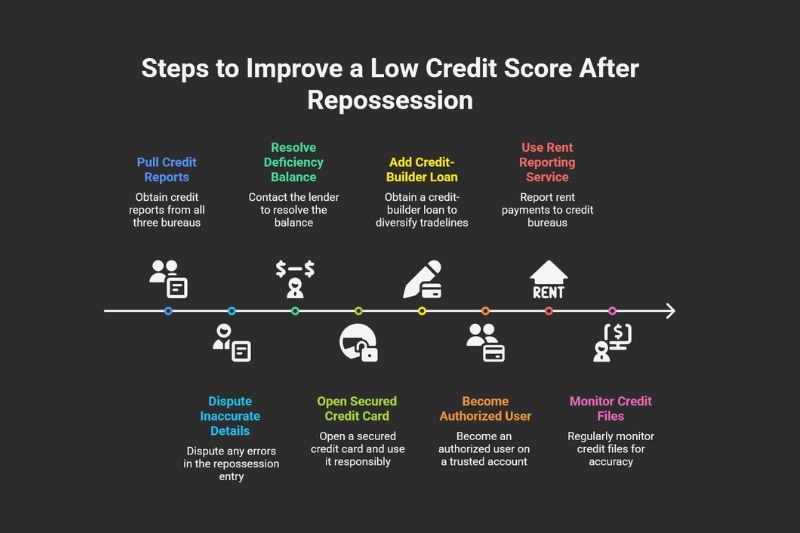
Rebuilding credit after a car repossession runs on two parallel tracks that start at the same time. Track one is accuracy: any error in how the repossession is recorded must be disputed under the FCRA immediately, because every month an inaccurate entry remains, it suppresses the score below its legal floor.
Track two is consistent positive payment history on new accounts opened after the repossession. Client Dispute Manager Software handles track one automatically so that track two can be the primary focus.
Follow these eight steps in order. Steps one and two address the accuracy track. Steps three through eight build the positive payment history track.
- Step #1: Pull your credit reports from all three bureaus at AnnualCreditReport.com immediately after the repossession. Import all three reports into Client Dispute Manager Software. The platform scans every tradeline and flags repossession entry errors automatically across all five common error types, including the associated collection account if the deficiency has already transferred to a collector.
- Step #2: Dispute any inaccurate details in the repossession entry with all three bureaus simultaneously. Client Dispute Manager Software generates bureau-specific dispute letters, attaches supporting documents, and tracks the 30-day FCRA investigation deadline for each bureau from a single dashboard. Do not wait to start this step. The dispute track and the rebuilding track run at the same time.
- Step #3: Resolve the deficiency balance. Contact the original lender directly before the deficiency is sold to a third-party debt collector. Addressing the balance at this stage gives more negotiating options than dealing with a collector later. See Section 4 for the full deficiency resolution strategy including direct settlement, debt management plans, and FDCPA validation.
- Step #4: Open one secured credit card within one to three months of the repossession. Choose a card that reports to all three bureaus. Use it for one or two small recurring purchases each month and pay the full balance before the due date. Keep the reported balance below 10 percent of the credit limit, not 30 percent.
- Step #5: Add a credit-builder loan within three to six months. This adds an installment tradeline alongside the revolving secured card, which improves credit mix and adds a second stream of positive payment history. Self Financial, local credit unions, and community banks offer credit-builder loans with minimal approval requirements.
- Step #6: Become an authorized user on a trusted account with three or more years of on-time payments and low utilization. Ask a family member or close friend to add you to their account. You do not need to use the card. Their account history is added to your credit file within 30 to 60 days with no application and no hard inquiry on your file.
- Step #7: Use a rent reporting service to add on-time rent payments to all three bureau files. Monthly rent payments do not appear on credit reports by default. Services such as Rental Kharma, Experian RentBureau, and Rock the Score report these payments as positive tradelines with no new account and no application required.
- Step #8: Monitor all three bureau files monthly with Client Dispute Manager Software. Track score changes tied to each action, verify the repossession entry is reflecting the correct status at each bureau, and catch any new reporting errors before they compound into additional score damage.
What Are the Best Strategies for Rebuilding Credit After Foreclosure?
The rebuilding strategy after a car repossession follows the same sequence as after a foreclosure, as covered in How to Rebuild Credit After Foreclosure or Short Sale. Both are derogatory event entries that resolve over time with consistent positive payment history, accurate reporting, and new positive tradelines.
The key difference is that a repossession almost always leaves an outstanding deficiency balance that must be addressed as a separate step, whereas a foreclosure does not always generate a collectible deficiency.
That deficiency balance is the additional action item that makes the repossession rebuilding plan slightly more complex, but the core sequence is identical: dispute first, then add positive accounts, then keep utilization low and monitor consistently.
Strategies for Boosting Credit Scores Quickly Before a Major Purchase.
Once the rebuilding plan is underway and a major purchase such as an auto loan or mortgage is approaching, targeted actions produce faster score movement.
Pay every revolving balance to below 10 percent of the credit limit before the credit card statement closing date, not the payment due date.
Submit any outstanding disputed entries through Client Dispute Manager Software immediately so corrections can process before the lender pulls credit.
Avoid applying for any new credit in the six to twelve months before the loan application. For more detail on the auto loan re-entry timeline specifically, see Section 6.
What Financial Products Help Improve Credit Utilization?
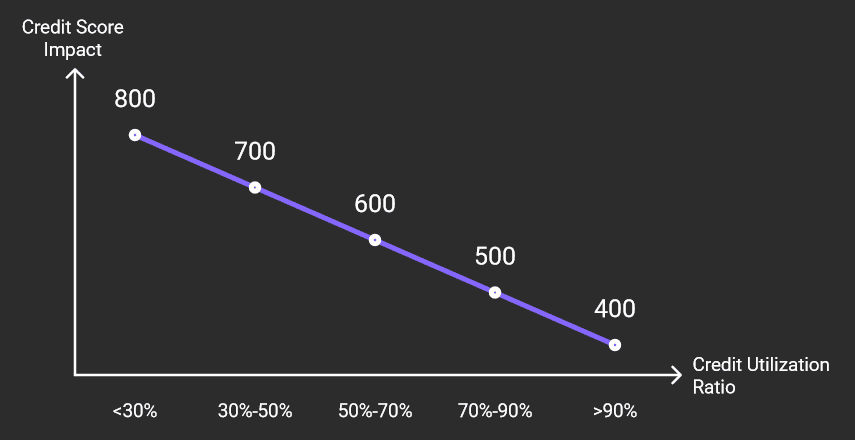
The most effective financial products for rebuilding after a car repossession are secured credit cards and credit-builder loans because both are accessible immediately after the event, both report to all three bureaus, and both build positive payment history in the two most heavily weighted FICO factors: payment history at 35 percent and credit utilization at 30 percent.
A secured card gives direct control over the utilization ratio. A credit-builder loan adds an installment tradeline that diversifies the credit mix without creating utilization exposure.
Authorized user status is the fastest single action available because it adds established account history with no application and no hard inquiry.
How Do Authorized Users Affect Credit Scores?
Being added as an authorized user on a credit card with three or more years of on-time payments, low utilization, and no late payments adds the primary account holder’s full positive history to the credit file within 30 to 60 days.
The primary cardholder does not need to provide access to the physical card. There is no credit application and no hard inquiry on the authorized user’s file.
For a consumer rebuilding after repossession whose report contains mostly negative entries, this is one of the fastest legal score boosts available because it imports years of clean history immediately without waiting for a new account to age into a meaningful contribution.
What Are the Benefits of Using a Rent Reporting Service for Credit Building?
Most consumers rebuilding after a repossession are paying rent on time every month, but those payments do not appear on bureau files by default. Rent reporting services like Rental Kharma, Experian RentBureau, and Rock the Score report on-time rent payments to the bureaus as positive tradelines.
For someone whose credit file contains the repossession entry and little else in the positive column, this converts a payment they are already making into a score-building action with no new account, no application, and no hard inquiry.
What Are Reliable Financial Products for Building Positive Payment History?
A complete post-repossession rebuilding plan uses multiple financial products to build payment history across different account types.
The combination of a revolving account and an installment account is what produces the most balanced score recovery over time.
| Product | Tradeline Type | When to Open | Score Impact | Application Required? |
|---|---|---|---|---|
| Secured Credit Card | Revolving | Month 1 to 3 post-repossession | High, payment history and direct utilization control | Yes, nearly guaranteed with security deposit |
| Credit-Builder Loan | Installment | Month 3 to 6 | Medium-high, credit mix and second payment history stream | Yes, minimal requirements |
| Authorized User Account | Revolving (inherited) | Immediately available | High, fastest legal boost, no application needed | No |
| Rent Reporting Service | Alternative data | Immediately available | Medium, positive payment history for thin files | No |
| Secured Auto Loan or Credit Union Auto Loan | Installment | Year 1 to 2 with improved score | High, replaces the repossession narrative with positive auto history | Yes |
Which Credit Card Types Are Most Effective for Building Credit from Scratch?
After a repossession, standard unsecured credit cards are typically inaccessible until the score recovers.
The most accessible options in order of priority are: secured credit cards where the credit limit equals the security deposit and approval is nearly guaranteed regardless of credit history, credit union credit cards with relationship-based approval criteria that are more flexible than major bank standards, and retail store cards with lower approval thresholds as a secondary step.
Secured cards should be the first choice because they report to all three bureaus, give direct utilization control, and can be upgraded to an unsecured card once the score reaches 650 or above and the card has been held for 12 or more months with a perfect payment history.
How Do Debt Management Plans Impact Credit Scores During Repair?
A car repossession almost always leaves an outstanding deficiency balance: the difference between the remaining loan amount and what the vehicle sold for at auction.
If left unaddressed, this deficiency is typically sold to a third-party debt collector, which adds a second collection account to the credit report on top of the repossession entry itself.
Addressing the deficiency balance before it advances further into collection stops that second derogatory mark from appearing and clears the path for new credit.
A debt management plan is one resolution option, but direct settlement and FDCPA validation are often more targeted for a single deficiency balance.
Three resolution paths are available depending on the consumer’s situation:
- Path #1: Direct settlement with the original lender or servicer. Contact the lender before the deficiency is sold to a collector.
Negotiate a lump sum settlement for less than the full deficiency amount or arrange a structured payment plan. A paid or settled deficiency stops the active damage and prevents a second collection account from appearing on the credit report.
A settled account typically shows as settled for less than the full amount on the credit report, which is a derogatory notation but significantly better than an active collection balance. Get any settlement agreement in writing before making any payment. - Path #2: Debt management plan through an NFCC-affiliated nonprofit agency. If the repossession deficiency is part of a broader debt load, a certified nonprofit credit counselor can help structure a debt management plan that addresses all outstanding balances together.
Note that enrolling in a debt management plan may require closing existing credit accounts, which can temporarily affect the credit score by reducing available revolving credit and shortening account age.
This is a workable path for consumers managing multiple debt obligations, not just the repossession deficiency in isolation. - Path #3: FDCPA debt validation if the deficiency has already moved to a collector. If the deficiency balance has been sold to a third-party debt collector, that collector is governed by the Fair Debt Collection Practices Act.
Under FDCPA Section 809, the consumer can send a written debt validation letter within 30 days of the collector’s first contact, forcing the collector to provide written proof that the debt is valid and that the amount claimed is accurate.
If the collector cannot validate, they must stop collection activity and the associated collection account entry must be removed from the credit report.
Client Dispute Manager Software generates debt validation letters alongside FCRA dispute letters from the same dashboard. For a full breakdown of this path, see How to Remove a Collection Account from Your Credit Report.
How to Dispute Inaccurate Items on My Credit Report?

Disputing inaccurate details in the repossession entry is the first action in the rebuilding plan, not a later step.
Every month an inaccurate date, inflated balance, or wrong account status remains on the credit report, it is suppressing the score below the level that the accurate reporting of the event would produce.
Running the dispute track in parallel with the rebuilding track is the fastest path to score recovery.
Client Dispute Manager Software automates the letter generation, document routing, and 30-day deadline tracking so the dispute process does not require ongoing manual management while the consumer is simultaneously focused on adding positive tradelines.
What Are My Rights Under the Fair Credit Reporting Act?
Under FCRA Section 611, every consumer has the right to dispute any inaccurate or unverifiable entry on their credit report at no cost. Once a dispute is submitted, the bureau has 30 days to investigate and respond.
These rights apply to both the repossession entry itself and any associated collection account for the deficiency balance.
If the bureau verifies an entry that the consumer has documentation proving is wrong, the next step is filing a complaint with the Consumer Financial Protection Bureau at consumerfinance.gov/complaint.
If a bureau or data furnisher willfully violates the FCRA, the consumer has the right to seek statutory damages through the courts.
Step-by-Step Guide to Using Credit Repair Software
The process inside Client Dispute Manager Software for repossession recovery runs in four steps that support both tracks simultaneously.
First, import credit reports from all three bureaus. The platform scans every tradeline and flags repossession entry errors across all five common error types, including any associated collection account for the deficiency.
Second, select the items to dispute and choose the letter type for each: FCRA dispute letter for bureau reporting errors, FDCPA debt validation letter if the deficiency has moved to a collector, or goodwill deletion letter if the account is already paid.
Third, Client Dispute Manager Software generates the appropriate letter for each item, attaches the supporting documents uploaded to the platform, and addresses each letter to the correct bureau or collector.
Fourth, the platform tracks every 30-day deadline and generates follow-up letters automatically when a bureau or collector fails to respond on time.
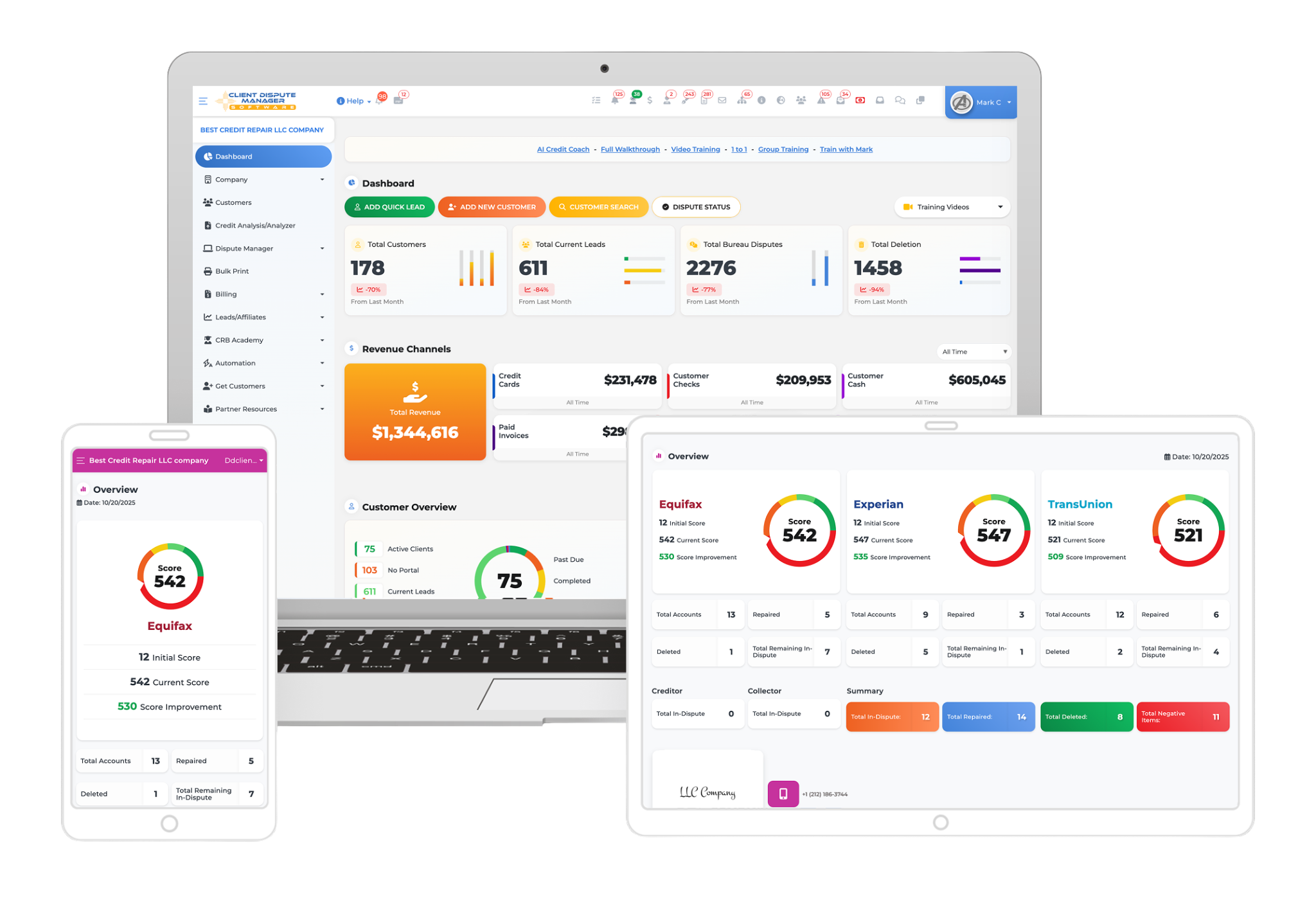
Score changes are monitored across all three bureaus on the same dashboard, so both the dispute track and the rebuilding track progress are visible in one place.
Strategies for Boosting Credit Scores Quickly Before a Major Purchase.
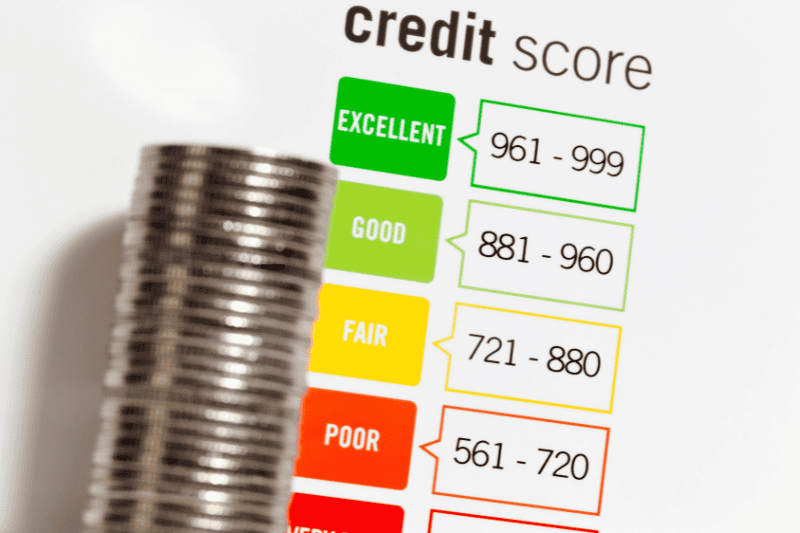
Most consumers who experienced a car repossession need to buy another vehicle before their credit score fully recovers. Waiting for a perfect score is not practical when transportation is needed.
The goal is to reach a score level that qualifies for reasonable loan terms, use the new auto loan as a positive installment tradeline that directly rebuilds the payment history record, and avoid high-cost alternatives that generate additional financial stress.
The score actions taken in the six to twelve months before the loan application make a meaningful difference in the interest rate offered.
Pre-application score optimization: pay every revolving balance to below 10 percent of the credit limit before the credit card statement closing date. Submit any outstanding disputed entries through Client Dispute Manager Software immediately.
Avoid applying for any new credit accounts in the six to twelve months before the loan application. Ask a trusted family member with excellent credit to add you as an authorized user if not already done.
If working with a specific auto lender and a verified dispute correction is in progress, ask the lender about rapid re-scoring.
| Option | Typical Score Needed | Waiting Period | Key Consideration |
|---|---|---|---|
| Subprime Auto Lender | 525 to 580 | 6 to 12 months post-repossession | High interest rate, acceptable short-term if managed and refinanced when score improves |
| Credit Union Auto Loan | 580 to 620 | 12 to 24 months with positive rebuild | Best terms for rebuilders, relationship-based lending with more flexible criteria |
| Standard Bank Auto Loan | 640 to 660 | 2 to 3 years post-repossession | Standard rates available once score stabilizes above 640 |
| Co-Signer Option | Co-signer score qualifies the loan | Available sooner with a strong co-signer | Co-signer takes full legal liability for the loan, use only when repayment is certain |
| Buy Here Pay Here | No score requirement | Immediately available | Very high cost, use only as a last resort and for the shortest time possible |
How Do Rapid Re-Scoring Services Work and Who Offers Them?
Rapid re-scoring updates verified bureau corrections in three to five business days instead of waiting out the standard 30-day dispute investigation cycle. The service is available only through lenders, not directly to consumers.
Auto lenders can access rapid re-scoring on behalf of a buyer when a verified correction is documented and the lender has a relationship with a rapid re-scoring company that holds bureau agreements.
The lender submits documented proof of the correction – such as a letter from the original creditor confirming a balance was resolved or a date was incorrect – and the bureau updates the record within days.
Client Dispute Manager Software prepares the supporting dispute documentation the lender needs to initiate the rapid re-score request.
This is most useful when a consumer is close to qualifying for a better loan tier and has a verified dispute correction pending that would push the score above the threshold.
Best Credit Repair Services for Rebuilding Credit After Bankruptcy
The same qualities that make a credit repair service effective for bankruptcy rebuilding apply directly to repossession recovery: automated dispute letter generation for the specific error types in the derogatory entry, FDCPA debt validation letters for collector-held deficiency balances, tracking of all three bureau response deadlines simultaneously, score monitoring tied to each dispute round, and CROA-compliant operations with no advance fees before services begin.
Software-first credit repair provides full transparency into every letter generated, every bureau response received, and every score change recorded, at a fraction of the cost of traditional service companies that charge $79 to $149 per month.
What Platforms Automate the Credit Dispute Process?
Three options are available for managing the dispute track and monitoring the rebuilding track after a car repossession:
| Option | Cost | Letter Types | Automation Level | CROA Compliant |
|---|---|---|---|---|
| DIY Manual Letters | Free | You write all types manually | None | Yes |
| Credit Repair Service Companies | $79 to $149 per month | FCRA letters; varies by service | Partial | Varies, verify before enrolling |
| Client Dispute Manager Software, 30-Day Free Trial | Low monthly fee | FCRA, FDCPA, pay-for-delete, goodwill, score monitoring | Full | Yes, built by CROA practitioner |
Are There Credit Repair Services That Offer a Free Trial Period Before Subscription?
Client Dispute Manager Software offers a 30-day free trial with full access to the dispute letter generator, FDCPA debt validation letters, pay-for-delete templates, the bureau tracking dashboard, and score monitoring across all three bureaus.
No credit card is required to start. This lets the consumer run a complete repossession dispute workflow and begin monitoring the score recovery before making any financial commitment.
Which credit repair platforms provide access to certified credit specialists? Client Dispute Manager Software was built by Mark Clayborne, a certified credit consultant and CROA practitioner with over a decade of credit repair experience.
That background knowledge is embedded in the platform’s letter logic, compliance workflows, and dispute strategy guidance.
Frequently Asked Questions
What Are the Essential Steps for Improving a Low Credit Score?
Rebuilding after a car repossession follows an eight-step sequence. Pull all three credit reports and dispute any repossession entry errors immediately.
Resolve the deficiency balance before it transfers to a collector. Open a secured credit card within one to three months and pay the balance in full monthly. Add a credit-builder loan at three to six months for a second positive tradeline.
Become an authorized user on a clean established account. Use a rent reporting service for on-time rent payments. Keep utilization below 10 percent. Monitor all three bureau files monthly with Client Dispute Manager Software.
What Negative Items Can Be Removed from a Credit Report?
In the context of a car repossession, inaccurate details within the entry are disputable under FCRA Section 611: a wrong date of first delinquency, an inflated deficiency balance that does not reflect the post-auction amount, a duplicate entry from both the original lender and a debt collector, a wrong account status after the repossession completed, and entries remaining past the seven-year reporting limit.
An accurately recorded, verified repossession within the seven-year window cannot be removed before the limit expires. For the full removal guide, see How to Remove a Repossession from Your Credit Report.
How Long Does It Take to See Credit Score Improvements?
Most consumers rebuilding after a car repossession see the first measurable score improvements within 12 to 18 months with consistent positive payment history. The score typically moves toward the 580 to 620 range within the first year and reaches 620 to 650 within two years.
The 700-plus range is achievable in three to four years. Higher scores before the repossession tend to recover faster because there is more positive history to rebuild from.
What Financial Products Help Improve Credit Utilization?
Secured credit cards give direct control over the utilization ratio because the consumer controls how much is charged relative to the credit limit. Keep the reported balance below 10 percent of the limit, not 30 percent, for the maximum score benefit.
Requesting a credit limit increase after 12 months of on-time payments also improves the ratio without opening a new account. Credit-builder loans add an installment tradeline that does not affect revolving utilization but builds payment history and credit mix.
Authorized user status on a low-utilization account contributes that account’s favorable ratio to the credit profile.
How Do Authorized Users Affect Credit Scores?
Being added as an authorized user on a credit card with three or more years of on-time payments and low utilization adds the primary account holder’s full positive history to the credit file within 30 to 60 days.No credit application is required and no hard inquiry affects the file.
This is one of the fastest legal score boosts available during repossession recovery because it imports established positive history immediately without waiting for a new account to age into a meaningful contribution.
The primary account must be clean and well-managed for the strategy to produce the intended result.
Conclusion
Improving your credit score comes down to clear steps and consistent action. When you understand what impacts your score and focus on the right areas, you avoid wasted effort. Paying on time, lowering balances, and addressing inaccurate items all play a direct role. When you track your progress and stay disciplined, you create steady upward movement instead of short-term spikes.
The key is to stay consistent and avoid shortcuts that can lead to setbacks. Review your credit reports often, fix issues early, and use tools that help you stay organized. Over time, these habits build a stronger credit profile that supports your long-term financial goals.

Mark Clayborne
Mark Clayborne specializes in credit repair, starting and running credit repair businesses. He's passionate about helping businesses gain freedom from their 9-5 and live the life they really want. You can follow him on YouTube.
Start Today and Explore the Features Firsthand!
Related Guides:
- How to Fix Your Credit: Bankruptcy, Collections, Charge-Offs, Late Payments & More
- How to Rebuild Your Credit After Bankruptcy (Chapter 7 and 13)
- How to Challenge a Bankruptcy on Your Credit Report?
- How to Dispute a Foreclosure on Your Credit Report?
- How to Remove a Collection Account from Your Credit Report?
Client Dispute Manager
Free 30-Day Trial
Experience our credit repair software, risk-free.