If you run a credit repair business, knowing how to read a credit report for clients is the most important skill you can develop. It determines the quality of every dispute you file, the results you deliver, and ultimately the reputation of your business.
Most credit repair training focuses on dispute letters. But a letter is only as strong as the analysis behind it. If you miss errors during the report review, you file weaker disputes, deliver slower results, and leave money on the table for your clients.
The best way to read a credit report for credit repair is to work through it section by section personal information, account history, negative items, inquiries, and public records actively identifying anything inaccurate, outdated, or unverifiable that can be legally challenged under the Fair Credit Reporting Act.
That is exactly what this guide walks you through. By the end, you will have a repeatable, professional process for reviewing any client’s credit report and building a dispute strategy designed to win.
Key Takeaways:
- Reading a credit report section by section is the foundation of every winning dispute strategy.
- The most impactful errors include re-aged accounts, duplicate tradelines, wrong balances, and mixed credit files.
- FCRA Section 611 and Section 623 give you a clear legal framework to challenge errors at the bureau and furnisher level.
- A repeatable eight-step dispute process keeps your results consistent across every client case.
- Client Dispute Manager Software centralizes your entire dispute workflow so your business can scale without losing control of active cases.
Why Most Credit Repair Businesses Struggle With Credit Reports?

Credit repair businesses often struggle with credit reports because reports are dense, filled with status codes and bureau-specific formatting, and most training focuses on dispute letters rather than systematic report analysis.
Without a clear review process, it is easy to miss disputable items that could significantly improve a client’s score.Understanding a credit report at a professional level is not something most credit repair training programs prioritize.
They teach you what to write in a dispute letter, but not how to thoroughly analyze the document that the letter needs to be built from. That gap is where most businesses lose results before the dispute process even begins.
The Hidden Cost of Misreading a Client's Report
If a credit repair business misreads a client’s credit report, it may miss disputable errors that could improve the client’s credit score, file weaker disputes, and ultimately deliver slower results damaging client retention and the business’s reputation.
When you skip a re-aged account, overlook a duplicate tradeline, or miss an unauthorized inquiry, that is not just a missed dispute. It is a missed result for your client. And in a business that runs on referrals and trust, slow or incomplete results have a direct impact on your bottom line.
Knowing exactly what credit report errors to look for on every review is what keeps your business competitive and your clients progressing.
What Separates a Weak Dispute From a Winning One?
A successful credit dispute is specific, well-documented, and legally grounded. It identifies the exact error, names the account and bureau, cites the relevant FCRA provision, and includes supporting documentation giving the bureau no basis to dismiss it as frivolous.
Weak disputes are vague. They say an account is wrong without explaining why or providing proof. Credit bureaus are legally permitted to dismiss disputes they consider frivolous, and a poorly written, unsupported dispute gives them every reason to do exactly that.
How to dispute credit report errors effectively always starts with how thoroughly you read the report in the first place. The analysis drives the letter, and the letter drives the outcome.
Why Reading a Credit Report Is the Foundation of Every Successful Dispute?

Reading a credit report is the foundation of every dispute because you cannot challenge what you have not identified. A thorough report review reveals every inaccuracy, outdated item, and unverifiable account which determines exactly what disputes to file, in what order, and with which bureau.
Most credit repair businesses treat the dispute letter as the product. The report review is just a preliminary step they move through quickly. That thinking is backwards. The report review is where disputes are won or lost. The letter is simply how you communicate what the analysis already uncovered.
When you approach understanding a credit report as a systematic, professional process rather than a quick scan, the quality of every dispute you file improves immediately.
Your Client's Rights Under the Fair Credit Reporting Act (FCRA)
Under the Fair Credit Reporting Act, consumers have the right to dispute inaccurate or unverifiable information on their credit report. Under Section 611, credit bureaus must investigate disputes within 30 days. Under Section 623, the company that reported the information, called the furnisher, must also investigate and correct any inaccurate data they provided.
These are not suggestions. They are federal obligations. As a credit repair business, you are helping your clients exercise rights they are already entitled to under federal law. FCRA Section 611 and Section 623 together give you two distinct legal avenues to challenge errors, one at the bureau level and one at the source.
Knowing which avenue to use, and when, is part of what makes a credit repair business effective. Every report review should be conducted with these rights in mind, because they define the boundaries of what you can challenge and how far you can push when a bureau resists.
How to Read a Credit Report for Clients vs. Reading Your Own?
Reading a credit report for a client requires a professional, systematic approach focused on identifying disputable items across all five report sections. As a credit repair business, you are analyzing the report as evidence, looking for anything inaccurate, outdated, or unverifiable that can be legally challenged on the client’s behalf.
When you review your own credit report, the goal is personal awareness. You are checking for anything that looks unfamiliar and making sure the big picture looks accurate. When you are reviewing a client’s credit report, the goal is entirely different. You are conducting a professional audit.
Every account status needs to be verified. Every date needs to be checked against reporting timelines. Every inquiry needs to be confirmed as authorized. Every negative item needs to be evaluated for accuracy, verifiability, and legal expiration.
Reviewing a client’s credit report is an active, investigative process, and treating it that way from the start is what separates credit repair businesses that get consistent results from those that do not.
Credit Report Sections Explained: What Every Credit Repair Business Needs to Know?

A credit report has five main sections. Each one contains specific data that credit repair businesses should review for errors, outdated reporting, or information that cannot be verified by the reporting bureau or furnisher:
- Personal Information: Names, Addresses, Social Security number, and employer details
- Account History (Tradelines): Every open and closed credit account and its full payment history
- Negative Items: Late payments, charge-offs, collections, and other derogatory accounts
- Hard Inquiries: Every entity that has pulled your client’s credit report
- Public Records: Bankruptcies and civil judgments
Understanding a credit report at a professional level means knowing what each section is supposed to contain, what accurate reporting looks like, and what falls outside those boundaries.
When you know the standard, identifying what is wrong becomes significantly faster and more precise. Here is what each section contains and exactly what to look for as a credit repair professional.
Section #1: Personal Information — The First Place Errors Hide
In the personal information section, look for misspelled names, incorrect Social Security number digits, outdated or unrecognized addresses, and wrong employer information. These errors can sometimes indicate a mixed credit file, where another person’s data has been merged with your client’s report, which is a serious error that can affect every section of the report.
Personal information does not directly impact a credit score, but it matters more than most credit repair businesses realize. An incorrect address or name variation can be a sign that the report contains accounts belonging to someone else entirely.
A mixed credit file is one of the more complex errors to resolve, but catching it starts here, in the first section, before you have reviewed a single account. Check every field. Confirm every detail against your client’s verified identification.
Section #2: Account History and Tradelines — The Core of Every Dispute

Tradelines are individual credit accounts listed on a credit report, including credit cards, auto loans, mortgages, and personal loans. Each tradeline shows the account type, balance, credit limit, payment history, account status, and open or close date, making this the most important section for identifying disputable errors that directly impact a client’s credit score.
This is where the majority of your dispute opportunities will be found. As you review each tradeline, you are checking account status accuracy, payment history notation, balance and credit limit figures, and whether the account actually belongs to your client.
A single tradeline can contain multiple errors, and each one is a separate dispute opportunity. Work through this section methodically and document every discrepancy before moving on.
Section #3: Negative Items — What They Mean and How Long They Stay
A negative item on a credit report is any account or record that reflects poorly on a borrower’s creditworthiness, including late payments, charge-offs, collection accounts, and bankruptcies. Most negative items must be removed after seven years from the date of first delinquency, and any negative item reported past this window or with an incorrect date is a disputable FCRA violation.
The 7-year rule is one of the most important reporting timelines for credit repair businesses to know. A charge-off or collection account that has been on a client’s report for seven years and one month is no longer legally reportable and should be disputed for immediate removal.
Beyond expiration, you are also checking whether the negative item is accurately reported in the first place. Is the balance correct? Is the account status right? Is the date of first delinquency accurate? What does a negative item mean on a credit report in practical terms?
It means a scored impact that your client is paying for every day it remains on the report, which is why accuracy and timing matter so much in this section.
Section #4: Hard Inquiries — When They Are Disputable and When They Are Not
A hard inquiry can be disputed when it was made without the client’s authorization or knowledge. Unauthorized hard inquiries may indicate identity theft or a creditor pulling a report without permissible purpose under the FCRA, both of which are valid grounds for a dispute with the credit bureau.
Not every hard inquiry is disputable. If your client applied for a credit card and the issuer pulled their report, that inquiry is authorized and cannot be removed simply because the client does not like it. What you are looking for in this section are inquiries your client does not recognize and cannot account for.
Each unauthorized hard inquiry on a credit report is a potential FCRA violation and should be documented and disputed with the bureau where it appears.
Section #5: Public Records — What to Flag and Why It Matters

Public records on a credit report include bankruptcies and civil judgments. A Chapter 7 bankruptcy stays on a credit report for 10 years from the filing date, while a Chapter 13 bankruptcy stays for 7 years. Any public record reported past its legal expiration date, or with incorrect filing information, can be disputed under the FCRA.
Public records carry significant weight on a credit report and can affect a client’s ability to qualify for housing, credit, and employment. When reviewing this section, confirm the filing date, the type of bankruptcy or judgment, and whether the reporting timeline has expired.
Even if the public record is within its legal window, check that the details are accurate. An incorrect filing date on a bankruptcy, for example, could mean it is being reported longer than the law allows, which is a clear and winnable dispute.
How to Identify Errors on a Credit Report Like a Professional?
The most common credit report errors include incorrect account status, duplicate accounts, re-aged derogatory items with manipulated dates, wrong balances or credit limits, and accounts that do not belong to the client due to mixed files or identity theft.
Each of these is a potential dispute opportunity under the Fair Credit Reporting Act. Knowing how to identify errors on a credit report is what transforms a report review from a passive read-through into an active audit.
Every section you reviewed in the previous step now becomes a checklist. You are not reading for general understanding anymore. You are reading to build a case. Here is what to look for in each error category and why each one matters for your client’s dispute strategy.
Incorrect Account Status: Open, Closed, and Everything in Between
An incorrect account status on a credit report occurs when an account is listed as open when it has been closed, delinquent when it has been paid, or in collections when the debt has been satisfied. Each of these status errors directly affects a client’s credit score and is a disputable inaccuracy under the FCRA.
Account status errors are among the most common credit report errors to look for and among the easiest to document. If your client closed a credit card two years ago and the report still shows it as open, that is an error. If a collection account was paid in full and the status still reads unpaid, that is an error.
In both cases, you have a clear, specific, documentable discrepancy between what the report says and what actually happened. Correcting account status errors can have an immediate and meaningful impact on a client’s credit profile, which makes them a high priority during every report review.
Duplicate Accounts and Mixed Credit Files
Duplicate accounts on a credit report occur when the same debt is reported more than once, either under the same creditor name or under a slightly different variation. A mixed credit file occurs when another person’s accounts appear on your client’s report, typically due to similar names, Social Security number errors, or bureau data matching mistakes.
Both errors can do significant damage to a client’s credit score. A duplicate collection account, for example, effectively doubles the negative impact of a single debt. A mixed credit file can introduce derogatory accounts, high balances, and public records that have nothing to do with your client’s actual credit history.
When reviewing tradelines, look for accounts your client does not recognize, accounts listed twice under different creditor names, and any personal information in the report that does not match your client’s verified details. These are strong indicators of either a duplicate reporting error or a mixed file situation, and both are disputable under the FCRA.
Re-Aged Accounts: The FCRA Violation Most Businesses Miss

Account re-aging is when a creditor or collector manipulates the date of first delinquency on a derogatory account to make it appear more recent than it actually is, effectively extending how long the negative item stays on the credit report. Re-aging is a direct violation of the Fair Credit Reporting Act and is one of the most impactful errors to dispute because correcting it can eliminate a negative item years ahead of schedule.
Re-aged accounts are one of the most important credit report errors to look for precisely because they are easy to miss if you are not specifically checking dates. A collection account that should have aged off the report two years ago but has a manipulated date of first delinquency will continue to appear and suppress your client’s score indefinitely unless it is caught and challenged.
When reviewing negative items, always verify the original date of first delinquency against any documentation your client has, and cross-reference it against the 7-year reporting window. If the dates do not align, you have a clear FCRA violation and a strong dispute case.
Wrong Balances, Credit Limits, and How They Hurt Your Client's Score
Incorrect balance and credit limit figures on a credit report directly affect a client’s credit utilization ratio, which is one of the most heavily weighted factors in credit scoring. A balance reported higher than the actual amount owed, or a credit limit reported lower than the actual limit, can artificially inflate the utilization percentage and suppress the client’s score.
This is a credit report error that often gets overlooked because it does not look as dramatic as a collection account or a public record. But the score impact can be significant. A client with a credit card that has a reported balance of four thousand dollars when the actual balance is one thousand dollars is carrying three thousand dollars of phantom debt in the eyes of the scoring model.
Similarly, a credit limit reported at three thousand dollars when the actual limit is five thousand dollars compresses the available credit and pushes utilization higher than it should be. Review every tradeline for balance and credit limit accuracy, and flag any figure that does not match your client’s actual account statements.
Credit Report Errors to Look for on Every Single Review
A professional credit report error checklist should include: incorrect personal information, wrong account status, duplicate tradelines, re-aged derogatory accounts, inaccurate balances or credit limits, accounts belonging to another person, unauthorized hard inquiries, and negative items reported past their legal expiration date.
Reviewing every client’s report against this checklist ensures no dispute opportunity is missed.
Consistency is what makes a credit repair business scalable. When you apply the same structured review process to every client’s report, you stop relying on instinct and start operating a repeatable system.
Every item on this checklist represents a category of inaccurate information on a credit report that has a defined legal standard under the FCRA. Either the information is accurate, verifiable, and within its reporting window, or it is not. Your job is to identify everything that does not meet that standard, document it precisely, and build a dispute strategy around it before you write a single letter.
Step-by-Step Dispute Process for Credit Repair Businesses
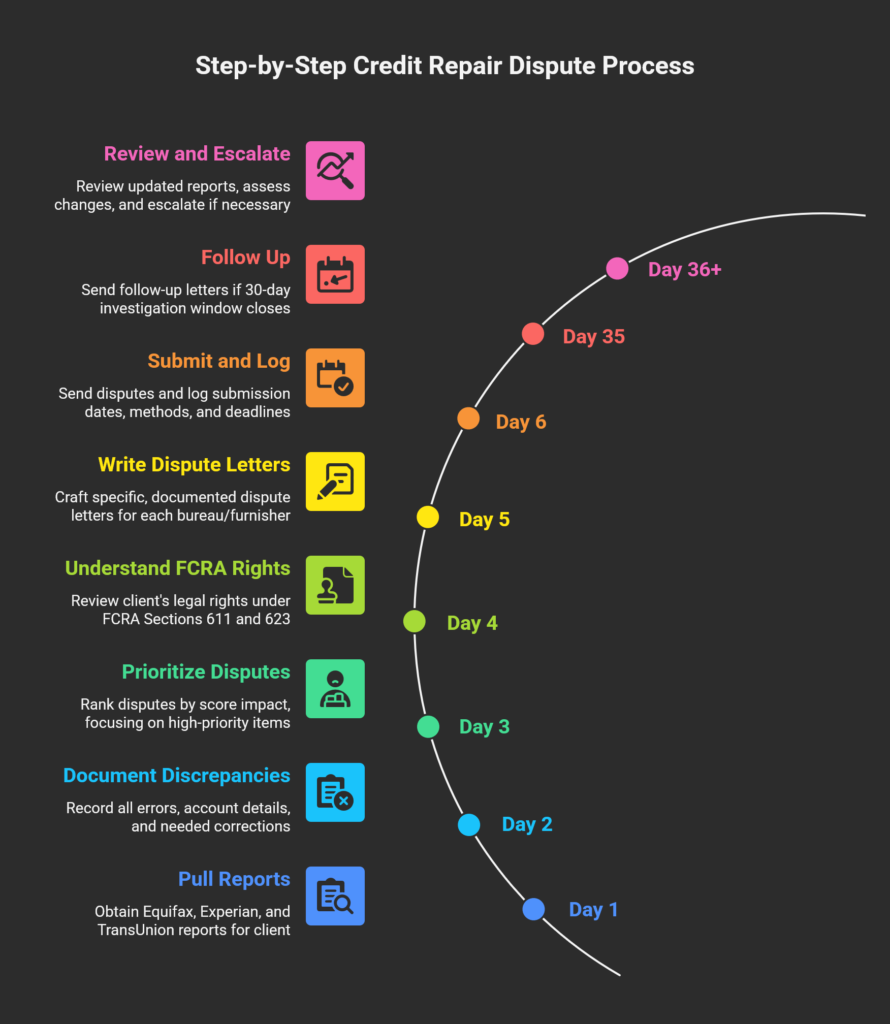
The credit repair dispute process involves eight steps: pull all three bureau reports, document every discrepancy, prioritize disputes by score impact, understand the client’s FCRA rights, write specific dispute letters with supporting documentation, submit and log every dispute with dates, follow up when the 30-day investigation window closes, and review the updated report to assess what changed.
This is the section where report analysis becomes action. Everything you identified during the review now gets organized into a structured, legally grounded dispute strategy. Each step builds on the one before it, and skipping any one of them weakens the entire case. Work through this process in order, for every client, every time.
Step #1: Pull All Three Bureau Reports and Compare Them Side by Side
Always pull reports from Equifax, Experian, and TransUnion before filing any disputes. The same error often appears on only one or two bureaus, and some errors appear differently across all three. Disputing without comparing all three reports risks missing inaccuracies and filing incomplete cases for your clients.
Each bureau operates independently and receives data from furnishers on its own reporting schedule. That means a collection account might appear on an Experian report with one balance and on a TransUnion report with a different balance, or it might not appear on an Equifax report at all.
Pulling a tri-merge report or all three reports individually at the start of every client engagement gives you a complete picture before you file anything. You cannot build a comprehensive dispute strategy from a single bureau report.
Step #2: Document Every Discrepancy Before You File Anything
Before filing any dispute, document each discrepancy by recording the bureau it appears on, the account name, account number, error type, and the specific correction needed. This documentation becomes the foundation of every dispute letter and ensures nothing is missed or filed incorrectly when managing multiple client cases.
Skipping this step and going straight to writing letters is one of the most common mistakes credit repair businesses make. Documentation is not just an organizational habit. It is what allows you to write specific, targeted dispute letters rather than vague, generic ones.
For each error you identified during the report review, create a clear record that captures exactly what is wrong, where it appears, and what the correct information should be. This record is your dispute roadmap, and every letter you write should trace directly back to it.
Step #3: Prioritize Disputes by Score Impact
Dispute high-impact errors first. Collection accounts, charge-offs, and late payment notations have the greatest negative effect on a credit score and should be prioritized. Minor personal information errors like an outdated phone number have little to no score impact and can be addressed after the primary disputes are resolved.
Prioritization matters because credit repair is a process, not a single event. Your client’s score will not change overnight, and filing ten disputes simultaneously without a strategy can create confusion during the investigation phase.
Start with the errors that are suppressing the score the most. A single collection account removal can move a score significantly. A corrected credit limit figure can improve utilization immediately. Build your dispute sequence around impact, and your clients will see measurable progress at each stage of the process.
Step #4: Know Your Client's Legal Rights Under FCRA Section 611 and 623

FCRA Section 611 requires credit bureaus to investigate a dispute within 30 days of receiving it and notify the consumer of the outcome. Section 623 requires the furnisher, the company that originally reported the information, to investigate and correct any data it reported inaccurately.
Together, these two provisions give credit repair businesses a clear legal framework for challenging errors at both the bureau and the source level.
These are not background details. They belong inside every dispute letter you write. Citing FCRA Section 611 when disputing with a bureau and FCRA Section 623 when disputing with a furnisher signals to both parties that your client knows their rights and that you know the law.
Bureaus and furnishers are far less likely to dismiss a dispute as frivolous when it is grounded in specific statutory language. Make FCRA citations a standard part of every letter, not an occasional addition.
Step #5: Write Dispute Letters That Are Too Specific to Dismiss
A strong credit repair dispute letter should include the client’s full name and address, the specific account being disputed, the exact error and why it is inaccurate, supporting documentation that proves the error, and a clear request for correction or removal.
Vague or generic dispute letters are frequently dismissed as frivolous by credit bureaus, and specificity is what makes a dispute winnable.
Generic dispute letters that simply state “this account is not mine” or “please verify this information” give the bureau very little to investigate and are routinely dismissed.
A well-constructed dispute letter tells the bureau exactly what is wrong, exactly why it violates the FCRA, and exactly what correction is required.
It also includes documentation that supports the claim, whether that is a payment confirmation, an account closure letter, or a copy of the client’s identification in cases of mixed file disputes. The more specific and documented the letter, the harder it is for the bureau to dismiss without a full investigation.
Step #6: Submit, Log, and Track Every Dispute With Dates
Credit repair businesses should log every dispute submission with the date sent, the bureau or furnisher it was sent to, the delivery method used, and the expected response deadline. Without a reliable tracking system, it is easy to miss follow-up windows, especially when managing disputes across multiple clients simultaneously.
This is where many credit repair businesses start to lose control of their process as their client list grows. When you are managing one or two clients, tracking disputes manually in a spreadsheet is manageable.
When you are managing twenty or thirty clients with multiple open disputes each, manual tracking creates gaps that hurt your clients and your business. Client Dispute Manager Software was built specifically for this stage of the process. It centralizes every dispute submission, tracks response deadlines automatically, and keeps your entire client workflow organized in one place so nothing falls through the cracks regardless of how many cases you are running.
Step #7: Follow Up When the 30-Day Window Closes

If a credit bureau fails to respond within 30 days of receiving a dispute, the item in question may legally need to be removed from the credit report under FCRA Section 611. The credit repair business should send a follow-up letter citing the original submission date and referencing the bureau’s statutory obligation to investigate and respond within the 30-day window.
The 30-day investigation deadline is not a courtesy. It is a federal requirement, and bureaus that fail to meet it are in violation of the FCRA. Following up promptly when that window closes is one of the most important steps in the dispute process, and it is one of the easiest to miss without a reliable tracking system in place.
When a bureau misses the deadline, your follow-up letter should be direct, cite the original dispute date, reference Section 611 by name, and request immediate resolution. In some cases, a missed deadline alone is sufficient grounds for removal of the disputed item.
Step #8: Review the Updated Report and Assess What Changed
After a dispute investigation closes, pull an updated copy of the client’s credit report from the relevant bureau and verify that the corrected or removed item no longer appears. If the bureau claims the information was verified as accurate and no change was made, the next step is to escalate the dispute directly to the furnisher under FCRA Section 623 or file a complaint with the Consumer Financial Protection Bureau.
Not every dispute will result in a removal or correction on the first attempt.
When a bureau responds that the information has been verified and will remain on the report, that is not the end of the road. It is the beginning of the next phase. Under FCRA Section 623, you can take the dispute directly to the furnisher, the original creditor or collector that reported the information, and challenge it at the source.
If the furnisher cannot verify the accuracy of what they reported, they are legally required to correct or delete it and notify all three bureaus of the change. Reviewing the updated report after every dispute round is what keeps the process moving forward and ensures your client’s file is progressing toward the outcome they hired you to deliver.
How Client Dispute Manager Software Helps You Run a More Efficient Credit Repair Business?

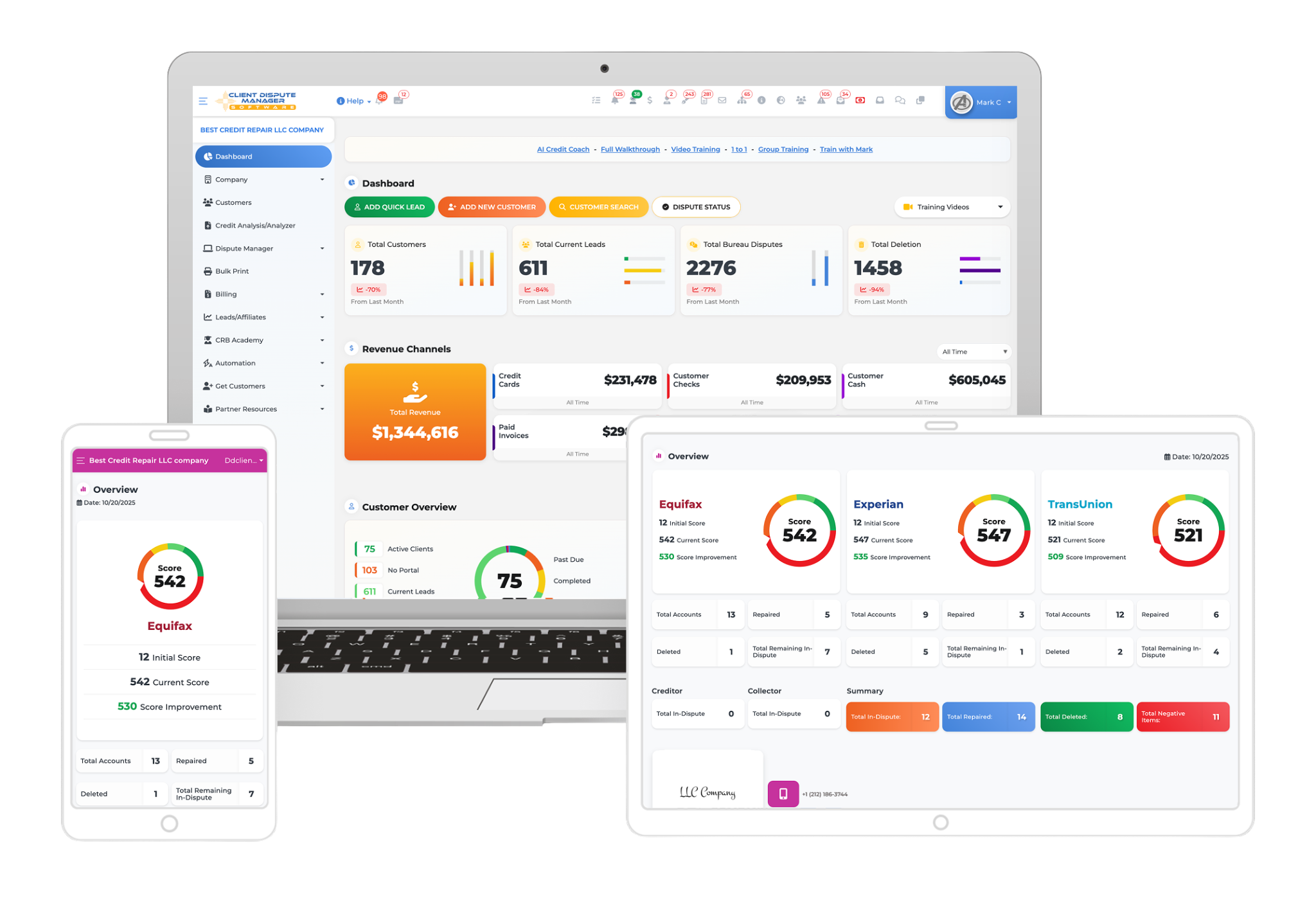
Client Dispute Manager Software is credit repair software built specifically for businesses that manage disputes on behalf of clients. It centralizes the entire dispute workflow from initial credit report import to submission tracking, response monitoring, and client communication so credit repair businesses can handle more clients without losing control of active cases.
Managing the eight-step dispute process manually works when you are starting out. But as your client list grows, the gaps become costly. Deadlines get missed. Disputes go unfollowed. Clients stop hearing from you.
Client Dispute Manager Software was built by Mark Clayborne, a credit repair specialist with over a decade of experience, specifically to solve the operational challenges that credit repair businesses face as they scale. It is not generic business software adapted for credit repair. It was designed from the ground up for this industry and this workflow.
Start Today and Explore the Features Firsthand!
Key Features of Client Dispute Manager Software
Client Dispute Manager gives credit repair businesses the tools to run a complete, compliant, and scalable operation from a single platform. Here is what the software includes:
- One-Click Credit Report Import: Pull credit reports directly from trusted platforms into the system in seconds, eliminating manual data entry and reducing review time significantly.
- Automated Dispute Workflow: Streamline Metro 2, AI-powered, manual, and system disputes from one dashboard. Generate unique, compliant dispute letters using the AI Rewriter and Metro 2 Attack Engine without starting from scratch on every case.
- Client Management and Progress Tracking: Monitor every client’s dispute status, track active cases, and never miss a follow-up deadline. The software gives you a clear view of where each client stands at every stage of the process.
- Self-Service Client Onboarding: Clients can sign up, review service agreements, acknowledge CROA disclosures, and submit payment details automatically, without requiring you to manage the onboarding process manually for every new client.
- Smart Interviewer and Analyzer: Use built-in tools to conduct client intake interviews and analyze credit reports systematically, so the review process is structured and consistent across every case.
- Automated Client Communication: Send dispute updates, progress reports, SMS notifications, and personalized emails directly from the platform. Clients stay informed without you having to manage communication individually.
- Fast Checker: Instantly verify dispute deletions without logging into multiple bureau portals, saving significant time during the post-dispute review phase.
- Legal Contracts and Compliance: Access ready-made contract templates that include required CROA disclosures and client agreements, keeping your business legally protected from day one.
- Built-In Affiliate and Team Management: Manage referral partners, track commissions, and assign employee roles with custom permissions as your business grows beyond a solo operation.
- Certifications and Training: Every CDMS membership includes access to professional certifications covering credit repair, FCRA, FDCPA, FCBA, and FICO scoring, giving you the credentials to build client trust and stand out in a competitive market.
If you are ready to move from managing your credit repair business manually to running it on a system built for scale, Client Dispute Manager Software offers a 30-day free trial with no credit card required. Start your free trial today and see how much faster the entire dispute process moves when everything runs from one place.
Start Today and Explore the Features Firsthand!
Frequently Asked Questions About Reading Credit Reports for Credit Repair
How Often Should a Credit Repair Business Pull a Client's Credit Report?
A credit repair business should pull a client’s credit report at the start of the engagement and again after each round of disputes is resolved, typically every 30 to 45 days. Regular monitoring ensures that dispute outcomes are captured accurately and that any new errors or re-aged items are caught and addressed quickly.
Pulling reports too infrequently means you may miss changes that affect your dispute strategy. Bureaus update credit files on their own schedule, and a deletion confirmed in one round may not appear on the updated report for several weeks.
Building a consistent review cadence into your client workflow keeps every case moving forward and gives your clients visible, measurable progress at each stage.
What Is the Difference Between Disputing With the Bureau vs. the Furnisher?
Disputing with the credit bureau asks the bureau to investigate whether the information a furnisher reported is accurate. Disputing directly with the furnisher under FCRA Section 623 challenges the data at its source, the original creditor or collector. For persistent errors that survive a bureau dispute, going directly to the furnisher is often the more effective next step.
When a bureau investigates a dispute, it contacts the furnisher and asks them to verify the information. If the furnisher confirms it without reviewing the actual account records, the bureau will mark the item as verified and leave it on the report. Disputing directly with the furnisher bypasses this process and requires the furnisher to conduct its own investigation.
If the furnisher cannot verify the accuracy of what they reported, they are legally required under FCRA Section 623 to correct or delete the information and notify all three bureaus of the change.
Can You Dispute With All Three Bureaus at the Same Time?
Yes, you can file disputes with Equifax, Experian, and TransUnion simultaneously. Since each bureau operates independently, an error on one report does not automatically get corrected on the others. If the same inaccuracy appears across all three reports, each bureau must be disputed separately to ensure the correction is made across all of a client’s credit files.
Filing simultaneously saves time and shortens the overall dispute timeline for your client. However, it also requires careful tracking, because each bureau will respond independently and on its own schedule.
Make sure every simultaneous submission is logged with the correct bureau, submission date, and expected response deadline so no investigation window gets missed during the process.
What Happens if a Bureau Dismisses a Dispute as Frivolous?
If a bureau dismisses a dispute as frivolous, it must notify the consumer within five business days explaining why. The credit repair business should respond with a more detailed letter that provides additional evidence and specifically cites the FCRA violation being challenged. If the bureau continues to refuse investigation without valid reason, a complaint can be filed with the Consumer Financial Protection Bureau.
A frivolous determination is not a final answer. It is a signal that the dispute needs more specificity and stronger documentation. Review the original letter, identify what was missing or too vague, and resubmit with clearer language, more precise account details, and additional supporting documentation.
FCRA Section 611 gives consumers the right to a legitimate investigation, and a bureau that repeatedly dismisses well-documented disputes without cause is itself in violation of that obligation.
How Long Does the Full Dispute Process Take?

A single dispute round takes a minimum of 30 days, as that is the bureau’s legal investigation window under FCRA Section 611. However, the full credit repair process for a client typically takes three to six months, depending on the number of errors, whether furnishers need to be separately disputed, and how quickly bureaus update the credit file after a successful dispute.
Setting accurate expectations with clients from the beginning is one of the most important things a credit repair business can do. Clients who understand the timeline stay engaged and trust the process. Clients who expected overnight results become frustrated and difficult to retain.
Be transparent about the 30-day investigation window, explain that multiple rounds of disputes may be necessary for complex cases, and use progress reports at each stage to show clients exactly what has changed and what is still in process. That transparency is what builds long-term client relationships and a referral-driven business.
Conclusion
A single dispute round takes a minimum of 30 days, as that is the bureau’s legal investigation window under FCRA Section 611. However, the full credit repair process for a client typically takes three to six months, depending on the number of errors, whether furnishers need to be separately disputed, and how quickly bureaus update the credit file after a successful dispute.
Setting accurate expectations with clients from the beginning is one of the most important things a credit repair business can do. Clients who understand the timeline stay engaged and trust the process. Clients who expected overnight results become frustrated and difficult to retain.
Be transparent about the 30-day investigation window, explain that multiple rounds of disputes may be necessary for complex cases, and use progress reports at each stage to show clients exactly what has changed and what is still in process. That transparency is what builds long-term client relationships and a referral-driven business.

Mark Clayborne
Mark Clayborne specializes in credit repair, starting and running credit repair businesses. He's passionate about helping businesses gain freedom from their 9-5 and live the life they really want. You can follow him on YouTube.
Start Today and Explore the Features Firsthand!
Below Is More Content For Your Review: