Get Started for as Low as $49 for the First Month: Click Here
Written by Mark Clayborne
Last updated on September 15, 2026

Setting up an email marketing campaign for a credit repair business requires four components working in sequence: an opt-in list built from people who have actively requested information, a welcome sequence that establishes credibility within 48 hours, a nurture series of five to seven emails that educates prospects on their FCRA rights before introducing your services, and a CRM that delivers and tracks every message automatically.
Email marketing for a credit repair business is one of the highest-return acquisition channels available because every dollar invested in building the list compounds over time as the subscriber base grows and the automated nurture sequence converts leads weeks or months after they first opted in.
Every commercial email in this system must comply with the CAN-SPAM Act (15 U.S.C. 7701): physical mailing address, honest subject line that accurately reflects the email content, and a working unsubscribe link honoured within 10 business days.
Email copy must never contain guarantee language, advance fee offers, or claims that accurate negative information can be removed from a credit report, because CROA Section 1679b (15 U.S.C. 1679b) applies to commercial email promoting credit repair services with the same force it applies to paid advertising.
Email is one of eight client acquisition channels covered in the complete guide on how to get clients for a credit repair business, and it is the channel that produces the most consistent results over time when the four components connect into a single automated pipeline.

Effective email marketing campaigns for credit repair prospects follow an education-first structure: the first two emails in any sequence build credibility by explaining FCRA rights and what can legally be disputed before any service offer appears.
A prospect who understands their rights before receiving a pitch is a more qualified buyer than one who receives a promotional offer cold, because they have already self-identified as someone with a credit problem who is actively researching solutions.
An email marketing campaign for a credit repair business that leads with education converts at higher rates than one that leads with a service offer because it positions the business as the authority before it positions itself as the solution.
Two campaign types serve different prospect segments and must not be confused. The warm nurture sequence is for opt-in leads who have actively requested information through a lead magnet, a Facebook lead form, or a consultation request: these prospects have raised their hand and need a structured five-email journey from awareness to consultation booking.
The re-engagement campaign is for leads who opted in weeks or months earlier but went cold without booking: these prospects need a two to three email reactivation sequence with a fresh hook, a specific outcome example with the required FTC results disclaimer, and a time-limited consultation offer.
Running both campaign types simultaneously ensures that every lead in the pipeline, warm or cold, receives a message that matches where they are in the decision process.
The subject line is the single most leveraged element in a credit repair email campaign because it determines whether the email is opened at all. Every subject line must be honest under CAN-SPAM: it must accurately reflect the content of the email without misleading the recipient about what is inside.
Subject lines that perform consistently well for credit repair email campaigns are question-based questions that name a specific problem (‘What Is Actually on Your Credit Report Right Now?’), curiosity hooks built on FCRA rights (‘The Federal Law That Lets You Challenge Errors on Your Credit Report’), and specificity statements that name a concrete timeframe or outcome without making guarantee claims (‘One of Our Clients Completed 14 Disputes in 90 Days’).
That last type requires an FTC-required results disclaimer immediately below the testimonial in the email body: ‘Individual results vary. These results are not guaranteed and may not be typical.’ Attract credit repair clients through email by building subject line discipline into every campaign from the first send.
A credit repair email list that converts is built exclusively from opt-in subscribers who have actively requested information, not from purchased, rented, or scraped contact lists.
Purchased lists produce low open rates, high spam complaint rates, and CAN-SPAM liability if the original consent is not properly documented. A spam complaint rate above 0.1 percent triggers ISP filtering that suppresses deliverability across every future campaign regardless of how good the content is.
Building the credit repair email list from opt-in sources takes more time upfront than buying a list but produces a subscriber base that opens, reads, and converts at rates that purchased lists cannot match. The four primary list-building mechanisms for a credit repair business each attract a different type of prospect at a different stage of the decision process.
A lead magnet on the landing page, such as a free FCRA rights guide, a credit report error checklist, or a dispute letter template overview, attracts prospects in the early research stage who are not yet ready to book a consultation but are actively looking for information.
A consultation booking confirmation sequence captures the contact details of every prospect who books a consultation and adds them to the email list with a tag indicating they have already taken the highest-value action, which means they receive a different message sequence than cold opt-ins.
A Facebook lead form opt-in connected directly to a CRM captures prospects from paid social media campaigns without requiring a landing page visit, reducing friction and increasing list growth rate.
An exit-intent popup on the website offers a final opportunity to capture an email address from a visitor who would otherwise leave without converting: keep the popup form to two fields, name and email, and the offer specific, such as a link to the free credit report tool at AnnualCreditReport.com.
For the full breakdown of lead capture tools that connect to each of these opt-in mechanisms, the guide on lead generation tools for credit repair covers CRM selection, chatbot setup, and scheduling widget integration in detail.
Every opt-in mechanism must capture documented consent before the first email is sent. Under CAN-SPAM, the business must be able to demonstrate how and when each subscriber opted in, because undocumented consent is indistinguishable from no consent in a regulatory investigation.
Any opt-in mechanism that collects credit situation information alongside contact details, such as a form that asks for the subscriber’s current credit score range or which items they want to dispute, triggers GLBA Safeguards Rule (16 C.F.R. Part 314) data security obligations before the first message is sent.
Tag every opt-in by source in the CRM before the first message is delivered so that email list building credit repair reporting shows which opt-in sources produce the highest-quality leads rather than just the highest volume.

A credit repair email sequence that books consultations is structured around five emails delivered over 14 days. The sequence converts because it builds trust before making an ask: the first two emails educate the prospect on their legal rights and what qualifies for a dispute, the third demonstrates a realistic client outcome with the required FTC disclaimer, the fourth handles the three objections that stop most prospects from booking, and the fifth makes the consultation offer with a genuine deadline.
A credit repair nurture sequence that follows this structure converts at higher rates than one that leads with the service offer in the first email because the prospect arrives at Email 5 already understanding the problem, the legal framework, and a realistic outcome before they are asked to take any action.
The credit repair drip campaign version of this sequence delivers the same five emails but spaces them over 21 days for prospects in the re-engagement stage who need more time between touches.
The CTA in every email must be a free consultation booking, never an upfront payment request, because CROA Section 1679b and TSR 16 C.F.R. 310.4(a)(2)(i) both prohibit collecting fees before services are fully performed.
A CTA that says ‘Book your free consultation and we will review your specific credit report together’ is compliant. A CTA that says ‘Sign up today for $99 and we start immediately’ is not, because it describes collecting a fee before any service is performed.
Every subject line in the credit repair email sequence must honestly reflect the email’s content under CAN-SPAM: no subject line may promise a specific score outcome, and none may be written in a way that misleads the recipient about what is inside the message.
| Subject Line Angle | Body Content Focus | Call To Action | Compliance Requirement | |
|---|---|---|---|---|
| Email 1 Day 1 | "Your Free FCRA Rights Guide Is Inside" | Confirms opt-in, delivers the lead magnet, explains the consumer's right to dispute inaccurate information directly with the credit bureaus at no cost | Download the guide / Book a free consultation | CROA 1679c requires self-dispute rights disclosure. CAN-SPAM requires honest subject lines. |
| Email 2 Day 3 | "What Can Actually Be Disputed On A Credit Report?" | Explains what qualifies for dispute under the FCRA: inaccurate, incomplete, or unverifiable information only. Clearly states that accurate lawfully reported items cannot be removed. | Read the full explanation on your site | CROA 1679b prohibits claims that accurate items can be removed. FTC Act requires truthful statements. |
| Email 3 Day 6 | "What One Of Our Clients Experienced After 90 Days" | Specific client case study explaining which items were disputed, why they qualified under the FCRA, the timeline, and the outcome. FTC disclaimer placed directly after the results. | Book your free consultation | FTC 16 C.F.R. Part 255 requires the disclaimer: "Individual results vary. These results are not guaranteed and may not be typical." |
| Email 4 Day 9 | "The 3 Questions People Ask Before Starting Credit Repair" | Answers the most common objections honestly: pricing, timeline expectations, and whether consumers can dispute items themselves for free | Book your free consultation | CROA 1679b prohibits guarantee language. CAN-SPAM requires subject lines to accurately reflect email content. |
| Email 5 Day 14 | "Last Chance: Free Consultation Available This Week" | Final offer with a real deadline, consultation recap, realistic discussion of disputable items and timelines, plus a direct booking link | Book before [real date] | CAN-SPAM prohibits fake urgency. CROA 1679b prohibits advance fee language. TSR 310.4 prohibits collecting fees before services are performed. |
The credit repair email sequence table above is the operational blueprint for the nurture campaign. Each email should run 150 to 250 words in the body.
Shorter emails outperform longer ones in this sequence because the prospect is still evaluating whether to engage, and a dense long-form email in the early stages signals that the business does not respect the prospect’s time.
The credit repair drip campaign that converts most consistently is tight, specific, and legally clean in every message from the subject line through the CTA.

Credit repair email deliverability depends on three factors: sender reputation, list hygiene, and authentication setup. Neglecting any one of them reduces every campaign’s inbox placement rate regardless of how well the email copy is written.
A credit repair email list with more than two percent invalid addresses will damage sender reputation and reduce deliverability across all future campaigns, because ISPs track bounce rates per sending domain and begin filtering messages from domains with elevated bounce activity.
Email verification services improve credit repair email deliverability by removing invalid, duplicate, role-based, and temporary addresses from the list before each campaign, which keeps bounce rates below the 0.5 percent threshold that triggers ISP suppression.
The practical verification protocol for a credit repair email list is straightforward: verify every new list segment before the first send, and re-verify any list that has not been mailed in 90 days, because email addresses decay at approximately two percent per month through job changes, domain closures, and inbox abandonment.
Maintain a hard bounce rate below 0.5 percent and a spam complaint rate below 0.1 percent as the two non-negotiable performance thresholds.
Exceeding either threshold at a major email service provider triggers automatic account review and potential suspension, which means a deliverability failure is a compliance failure in practical terms: a business whose email account is suspended cannot meet its CAN-SPAM obligation to honour unsubscribe requests within 10 business days.
Sender authentication is the technical infrastructure that verifies to receiving mail servers that the email is genuinely sent by the domain it claims. Three protocols must be configured before any credit repair email campaign launches.
SPF (Sender Policy Framework) tells receiving servers which IP addresses are authorised to send email on behalf of the domain. DKIM (DomainKeys Identified Mail) adds a cryptographic signature to every outgoing message that receiving servers verify against the domain’s DNS records.
DMARC (Domain-based Message Authentication, Reporting and Conformance) tells receiving servers what to do with messages that fail SPF or DKIM checks, and it provides reporting that shows who is attempting to send email from your domain. All three are DNS records that take fewer than 30 minutes to configure and permanently improve inbox placement rates.
A new sending domain used for credit repair email marketing also requires a warm-up protocol: start with 50 messages per day to the most engaged subscribers on the list, increase volume by 50 percent every three days, and reach full campaign volume only after two to three weeks of consistent inbox placement. Skipping the warm-up protocol on a new domain almost always results in spam folder placement for the first major send.
Automating marketing tasks for a credit repair business means configuring the CRM to send the right email to the right prospect at the right time without manual intervention per contact. Three automation sequences cover the full prospect lifecycle from opt-in to signed client.
The welcome and nurture sequence triggers the moment a prospect joins the email list, delivering the five-email series described in the previous section on a pre-set schedule without requiring any manual send.
The consultation reminder sequence triggers when a prospect books a consultation, delivering a confirmation email, a 24-hour reminder, and a one-hour reminder with the meeting link, all automatically.
The re-engagement drip triggers after a prospect has been in the database for 21 days without booking a consultation, delivering two to three emails with a fresh angle on why to book now.
Automated email follow-up for credit repair is the function that converts the most leads because it eliminates the follow-up gap that exists in every business that manages leads manually.
The research on lead response times is clear: a prospect contacted within five minutes of opt-in is significantly more likely to book a consultation than one reached manually 30 minutes later. No credit repair business owner can respond manually to every new opt-in within five minutes across all channels simultaneously.
A CRM with automated sequence triggering sends a personalised first-touch email within seconds of list sign-up, moves the prospect through the nurture sequence on a defined schedule, and routes non-responders to the re-engagement drip without any human action required between opt-in and booked consultation.
Email marketing automation for credit repair removes the manual tracking burden that causes most business owners to spend their time on administration rather than client acquisition.
Selecting a CRM for email marketing automation in a credit repair business requires evaluating four capabilities: sequence trigger flexibility (can it trigger different sequences based on which opt-in source the prospect came from), sequence branching (can it send different emails to prospects who opened Email 3 but did not click vs. those who did not open it), deliverability reporting (does it show open rate, click rate, and unsubscribe rate per email in the sequence), and compliance features (does it automatically include the physical mailing address and manage unsubscribe requests in every automated email).
Email marketing automation for credit repair that meets all four criteria eliminates the manual tracking and follow-up work that causes business owners to spend their time on administration rather than on client acquisition.
Every automated email in every sequence must include the physical mailing address and working unsubscribe mechanism required by CAN-SPAM, and every automated email promoting credit repair services must comply with CROA Section 1679b regardless of whether it was written manually or generated from a template.
Any automated SMS messages sent alongside email sequences in the same CRM require prior express written consent collected separately from the email opt-in under the TCPA (47 U.S.C. 227).

Both cold calling and cold email are effective for credit repair lead generation when used within their distinct legal frameworks, and both produce different results for different prospect types.
Cold email credit repair outreach does not require prior opt-in consent for business-to-business communication under CAN-SPAM, but every cold commercial email must include the sender’s physical mailing address, an honest subject line, a clear identification that the message is an advertisement, and a working unsubscribe mechanism that is honoured within 10 business days.
Cold email for credit repair is most effective for reaching referral partners such as mortgage brokers, real estate agents, and car dealership finance managers whose professional email addresses are publicly listed and whose business model creates a natural need for the service being offered.
An email marketing campaign credit repair operators use for referral partner outreach differs significantly from a consumer nurture sequence: it is shorter, more direct, and focused on the partner’s business problem rather than the consumer’s credit problem.
Cold calling for credit repair services falls under the Telemarketing Sales Rule (TSR, 16 C.F.R. 310.4), which requires specific oral disclosures before any sales pitch, prohibits collecting advance fees in connection with any telemarketing call, and requires the business to maintain and scrub its call lists against the National Do Not Call Registry.
The TSR advance fee prohibition means that any call that ends with a payment agreement before services are performed is a TSR violation regardless of how the call began.
Cold calling for direct consumer acquisition carries higher compliance complexity than cold email because the TSR’s oral disclosure requirements and do-not-call obligations apply immediately to every outbound call, whereas cold email compliance requirements are largely mechanical and can be automated into the sending platform.
The hybrid sequence that produces the highest consultation booking rate from cold outreach is cold email first, followed by a phone call to prospects who have opened the email but have not responded within 48 hours.
The email open confirms that the prospect has seen the message and has at least passing interest in the content, which makes the follow-up phone call a warm touch rather than a cold one.
The email outreach credit repair system that works best for referral partner development uses this sequence: a personalised cold email introducing the partnership opportunity, a follow-up call to email openers, a second email to non-openers with a different subject line angle, and a final call to second-email openers before removing the contact from the active sequence.
Consumer acquisition through cold outreach is more effective through paid social media and SEO than through either cold email or cold calling, because consumers searching for credit repair through organic or paid channels are already in the decision stage rather than the awareness stage.
Effective direct mail strategies for attracting credit repair clients target high-intent audiences who have already experienced the specific life event that creates demand for credit repair services. Recent bankruptcy filers whose court filings are public record are one of the most receptive audiences for credit repair direct mail because the bankruptcy discharge creates an immediate credit rebuilding need.
Mortgage denial applicants who received a credit-based adverse action notice from a lender represent another high-intent audience because the denial letter itself confirms the problem and the motivation to fix it. Post-repossession and post-foreclosure households round out the three primary direct mail audiences for credit repair, because each event creates an extended period of credit score damage that professional credit repair can help address within the boundaries of what the FCRA allows.
Direct mail copy for credit repair must comply with CROA advertising restrictions and FTC Act Section 5 with the same rigour as digital advertising. No mailer may promise guaranteed results, specific score increases, or removal of accurate negative information, and no mailer may include an advance fee offer or suggest that payment is required before services begin.
Some states require credit repair businesses to include their Credit Services Organization registration number or a state-mandated disclosure statement in all advertising, which may include direct mail, so verify state-specific CSO advertising requirements before mailing in any new state.
The most effective direct mail format for credit repair is a personal letter rather than a postcard, because a letter can include enough context to answer the three primary objections (cost, timeline, legality) without the space constraints of a postcard, and because an envelope that requires the recipient to open it generates higher read rates than a postcard that competes for attention on a kitchen counter.
Direct mail works best for a credit repair business when it drives the prospect to a digital opt-in rather than to a phone number. A QR code on the mailer that links to a landing page with a lead magnet offer, such as a free FCRA rights guide or a free credit report review, converts mail recipients into email list subscribers who then enter the five-email nurture sequence described earlier.
That bridge from physical mail to email follow-up allows the credit repair business to reach an audience that is not reachable through digital advertising while still delivering the automated follow-up that digital channels make possible.
Marketing channels for credit repair that connect direct mail to email sequences produce signed clients at a lower combined cost per acquisition than either channel operating in isolation.

Setting up an email marketing campaign for a credit repair business requires four steps executed in sequence. First, build an opt-in list from lead magnets, consultation booking confirmations, Facebook lead form integrations, and exit-intent popups on the website. Second, configure a CRM to trigger the welcome sequence automatically when each new subscriber joins the list.
Third, write the five-email nurture series covering FCRA rights education, a disputable items explainer, a client case study with the FTC required results disclaimer, an objection FAQ, and the final consultation offer. Fourth, connect the consultation CTA in every email to a scheduling link that routes the prospect directly into a booked appointment. An email marketing campaign for a credit repair business that executes all four steps produces a consistent pipeline of consultation bookings without requiring manual follow-up on every inquiry.
The best platforms for credit repair client outreach campaigns fall into three categories. CRM-integrated email platforms handle sequence automation, deliverability reporting, and unsubscribe management from a single system.
Standalone email service providers offer broader template libraries and deliverability infrastructure but require a separate CRM connection for sequence automation. All-in-one marketing automation platforms combine email, SMS, and pipeline management in one tool, which reduces the number of integrations required and gives the credit repair business owner a single dashboard showing every lead’s position in the outreach sequence.
The evaluation criteria that matter most are sequence trigger flexibility, deliverability reporting at the individual email level, CAN-SPAM compliance features including automatic physical address insertion and unsubscribe management, and whether the platform’s template library can be configured to avoid CROA-prohibited claim language across all automated messages.
Automating credit repair client follow-ups requires a CRM configured with three trigger-based sequences. The opt-in welcome sequence triggers the moment a new subscriber joins the list, delivering the five-email nurture series over 14 days without any manual intervention.
The consultation reminder sequence triggers when a prospect books a consultation, delivering a booking confirmation, a 24-hour reminder, and a one-hour reminder with the meeting link automatically. The re-engagement drip triggers after 21 days of list inactivity with no consultation booked, delivering two to three emails with a fresh angle on the consultation offer.
Tools for sending automated updates to credit repair clients must comply with CAN-SPAM for every email in every sequence, and any SMS automation added to the same pipeline requires prior express written consent collected separately from the email opt-in under the TCPA (47 U.S.C. 227).
Three software tool categories automate client outreach for a credit repair business. A CRM with sequence automation sends email and SMS follow-up without manual triggers per contact, tracks open and click rates for every message in the sequence, and routes non-responders into re-engagement campaigns automatically.
A chatbot on the credit repair website qualifies visitors at any hour, answers the five pre-conversion objections, and routes qualified prospects to a scheduling link without human involvement. A scheduling tool eliminates the back-and-forth of manual consultation booking by letting the prospect choose a time directly from a calendar that connects to the CRM and triggers the consultation reminder sequence.
Automating marketing tasks for a credit repair business using all three tools connected in a single pipeline means every prospect from opt-in to booked consultation moves through the funnel at machine speed rather than at the speed of the business owner’s available time.
The tools that work best for sending automated updates to credit repair clients are CRM email sequences for transactional and progress-related messages, SMS automation for high-priority milestone alerts, and client portal notification systems for real-time case visibility.
The four update types that maintain the highest credit repair client engagement are dispute submission confirmation (sent the day a dispute is filed), bureau response received notification (sent when the credit bureau responds to a dispute), item deleted or updated alert (sent when a deletion or correction is confirmed), and the monthly progress report (sent on a fixed date each month showing all items in progress, items resolved, and current score if tracked).
All automated update messages must comply with CAN-SPAM for email, TCPA for SMS, and CROA Section 1679b for any content that references dispute activity, credit outcomes, or service results, because those messages promote credit repair services even when framed as client updates.
An email marketing campaign for a credit repair business that generates consistent signed clients is a four-layer system: an opt-in list built from documented consent, a five-email nurture sequence that educates before it sells, automation that eliminates the follow-up gap between opt-in and booked consultation, and deliverability management that keeps every message reaching the inbox.
Email marketing for a credit repair business produces the highest long-term return of any acquisition channel because the cost per message is near zero at scale, the opt-in list compounds in value as it grows, and a well-maintained nurture sequence converts leads weeks or months after they first opted in without requiring any additional spend.
Every email in every sequence must comply with CAN-SPAM (15 U.S.C. 7701), CROA Section 1679b, and the TCPA where SMS automation is combined, because a compliance failure in the email channel carries consequences that no campaign volume can offset.
Managing an opt-in list, a five-email nurture sequence, a re-engagement drip, CROA-compliant onboarding documentation, dispute tracking, and automated client progress reports across separate tools creates compliance gaps at every manual handoff between systems.
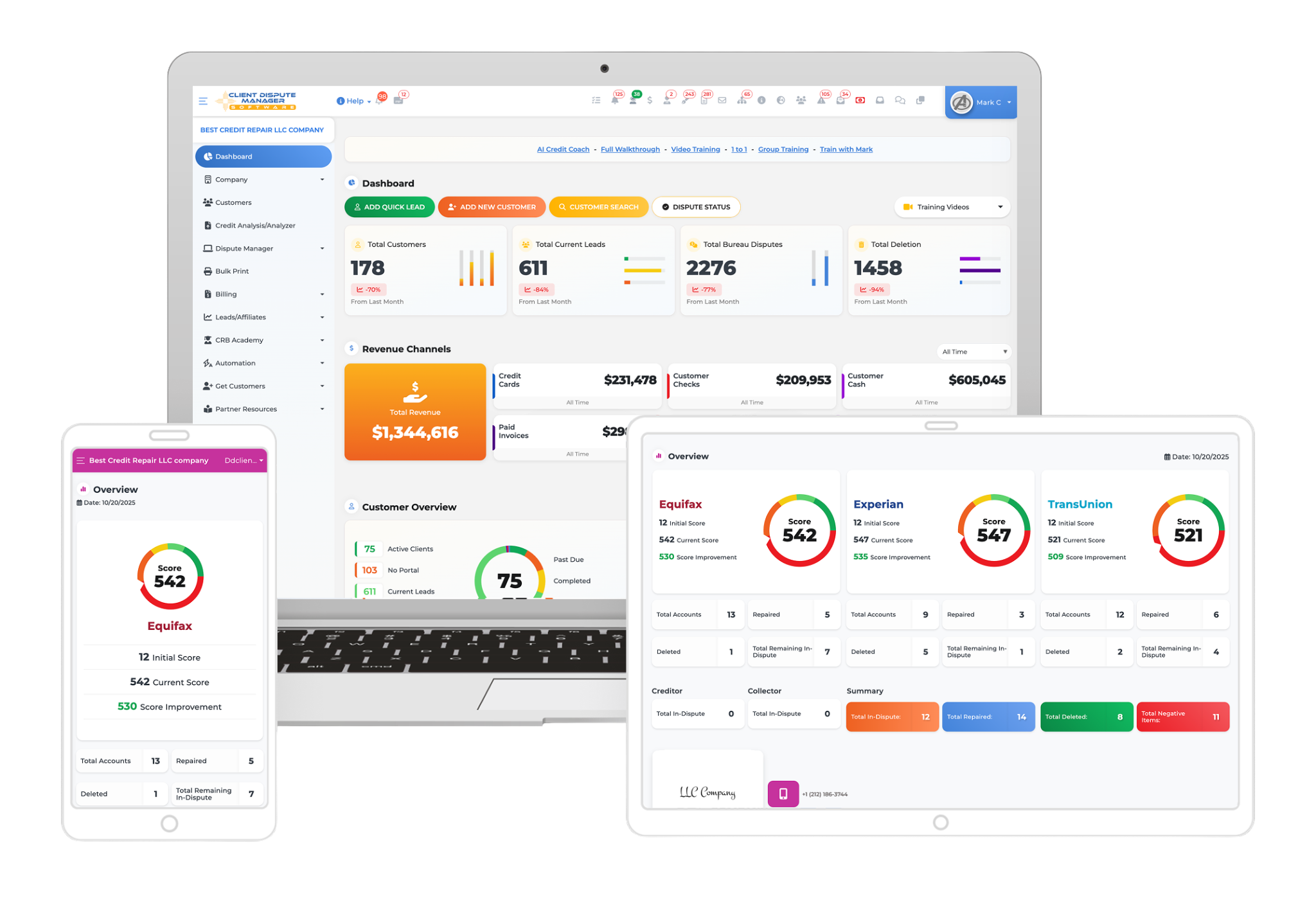
Client Dispute Manager Software centralises every part of that workflow in a single platform: CROA-compliant client intake with automated contract delivery and electronic signature, dispute tracking across all three credit bureaus, automated client progress reports delivered on a fixed schedule, and a client portal that keeps clients informed in real time without requiring manual status updates from the business owner.
When the credit repair software handles the administrative and compliance burden automatically, every hour recovered from manual follow-up goes directly into acquiring the next email subscriber and the next signed client. Try Client Dispute Manager Software free for 30 days at clientdisputemanagersoftware.com. No credit card required.

Mark Clayborne specializes in credit repair, starting and running credit repair businesses. He's passionate about helping businesses gain freedom from their 9-5 and live the life they really want. You can follow him on YouTube.
Experience our credit repair software, risk-free.