Get Started for as Low as $49 for the First Month: Click Here
Written by Mark Clayborne
Last updated on September 16, 2026
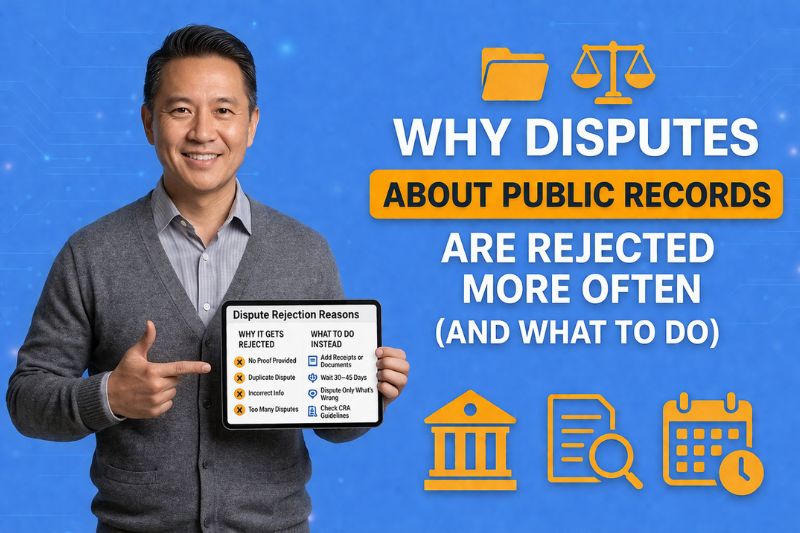
Disputes about public records, covering bankruptcies, civil judgments, and tax liens, are rejected more often than account-level disputes for three specific structural reasons.
The dispute process for public records differs from the process for a credit card or loan tradeline in ways that reduce the consumer’s available options and increase the bureau’s ability to verify the information quickly without engaging a furnisher at all. Understanding those three differences tells you exactly what to do differently when a public record dispute fails.
This article covers what those structural differences are, what the FCRA actually permits consumers to dispute on public records, what the reporting period limits are for bankruptcies and judgments, how the 2017 National Consumer Assistance Plan changed what appears on credit reports, and the decision framework for determining whether to dispute or request removal based on the specific situation you are dealing with.
Common reasons disputes against public records are rejected fall into three structural categories that are unique to public record items and do not apply to standard account-level disputes.
The first is that furnisher direct dispute rights under Regulation V do not apply to information derived from public records, which removes the parallel dispute path that consumers can use for account disputes.
The second is that credit bureaus can verify public records against court databases and official government sources rather than relying solely on furnisher confirmation.
The third is that most public record disputes involve dates, and those dates are typically verifiable directly against court records, making them harder to contradict with consumer-generated documentation.
| Scenario | Right Action | FCRA Basis |
|---|---|---|
| Closed Account With Inaccurate Information Within The 7-Year Reporting Period | Standard dispute under Section 611(a)(1), certified mail with supporting documentation naming the specific error | FCRA Section 611(a)(1) -- investigation obligation applies regardless of account status |
| Closed Account That Has Exceeded Its Section 605 Reporting Period | Section 605 removal request citing date of first delinquency and expiration calculation; not a standard accuracy dispute | FCRA Section 605 -- bureau is prohibited from reporting information past the limit |
| Collection Account With An Incorrect Date Of First Delinquency That Extends The Reporting Period | Dispute the specific date of first delinquency as a factual inaccuracy under Section 611(a)(1); attach documentation showing the correct original delinquency date | FCRA Section 611(a)(1) -- incorrect reporting period start date is a factual inaccuracy subject to dispute |
| Item Within 1 To 2 Years Of Its Section 605 Expiration With No Available Documentation | Weigh the effort against natural expiration; if documentation is unavailable and the item expires within 18 months, waiting is likely more efficient than disputing without evidence | FCRA Section 605 reporting period calculation |
| Item At Or Past Its Section 605 Reporting Period Limit | Written removal request to each bureau citing Section 605 with the expiration calculation; CFPB complaint if the bureau refuses to remove | FCRA Section 605 -- refusal to remove a verified expired item is a violation |
The practical consequence of the Regulation V exception is significant. For a rejected account dispute, a consumer has two investigation paths: re-dispute with the bureau, and dispute directly with the furnisher. For a rejected public record dispute, only one path exists. The bureau dispute under FCRA Section 611(a)(1) is the only mechanism.
When it fails, the escalation goes directly to the CFPB complaint and, where applicable, the court record correction, without the furnisher direct step that exists for account items. The court database verification method changes the evidentiary standard for public record disputes.
For an account dispute, a bank statement showing a payment directly contradicts what the furnisher reported in its database. For a public record dispute, a consumer-generated document does not contradict what the court’s official system shows. The only evidence that carries weight in a public record dispute is a document issued by the court itself.
Yes. You can dispute a bankruptcy on your credit report. The FCRA dispute right under Section 611(a)(1) applies to any item on a credit report, including public records.
The dispute is appropriate when the bankruptcy entry contains a specific factual inaccuracy: the wrong chapter is listed, the filing date is incorrect, the discharge date is wrong, the bankruptcy belongs to someone with a similar name in a mixed file situation, or the bankruptcy was dismissed but the report shows it as discharged.
What is not an appropriate dispute basis is disputing a correctly reported bankruptcy because it is negative. A Chapter 7 bankruptcy filed and discharged on the dates listed is accurately reported, and the bureau will verify that result because the court record confirms it.
The FCRA does not give consumers the right to remove accurate information. What the FCRA provides for a correctly reported bankruptcy that has exceeded its Section 605 reporting period is a removal request, which is a different process from a standard accuracy dispute. The reporting periods are ten years from the filing date for Chapter 7 and seven years from the filing date for Chapter 13.
Regulation V explicitly excludes information derived from public records from the furnisher direct dispute obligation. The specific provision is 12 C.F.R. 1022.43(b)(1)(iv), which lists public records as one of the categories for which a furnisher is not required to investigate a direct dispute.
This exclusion means consumers cannot bypass the credit bureau and dispute a bankruptcy, judgment, or lien entry directly with the entity that reported it to the bureau. The bureau dispute under FCRA Section 611(a)(1) is the only required investigation path for public record items.
The rationale for the public record exclusion follows from the nature of the information. Bankruptcies, judgments, and liens are derived from official court proceedings and government filings, not from the furnisher’s own account records.
The furnisher that reported the public record to the bureau typically obtained the information from court data rather than from a direct account relationship with the consumer. Requiring the furnisher to investigate a direct dispute about information it obtained from public court records would not meaningfully add to what the bureau can already verify directly against those same court records.
The practical consequence for consumers is that the rejection of a public record dispute has fewer follow-on options than the rejection of an account dispute. A rejected account dispute can be followed by a furnisher direct dispute under Regulation V, which creates a second independent investigation obligation.
A rejected public record dispute has no equivalent second path. The CFPB complaint becomes the primary escalation tool after a bureau public record dispute is rejected, because the CFPB’s 15-day response requirement creates the most reliable path to escalated review when the only dispute path available has already returned a verified result.
For standard account disputes, the bureau sends a coded inquiry through e-OSCAR to the furnisher, which responds with a confirmation code. That exchange takes less than 24 hours in most cases and does not require the furnisher to review original documents.
For public records, credit bureaus can verify information directly against court databases and official government records without depending on furnisher confirmation at all. All three major credit bureaus have access to court record databases that allow them to confirm bankruptcy filing dates, judgment entry dates, lien filing dates, and case disposition status against court system data.
A consumer who disputes the filing date of a bankruptcy because they believe it is incorrect will typically receive a verified result not because the furnisher confirmed it, but because the bureau checked the court’s own record and found the date consistent with what was reported.
That verification source is also the reason court-sourced documents are the only effective evidence for public record disputes. A bank statement does not contradict a court record. A certified copy of the court’s filing showing a different date does. When the court record itself contains an error, the bureau’s verification will continue to confirm the incorrect information because it is verifying against the source of the error.
In those cases, correcting the underlying court record by filing the appropriate motion with the clerk of court is the necessary first step before re-disputing with the bureau. Once the court record reflects the accurate information, the bureau’s next verification will confirm the corrected data.

The FCRA Section 605 reporting period limits for public records determine how long each type of public record can legally appear on a credit report. The table below maps each public record type to its applicable reporting period and identifies the date that starts the clock.
Knowing the correct start date is as important as knowing the limit, because the start date is sometimes reported incorrectly by furnishers in ways that extend the reporting period beyond what Section 605 allows.
| Public Record Type | FCRA Reporting Period | Clock Starts From | Section 605 Reference |
|---|---|---|---|
| Chapter 7 Bankruptcy | 10 years | Date of filing, not the date of discharge | Section 605(a)(1) |
| Chapter 13 Bankruptcy | 7 years | Date of filing, not the date of completion or discharge | Section 605(a)(1) |
| Civil Judgments (Where Still Reported) | 7 years, or until the governing statute of limitations expires, whichever is longer | Date the judgment was entered by the court | Section 605(a)(2) |
| Federal Tax Liens (Paid) | 7 years | Date the lien was filed | Section 605(a)(3) |
| Satisfied Civil Judgments | 7 years | Date of satisfaction filing with the court, or entry date, whichever produces the longer period | Section 605(a)(2) |
The filing date starts the reporting period clock for both Chapter 7 and Chapter 13 bankruptcies, not the discharge date. A Chapter 7 bankruptcy that was filed in January 2015 and discharged in August 2015 began its ten-year reporting period in January 2015.
The ten-year limit expires in January 2025, at which point the bureau is prohibited from reporting it. If the credit report shows the filing date incorrectly in a way that extends the clock, disputing the specific date as a factual inaccuracy is a legitimate dispute basis under Section 611(a)(1).
The National Consumer Assistance Plan (NCAP), implemented by Equifax, Experian, and TransUnion in 2017 and 2018, changed what public records appear on credit reports but did not change the dispute process itself.
Under the NCAP, all three bureaus agreed to stop reporting civil judgments and tax liens that did not include at least three identifying data points: name, address, and either a Social Security number or a date of birth.
Because most public court records lack complete identifying information, the overwhelming majority of civil judgment and tax lien entries were removed from credit reports at that time.
If a civil judgment or tax lien still appears on your credit report today, the first step is to determine whether it meets the NCAP standards. Pull a copy of the court filing for the item and check whether it includes a name, current address, and either a Social Security number or date of birth.
If it does not include all three, the dispute basis is that the item does not meet the bureau’s own NCAP data standards and should not be appearing on the report. That is a different dispute basis from a standard accuracy dispute, and it is worth stating specifically in the dispute letter.
If the civil judgment or tax lien does meet the NCAP standards, the standard dispute process applies for any factual inaccuracy, and the Section 605 removal request applies if the item has exceeded its reporting period.
The NCAP did not create new dispute rights. It created a new category of items that should not appear on credit reports, and an item in that category that persists on the report has a specific, documentable basis for removal.

Removing a public record from a credit report requires identifying which situation applies to the specific item and which process the FCRA provides for that situation. Using the wrong process for the situation produces a result that the bureau can close without making a change. The table below maps the four most common public record scenarios to the correct action and the FCRA basis for each.
| Scenario | Right Action | FCRA Basis |
|---|---|---|
| Public record with a factual inaccuracy: wrong chapter, wrong date, wrong name, case dismissed but showing as discharged | Standard accuracy dispute under Section 611(a)(1), certified mail, attach the court-sourced document that directly contradicts the specific inaccuracy | FCRA Section 611(a)(1) -- investigation obligation applies to public records containing inaccurate information |
| Public record that has exceeded its Section 605 reporting period (Chapter 7 past 10 years, Chapter 13 or civil judgment past 7 years) | Written removal request citing FCRA Section 605, identifying the filing date and the reporting period expiration calculation; this is not a standard accuracy dispute | FCRA Section 605 -- bureau is prohibited from reporting items past the applicable time limit |
| Civil judgment or tax lien without complete NCAP identifiers (missing address, SSN, or date of birth) | Written dispute citing the bureau's own NCAP data standards; state that the item lacks the required identifiers and should be removed under the NCAP policies adopted in 2017 | NCAP bureau policy, supported by FCRA Section 611(a)(1) for the factual inaccuracy basis |
| Accurately reported public record within its reporting period with no factual inaccuracy | No actionable dispute basis; add a consumer statement under FCRA Section 611(b) to provide context for lenders; wait for Section 605 expiration | FCRA Section 611(b) -- consumer statement right for unresolved disputes |
The distinction between an accuracy dispute and a Section 605 removal request is not procedural. It determines what outcome you are legally entitled to. An accuracy dispute asks the bureau to investigate whether the information is correct.
A Section 605 removal request asks the bureau to delete the item because its time limit has expired, regardless of whether the information is accurate. Using an accuracy dispute for an item that is accurately reported but past its reporting period will produce a verified result, because the information is accurate. The correct tool is the removal request, not the dispute.
Court-sourced documentation is the key variable for accuracy disputes. An official certified copy of the bankruptcy discharge order, a court dismissal filing, a satisfaction of judgment filed with the court clerk, or a lien release certificate from the relevant government office gives the bureau evidence it cannot dismiss through database verification.
These documents require requesting them from the clerk of the court or government agency that handled the case. Most courts provide certified copies for a nominal fee, typically between $10 and $30 per document.

Disputing a public record requires court-sourced documentation because the bureau verifies public records against official government records, not furnisher databases. Consumer-generated documents, such as personal letters, bank statements, or attorney correspondence, provide context but are not the evidence that changes a public record dispute outcome.
The documents that directly contradict a public record entry are the ones issued by the court or government agency that created the record. For a bankruptcy dispute, the relevant documents are certified copies from the bankruptcy court: the petition showing the filing date, the discharge order showing the discharge date, or the dismissal order if the case was dismissed.
For a civil judgment dispute, the relevant documents are certified copies from the civil court: the judgment entry showing the date it was entered, or the satisfaction of judgment showing the date it was filed with the court after payment. For a tax lien dispute, the relevant document is the lien release certificate from the IRS or state taxing authority showing the date the lien was released.
When submitting these documents with a bureau dispute, number each attachment and reference it explicitly in the dispute letter by number and description. State specifically what the document shows and how it contradicts the information reported.
The more precisely you connect the court document to the specific inaccuracy, the harder the bureau’s automated verification system makes it to close the case without a substantive review of the contradiction you presented.
When a public record dispute comes back verified, the escalation options are more limited than for account-level disputes because the furnisher direct path does not exist. Three actions remain available after a verified public record result, and they are most effective when used in combination rather than in sequence.
The first is requesting the method of verification under FCRA Section 611(a)(6)(B)(iii). Submit a written request to the bureau asking for a description of the procedure it used in its reinvestigation and the name and address of the information source.
For a public record dispute, the response will typically confirm that the bureau verified against a court database or government records source. That documentation serves two purposes: it establishes the verification source for the CFPB complaint, and it confirms which court record the bureau relied on, which tells you whether correcting the underlying court record is the next necessary step.
The second is filing a CFPB complaint at consumerfinance.gov. The bureau must respond within 15 days of receiving a CFPB complaint, which typically triggers escalation from the standard automated verification process to a human analyst review.
Include in the complaint submission the specific inaccuracy you are disputing, the court document that contradicts the bureau’s verified result, the date of the original dispute, the date of the verified result notice, and the method of verification response if you received one.
A CFPB complaint supported by court documentation is significantly more likely to produce a substantive review than a complaint without supporting evidence.
The third is correcting the underlying court record if the error originated in the court system itself.
If the court’s official record contains an incorrect date, name, or case status, the bureau’s verification will continue to confirm the incorrect information because the verification source is wrong. Correcting a court record requires filing the appropriate motion or petition with the clerk of the court that handled the original proceeding.
The specific process varies by court system and jurisdiction. Once the court record is corrected, a new bureau dispute citing the corrected court filing as new evidence triggers a new investigation obligation under FCRA Section 611(a)(1).

Yes. Filing a CFPB complaint at consumerfinance.gov is the primary escalation step available when a public record bureau dispute has been rejected and the furnisher direct dispute path does not exist. The CFPB routes the complaint to the bureau and requires a response within 15 days.
That 15-day regulatory response window typically results in the case being assigned to a human analyst rather than processed through the standard automated verification system.
When filing the CFPB complaint for a rejected public record dispute, include the specific public record being disputed, the specific inaccuracy you are claiming, the court document that directly contradicts the bureau’s verified result, the dates of your original dispute submission and the verified result notice, and the method of verification request response if you submitted one and received a reply.
A CFPB complaint for a public record dispute that includes court-sourced documentation contradicting the bureau’s verification source is more likely to produce a meaningful review than one without specific documentation.
The five questions below address the most common scenarios readers encounter when disputing public records on their credit reports.
Yes. A discharged bankruptcy continues to appear on your credit report after the discharge date. The discharge is the court order that releases you from personal liability for the debts included in the bankruptcy. It does not remove the bankruptcy record from your credit report.
The bankruptcy entry remains on the report for the full Section 605 reporting period: ten years from the filing date for Chapter 7 and seven years from the filing date for Chapter 13.
The status of the entry should update from “pending” or “discharged” to reflect the correct case status after the discharge is entered, but the tradeline itself remains until the Section 605 limit expires.
If the bankruptcy entry still shows as pending after a discharge order has been issued, that is a factual inaccuracy you can dispute under FCRA Section 611(a)(1). Include a certified copy of the discharge order from the bankruptcy court as your supporting documentation.
That document directly contradicts the pending status and is the court-sourced evidence the bureau needs to update the record.
A paid or released federal tax lien may or may not appear on your credit report depending on whether it was removed under the 2017 National Consumer Assistance Plan. Under the NCAP, the three major bureaus agreed to stop reporting tax liens that do not include a name, address, and either a Social Security number or date of birth.
Because most tax lien records in court databases lack complete identifying information, the majority of tax lien entries were removed from credit reports in 2017 and 2018. If a paid tax lien still appears on your credit report after 2017, check whether the entry includes all three NCAP identifiers. If it does not, the dispute basis is that the entry fails the bureau’s own data standards.
If it does include all three identifiers and is accurately reported, the Section 605 reporting period applies: a paid tax lien may remain for seven years from the date the lien was filed. A release certificate from the IRS, obtained through the IRS Lien Unit, is the document to attach to a dispute about the satisfaction status if the report shows the lien as unpaid after release.

Yes. A bankruptcy that belongs to someone else appearing on your credit report is a mixed file error, and it is one of the most clearly actionable dispute bases in the public records category.
A mixed file occurs when the bureau has merged another consumer’s account information into your credit file, typically because of similar names, addresses, or other identifying information.
A bankruptcy filed by another person with a similar name that appears on your report is inaccurate information under the FCRA and is subject to full investigation under Section 611(a)(1).
To dispute a mixed file bankruptcy, submit the dispute by certified mail with a copy of your current government-issued photo ID, a recent proof of address, and a statement explaining that the bankruptcy does not belong to you and was filed by a different individual.
If you can identify the case number from the credit report entry, you can request a case summary from the bankruptcy court to confirm the case was filed by someone other than yourself. That case summary, showing a different name, address, or Social Security number, is the most effective documentation for a mixed file public record dispute.
Mark the dispute as a mixed file claim specifically, because bureaus have separate internal handling procedures for mixed file disputes that typically produce faster and more thorough review than a standard accuracy dispute.
If you filed for bankruptcy and it does not appear on your credit report, no action is required and no dispute is available. Consumers do not have the right under the FCRA to force a credit bureau to add negative information that is missing from a report.
The FCRA’s dispute and accuracy provisions protect consumers from inaccurate or incomplete information that harms them. The absence of a negative item from a credit report does not harm the consumer and is not a dispute basis under any FCRA provision.
Some credit bureaus update their records faster than others, so a recent bankruptcy filing may appear on reports from some bureaus before it appears on reports from others.
If the bankruptcy appears on one report and not another and you are concerned about the discrepancy affecting how lenders assess your creditworthiness, there is no mechanism under the FCRA to compel any bureau to add the record.
The bureau that does not yet show the bankruptcy will update its records when the court data is transmitted through the bureau’s public record data collection process, which typically occurs within 30 to 90 days of the filing date.
Yes. Under FCRA Section 611(b), consumers have the right to add a brief statement, limited to 100 words, to their credit file when a dispute is not resolved to their satisfaction. That statement is included in all future credit reports and is visible to any lender or entity that reviews the report.
It does not remove the public record or change the investigation result, but it creates a consumer-side narrative that accompanies the entry for as long as it remains on the report.
A consumer statement for a public record dispute is most useful when you are actively applying for credit and want lenders to know the item is contested, when the public record involves a case that was dismissed or discharged but the outcome is not clearly reflected in the credit report, or when there is relevant context about the public record that a lender reviewing the report would not otherwise have.
Keep the statement factual, specific, and under 100 words. A statement that says “this Chapter 13 bankruptcy was dismissed on [date] and a dismissal order was filed with the court; I am disputing the continued presence of this entry on my report” is more useful to a lender than a general statement expressing disagreement with the result.
Public record disputes are rejected more often than account disputes because three structural differences reduce the consumer’s options and increase the bureau’s verification ability.
Regulation V excludes public records from furnisher direct dispute rights, removing the parallel investigation path that exists for account-level items. Bureaus verify public records against court databases rather than furnisher codes, making court-sourced documentation the only evidence that carries weight.
And most public record disputes involve official dates that courts can confirm directly, making consumer-generated documents insufficient to override a verified result. Knowing these three structural differences tells you exactly how to position each public record dispute before submitting it.
The practical path forward depends on which situation applies. Factual inaccuracies in public records require court-sourced documentation and a specific dispute under FCRA Section 611(a)(1). Items past their Section 605 reporting period require a removal request, not a standard dispute.
Civil judgments and tax liens that lack complete NCAP identifiers have a specific removal basis under the bureau’s own data standards. And when a public record dispute is rejected despite court documentation, the CFPB complaint is the most effective escalation tool available.
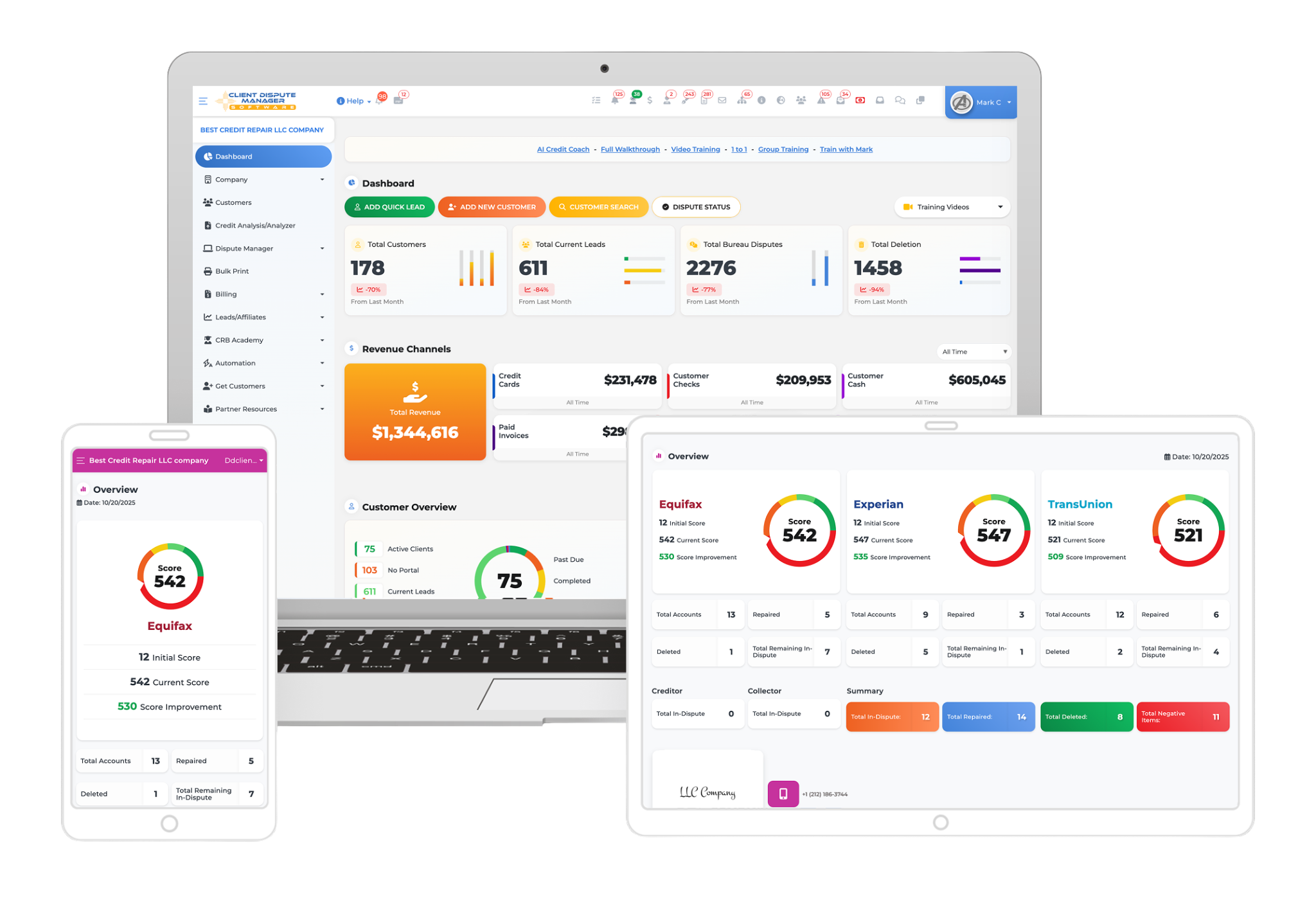
Client Dispute Manager Software is built to organize that entire workflow, from first dispute through escalation, so every court document is tracked, every bureau response deadline is monitored, and no Section 605 removal request window is missed. The 30-day free trial includes full platform access with no credit card required.

Mark Clayborne specializes in credit repair, starting and running credit repair businesses. He's passionate about helping businesses gain freedom from their 9-5 and live the life they really want. You can follow him on YouTube.
Experience our credit repair software, risk-free.