
Credit Repair Client Management: Onboarding, Disputes, and Operations (2026)
Written by Mark Clayborne
Last updated on April 2, 2026
On this page
Best practices for credit repair client onboarding require four steps before any dispute work begins: a signed CROA-compliant contract with all required disclosures, a three-business-day cancellation window that must fully expire before services start, a standalone consumer rights statement delivered separately from the contract, and a three-bureau credit report pull to establish the dispute baseline.
Credit repair client management is a compliance operation as much as a service one. Client Dispute Manager Software handles all four onboarding steps natively, built by Mark Clayborne, a certified credit consultant and CROA practitioner, so every default workflow meets federal legal requirements from the first client engagement.
This guide covers every operational area of credit repair client management: CROA-compliant onboarding, contracts and required forms, FCRA-grounded dispute automation, secure data storage, TSR-compliant billing, digital signature requirements, and virtual assistant operations. Each section identifies the specific federal law that governs that area.
Best Practices for Credit Repair Client Onboarding?

Best practices for credit repair client onboarding are defined by CROA. Under Section 1679b(b), no services may begin until a written contract is signed.
Under Section 1679d, the three-business-day cancellation right must fully expire before services are performed. Under Section 1679c, a standalone consumer rights statement must be delivered as a separate document from the contract.
After those legal steps, pull a three-bureau credit report to set the dispute baseline. Any skipped step creates CROA violations regardless of client consent. For the full legal setup sequence, see our complete legal guide to starting a credit repair business.
Start Today and Explore the Features Firsthand!
What Are the Top-Rated Client Onboarding Software Solutions for Credit Repair Startups?
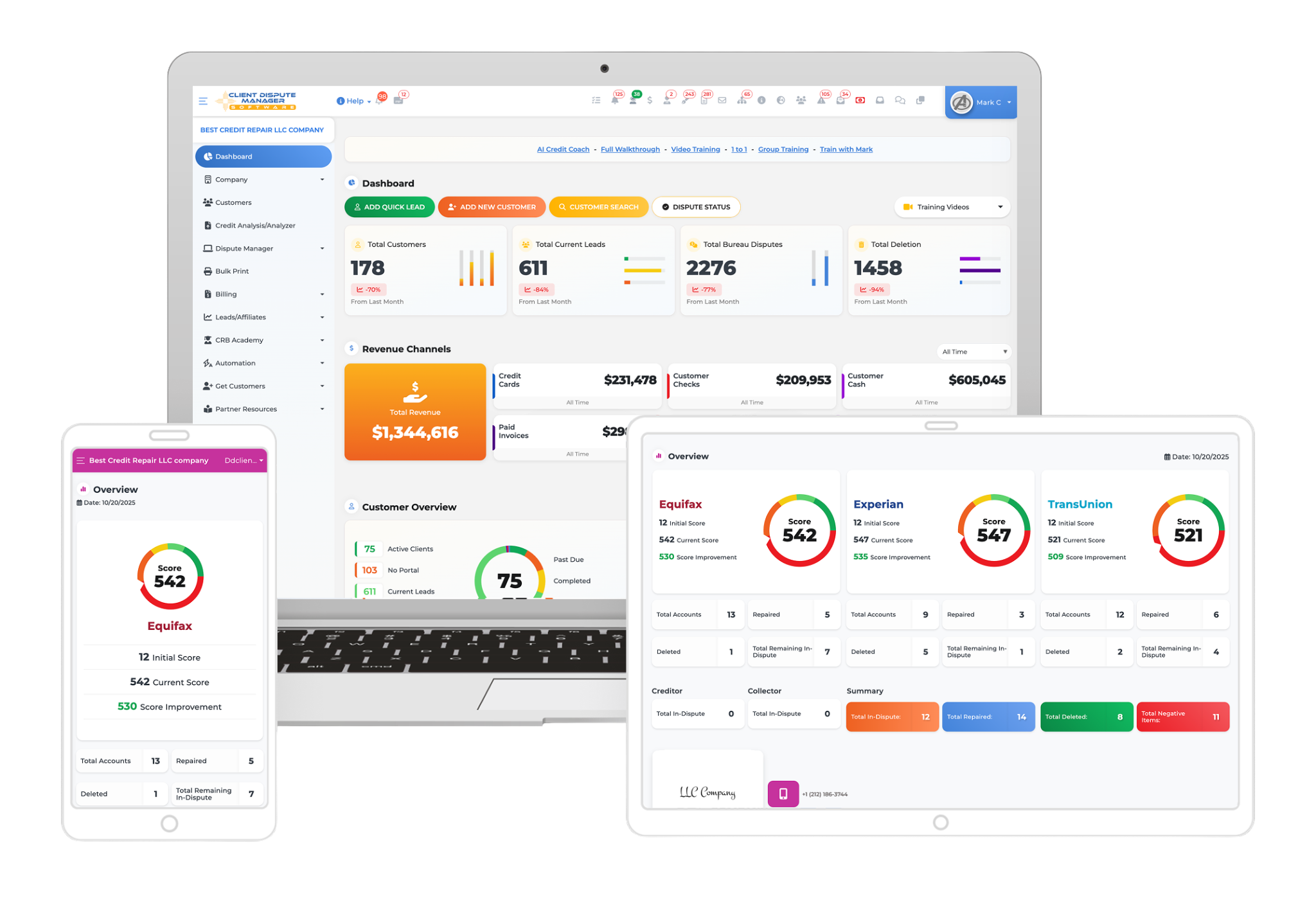
Client Dispute Manager Software handles the complete onboarding workflow natively: CROA-compliant contract signing with all required disclosures, standalone consumer rights statement delivery, credit report pull authorization, and client portal access provisioning in one connected sequence.
Built by Mark Clayborne, a CROA practitioner, the platform requires no additional configuration to meet CROA onboarding requirements. Every onboarding action is documented within the client file for compliance audit purposes.
The key onboarding software requirement is that the contract template must include all five CROA-required elements. Software using a generic service agreement without those elements creates regulatory exposure from the first client signed.
How to Create Effective Credit Repair Contracts and Agreements?

An effective credit repair contract must meet the five CROA Section 1679d required elements: a full description of services, total cost, performance timeframe, any guarantee or explicit statement that none is made, and the three-business-day cancellation right.
A standalone consumer rights disclosure under CROA Section 1679c must be a separate document, not a contract clause.
Collecting payment before the cancellation window expires or before services are performed violates CROA Section 1679b(b) and the TSR advance fee prohibition. Contract terms misrepresenting services or outcomes create FTC Act Section 5 liability.
Templates for Credit Repair Client Agreements?
CROA-compliant credit repair client agreement templates are included with Client Dispute Manager Software as part of the platform subscription.
The templates cover initial service agreements, ongoing monthly service terms, and cancellation documentation, built to meet all five of CROA’s required disclosure elements.
Using platform-native templates maintained by a CROA practitioner is more reliable than templates sourced from general legal websites because the templates are updated when regulatory requirements change, not drafted once and left static.
Under CROA Section 1679g, a non-compliant contract creates civil liability. A template from a general legal marketplace may have been accurate once and never updated since.
Templates maintained by a practitioner actively engaged with credit repair regulation carry a meaningful compliance advantage.
Where to Purchase Credit Repair Business Forms?
The core credit repair business forms are the CROA-compliant service contract, the standalone consumer rights statement required separately under CROA Section 1679c, credit report pull authorization citing the FCRA permissible purpose, client intake questionnaire, dispute tracking documentation, and cancellation and refund request forms.
Client Dispute Manager Software includes all of these as part of the platform. Mark Clayborne’s training resources also provide practitioner-built document templates designed specifically for the credit repair workflow.
For state-specific requirements, consult an attorney before finalizing any template. CROA is the federal floor. Some states require additional disclosures beyond CROA’s minimums, and a form meeting federal but not state requirements remains non-compliant.
Start Today and Explore the Features Firsthand!
How to Automate Credit Dispute Letters for Client Accounts?

Credit dispute letter automation software generates bureau-specific letters based on item type and FCRA dispute grounds. Under FCRA Section 1681i, bureaus must investigate within 30 days of receiving a dispute (45 days if the consumer submits additional information).
Under FCRA Section 1681s-2(a), data furnishers must also investigate and correct inaccurate information once notified. Under FTC Act Section 5, dispute letters must not contain fabricated grounds. Submitting disputes on inaccurate grounds creates deception liability regardless of who drafted the letter.
Which companies provide credit dispute automation tools? Client Dispute Manager Software, Credit Repair Cloud, DisputeBee, ScoreCEO, and DisputeFox all offer automation.
Platforms that offer credit repair dispute letter templates with automation features differ in whether templates are grounded in FCRA categories. For a platform comparison, see our guide to the best credit repair software for new business owners.
- Import the client’s tri-merge credit report into the dispute software platform.
- Review each negative item and identify those that are inaccurate, outdated, or unverifiable under FCRA standards.
- Select the appropriate FCRA dispute grounds for each item: inaccuracy, outdated entry, unverifiable information, or Metro 2 formatting error.
- Generate bureau-specific dispute letters for each item using platform-automated templates.
- Submit letters to the appropriate bureaus and activate the 30-day FCRA investigation deadline tracker.
- Document every submitted letter and bureau response within the client file for compliance and follow-up.
How to Select Dispute Letter Generation Software With Customizable Templates?
Evaluate dispute letter generation software on four criteria: whether templates are item-type specific covering collections, charge-offs, late payments, inquiries, and public records; whether letters cite FCRA grounds accurately; whether the platform tracks 30-day bureau response deadlines automatically under FCRA Section 1681i; and whether every letter and response is documented in the client file for compliance audit purposes.
Any customization must remain grounded in accurate FCRA dispute grounds. Software allowing unrestricted free-form letter creation without FCRA grounding makes it easy to submit disputes on inaccurate grounds, creating FTC Act Section 5 liability.
What Are the Leading Dispute Letter Generation Tools With AI Features?
Credit repair software platforms including Client Dispute Manager Software incorporate AI-assisted dispute letter generation that selects the appropriate template and FCRA basis based on item type and bureau.
AI features reduce manual drafting time but must be paired with practitioner review before submission. Under FTC Act Section 5, the FCRA grounds in any submitted dispute letter must be accurate regardless of whether a human or AI drafted the initial version.
AI tools add value when they accelerate accurate drafting, not when they replace practitioner judgment. A letter with fabricated grounds creates the same FTC Section 5 liability whether drafted by AI or by hand.
Start Today and Explore the Features Firsthand!
Secure Data Storage Solutions for Credit Repair Client Files?
Secure data storage for credit repair client files must satisfy three legal requirements: FTC Act Section 5 requires reasonable security for consumer financial data; FCRA Section 1681e restricts consumer report data to the permissible purpose it was obtained for; and CROA Section 1679b(a)(3) prohibits altering consumer records, requiring an unalterable audit trail.
A breach involving tri-merge reports, contracts, and billing records creates exposure under all three frameworks simultaneously.
Cloud-Based Document Management for Credit Repair Files?
Cloud-based document management for credit repair files requires encrypted storage with role-based access controls, automatic version history for all documents, and a tamper-evident audit log of every file access and modification.
Client Dispute Manager Software stores all client file data, dispute documentation, signed contracts, and billing records within the platform with these security and audit requirements built in, satisfying the FTC Act Section 5 reasonable security standard and the CROA Section 1679b(a)(3) record integrity requirement.
Avoid storing client files in personal cloud accounts without specific security configuration. A purpose-built credit repair platform provides a more defensible security posture than a self-configured general storage solution under FTC Section 5.
How to Set Up Recurring Billing Systems Tailored for Credit Repair Services?
Recurring billing for credit repair must follow service delivery. Under CROA Section 1679b(b) and TSR Section 310.4(a)(2), no fee may be collected before contracted services are fully performed.
Each monthly billing cycle must follow the dispute services delivered that month. Setup fees are permissible only when disclosed in the written contract and earned before collection.
TSR Section 310.3(a)(1)(iii) requires that all material billing terms be disclosed before the client’s billing information is submitted. For pricing model guidance, see our credit repair business pricing and cost guide.
What Payment Processing Solutions Work Well for Credit Repair Businesses?
Stripe and Square are the most widely used payment processors for credit repair businesses because both support recurring subscription billing and integrate with credit repair software platforms.
Some processors classify credit repair as a high-risk merchant category, resulting in higher fees or account holds. PaymentCloud specializes in high-risk accounts and may offer more stable terms.
The best online payment gateways for credit repair are those that integrate with your software platform and support billing timing that can be configured to follow service delivery rather than client enrollment.
The critical requirement is whether billing timing can be configured to follow service delivery. A processor defaulting to enrollment-day billing requires manual reconfiguration to achieve CROA and TSR advance fee compliance. Client Dispute Manager Software’s integrated billing handles this natively.
Start Today and Explore the Features Firsthand!
What Are the Best Digital Signature Tools for Credit Repair Client Agreements?
Digital signature tools for credit repair agreements must support E-SIGN Act consent capture before any electronic signature is valid.
Under the Electronic Signatures in Global and National Commerce Act (15 U.S.C. Section 7001), an electronic signature on a credit repair contract is legally enforceable only if the consumer affirmatively consented to receive electronic records before signing.
DocuSign, HelloSign (Dropbox Sign), and PandaDoc all support E-SIGN compliant signing with proper consent workflows. Client Dispute Manager Software handles CROA contract signing within the platform natively, including the required E-SIGN consent step.
The standalone consumer rights statement required under CROA Section 1679c must also be electronically acknowledged through a compliant E-SIGN process before the acknowledgment is valid.
Automated Tools for Credit Report Analysis?
Automated credit report analysis tools identify disputable items by type, flag items that may qualify under FCRA inaccuracy, outdatedness, or unverifiability grounds, and suggest the appropriate dispute strategy for each item.
Under FCRA Section 1681e(b), consumer report data pulled for dispute purposes must be used only for that permissible purpose.
Client Dispute Manager Software includes automated report analysis as part of the dispute workflow, reducing manual review time while keeping analysis grounded in FCRA-legitimate dispute categories. Verify that analysis tools identify items based on FCRA-legitimate grounds, not all negative items.
Tools suggesting disputes of accurate items create FTC Act Section 5 liability. The analysis must distinguish genuinely inaccurate, outdated, or unverifiable items from items that are simply unfavorable.
Virtual Assistant Services for Credit Repair Businesses?
Virtual assistants for credit repair businesses can handle dispute letter preparation using software templates, client file updates, FCRA 30-day deadline tracking, and client communication.
Upwork and Fiverr provide access to contractors for these roles. Client Dispute Manager Software’s role-based permissions allow VAs to access only the functions they need, without exposure to billing or administrative controls.
Any VA working on dispute preparation must be trained on CROA compliance and FCRA dispute grounds before handling client files. Under CROA, persons acting on behalf of a credit repair organization in providing credit repair services are subject to the same legal requirements as the business itself.
A VA who submits dispute letters with inaccurate grounds or makes prohibited representations to clients creates the same regulatory liability as if the business owner took those actions directly.
Start Today and Explore the Features Firsthand!
FAQ: Credit Repair Client Operations
Best Practices for Credit Repair Client Onboarding?
CROA requires a signed written contract before services begin, a three-business-day cancellation right that must fully expire before any services are performed, and a standalone consumer rights statement delivered separately from the contract.
After the cancellation window expires, pull a three-bureau credit report to establish the dispute baseline. Client Dispute Manager Software handles all four onboarding steps in one connected CROA-compliant workflow.
How to Automate Credit Dispute Letters for Client Accounts?
Import the client’s tri-merge report, identify items that are inaccurate, outdated, or unverifiable under FCRA, generate bureau-specific letters with accurate FCRA dispute grounds, and track the 30-day investigation deadline under FCRA Section 1681i.
Under FTC Act Section 5, dispute letters must be grounded in accurate FCRA grounds. Fabricated dispute grounds create deception liability regardless of whether automation or a human drafted the letter.
Secure Data Storage Solutions for Credit Repair Client Files?
Secure storage must meet FTC Act Section 5 reasonable security requirements, comply with FCRA Section 1681e permissible use rules, and maintain an unalterable audit trail under CROA Section 1679b(a)(3).
Client Dispute Manager Software stores all client data, dispute documentation, contracts, and billing records with encryption, role-based access controls, and a tamper-evident audit log built into the platform.
How to Set Up Recurring Billing Systems Tailored for Credit Repair Services?
Recurring billing must follow service delivery under CROA Section 1679b(b) and TSR Section 310.4(a)(2). No fee may be collected before contracted services are fully performed. Each billing cycle must follow the dispute services delivered in that cycle.
Setup fees are permissible only when disclosed in the contract and earned before collection. Client Dispute Manager Software’s integrated billing handles these advance fee compliance requirements natively.
What Are the Best Digital Signature Tools for Credit Repair Client Agreements?
DocuSign, HelloSign (Dropbox Sign), and PandaDoc support E-SIGN Act compliant electronic contract signing. Under the E-SIGN Act (15 U.S.C. Section 7001), an electronic signature is legally valid only if the consumer affirmatively consented to electronic records before signing.
Client Dispute Manager Software handles CROA contract signing with the required E-SIGN consent step built into the onboarding workflow.
Run Your Credit Repair Operations on a Compliant Foundation
Credit repair client management is a compliance operation at every stage. Each step from contract signing through dispute submission, billing, and data storage is governed by federal laws that carry civil and regulatory liability when violated.
Client Dispute Manager Software was built by Mark Clayborne, a certified credit consultant and CROA practitioner, with every compliance requirement built into the default workflows.

Mark Clayborne
Mark Clayborne specializes in credit repair, starting and running credit repair businesses. He's passionate about helping businesses gain freedom from their 9-5 and live the life they really want. You can follow him on YouTube.
Start Today and Explore the Features Firsthand!
Related Guides:
- How to Legally Start a Credit Repair Business (2026)
- How to Write a Credit Repair Business Plan (2026)
- Best Credit Repair Software for New Business Owners
- Credit Repair Training and Certification for New Business Owners
- How to Market a Credit Repair Business and Generate Leads (2026)
- Credit Repair Client Management: Onboarding, Disputes, and Operations
- How to Scale a Credit Repair Business: Hiring, White-Label, and Automation (2026)
Client Dispute Manager
Free 30-Day Trial
Experience our credit repair software, risk-free.