

Credit repair scams are deceptive services that promise to fix or erase negative credit information through illegal or misleading tactics. These schemes often target financially vulnerable consumers, charge prohibited upfront fees, or guarantee impossible results. Understanding how credit repair fraud works is the first step toward protecting your rights under consumer credit protection laws.
If you’ve ever searched online for help improving your credit, you’ve probably seen bold promises:
- “Guaranteed 100-point score increase.”
- “Instant deletion of collections.”
- “New credit identity available.”
Those claims sound reassuring especially if you’re dealing with denied loans, high interest rates, or financial stress. But here’s the uncomfortable truth: many of those offers are red flags of credit repair scams.
The demand for credit improvement is real. Millions of consumers are actively looking for ways to rebuild their credit profiles. That demand has created a legitimate industry but it has also created space for illegal credit repair companies and fake credit repair services to exploit confusion about the law.
Many people do not fully understand what the Credit Repair Organizations Act (CROA) allows or prohibits. They may not know about the advance fee ban in credit repair, required disclosures, or their cancellation rights. That knowledge gap is exactly what credit repair fraud relies on.
This guide is designed to change that.
Throughout this article, you’ll learn:
- Why credit repair scams are so prevalent?
- The most common credit repair warning signs
- What promises are illegal under federal law?
- What CROA consumer rights actually protect you from?
- How to tell if a credit repair company is legitimate?
- How to report credit repair fraud safely and effectively?
This is not financial advice. It is an educational resource grounded in consumer protection standards, FTC credit repair rules, and CFPB enforcement guidance.
By the end of this guide, you will understand how to spot credit repair scams before they cost you money and how to protect yourself with confidence.
Let’s start with a critical question:
Why are credit repair scams so common in the first place?
Key Takeaways:
- Credit repair scams rely on illegal guarantees and upfront fees. No company can legally promise specific score increases or remove accurate negative information.
- The Credit Repair Organizations Act (CROA) protects you. It requires written disclosures, bans advance fees, and gives you a three-day cancellation right.
- Major red flags include pressure tactics, vague contracts, fake reviews, and advice to create a new credit identity. These are common signs of credit repair fraud.
- You have the legal right to dispute inaccurate information yourself. Federal consumer credit protection laws allow you to review and challenge errors without hiring a third party.
- Report suspicious activity to the FTC, CFPB, or your State Attorney General. Reporting credit repair scams helps regulators stop illegal operators and protect other consumers.
Why Are Credit Repair Scams So Prevalent?

Credit repair scams are prevalent because high consumer demand meets financial vulnerability, legal confusion, and aggressive online marketing. When people urgently need better credit, they may overlook warning signs. This creates opportunities for credit repair fraud and illegal credit repair companies to exploit misinformation and emotional decision-making.
Millions of Americans struggle with credit challenges. A low credit score can affect loan approvals, housing opportunities, insurance premiums, and even employment in some cases. When financial pressure builds, urgency increases. And urgency reduces skepticism.
Scammers understand this psychology well.
Instead of offering education, they offer shortcuts. Instead of explaining consumer credit protection laws, they promise quick fixes. That combination makes credit repair scams especially effective against individuals who feel stuck or desperate for change.
Let’s break down the core reasons this problem continues to grow.
Why Do Credit Repair Scams Target Financially Vulnerable Consumers?
Credit repair fraud often targets individuals experiencing financial hardship because they are more likely to seek rapid solutions and trust bold promises. When someone feels that their credit is blocking opportunity, they may be more receptive to guarantees or “exclusive” offers.
Consider a simple scenario.
Someone is denied an auto loan. They’re told their credit score is too low. They go online searching for help. Within minutes, they see ads claiming guaranteed score increases or immediate collection removals.
That emotional moment frustration, embarrassment, urgency is when deceptive marketing becomes powerful.
Scammers rely on:
- Emotional pressure
- Confusion about legal rights
- Lack of awareness about CROA consumer rights
- Fear of long-term financial consequences
Financial stress can cloud judgment. That’s why education is the strongest protection.
How Misinformation About Credit Laws Creates Opportunity for Scammers?
Misunderstanding the Credit Repair Organizations Act (CROA) allows credit repair fraud to thrive. Many consumers are unaware of the advance fee ban, required disclosures, or their three-day cancellation rights.
When people don’t know:
- What a legitimate credit repair company must disclose?
- That guarantees are legally problematic
- That they can cancel within three business days
- They are more vulnerable to manipulation.
Consumer credit protection laws exist to prevent abuse. But laws only protect those who understand them.
Red Flags of Credit Repair Fraud You Should Never Ignore
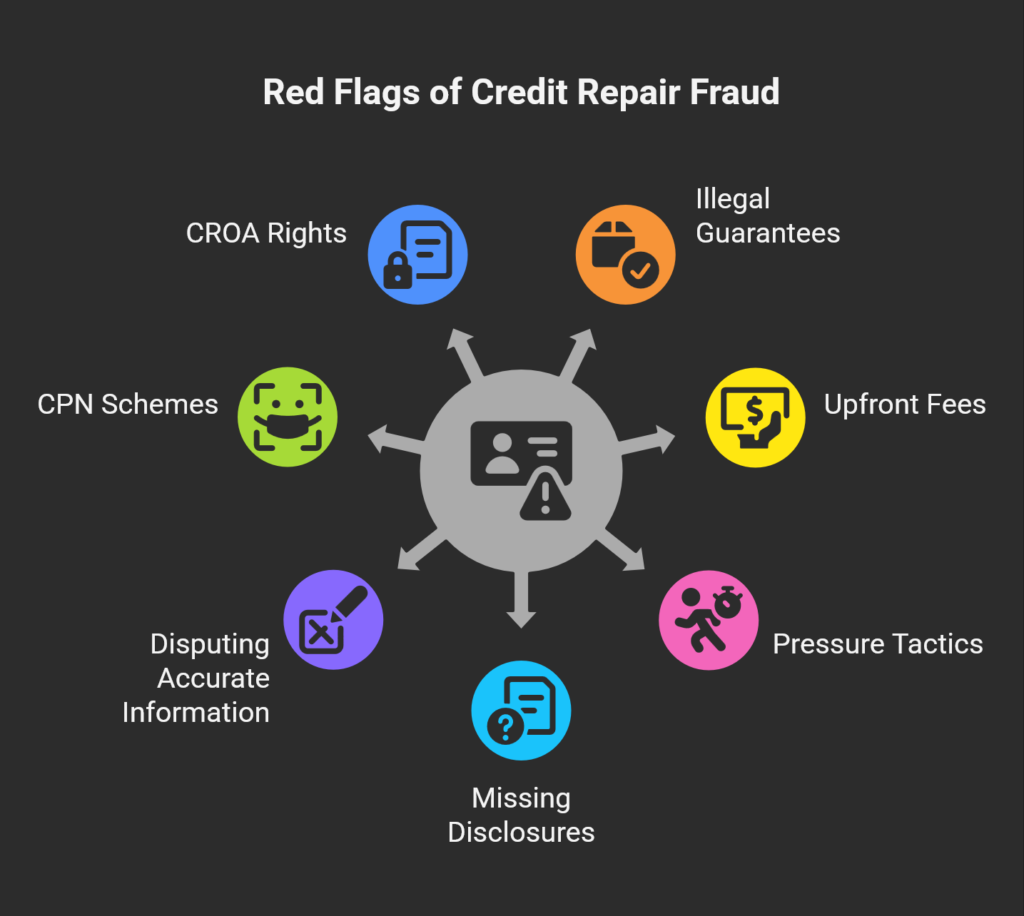
The most reliable way to protect yourself from credit repair scams is to recognize clear warning signs before you pay anything. Credit repair fraud often follows predictable patterns including illegal guarantees, upfront fees, pressure tactics, and missing disclosures. If you understand these red flags, you dramatically reduce your risk.
Below are the most common credit repair warning signs consumers should watch for.
Are Credit Repair Companies Allowed to Guarantee Results?
No. Credit repair companies are not legally allowed to guarantee specific results, such as score increases or deletion of accurate information. The Credit Repair Organizations Act (CROA) prohibits misleading or untrue claims about improving credit.
If a company says:
- “We guarantee a 100-point increase.”
- “We will remove all collections.”
- “We promise fast score results.”
That is a serious red flag.
No legitimate credit repair company controls how credit bureaus evaluate information. Accurate negative items cannot legally be erased simply because someone requests it. Guarantees are one of the clearest indicators of credit repair scams.
Can Credit Repair Companies Charge Upfront Fees?
No. Under the advance fee ban in credit repair law, companies cannot collect payment before performing services. Charging upfront fees is a common sign of illegal credit repair companies.
CROA requires that services be completed before fees are collected. If a company demands payment before doing any work especially large “setup” fees you should pause immediately.
Common examples include:
- “Enrollment fees”
- “File preparation charges”
- “Credit sweep fees”
Legitimate businesses comply with the advance fee ban. Fake credit repair services often do not.
Pressure Tactics and “Limited-Time” Offers

High-pressure sales tactics are a common feature of credit repair fraud. Scammers often create urgency to prevent you from researching or asking questions.
You might hear:
- “You must sign today.”
- “This discount expires in one hour.”
- “If you wait, your credit will get worse.”
Financial decisions should never be rushed. A legitimate credit repair company will allow you time to review contracts and disclosures.
Refusal to Provide Written Contracts or Required Disclosures
CROA requires written contracts and specific credit repair disclosures. If a company avoids providing documentation, that is a strong indicator of credit repair scams.
You must receive:
- A written agreement
- A description of services
- A clear fee structure
- A statement of your cancellation rights
If those are missing, incomplete, or vague, you may be dealing with credit repair fraud.
Advice to Dispute Accurate Information
No company can legally remove accurate negative information from your credit report. Encouraging you to dispute truthful items is unethical and may be illegal.
Some illegal credit repair companies suggest disputing everything even accurate accounts hoping something “falls off.” That approach can backfire and may damage your credibility with credit bureaus.
Ethical services focus only on verifying accuracy, not manipulating the system.
Requests to Create a New Credit Identity (CPN Schemes)
Advising consumers to create a new credit identity, often called a CPN (Credit Privacy Number), is a major red flag. This can involve identity misrepresentation and potentially criminal activity.
If a company suggests:
- Using a new Social Security number
- Applying for credit under a different identity
- “Starting fresh” with a new file
You are likely encountering credit repair fraud. There is no legal shortcut to creating a new credit identity.
Avoiding Questions About CROA Consumer Rights
If a company cannot explain your rights under the Credit Repair Organizations Act, that is a serious red flag. Ethical companies understand compliance requirements.
You should be able to ask:
- What does CROA protect consumers from?
- Do you charge upfront fees?
- What are my cancellation rights?
If answers are unclear or dismissive, reconsider moving forward.
Illegal Promises Credit Repair Companies Make

Many credit repair scams rely on promises that are legally prohibited under federal law. The Credit Repair Organizations Act (CROA) and FTC credit repair rules restrict companies from making deceptive claims about improving credit. When a company guarantees results or misrepresents what it can legally do, that is a major warning sign of credit repair fraud.
Understanding which claims cross the legal line helps you separate a legitimate credit repair company from illegal credit repair companies.
What Claims Are Prohibited Under the Credit Repair Organizations Act?
The Credit Repair Organizations Act prohibits credit repair companies from making untrue or misleading statements about their services. They cannot claim they can remove accurate negative information, create a new credit identity, or guarantee specific score increases.
Under CROA consumer rights protections, companies may not:
- Promise to delete accurate late payments, collections, or charge-offs
- Claim they can “erase” bankruptcies that are properly reported
- Suggest using a new Social Security number or alternate identity
- Collect payment before completing services (advance fee ban credit repair)
- Misrepresent their relationship with credit bureaus
The law focuses on preventing deception. If a claim sounds like a shortcut around accurate reporting, it likely violates consumer credit protection laws.
How Do I Know If a Credit Repair Company Is Legit?
A legitimate credit repair company operates transparently, follows the Credit Repair Organizations Act (CROA), avoids guarantees, and does not charge upfront fees. If a company clearly explains your rights, provides written disclosures, and sets realistic expectations, it is more likely operating within consumer credit protection laws.
When researching services, your goal is not to find bold promises it is to find compliance, transparency, and clarity.
Questions to Ask Before Hiring a Legitimate Credit Repair Company

Asking direct, compliance-focused questions is one of the most effective ways to detect credit repair scams. Ethical companies will answer clearly and confidently. Fraudulent operators often deflect or use vague language.
Before signing anything, consider asking:
- Do you charge any fees before services are completed?
- What does the Credit Repair Organizations Act require you to disclose?
- Can you guarantee specific results?
- What happens if no inaccurate items are found?
- How long does the process typically take?
A legitimate credit repair company should:
- Acknowledge the advance fee ban in credit repair law
- State clearly that results cannot be guaranteed
- Explain your three-day cancellation right
- Describe services in plain language
If answers are unclear or overly scripted, that is a potential credit repair warning sign.
Can You Do Credit Repair Yourself? A Safe and Legal DIY Overview?
Yes, you can legally dispute inaccurate information on your credit report yourself. Federal consumer credit protection laws give individuals the right to review their credit reports, challenge errors, and request investigations. You do not need to hire a company to exercise these rights but you do need to understand the legal boundaries.
Many consumers turn to credit repair services because the process feels confusing. That confusion is often what fuels credit repair scams. The reality is that the law already gives you tools to act independently.
The key is understanding what is permitted and what is not.
What Consumer Credit Protection Laws Allow You to Do?
Under federal law, consumers have the right to dispute inaccurate, incomplete, or unverifiable information on their credit reports. This right is protected primarily by the Fair Credit Reporting Act (FCRA), alongside safeguards in the Credit Repair Organizations Act (CROA).
These laws allow you to:
- Obtain a copy of your credit report
- Identify information you believe is inaccurate
- Submit a dispute to the credit bureau
- Request verification of reported information
- Receive investigation results within required timelines
What the law does not allow is disputing accurate information simply to remove it. Accurate negative items generally remain for their legally defined reporting period.
Understanding this distinction protects you from misinformation spread by illegal credit repair companies that imply all negative items can be erased.
Step-by-Step Educational Overview of the DIY Dispute Process
The DIY dispute process involves reviewing your credit reports, identifying potential inaccuracies, submitting a formal dispute, and tracking the investigation outcome. It is a documentation-driven process not a shortcut system.
A simplified educational overview looks like this:
- Request your credit reports from the major credit bureaus.
- Review each account carefully for accuracy, completeness, and dates.
- Identify specific items you believe may be inaccurate or unverifiable.
- Submit a written dispute explaining the issue clearly and attaching supporting documentation if available.
- Wait for the bureau’s investigation results, which are typically required within 30 days.
- Review the response and determine whether corrections were made.
Keeping organized records of correspondence and timelines is important. Some consumers use structured tools or software for documentation tracking, while others manage the process manually.
What’s important is staying factual and accurate. The dispute process is designed to correct errors not to remove legitimate debt.
How Client Dispute Manager Software Supports DIY Credit Repair

Consumers have the legal right to dispute inaccurate information on their credit reports themselves. Software platforms like Client Dispute Manager Software are designed to help organize documentation, track disputes, and generate compliant correspondence without promising guaranteed results or bypassing consumer credit protection laws.
It’s important to understand what software can and cannot do.
Credit repair software does not “erase” accurate negative information. It does not manipulate credit bureaus. It does not override scoring systems. Instead, it helps consumers exercise their existing rights under the Fair Credit Reporting Act (FCRA) and the Credit Repair Organizations Act (CROA).
When used responsibly, tools like Client Dispute Manager Software can provide structure and clarity for individuals who want to manage the dispute process independently.
Start Today and Explore the Features Firsthand!
Key Features That Support Compliance and Transparency
Client Dispute Manager Software is designed to organize and streamline the credit dispute process while aligning with consumer credit protection laws. Its features focus on documentation, workflow tracking, and compliance-aware communication not on guaranteeing outcomes or bypassing legal limits.
When used responsibly, the software supports structure and clarity through features such as:
- Pre-formatted dispute letter templates aligned with standard compliance language
- Automated workflow tracking to monitor dispute timelines and bureau responses
- Secure document storage for credit reports, correspondence, and verification records
- Audit trail history to maintain organized records of actions taken
- Client progress dashboards for transparency in dispute activity
- Compliance-focused communication formatting to reduce vague or misleading wording
These features help users stay organized and consistent. They do not promise deletion of accurate items or guaranteed score increases.
In the context of preventing credit repair scams, tools like Client Dispute Manager Software demonstrate an important distinction: ethical systems focus on documentation and lawful dispute procedures not shortcuts or unrealistic claims.
Start Today and Explore the Features Firsthand!
How to Report Credit Repair Scams?

If you believe you’ve encountered credit repair scams or credit repair fraud, reporting it can help protect both you and other consumers. Federal and state agencies use complaint data to identify illegal credit repair companies, enforce consumer credit protection laws, and stop deceptive practices.
Taking action may feel overwhelming, but the reporting process is structured and accessible.
Here are the primary channels available to consumers.
How Can I Report a Credit Repair Scam to the FTC?
You can report credit repair scams directly to the Federal Trade Commission (FTC) through its online reporting portal. The FTC collects complaints related to deceptive practices, including violations of FTC credit repair rules and the advance fee ban credit repair provisions.
To file a complaint:
- Visit the official FTC reporting website (ReportFraud.ftc.gov)
- Provide the company’s name and contact information
- Describe the services offered and any guarantees made
- Include payment details and communication records
- Upload supporting documents if available
While the FTC does not resolve individual disputes, it uses complaint patterns to investigate and pursue enforcement actions against illegal credit repair companies.
Filing a Complaint With the CFPB
The Consumer Financial Protection Bureau (CFPB) accepts complaints related to credit reporting and credit repair services. The CFPB forwards complaints to companies and tracks responses.
You can file a complaint through the CFPB’s official website by providing:
- Details about the company
- Description of the issue
- Timeline of events
- Copies of relevant documents
The CFPB monitors trends in credit repair fraud and may initiate investigations based on complaint volume and severity.
Submitting a complaint creates a formal record that regulators can analyze.
Frequently Asked Questions About Credit Repair Scams And Consumer Rights
How Do I Know If A Credit Repair Company Is Legit?
A legitimate credit repair company follows the Credit Repair Organizations Act (CROA), does not charge upfront fees, does not guarantee results, and provides clear written contracts and disclosures.
Ethical companies explain your cancellation rights, outline services transparently, and set realistic expectations. Avoid any company that uses pressure tactics or vague promises.
Are Credit Repair Companies Allowed To Guarantee Results?
No. Credit repair companies are not legally allowed to guarantee specific score increases or deletion of accurate negative information. Under CROA and FTC credit repair rules, guarantees are considered misleading because companies do not control credit scoring models or bureau decisions. Any promise of guaranteed results is a major red flag.
What Does The Credit Repair Organizations Act Protect Consumers From?
The Credit Repair Organizations Act protects consumers from deceptive practices, advance fees, false advertising, and undisclosed contracts. It requires written disclosures, prohibits misleading claims, and gives consumers a three-business-day right to cancel without penalty.
CROA exists to prevent credit repair fraud and increase transparency in the industry.
Can Credit Repair Companies Charge Upfront Fees?
No. The advance fee ban under federal law prohibits credit repair companies from collecting payment before services are fully performed. Any company demanding enrollment, setup, or upfront service fees may be violating consumer credit protection laws.
Upfront payment requirements are one of the clearest warning signs of credit repair scams.
Are All Credit Repair Companies Scams?
No. Not all credit repair companies are scams. However, consumers should evaluate services carefully. A legitimate credit repair company operates transparently, follows CROA requirements, and avoids unrealistic promises.
The difference between ethical services and credit repair fraud lies in compliance, honesty, and accountability.
Conclusion
Credit repair scams succeed when urgency overrides understanding. The strongest defense against credit repair fraud is knowing your rights, recognizing illegal promises, and refusing to be pressured by guarantees that violate consumer credit protection laws.
The Credit Repair Organizations Act (CROA) was created to require transparency, prohibit advance fees, and protect consumers from deceptive practices. Legitimate credit improvement is based on correcting inaccuracies, not erasing accurate history or promising instant results.
Before hiring any service, pause and evaluate the fundamentals: Are they explaining your rights clearly? Are they avoiding guarantees? Are they providing written disclosures and respecting cancellation rules? An ethical company will operate within the law and set realistic expectations. The more informed you are, the less vulnerable you become and informed consumers are the strongest defense against credit repair scams.

Mark Clayborne
Mark Clayborne specializes in credit repair, starting and running credit repair businesses. He's passionate about helping businesses gain freedom from their 9-5 and live the life they really want. You can follow him on YouTube.
Start Today and Explore the Features Firsthand!
Below Is More Content For Your Review:
