![How to Start a Credit Repair Business in California Complete Step-by-Step Guide [2026]](https://clientdisputemanagersoftware.com/wp-content/uploads/2023/04/How-to-Start-a-Credit-Repair-Business-in-California-Complete-Step-by-Step-Guide-2026-1.jpg)
Starting a credit repair business in California offers tremendous opportunity in 2026. With over 16 million Californians having credit scores below 700 and the average resident carrying $5,700 in debt, the demand for credit repair services has never been higher.
However, California has some of the strictest credit repair regulations in the United States. Unlike most states, California requires:
- A $100,000 surety bond (actual cost: $1,000-$5,000/year)
- Registration with the California Department of Justice
- Compliance with both state (CCSA) and federal (CROA) laws
- Detailed written contracts and disclosure requirements
The good news? You can start a credit repair business in California from home with as little as $2,500-$5,000 in startup costs if you follow the right steps.
In this comprehensive guide, you’ll learn:
- Exact legal requirements and how to register your business
- How to obtain your $100,000 surety bond (without paying $100,000)
- Step-by-step process from LLC formation to accepting your first client
- Real startup costs and profit potential in California
- How to get your first clients and scale your business
- Common mistakes that lead to compliance violations
Let’s dive into everything you need to legally launch and grow a credit repair business in California.
Is Credit Repair Legal in California?

Yes, credit repair is 100% legal in California when done in compliance with state and federal laws. California regulates credit repair through the California Credit Services Act (Civil Code §1789.10-1789.26), which requires businesses to register as Credit Services Organizations (CSOs).
Key Legal Facts:
- You do NOT need a license to operate a credit repair business in California
- You MUST register with the California Department of Justice as a CSO
- You MUST obtain a $100,000 surety bond
- You MUST comply with the federal Credit Repair Organizations Act (CROA)
As of January 1, 2026, credit repair businesses also fall under oversight of the California Department of Financial Protection and Innovation (DFPI) due to SB 825. This adds an additional layer of regulatory compliance.
What Is Legal:
- Disputing inaccurate, outdated, or unverifiable information on credit reports
- Educating consumers about their credit rights
- Providing credit counseling and financial advice
- Charging for services AFTER they are performed
What Is ILLEGAL:
- Charging fees before services are rendered
- Advising clients to make false statements
- Misrepresenting what you can accomplish
- Failing to provide required written disclosures
- Not obtaining a surety bond
How Much Does It Cost to Start a Credit Repair Business in California?
The total startup cost for a California credit repair business ranges from $2,500 to $15,000 depending on whether you start home-based or with a physical office.
Minimum Home-Based Startup (Budget Option)
| Expense Category | Cost Range | Notes |
|---|---|---|
| LLC Formation | $70 to $800 | $70 for online filing. $800 if using an attorney. |
| Surety Bond Annual Premium | $1,000 to $5,000 | Based on personal credit. Not $100,000 upfront. |
| CSO Registration DOJ | $0 | No filing fee in California. |
| Business License City | $50 to $400 | Varies by municipality. |
| Credit Repair Software | $50 to $180 per month | First month. Annual range $600 to $2,160. |
| Professional Contracts | $0 to $500 | Free templates available or hire an attorney. |
| Website and Domain | $100 to $500 | Basic WordPress site with hosting. |
| Business Phone Line | $20 to $50 per month | VoIP service such as RingCentral. |
| TOTAL MINIMUM | $2,290 to $7,430 | First year. Home based. |
Full Professional Setup (Recommended)
| Additional Expenses | Cost Range | Purpose |
|---|---|---|
| General Liability Insurance | $500 to $1,500 per year | Protects against client lawsuits. |
| Errors and Omissions Insurance | $1,000 to $2,500 per year | Professional liability coverage. |
| Registered Agent Service | $100 to $300 per year | Required if no California physical address. |
| Business Attorney Consultation | $1,000 to $3,000 | Contract review and compliance setup. |
| Marketing and Advertising | $500 to $3,000 | Website SEO, Google Ads, business cards. |
| Office Space Optional | $500 to $2,000 per month | Co working or small office. |
| TOTAL COMPREHENSIVE | $5,890 to $19,730 | First year, full setup. |
Step-by-Step Guide: How to Start Your California Credit Repair Business?
Follow these 10 steps to legally launch your credit repair business in California. This can be a sole proprietorship, partnership, corporation, or limited liability company (LLC).
Total timeline: 4-8 weeks from start to accepting your first client.
Step #1: Choose Your Business Structure

This can be a sole proprietorship, partnership, corporation, or limited liability company (LLC).
Sole Proprietorship:
This is the simplest form of business structure in which one person owns and operates the business. The owner is personally liable for all debts and obligations of the business.
Partnership:
This is a business structure in which two or more people own and operate the business. Partnerships can be general partnerships or limited partnerships, and partners may be personally liable for the debts and obligations of the business.
Corporation:
This is a legal entity that is separate from its owners. Corporations can be owned by one or more shareholders, and shareholders are not personally liable for the debts and obligations of the business.
Limited Liability Company (LLC):
This is a hybrid business structure that combines the liability protection of a corporation with the tax benefits of a partnership. Owners of an LLC are called members and are not personally liable for the debts and obligations of the business.
Cooperative:
This is a business structure in which the members own and operate the business. Cooperatives can be formed for a variety of purposes, including marketing and distribution of goods and services.
Step #2: Choose and Register Your Business Name
Choose a business name that is not already in use by another company in California. You can check for name availability through the California Secretary of State’s website.
- Avoid choosing a name that is already in use: Choose a name that is not already in use by another company in California. You can check for name availability through the California Secretary of State’s website.
- Choose a name that is easy to remember and easy to spell: Your business name should be easy for customers to remember and spell, and it should be easy to pronounce.
- Avoid using generic or descriptive terms: Avoid using generic or descriptive terms in your business name, such as “credit repair services” or “financial solutions.” These types of names are often overused and can be confusing to customers.
- Choose a name that is relevant to your business: Your business name should reflect the nature of your credit repair services and the values of your business. Choose a name that is relevant and meaningful to your customers.
- Check for trademark infringement: Make sure that your chosen business name is not already trademarked by another company. You can check for trademark infringement through the United States Patent and Trademark Office (USPTO) website.
- Consider getting professional advice: It is recommended that you consult with a business attorney or a business consultant who specializes in the credit repair industry to ensure that your chosen business name is in compliance with all state and federal regulations.
California Naming Requirements:
- Must include “LLC” or “Limited Liability Company” if forming an LLC
- Cannot be identical to existing registered CA business
- Check availability at: bizfileonline.sos.ca.gov
Step #3: Register Your LLC with California Secretary of State

You can file the necessary forms and pay the filing fee online. The exact forms and fees will depend on the type of business structure you choose.
- Visit the California Secretary of State’s website.
- Click on “Business Programs”: From the homepage, click on “Business Programs” located at the top of the page.
- Select “Business Entities”: Under the Business Programs menu, select “Business Entities” to access the page where you can register your business.
- Choose your business structure: Choose the type of business structure you want to register, such as a corporation, LLC, partnership, or sole proprietorship.
- File the appropriate forms: Follow the instructions to file the appropriate forms for your chosen business structure. You can file the forms online and pay the filing fee using a credit or debit card.
Direct Filing URL: https://bizfileonline.sos.ca.gov
Required information:
- Business Name
- Registered Agent Name and CA Address
- Management Structure (member-managed or manager-managed)
- Purpose of LLC (can be “any lawful business”)
Filing Fee: $70 (online) or $75 (mail)
Processing Time: 5-7 business days
Step #4: Obtain Your EIN from the IRS
This is a unique identifier for your business that will be required for tax purposes. Get Your EIN from IRS
You need an EIN to:
- Open a business bank account
- Hire employees
- File business taxes
- Obtain your surety bond
Step #5: Obtain Your $100,000 Surety Bond

As mentioned earlier, California law requires credit repair organizations to obtain a $100,000 surety bond before conducting business. You will need to file this bond with the California Secretary of State’s office.
How Surety Bonds Work:
- You apply with a surety bond provider
- They review your personal credit and business info
- They quote you an annual premium (1-10% of $100,000)
- You pay the premium (NOT $100,000)
- They issue the bond certificate
- You file this certificate with CA DOJ
Required Bond Amount: $100,000
Your Actual Cost: $1,000-$5,000/year (depending on credit)
Step #6: Register with the California Department of Tax and Fee Administration (CDTFA)
You will need to register for a seller’s permit if you will be selling tangible goods or services in California.
Registration Portal: https://oag.ca.gov/consumers/credit-services-organizations
Required Documents:
- Completed CSO Registration Form
- $100,000 surety bond certificate (from Step 5)
- Certificate of Good Standing from CA Secretary of State
- Business formation documents
You CANNOT operate until you receive your CSO registration confirmation from the CA Attorney General’s office.
Step #7: Obtain Local Business Licenses and Permits

Credit repair organizations are required to register with the California Department of Justice and provide certain information, including the business name and address, the names of the business owners, and any other information requested by the department.
Obtain a Certificate of Good Standing:
Before registering with the California Department of Justice, you will need to obtain a Certificate of Good Standing from the California Secretary of State’s office. This certificate will verify that your business is registered and in good standing with the state of California.
Complete The Registration Form:
You will need to complete a registration form provided by the California Department of Justice. This form will require information about your business, including the name and address of your business, the names and addresses of the owners or partners, and any other information requested by the department.
Provide Supporting Documents:
You may need to provide supporting documents, such as a copy of your business license, proof of insurance, or the surety bond you obtained earlier.
Pay The Registration Fee:
You will need to pay a registration fee to the California Department of Justice. The exact fee will depend on the type of business you are registering and the number of employees.
Submit The Registration Form:
Once you have completed the registration form and provided any necessary supporting documents, you will need to submit the form and the fee to the California Department of Justice.
Maintain Your Registration:
After your business is registered with the California Department of Justice, you will need to maintain your registration by renewing it annually and updating any changes in your business information.
Complying with California's Credit Services Act

The Credit Services Act in California regulates credit repair organizations and sets out specific requirements for how credit repair services can be marketed and advertised.
The California Credit Services Act (CCSA) is a state law that regulates the activities of credit repair organizations in California. The law sets out specific requirements for how credit repair services can be marketed and advertised, and establishes certain consumer protections.
Under the CCSA, credit repair organizations are required to provide written disclosures to consumers, including a contract that outlines the services to be provided, the fees charged, and the time frame in which the services will be performed.
The law prohibits certain practices by credit repair organizations, such as charging upfront fees before services are provided, misrepresenting their services, or making false statements about a consumer’s credit report or credit history.
The CCSA also requires credit repair organizations to register with the California Department of Justice and provide certain information, including the business name and address, the names of the business owners, and any other information requested by the department.
In addition to the requirements set out in the CCSA, credit repair organizations in California are also subject to federal regulations, such as the Credit Repair Organizations Act (CROA), which requires credit repair organizations to provide certain disclosures to consumers, including a written contract outlining the services to be performed and the fees charged.
Step #8: Set Up Your Credit Repair Software and Systems
Operating a credit repair business without specialized software in California is not just inefficient, it’s risky. California’s strict CCSA requirements demand precise documentation, specific contract language, and detailed record-keeping that manual processes simply cannot reliably maintain.
What Happens Without Proper Software:
- Missing required disclosure statements (CCSA violation)
- Improper contract language (grounds for lawsuits)
- Forgotten 3-day cancellation notices (compliance failure)
- No audit trail if California DOJ investigates
- Hours wasted on manual dispute letter creation
- Billing clients before services rendered (CROA violation)
- Professional credit repair software eliminates these risks while dramatically increasing your efficiency and scalability.
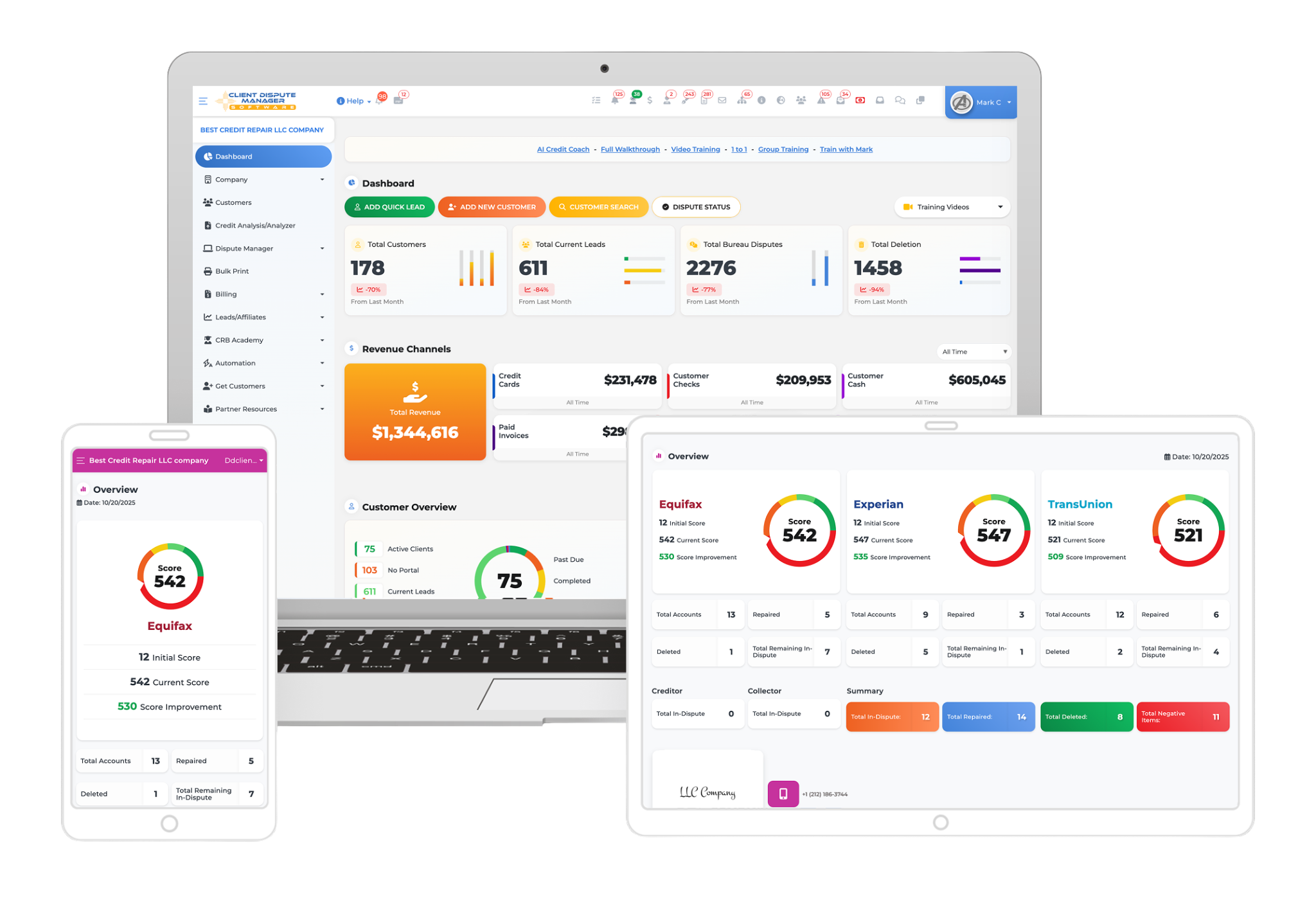
Client Dispute Manager Software: Built for California Compliance

Client Dispute Manager Software is specifically designed to help credit repair professionals navigate California’s complex regulatory environment while building profitable, scalable businesses.
California-Specific Compliance Features:
- CCSA-Compliant Contract Templates: Client Dispute Manager includes pre-built, attorney-reviewed contract templates that automatically incorporate all required California disclosures.
Automated Disclosure Management: The software automatically generates required disclosure statements before contract signing, tracks when disclosures were provided to each client, maintains permanent records for DOJ audits, and ensures you never skip a required disclosure step.
California Payment Compliance: Built-in safeguards prevent CROA/CCSA violations by enforcing that you cannot bill clients until after services are performed, automating invoicing only after dispute rounds complete, tracking payments tied to service delivery dates, and maintaining audit trails proving compliance.
6-Month Contract Term Management: California limits credit repair contracts to 6 months maximum. The system alerts when contracts approach expiration, provides automatic renewal workflow for continuing clients, tracks compliance to prevent violations, and maintains contract history for regulatory review.
Start Today and Explore the Features Firsthand!
Frequently Asked Questions About Starting a Credit Repair Business in California
Do You Need A License to Start a Credit Repair Business in California?
You must:
- Register as a Credit Services Organization (CSO) with the CA Attorney General,
- Obtain a $100,000 surety bond, Register your LLC or other business entity with CA Secretary of State
- Obtain local business licenses/permits from your city
Think of CSO registration as your “authorization to operate” rather than a traditional license.
Can I Start a Credit Repair Business From Home in California?
Yes, California allows home-based credit repair businesses. You can use your home address as your business address, meet with clients virtually (Zoom, phone) & never see clients in person if you prefer
How Long Does It Take to Start a Credit Repair Business in California?
Normally it may take 4-8 weeks total.
- Week 1: Form LLC, get EIN, apply for bond
- Week 2-3: Receive bond, register with DOJ
- Week 3-4: Await CSO registration approval
- Week 4-6: Set up software, website, contracts
- Week 6-8: Launch marketing, get first clients
You can accelerate this by paying for expedited LLC filing ($350 for 24-hour processing).
Conclusion
Starting a credit repair business in California offers exceptional opportunity in 2026, with 16.1 million Californians needing credit repair services and the industry growing 22% annually. While California requires a $100,000 surety bond, CSO registration, and strict CCSA compliance, these regulations protect serious professionals from unqualified competitors.
Follow this guide’s step-by-step process form your LLC, obtain your bond ($1,000-$5,000/year), register with the CA Attorney General, and set up Client Dispute Manager Software with California-compliant contracts.
Success requires absolute compliance, proper systems from day one, and focus on real client results. Hundreds of California entrepreneurs have built six-figure credit repair businesses following this exact roadmap many starting part-time from home.
Within 4-8 weeks of following these steps, you can be accepting clients and generating revenue.

Mark Clayborne
Mark Clayborne specializes in credit repair, starting and running credit repair businesses. He's passionate about helping businesses gain freedom from their 9-5 and live the life they really want. You can follow him on YouTube.
Start Today and Explore the Features Firsthand!
Below Is More Content For Your Review: