Get Started for as Low a $49 for the First Month: Click Here
Written by Mark Clayborne
Last updated on June 10, 2026
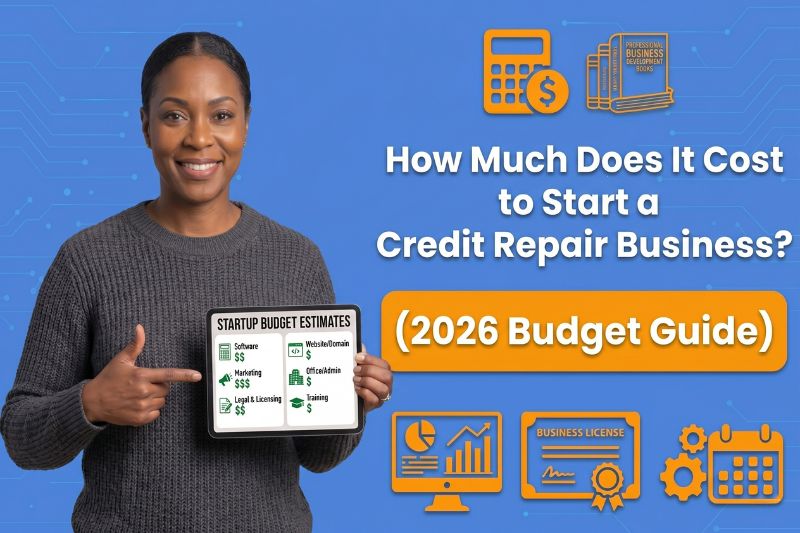
Starting a credit repair business costs between $650 and $5,000 at minimum, depending on your state’s bonding requirement, software choice, and legal setup. Required costs include business entity formation, state registration or bonding where applicable, credit repair management software, and Credit Repair Organizations Act (CROA)-compliant written contract templates. State bond requirements are the largest variable and range from $10,000 in Florida and Texas to $100,000 in California.
| Startup Cost Category | Low Estimate | High Estimate |
|---|---|---|
| Business Registration & LLC | $50 | $500 |
| Credit Repair Software | $99/mo | $299/mo |
| Surety Bond (Where Required) | $100/yr | $1,200/yr |
| CROA Compliance Training / Certification | $0 | $500 |
| Website & Domain | $100 | $500 |
| Marketing (First 3 Months) | $300 | $2,000 |
| Total Estimated Startup | ~$650 | ~$5,000 |

Starting a credit repair business legally requires four non-negotiable cost categories: business entity formation, federal EIN registration, CROA-compliant service agreement templates, and credit repair management software.
These costs apply in every state before you accept a single client. State-specific requirements bonding, registration as a Credit Services Organization stack on top of this baseline.
Required costs for every state are:
State-specific requirements (varies by state):
Business entity formation costs between $50 and $500 depending on your state’s filing fees. Most credit repair business owners form a Limited Liability Company. The LLC provides personal liability protection and a separate legal identity for your business, both of which matter when you are operating under a federal consumer protection statute.
File your LLC with your state’s Secretary of State office. You can use the SBA business registration guide to find your state’s specific filing portal. After forming the entity, apply for a federal Employer Identification Number. The [IRS EIN application is free and takes about ten minutes online.
An S-Corporation is an alternative for owners expecting significant early revenue, but the administrative complexity is higher. For most new credit repair business owners, the single-member LLC is the right starting point.
CROA compliance setup costs between $0 and $1,000, depending on whether you draft your own contracts using a template service or hire an attorney to review them. This cost is not optional. The Credit Repair Organizations Act at 15 U.S.C. section 1679d requires every credit repair service contract to be in writing, signed by both parties, and delivered to the consumer before services begin.
The written contract must include specific elements. These five required elements appear in every CROA-compliant agreement:
Beyond the contract itself, CROA at 15 U.S.C. section 1679c requires you to provide a separate Consumer Rights Statement before any contract is signed. This document is specified by statute. You cannot incorporate it into the contract as a footnote or attached page. It must be a separate written document delivered before the contract is executed.
Most startup cost guides for credit repair businesses understate the real investment because they omit two categories: the time cost of CROA compliance setup (written contracts, Consumer Rights Statements, cancellation notice procedures) and the cost of state-level registration where required. A business that skips either is not cheaper to start. It is operating illegally.
The FTC enforces CROA. You can review the FTC’s guidance on credit repair compliance at consumer.ftc.gov. If you structure your compliance documents incorrectly from day one, correcting them after your first client dispute is more expensive than getting them right before launch. CROA-compliant credit repair services
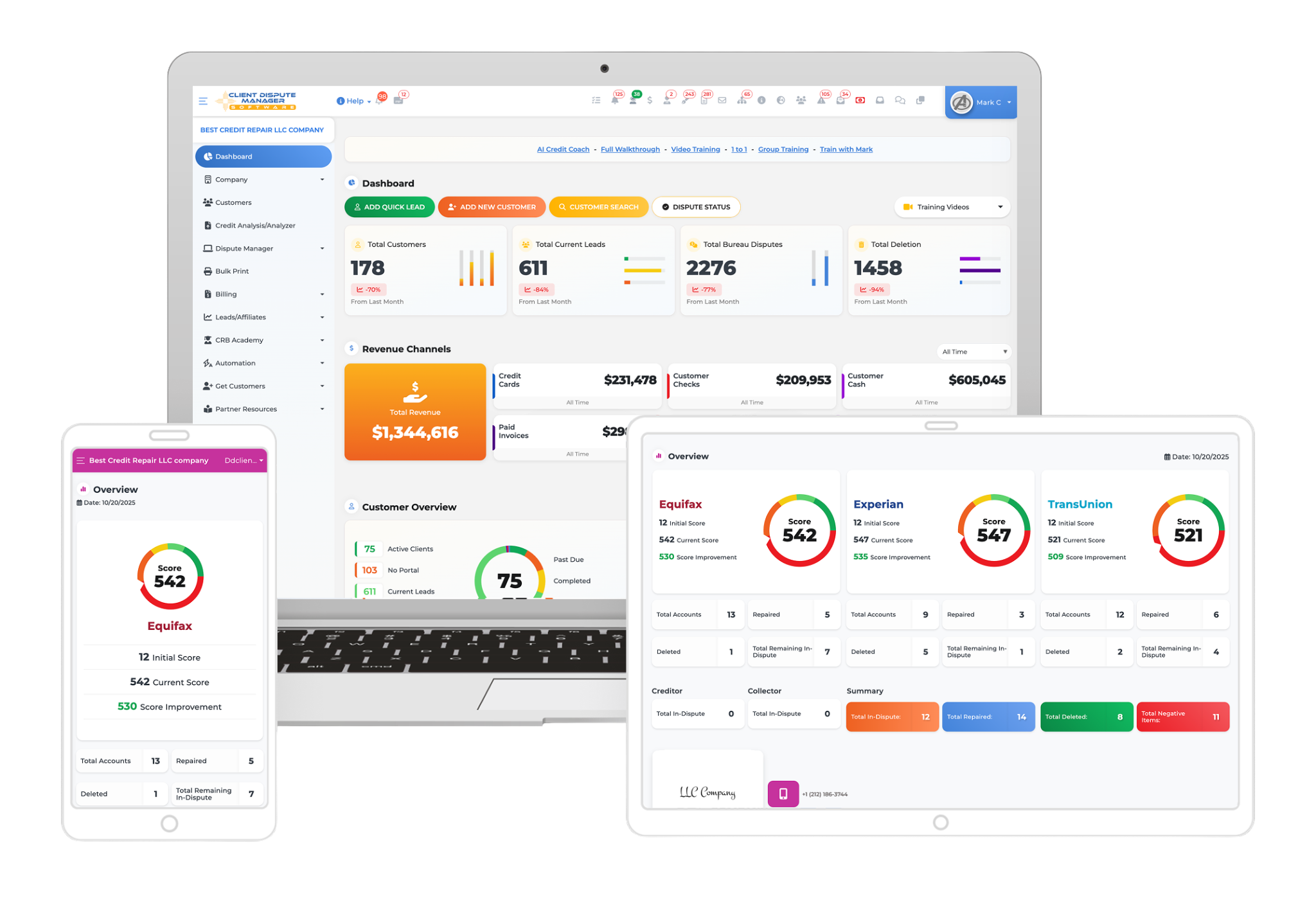
Credit repair software costs between $99 and $299 per month for a new business-level subscription. This is the core operating infrastructure for a professional credit repair business. The software automates dispute letter generation, tracks client progress through each bureau investigation cycle, stores signed contracts, and manages client communication workflows.
Without software, each of those functions requires manual document tracking, spreadsheet management, and individually typed letters. Manual operations cap your client capacity at roughly three to five active clients before errors compound. Software-based operations scale to dozens of active clients per operator.
The monthly subscription is also the cost that determines when your business reaches break-even. Budget for at least three months of software cost as part of your launch reserve, before any client service revenue is complete.
Several states require credit repair businesses to register as Credit Services Organizations and obtain a surety bond before accepting clients. California has the strictest requirement at a $100,000 bond. Florida and Texas each require $10,000. Many states have no bond requirement at all.
Check your state’s Credit Services Organization Act or consult a licensed attorney before launch. The following table shows bond and registration requirements for the states with confirmed statutory requirements. Bond amounts are sourced from state Credit Services Organization Acts and should be verified with a licensed attorney in your state before launch.
| State | Bond Requirement | Registration Required | Statutory Source |
|---|---|---|---|
| California | $100,000 | Yes (CSO registration) | CA Health & Safety Code section 1789.18 |
| Georgia | $50,000 | Yes | GA Code section 16-9-59 |
| Maryland | $25,000 | Yes | MD Code, Credit Services Businesses Act |
| Tennessee | $15,000 | Yes | TN Code section 47-18-1004 |
| Florida | $10,000 | Yes | FL Statute section 817.7001 |
| Texas | $10,000 | Yes | TX Finance Code Chapter 393 |
| All Other States | Varies | Check state CSO Act | Many states have no bond requirement |
A Credit Services Organization (CSO) is the legal term most state statutes use to describe a business that, for compensation, improves or helps improve a consumer’s credit record, history, or rating. Registration as a CSO is required in several states before you can legally accept clients.
Filing fees for CSO registration typically range from $50 to $300, depending on the state. Federal CROA at 15 U.S.C. sections 1679 through 1679j applies as the minimum compliance floor in every state regardless of state-level CSO status.
A business that completes federal CROA setup but skips required state CSO registration is still operating illegally in that state. The two are not interchangeable.
California has the most stringent credit repair licensing requirements of any state, requiring a $100,000 surety bond under California Health and Safety Code section 1789.18. Georgia is the second most stringent at $50,000 under Georgia Code section 16-9-59. Maryland requires $25,000 under the Maryland Credit Services Businesses Act.
These three states represent the highest-cost jurisdictions for credit repair business launch. A business owner starting in California needs to budget between $700 and $1,500 per year just for the bond premium on a $100,000 bond, depending on the owner’s personal credit profile and the bonding company’s rate. Higher-credit applicants pay lower premiums.
The cost of the bond premium is not the same as the face value of the bond. A $100,000 California surety bond costs a credit repair business owner between $700 and $1,500 per year in annual premiums not $100,000. Most startup cost guides list the face value, which causes new owners to dramatically overestimate the actual cash outlay.
A surety bond for a credit repair business costs between $100 and $1,500 per year in annual premiums, depending on the bond’s face value and your personal credit score. A surety bond is a legally required financial guarantee that protects consumers against losses if the credit repair company fails to comply with state law.
The bond premium is a percentage of the bond’s face value. Applicants with good credit (above 700) typically qualify for rates between 1% and 3% annually. On a $10,000 required bond in Florida or Texas, that translates to $100 to $300 per year.
On California’s $100,000 required bond, the same rate range produces $1,000 to $3,000 annually. Budget for the annual premium, not the face value, when calculating your actual startup cost.

Three cost categories fall outside the legal minimum but directly affect how quickly your business generates completed service engagements and referrals: professional certification, a professional website, and an initial marketing budget. These are not required by federal or state law. They reduce the time to your first active clients and your first completed service periods.
Credit repair certification programs cost between $200 and $2,000 depending on the organization and the depth of training included. The most useful programs cover three subject areas: the Fair Credit Reporting Act (FCRA) dispute rights and limitations, CROA compliance requirements for credit repair businesses, and practical dispute strategy for common negative item types.
Certification is not required by CROA or by most state CSO statutes. What it provides is systematic grounding in the legal framework before you begin handling client disputes. A credit repair business owner who disputes an item that cannot legally be removed has wasted a client’s service period and damaged their own credibility.
The cost of certification is far lower than the cost of a client complaint to the Consumer Financial Protection Bureau (CFPB) over a mishandled dispute. [how professional service packages are structured](/credit-repair-service-packages)
A professional credit repair business website costs between $100 and $500 for the first year using a website platform, including domain registration and hosting. This is a baseline operational website a service description page, a contact or intake form, and your CROA-required disclosures.
It does not need to be a high-budget build. The website serves one primary compliance function: it is where potential clients encounter your service descriptions before signing a contract.
What your website says about your services must match what your CROA-compliant contract says. Discrepancies between a website’s service promises and a contract’s actual terms create CROA exposure under the prohibited practices provision at 15 U.S.C. section 1679b(a).
Budget between $300 and $2,000 for the first three months of marketing as a new credit repair business. The most cost-efficient client acquisition channel for new credit repair businesses is referral partner development relationships with mortgage brokers, real estate agents, auto dealers, and financial planners who regularly encounter clients with credit issues.
Referral partner development has minimal direct cost. The investment is time and relationship building, not paid advertising. A single mortgage broker who refers two clients per month is worth more than $2,000 in paid social media advertising for a new business.
Paid marketing Google Ads, social media advertising, local SEO becomes more effective once you have completed service deliveries you can document. Before you have that record, referral relationships are the more efficient path.

Starting a credit repair business from home costs between $650 and $2,500 in the first year, compared to $1,500 to $5,000 or more for an office-based operation. The primary savings come from eliminating commercial lease costs, office equipment, and in-person client meeting infrastructure.
Every required cost business formation, CROA compliance documents, software, and state bonding where required remains unchanged. Credit repair work is documentation and dispute management.
It requires a computer, internet access, and software all of which a home-based operator already has or can acquire for under $200. The CROA written contract and Consumer Rights Statement requirements apply identically to home-based and office-based businesses.
A home-based credit repair business eliminates four cost categories present in a traditional commercial operation. These four categories represent the primary savings:
What a home-based operation cannot eliminate: CROA compliance requirements, state CSO registration fees, surety bond premiums where required, software subscriptions, and marketing costs. Those costs are tied to the legal and operational requirements of the business, not the physical location.
The minimum viable budget to launch a credit repair business legally is approximately $650 in a state with no bond requirement, broken down as follows. These four costs are the floor:
That $650 floor assumes a no-bond state, a self-drafted contract from a reputable template, and the lowest-tier software subscription. A California-based business adds a $700 to $1,500 annual bond premium on top of that floor. A business that pays an attorney to draft and review CROA contracts from scratch adds $500 to $1,000.

A credit repair business is profitable when operated with low overhead and a consistent referral pipeline. The subscription-based service model, where each active client generates revenue for each completed monthly service period, creates recurring revenue per client engagement.
Most credit repair businesses reach break-even between months three and six. (based on reported operational benchmarks from credit repair business operators) Credit repair is not a capital-intensive business once the legal and software infrastructure is in place.
The primary variable cost scales with client volume, and most of those costs are software seats, not fixed overhead. A one-person home-based operation with ten active clients and $200 overhead per month reaches profitability faster than a business carrying $2,000 in monthly fixed costs.
Revenue per active client engagement varies by service delivery structure. A monthly service model generates between $79 and $149 per client per completed service month in most markets. A pay-per-deletion model generates between $50 and $150 per confirmed item removed, depending on the item type and the market rate in your area. how professional service packages are structured?
These figures are for completed service periods and confirmed deletions, not advance payments. CROA at 15 U.S.C. section 1679b(b) prohibits collecting any fee before services are fully performed. Revenue is realized when delivery is complete, not when a client signs up.
With ten active clients on a monthly service model at $99 per completed service period, a credit repair business generates $990 per month in completed service revenue. At twenty clients, that figure reaches $1,980 per month before expenses.
Most credit repair businesses reach break-even between months three and six, assuming a consistent referral pipeline and manageable overhead. Month one typically produces the first one to three active clients while systems and referral relationships are being established.
Months two through three add volume as referral partners begin sending consistent referrals. Businesses that invest in software automation from launch and build at least one active referral relationship before accepting clients reach break-even faster than businesses relying on paid advertising alone.
Paid advertising takes three to six months to optimize and costs money before it produces clients. A referral relationship can produce a client in the first week. Break-even calculation is straightforward.
Add your monthly fixed costs software, bond premium (annualized monthly), and any marketing spend. Divide by your per-client completed service revenue. That number is your break-even client count.
A realistic first-year revenue target for a credit repair business is $15,000 to $40,000 in completed service revenue, depending on your market, referral partnerships, and operational capacity. This assumes a ramp from two to three clients in month one to fifteen to twenty-five active clients by month twelve.
That range is conservative. A business owner who enters with an established referral relationship in place a mortgage broker, real estate agent, or financial planner already sending referrals can reach the high end of that range in nine months. A business starting with no referral pipeline builds more slowly.
Credit repair business owner salary benchmarks confirm this range. The median reported annual income for credit repair business owners is approximately $30,000 to $50,000 in year one, with growth accelerating significantly in year two as the referral network compounds.
Starting a credit repair business costs between $650 and $5,000 in the first year. Required costs include business entity formation ($50 to $500), federal EIN registration (free), CROA-compliant written contract templates ($0 to $1,000), and credit repair management software ($99 to $299 per month).
State bond requirements are the most significant variable: California requires a $100,000 surety bond; Florida and Texas require $10,000; many states require no bond at all.
The cost to start a credit repair company is the same as any credit repair business: $650 to $5,000 in the first year for a home-based operation without a bond requirement, and $1,500 to $7,000 or more in a high-bond state like California or Georgia.
The legal structure LLC, sole proprietorship, or corporation affects formation cost but not the CROA compliance requirements, which apply to every credit repair business regardless of entity type.
There is no single federal license required to start a credit repair business. Federal CROA establishes compliance requirements written contracts, Consumer Rights Statements, advance fee prohibition, three-day cancellation rights that apply to all credit repair businesses regardless of state.
Many states also require registration as a Credit Services Organization before accepting clients. A business fully compliant with federal CROA can still be operating illegally in a specific state if it has not met state-level CSO registration requirements.
Bond requirements depend entirely on your state. California requires a $100,000 surety bond under California Health and Safety Code section 1789.18. Georgia requires $50,000 under Georgia Code section 16-9-59. Maryland requires $25,000 under the Maryland Credit Services Businesses Act.
Florida requires $10,000 under Florida Statute section 817.7001. Texas requires $10,000 under Texas Finance Code Chapter 393. Tennessee requires $15,000 under Tennessee Code section 47-18-1004. Many states have no bond requirement. Check your state’s Credit Services Organization Act or consult a licensed attorney.
Credit repair businesses use credit repair management software that automates dispute letter generation, client progress tracking, signed contract storage, and client communication. Monthly subscription costs range from $99 to $299 per month depending on features and client volume capacity.
This software is the core operating infrastructure for a professional credit repair business and directly determines how many active clients an operator can manage without errors compounding.
Credit repair business startup costs are determined by four fixed requirements business formation, CROA compliance documents, state registration where applicable, and software plus one major variable: your state’s bonding requirement. California’s $100,000 bond is the extreme. Florida, Texas, and Tennessee are in the $10,000 to $15,000 range. Many states require no bond at all.
The total investment to launch legally ranges from approximately $650 in a no-bond state to $5,000 or more in a high-bond state. The compliance infrastructure written contracts that satisfy 15 U.S.C. section 1679d, a separate Consumer Rights Statement required at 15 U.S.C. section 1679c, the advance fee prohibition at 15 U.S.C. section 1679b(b) applies at every price point.
Reducing startup cost by skipping compliance documents does not reduce cost. It produces a business that is operating in violation of federal law before it has served a single client.
Credit repair businesses that launch with compliance infrastructure in place, software automation running from day one, and at least one referral partner relationship active reach break-even between months three and six. That is the model that works.

Mark Clayborne specializes in credit repair, starting and running credit repair businesses. He's passionate about helping businesses gain freedom from their 9-5 and live the life they really want. You can follow him on YouTube.
Experience our credit repair software, risk-free.