Get Started for as Low a $49 for the First Month: Click Here
Written by Mark Clayborne
Last updated on July 30, 2026
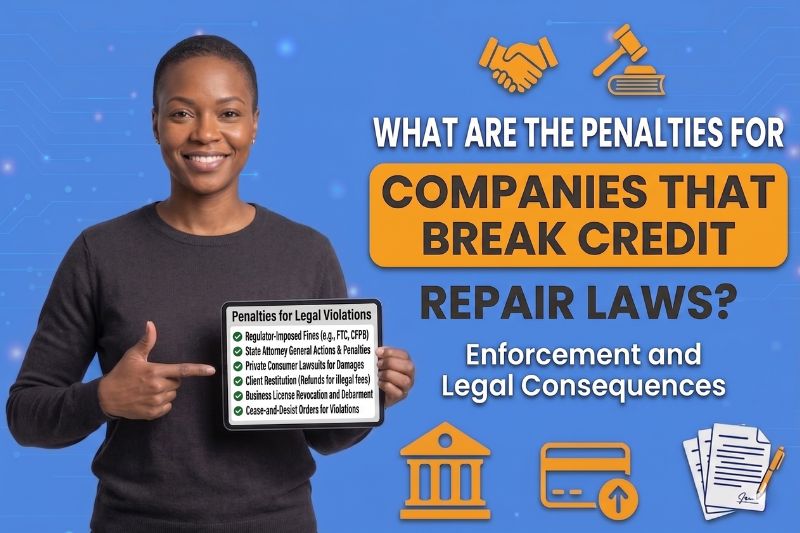
Companies that break credit repair laws face three enforcement channels that operate independently and can be pursued simultaneously: the FTC, which can impose civil penalties up to $50,120 per violation under the FTC Act; the CFPB, which can impose civil money penalties up to $1 million per day for knowing violations under the Dodd-Frank Act; and private consumer lawsuits under CROA’s private right of action at 15 U.S.C. section 1679g, which allow consumers to recover actual damages, punitive damages up to $1,000 per violation, and attorney fees without waiting for any government agency to act.
In enforcement actions against credit repair companies with large client bases, where each client transaction constitutes a separate violation, total penalties across all three channels can reach tens of millions of dollars.
This article maps every enforcement mechanism available against credit repair companies that violate CROA, the Telemarketing Sales Rule, and federal consumer protection law.
It covers how to identify when a credit repair company is breaking the law, which agencies have authority to act and how their enforcement processes work, what private remedies consumers can pursue independently, and what the penalties look like for the most serious violations, including identity fraud schemes that cross from civil CROA territory into federal criminal prosecution.
The penalties for companies that break credit repair laws span a three-tier enforcement structure that is capable of producing civil penalties, consumer restitution, permanent industry bans, and in the most serious cases criminal prosecution, with each tier operating independently of the others and all three capable of targeting the same company simultaneously.
The FTC enforces CROA, the TSR, and FTC Act Section 5 against credit repair companies. The CFPB enforces the same statutes under concurrent Dodd-Frank authority. Consumers enforce CROA directly through the private right of action at 15 U.S.C. section 1679g without any government agency involvement.
A credit repair company that commits multiple violations across a large client base is not managing one enforcement risk. It is managing three simultaneously.
Five conduct patterns during a credit repair company’s sales and onboarding process are the most reliable indicators that the company is operating outside CROA’s requirements, and each maps directly to a specific statutory violation rather than being a general concern about business quality or professionalism.
| Violation Type | What The Company Does | Statutory Provision Violated | Evidence To Document |
|---|---|---|---|
| Advance Fee Collection | Collects any fee before completing the contracted services, regardless of how the fee is labeled | CROA 15 U.S.C. § 1679b(b) + TSR 16 C.F.R. § 310.4(a)(2) | Receipts, bank records, contract showing fee timing vs. service start date |
| No Written Contract | Begins services without providing a written contract containing all CROA-required elements | CROA 15 U.S.C. § 1679d | Document any verbal agreement and the absence of a written contract |
| No Consumer Rights Statement | Fails to deliver a separate Consumer Rights Statement before the contract is signed | CROA 15 U.S.C. § 1679c | Retain all documents received at or before signing; note what was not provided |
| Guarantee Claims | Promises to remove all negative items, guarantees specific score increases, or claims the ability to delete accurate information | CROA 15 U.S.C. § 1679b(a) + FTC Act Section 5 | Screenshot or retain any written guarantee; note any verbal guarantee with date and content |
| No Cancellation Right | Does not provide a Notice of Cancellation form or includes a contract clause waiving the three-day cancellation right | CROA 15 U.S.C. § 1679e | Retain the contract showing the absence of a cancellation form or presence of a waiver clause |
Three complaint channels are available to consumers who have experienced a credit repair company’s CROA violation, and filing complaints with all three simultaneously creates the most complete regulatory record and the highest probability of triggering a formal investigation.
A consumer who files complaints with all three channels and retains documentation of the violation has created the most complete evidentiary foundation available for both regulatory enforcement and a private CROA lawsuit, and the existence of government complaint records substantially strengthens the factual foundation of any subsequent private litigation.

Consumers who suspect a credit repair company is violating the law can contact the FTC, the CFPB, and their state attorney general, each of which has independent enforcement authority and can act on complaints without coordination with the other agencies. The FTC enforces CROA, the TSR, and FTC Act Section 5.
The CFPB enforces consumer financial protection laws including CROA under the Dodd-Frank Act. State attorneys general enforce both federal credit repair laws and applicable state credit services organization laws, giving them a broader enforcement mandate in states with significant additional requirements beyond the federal baseline.
The FTC’s civil penalty authority for credit repair violations comes from three statutes that it enforces simultaneously against non-compliant credit repair companies. Under the FTC Act, the maximum civil penalty per violation is $50,120, a figure that is adjusted for inflation and represents the per-violation ceiling rather than a total cap.
Under CROA, the FTC has authority to seek injunctive relief and restitution for affected consumers in addition to civil penalties. Under the TSR, advance fee violations provide an additional basis for civil penalties independent of any CROA action.
The concept of per-violation penalties is the element of FTC credit repair enforcement that most credit repair business owners underestimate until they examine an actual enforcement case. A credit repair company that collected an advance fee from 800 clients before delivering any services has not committed one advance fee violation.
It has committed 800 separate violations, each carrying a maximum civil penalty of $50,120. The multiplication of individual violations across a client base is what produces the multi-million-dollar civil penalty totals that appear in published FTC enforcement actions, and it is the structural feature of FTC enforcement that makes a single non-compliant process at the operational level a potentially catastrophic financial exposure.
The CFPB holds concurrent enforcement authority over credit repair organizations under the Dodd-Frank Wall Street Reform and Consumer Protection Act and structures its civil money penalties in three tiers based on the degree of culpability of the violation.
| Agency | Enforcement Authority | Maximum Penalty | What Triggers Enforcement Action |
|---|---|---|---|
| Ftc | CROA + TSR + FTC Act Section 5 | $50,120 per violation (inflation-adjusted) | Advance fees, deceptive advertising, missing disclosures, guarantee claims |
| Cfpb | Dodd-Frank Act + CROA | Tier 1: $5,000/day | Tier 2: $25,000/day | Tier 3: $1M/day | Tier 1: violations; Tier 2: reckless violations; Tier 3: knowing violations |
| State Ag | State CSO laws + federal CROA | Varies by state; can include civil penalties, restitution, injunctions | State credit services organization law violations + federal CROA violations in that jurisdiction |
The CFPB’s supervisory authority is distinct from its enforcement authority and represents an earlier stage of regulatory engagement. The CFPB can examine credit repair businesses, review their records, and assess their compliance posture before any formal enforcement action is initiated, giving the agency a monitoring capability that precedes and informs its enforcement decisions.
A credit repair company with a high volume of unresolved CFPB complaints is signaling regulatory risk to the CFPB’s supervisory division even before any formal investigation is opened, which is why complaint management and proactive compliance documentation are not separate considerations from enforcement risk. They are the same consideration.
Federal agencies enforce laws against deceptive credit improvement practices through a sequential process that begins with complaint intake and pattern identification, proceeds through a formal investigation phase that can include civil investigative demands for company records, and resolves either through a negotiated consent order or through litigation in federal court.
The FTC and CFPB both use this process, and in significant credit repair enforcement cases they coordinate their actions to apply maximum pressure through both agencies simultaneously.
The typical enforcement resolution is a consent order that includes civil penalties, a consumer restitution fund, ongoing compliance monitoring, and in some cases a permanent ban on the named individuals from ever operating in the credit repair industry again.
The FTC’s enforcement process against a credit repair company typically moves through four stages, each of which builds on the prior stage’s findings and creates a progressively more serious regulatory situation for the company under examination.
Several monitoring resources beyond government agencies give consumers access to complaint histories and compliance assessments for credit repair companies before they sign any agreement. The CFPB Consumer Complaint Database at ConsumerFinance.gov allows any consumer to search for a company by name and review the complaints filed against it, the categories of those complaints, and the company’s response pattern.
A high volume of unresolved CFPB complaints about billing practices, failure to deliver services, or missing disclosures is a documented signal of non-compliant operations that any prospective client should treat as a disqualifying factor.
The Better Business Bureau maintains its own complaint and review database that covers credit repair companies and includes customer dispute histories that may reflect CROA violations without labeling them as such. State consumer protection agencies maintain separate complaint databases that cover violations of state credit services organization laws.
The FTC’s Consumer Sentinel Network, while not publicly searchable, aggregates complaint data that enforcement staff use to prioritize cases. The compounding effect of a clean record across all four of these databases is that a credit repair company with no documented complaint pattern has effectively removed itself from the population of companies that enforcement agencies actively monitor, which is the most durable form of compliance protection available.

Yes. Under 15 U.S.C. section 1679e, consumers have an unconditional three-day right to cancel any credit repair service contract without penalty, without providing a reason, and without any advance notice beyond informing the company of the cancellation decision.
This right is created by federal statute, not by the contract, which means it exists regardless of what the contract says about cancellation, and any clause in the contract that purports to limit, shorten, or eliminate the three-day window is void under federal law and unenforceable regardless of whether the consumer signed the clause.
The presence of a void waiver clause in a credit repair contract is itself a CROA violation independent of whether the company ever attempted to enforce it.
The three-day cancellation right under 15 U.S.C. section 1679e begins on the date the consumer signs the credit repair service contract. The consumer has three full business days from that date to notify the company of their decision to cancel, and the company must honor that cancellation without penalty, without requiring a reason, and without charging any cancellation fee or retaining any fee already collected during the cancellation window.
The credit repair company is required to include a Notice of Cancellation form in every contract package with written instructions on how to exercise the right, so the consumer is never required to research the cancellation process independently or negotiate the terms of a cancellation after the fact.
A credit repair company that refuses to honor a timely cancellation request, charges a cancellation fee, or claims the consumer waived their cancellation right by signing the contract is committing a CROA violation at the moment it does so, on top of any existing violation created by the presence of a non-compliant waiver clause in the contract.
A consumer whose cancellation request was refused has grounds for both a CFPB complaint and a private CROA lawsuit, with the refusal itself constituting documented evidence of the violation that eliminates the credibility defense the company might otherwise offer.
CROA’s private right of action at 15 U.S.C. section 1679g gives consumers the ability to file a civil lawsuit against a credit repair company that violated the statute without needing the FTC, CFPB, or state attorney general to have investigated or acted first.
The private right of action is available in federal and state court and can be filed by the consumer individually or as part of a class action if multiple consumers experienced the same violation from the same company.
The damages structure in a private CROA lawsuit is designed to make litigation economically viable even when the individual monetary loss is relatively modest.
The consumer can recover the greater of the actual amount paid to the credit repair company or the actual monetary harm caused by the violation. The court may additionally award punitive damages of up to $1,000 per violation on top of actual damages. And if the consumer prevails, the credit repair company is required to pay the consumer’s reasonable attorney fees and court costs.
The attorney fee provision is the structural key that enables private CROA enforcement at small individual loss amounts: an attorney can take a CROA case on contingency knowing that the defendant pays the fees if the consumer wins, which makes the case economically rational for legal representation even when the client’s direct monetary loss would not otherwise support a contingency arrangement.
Entities that impersonate credit reporting agencies or misrepresent their relationship with credit bureaus face civil penalties under CROA at 15 U.S.C. section 1679b(a) and FTC Act Section 5 for the false representations the impersonation involves, and in cases where the scheme extends to advising consumers to create new credit identities using Employer Identification Numbers in place of Social Security Numbers, federal criminal prosecution under 18 U.S.C. section 1028.
The civil and criminal exposure can be pursued simultaneously, and the criminal prosecution is not conditional on the civil enforcement action having been completed or resolved.
Two distinct categories of identity misrepresentation appear in credit repair enforcement cases, and both violate CROA and FTC Act Section 5 through different mechanisms. The first category is a credit repair company that represents itself as a credit bureau, claims to have a direct relationship with Equifax, Experian, or TransUnion that it does not actually have, or claims the authority to directly delete or modify items on a credit report without going through the standard FCRA dispute process.
These representations are false at the moment they are made, because third-party credit repair companies have no direct access to credit bureau systems and cannot delete items unilaterally regardless of how they describe their capabilities.
The second category is a credit repair company that misrepresents the nature or legal authority of its services in a way that creates a false impression about what credit repair can accomplish for the consumer.
A company that tells prospective clients it has a proprietary legal strategy that forces credit bureaus to delete negative items, or that it has relationships with creditors that allow it to negotiate deletions outside the standard dispute process, is making representations about its capabilities and authority that CROA’s false representation prohibition at 15 U.S.C. section 1679b(a) and FTC Act Section 5 both prohibit, regardless of whether those representations are made in advertising, in sales conversations, or in the service contract itself.
The EIN scheme, also marketed under the labels ‘credit privacy number,’ ‘CPN,’ or ‘secondary credit number,’ is a credit repair-adjacent fraud in which a company or individual advises a consumer to obtain an Employer Identification Number from the IRS and use it in place of their Social Security Number when applying for new credit accounts, creating the false impression of a new credit profile with no negative history.
This practice is a federal crime under 18 U.S.C. section 1028, which prohibits the knowing transfer, possession, or use of a means of identification with intent to commit any unlawful activity.
The criminal exposure in an EIN scheme is not limited to the credit repair company or individual who advises the scheme. A consumer who follows the advice and uses an EIN as a substitute SSN on a credit application is personally committing identity fraud under 18 U.S.C. section 1028, because they are knowingly misrepresenting their identity to a financial institution.
Both the company that offers the scheme and the client who implements it face federal criminal prosecution that is entirely separate from and independent of the civil CROA penalties the company faces for the same conduct. A consumer who has been advised by a credit repair company to obtain a CPN or use an EIN in place of their SSN should immediately cease following that advice, document exactly what the company told them, and report the conduct to the FTC at ReportFraud.ftc.gov and the CFPB at ConsumerFinance.gov/complaint, because what the company is selling is not credit repair. It is federal identity fraud.
Companies that break credit repair laws face three enforcement channels simultaneously. The FTC can assess civil penalties up to $50,120 per violation under the FTC Act. The CFPB can impose civil money penalties up to $1 million per day for knowing violations under Dodd-Frank.
Consumers can file private lawsuits under CROA at 15 U.S.C. section 1679g, recovering actual damages, punitive damages up to $1,000 per violation, and attorney fees without any government involvement.
In enforcement actions against companies with large client bases where each client transaction is a separate violation, total penalties across all three channels can reach tens of millions of dollars.
Three channels are available and should be used simultaneously for maximum effect. File with the FTC at ReportFraud.ftc.gov, which can investigate, impose civil penalties, order restitution, and permanently ban operators. File with the CFPB at ConsumerFinance.gov/complaint, which forwards the complaint to the company, tracks the response, and uses complaint patterns to identify supervisory examination targets.
File with your state attorney general, who has independent authority to enforce both federal credit repair laws and any applicable state credit services organization requirements in your jurisdiction.
Yes. CROA at 15 U.S.C. section 1679g provides consumers with a private right of action to file a civil lawsuit in federal or state court without requiring any government agency to have investigated or acted first.
Damages available include the greater of actual amounts paid or actual monetary harm, plus punitive damages up to $1,000 per violation, plus attorney fees paid by the defendant if the consumer prevails. The attorney fee provision makes CROA litigation economically viable on contingency at individual loss amounts that would not otherwise support private representation.
The primary monitoring resources are the CFPB Consumer Complaint Database at ConsumerFinance.gov, where any consumer can search a company by name and review its complaint history; the FTC’s complaint database, which is aggregated in the Consumer Sentinel Network and used by enforcement agencies; the Better Business Bureau, which tracks complaint and dispute histories; and state consumer protection agencies that maintain databases covering state credit services organization law violations.
A company with a clean record across all four databases has effectively demonstrated a compliance posture that enforcement agencies have no reason to examine.
Entities that impersonate credit reporting agencies face civil penalties under CROA at 15 U.S.C. section 1679b(a) and FTC Act Section 5 for the false representations the impersonation involves. Companies that advise consumers to use Employer Identification Numbers in place of Social Security Numbers to create new credit profiles face federal criminal prosecution under 18 U.S.C. section 1028 for identity fraud, independent of any civil CROA penalties.
Both the company that offers this scheme and the consumer who follows the advice can face criminal prosecution, making the EIN or credit privacy number scheme one of the most dangerous practices in the credit repair space.
The penalties for breaking credit repair laws are not theoretical deterrents that exist in the background of the industry without affecting day-to-day operations. They are the documented outcome of enforcement actions that the FTC and CFPB have pursued against credit repair companies whose non-compliant billing structures, missing disclosures, guarantee claims, and advance fee violations made them regulatory targets.
The three enforcement channels available to consumers, federal regulators, and state attorneys general operate independently of each other and can all pursue the same company at the same time, which is the structural feature of credit repair enforcement that converts a single non-compliant process into multi-channel, multi-million-dollar regulatory exposure.
No single agency needs to act for the others to be available, and no consumer needs a government investigation to vindicate their own CROA claim through the private right of action. Credit repair businesses built on compliant operations are not threatened by the enforcement framework described in this article.
They are protected by it, because the FTC’s and CFPB’s enforcement resources are directed at the operators who collected advance fees, skipped disclosures, made guarantee claims, and advised consumers to commit identity fraud, not at the operators who built their billing cycles around post-service collection, delivered their Consumer Rights Statements before every contract, and operated within the legal framework that CROA defines.
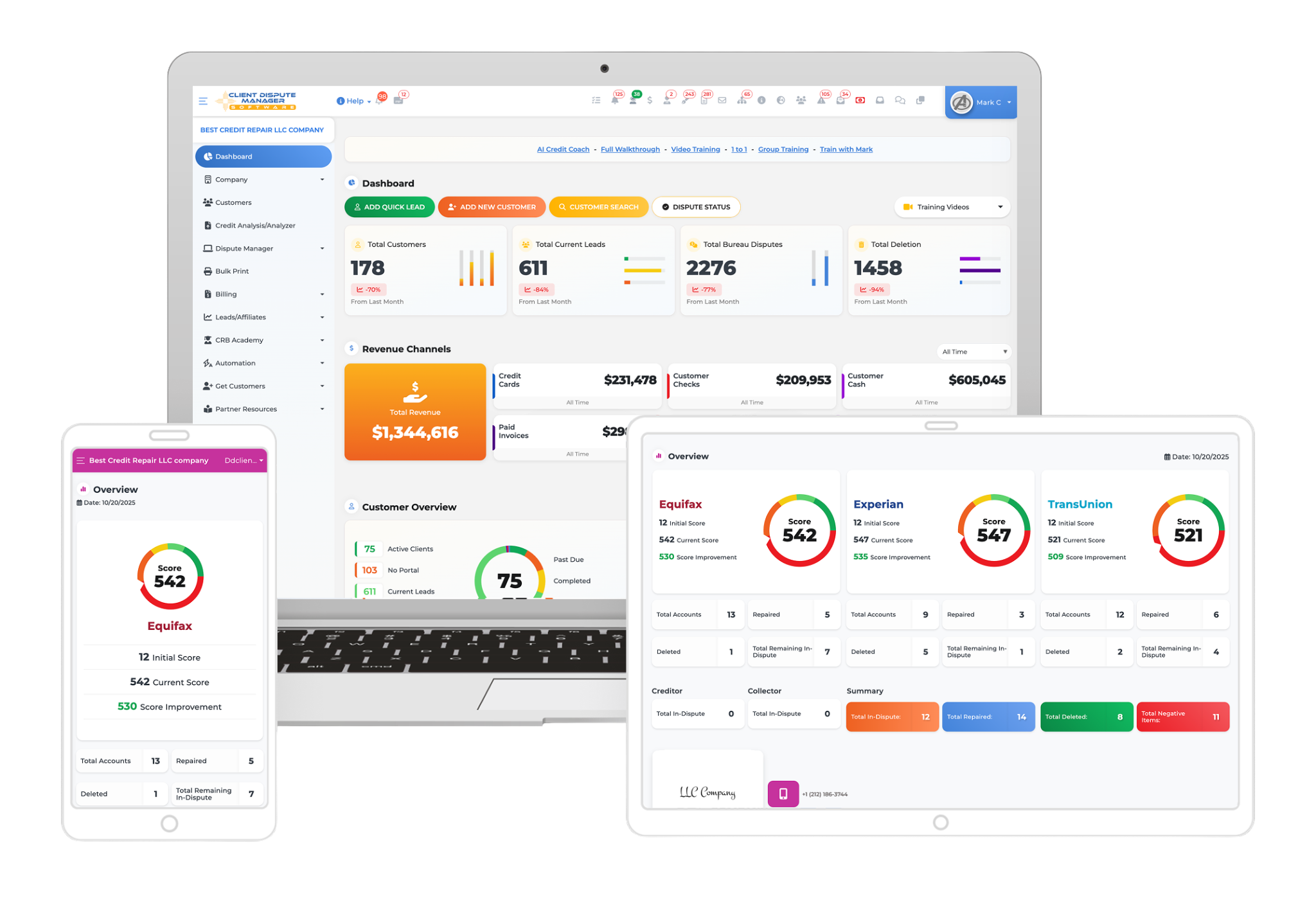
Client Dispute Manager Software is built around the compliance requirements that enforcement actions target when they are absent: CROA-compliant contract templates, Consumer Rights Statement delivery sequencing, post-service billing structures, and document retention that produces the complete audit trail a regulatory review demands. The compliance infrastructure is not an addition to the operational platform. It is the operational platform.

Mark Clayborne specializes in credit repair, starting and running credit repair businesses. He's passionate about helping businesses gain freedom from their 9-5 and live the life they really want. You can follow him on YouTube.
Experience our credit repair software, risk-free.