Get Started for as Low a $49 for the First Month: Click Here
Written by Mark Clayborne
Last updated on July 30, 2026
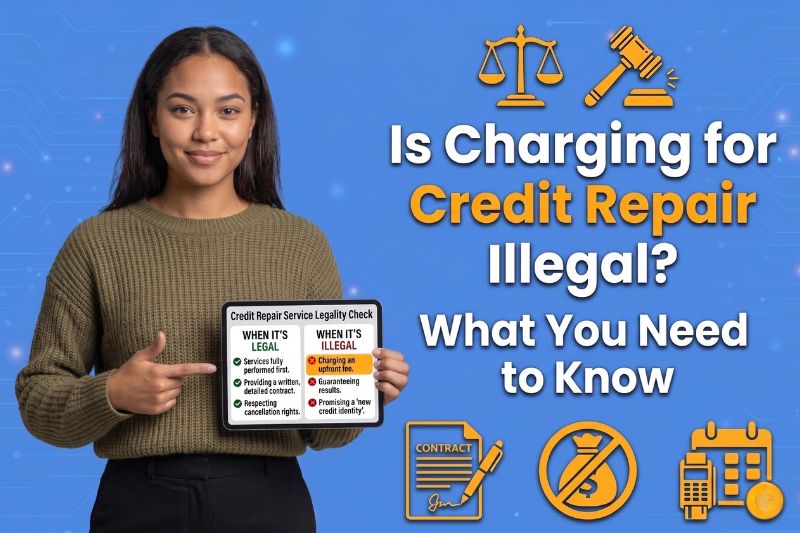
Charging for credit repair is not illegal in the United States, and the claim that it is represents one of the most persistent and consequential misconceptions in the consumer finance space.
What is illegal, under both the Credit Repair Organizations Act (CROA) at 15 U.S.C. section 1679b(b) and the Telemarketing Sales Rule (TSR) at 16 C.F.R. section 310.4(a)(2), is for a credit repair company to collect any fee from a consumer before it has fully performed the contracted services.
The distinction between those two statements is not a technicality. It is the entire legal framework governing credit repair billing, and understanding it correctly is what separates a consumer who can evaluate a credit repair company’s practices from one who cannot, and a credit repair business built for longevity from one creating regulatory exposure before its first client file is closed.
This article covers both sides of that framework. For consumers evaluating whether a credit repair company’s fees are structured legally, it explains what CROA and the TSR require, what fee structures are permissible, what state law can add on top of the federal baseline, and what enforcement looks like when companies cross the line.
For credit repair business owners, it maps the specific billing structures that satisfy both federal statutes and the contract transparency requirements that CROA imposes before a single fee can be collected.

Credit repair laws protect consumers from unfair billing through a coordinated prohibition that spans two separate federal statutes and closes every pathway to advance fee collection regardless of how a credit repair company structures its business model.
CROA at 15 U.S.C. section 1679b(b) bars any credit repair organization from charging or receiving money from a consumer before fully performing every service it agreed to provide.
The TSR at 16 C.F.R. section 310.4(a)(2) extends that prohibition to credit repair services marketed by telephone or online and adds a six-month post-delivery condition: even after services are performed, a company subject to the TSR cannot collect a fee until six months after the results it promised have been delivered.
Together, these two statutes eliminate every advance fee model in the credit repair industry, not as a compliance preference but as a categorical legal prohibition.
The coordination between CROA and the TSR is not redundant. Each statute covers a specific set of circumstances, and together they form a prohibition system with no gaps for compliant-sounding fee structures to pass through.
| Statute | Statutory Citation | What It Prohibits | Who It Covers |
|---|---|---|---|
| Croa | 15 U.S.C. § 1679b(b) | Any fee collected before all contracted services are fully performed, without exception for fee size, label, or consumer consent | All credit repair organizations providing services for compensation, regardless of business model or marketing channel |
| Tsr | 16 C.F.R. § 310.4(a)(2) | Any fee before services are delivered, plus any fee collected less than six months after promised results are provided for telephone and online-marketed services | Any seller or telemarketer of credit repair services marketed by telephone, email, internet, or online advertising |
Because most modern credit repair businesses market through telephone, email, and digital channels, the TSR applies to the vast majority of operations alongside CROA, which means a credit repair company operating in 2026 almost certainly faces both prohibitions simultaneously.
A company that violates the advance fee rule is not simply creating CROA exposure. It is creating concurrent TSR liability as well, and FTC enforcement actions against advance fee violations typically cite both statutes in the same complaint.
An advance fee is any payment collected before the contracted services have been fully performed, and the label a credit repair company puts on the fee does not change its legal classification.
Setup fees, enrollment fees, document preparation fees, processing fees, and administrative fees collected at intake before any dispute work has begun are all advance fees under CROA and the TSR, regardless of how they are described in the contract or how reasonable the amount appears to the consumer who paid them.
The timing of collection is the only variable that determines legality. The name of the fee, the size of the fee, and the consumer’s willingness to pay it are legally irrelevant to the question of whether collecting it violates the advance fee prohibition.
A fee collected the day after the first complete round of dispute work has been documented and delivered to the client is not an advance fee. A fee collected the day before that work begins is, regardless of what it is called in the contract.
That distinction, not the dollar amount and not the consumer’s agreement, is what CROA and the TSR enforce. Credit repair business owners who understand this timing rule from the first client engagement are not working around a compliance constraint. They are building the only billing structure that the law permits.

At the federal level, there is no maximum dollar amount a credit repair company can charge for its services, and this is one of the most commonly misunderstood aspects of the federal credit repair regulatory framework. CROA and the TSR restrict when fees can be collected, not how much.
A credit repair company that charges $500 per month and delivers that month’s services before billing is operating in full compliance with both federal statutes.
A credit repair company that charges $50 per month but collects that fee at intake before performing any work has violated both CROA and the TSR regardless of the low price. The amount is not the issue. The timing is the issue, and state law is where price caps, where they exist, actually come from.
CROA’s written contract requirement at 15 U.S.C. section 1679d does require that every credit repair service agreement state the total amount of all payments the consumer will make, which means the total cost must be disclosed before any services begin.
That disclosure requirement is not a price cap. It is a transparency mandate: whatever the company charges, the consumer must know the full amount before signing.
A credit repair company can charge any amount it chooses as long as that amount is clearly stated in the contract, collected only after services are performed, and not accompanied by guarantee claims that CROA separately prohibits.
The absence of a federal price cap does not mean there are no limits on what credit repair companies can charge. It means the federal framework chose timing and transparency as the consumer protection mechanisms rather than price regulation.
State law fills the gap where legislators in specific states decided that transparency alone was insufficient consumer protection and added direct fee caps on top of the federal framework.

Several states impose specific monthly fee caps on credit repair companies operating within their borders, and a credit repair business that is fully compliant with CROA and the TSR at the federal level can still be violating state law if it exceeds the applicable state cap for clients in those jurisdictions.
| State | Maximum Monthly Fee | Governing Law | Compliance Note |
|---|---|---|---|
| North Carolina | $75 per month per client | NC Credit Services Business Act | One of the strictest fee caps in the country; applies to all credit services organizations operating in the state |
| Georgia | No monthly cap; bond required | Georgia Fair Business Practices Act | Registration and $10,000 surety bond required; no monthly dollar cap but strict registration requirements |
| Texas | No monthly cap; bond required | Texas Credit Services Organizations Act | License and $10,000 bond required; no monthly dollar cap |
| California | No monthly cap; bond required | California Credit Services Act | $100,000 surety bond required; no monthly dollar cap but highest bond requirement in the country |
| Other States | Varies by state law | Consult each state's CSO Act | Always verify current fee caps directly with the state regulatory authority before accepting clients |
A credit repair business charging $199 per month in a state that caps fees at $75 per month is violating state law with every billing cycle, even if its federal CROA and TSR compliance is perfect.
The state cap applies based on where the client resides, not where the credit repair company is incorporated, which means a business operating from a state with no fee cap must still comply with the fee caps of every state where it accepts clients.
Credit repair services that offer both transparent pricing and compliance with US credit repair laws share three structural characteristics: every fee is disclosed in the written contract before any services begin, consistent with CROA’s requirement at 15 U.S.C. section 1679d; every fee is collected after the corresponding services have been delivered, satisfying the advance fee prohibition under both CROA and the TSR; and no guarantee of specific credit score outcomes or guaranteed item removal appears in any marketing material or contract language, which CROA’s prohibition on false representations at 15 U.S.C. section 1679b(a) independently requires.
The combination of all three characteristics is what separates a legally compliant credit repair service from one that is creating regulatory exposure with every client it signs.

The advance fee prohibition does not eliminate credit repair business models. It defines what compliant ones look like, and there are three fee structures that satisfy both CROA and the TSR while giving credit repair business owners flexibility in how they price and package their services.
| Fee Model | Legal Under Croa And Tsr? | When The Fee Is Collected | Compliance Condition |
|---|---|---|---|
| Monthly Subscription | Yes | After each month's dispute work is completed and documented | The fee for month two is billed after month one's work is finished; no month's fee can be collected before that month's work is done |
| Per-Deletion Or Per-Item | Yes | After the specific disputed item is removed or corrected on the report | Services are fully performed before the fee for that item is charged; no deletion, no charge |
| First Work Fee (After First Cycle) | Yes | After the first complete dispute cycle is documented and delivered | The first round of dispute letters must be sent and documented before any setup-style fee is collected |
| Flat Upfront Fee Before Any Work | No | Before any services are performed | Violates CROA at 15 U.S.C. section 1679b(b) and TSR at 16 C.F.R. section 310.4(a)(2) regardless of how the fee is labeled |
| Retainer Collected At Intake | No | Before any services are performed | Same violation as a flat upfront fee; the label "retainer" does not change the timing analysis under either statute |
The CROA written contract requirement at 15 U.S.C. section 1679d mandates that every credit repair service agreement state the total amount of all payments the consumer will make, and that requirement transforms pricing transparency from a marketing concept into a statutory obligation.
A contract that says fees will be determined month-to-month, that prices vary based on the number of items disputed, or that the total cost depends on results achieved does not satisfy the CROA total cost disclosure requirement, because the consumer has no way to know what they will pay in full before they sign.
The practical implication is that a credit repair company using a monthly subscription model must specify in the contract the monthly fee amount, the maximum number of months the engagement is expected to last, and the total cost if the engagement runs its full term.
A company using a per-deletion model must specify the per-item fee. The disclosure does not need to predict exact outcomes, but it must give the consumer a specific and complete picture of the maximum financial commitment they are making before any services begin.
A contract that lacks this disclosure is a CROA violation independent of whether the fees actually charged were reasonable and post-service. Both violations can be present in the same contract at the same time.

Every credit repair company, whether it operates through paper contracts or digital signup flows, is legally required under CROA at 15 U.S.C. section 1679e to provide consumers with an unconditional three-day right to cancel any credit repair service contract without penalty and without any reason being required.
CROA does not distinguish between paper and digital contracts, which means every online credit repair signup flow must include a properly sequenced Consumer Rights Statement delivered before the contract is signed, a Notice of Cancellation form included in the contract package, and a mechanism for receiving and processing cancellation requests submitted within the three-day window.
An online signup flow that skips these steps is a CROA violation from the first client it processes.
The three-day right to cancel under 15 U.S.C. section 1679e is unconditional. The consumer has three full business days from the date the contract is signed to cancel without any financial obligation, without providing a reason, and without any notice requirement beyond informing the company of the decision to cancel.
The credit repair company must include a Notice of Cancellation form in every contract package with written instructions on how the consumer can exercise the right, which means the consumer should never have to negotiate the terms of a cancellation or research the process independently after signing.
Any contract clause that purports to limit, shorten, or eliminate the three-day cancellation window is void under federal law. Its presence in the contract does not require the consumer to comply with it, and the presence of the clause is itself evidence of a CROA violation independent of whether the company ever attempted to enforce it.
A credit repair company that charges a cancellation fee, requires advance notice longer than three business days, or claims the consumer waived their cancellation right by signing is committing a CROA violation at the moment it enforces those terms, on top of the violation that was already present when the non-compliant clause was included in the contract.
Online credit repair contracts must meet the same CROA disclosure and sequencing requirements as paper contracts, because CROA applies based on the nature of the services provided and the fee collected, not the format of the agreement through which those services are sold.
A compliant online signup flow has three structural requirements that parallel the paper contract requirements exactly. The Consumer Rights Statement must be presented to the consumer and acknowledged before the service contract is presented for signature.
The service contract must include all required CROA elements, including the Notice of Cancellation form with instructions. And the company must have a documented mechanism, whether that is an email address, a web form, or a support channel, through which the consumer can submit a cancellation request within the three-day window.
A non-compliant online flow looks like this: the consumer checks a box agreeing to terms and conditions that incorporate the Consumer Rights Statement language rather than presenting it as a separate pre-contract document, or the flow collects the first payment at the point of signup before any services are documented as performed, or the terms and conditions include a waiver of the three-day cancellation right.
Any of these three failures is a CROA violation on its own, and all three appearing in the same signup flow is not unusual in enforcement cases the FTC has brought against online credit repair operators.

Legal regulations influence the pricing models of professional credit improvement services by making post-service fee collection the only legally available billing structure and eliminating every front-loaded pricing model regardless of how it is packaged, marketed, or contractually described.
The advance fee prohibition under CROA and the TSR is not a rule that credit repair companies navigate around. It is the rule that defines what a credit repair business model must look like to be legally operational, which means the regulation does not restrict credit repair pricing so much as it structures it.
Every permissible credit repair pricing model is a variation on the same fundamental principle: the client pays for work that has already been done, not for work that has been promised.
The advance fee prohibition shapes credit repair business models by creating a single non-negotiable structural requirement, post-service billing, and leaving everything else to the business owner’s discretion.
The monthly fee amount, the scope of services, the contract length, the number of clients, the marketing channels used, and the price point selected are all business decisions that the law does not prescribe.
The timing of fee collection is the one variable the law controls absolutely, and building a business model around that constraint from the first day of operations is not a limitation. It is the foundation of every credit repair business that has survived long enough to grow.
The businesses that struggle with the advance fee prohibition are almost always those that entered the industry with a revenue model that depended on collecting large upfront fees to fund their operating costs before delivering any services.
That model is not made non-viable by the regulation. It was never legally available to credit repair businesses in the first place.
The regulation codified a prohibition on a practice that was already fraudulent in the industry before CROA was enacted, and credit repair businesses that treat post-service billing as a compliance burden rather than a business model feature are misreading the regulatory framework entirely.
The FTC has brought multiple enforcement actions against credit repair companies specifically for advance fee violations, and the documented pattern in those cases is consistent: advance fee collection is almost never the only violation present.
In every published FTC credit repair enforcement case, the advance fee violation appears alongside deceptive advertising claims, including promises to remove all negative items from credit reports, guarantees of specific score increases within defined timeframes, and claims about creating new credit identities.
The combination of those two violation categories, charging fees before delivering services and making guarantees the law prohibits, is what transforms a billing compliance problem into an enforcement case that results in civil penalties, consumer restitution, and in some cases permanent bans from the credit repair industry.
The CFPB holds concurrent enforcement authority over credit repair organizations under the Dodd-Frank Act and has used that authority to pursue credit repair billing violations as part of broader supervisory examinations of the industry.
The practical consequence of the combined FTC and CFPB enforcement posture is that credit repair businesses operating on post-service billing models are not just compliant.
They are operating in a market where enforcement resources are directed specifically at their non-compliant competitors, which over time makes the market more favorable for businesses that built their billing structures correctly from the beginning.
The regulatory framework that most credit repair business owners fear is, in practice, the framework that protects the ones operating within it.

Paying for credit repair is not a crime for the consumer, and no federal law prohibits a consumer from choosing to pay upfront.
What federal law prohibits is the credit repair company from collecting a fee before delivering the services that fee covers. CROA at 15 U.S.C. section 1679b(b) and the TSR at 16 C.F.R. section 310.4(a)(2) place the advance fee obligation on the company, not the consumer.
The consumer is never the violator in an advance fee situation. The company that collects before performing creates the statutory liability, and it is the company, not the consumer, that faces FTC and CFPB enforcement consequences.
Both CROA at 15 U.S.C. section 1679b(b) and the TSR at 16 C.F.R. section 310.4(a)(2) prohibit any credit repair company from collecting a fee before fully performing the contracted services.
Three billing structures satisfy both statutes: a monthly subscription fee collected after each month’s work is delivered, a per-deletion fee collected only after the specific item is removed or corrected, and a first work fee collected after the first complete dispute cycle is documented.
Every dollar collected before corresponding services are performed is a separately actionable violation under both statutes, regardless of how the payment is labeled in the contract.
Payment history is the single largest component of most credit scoring models, accounting for approximately 35 percent of a FICO score. A collection account, charge-off, or late payment on a credit report signals a payment history failure and can suppress a score significantly, with the most severe impact in the first 12 to 24 months and the effect diminishing as the account ages.
Disputing inaccurate negative items under the Fair Credit Reporting Act and addressing abusive collection practices through FDCPA rights are the two primary legal tools for rebuilding the payment history component of a credit profile.
Legally compliant and transparent credit repair services share three structural features: the total cost is stated in the written contract before any services begin, satisfying CROA’s disclosure requirement at 15 U.S.C. section 1679d; all fees are collected after the corresponding services are performed, satisfying the advance fee prohibition under both CROA and the TSR; and no guarantee of specific score outcomes or guaranteed item removal appears in any marketing material or contract.
The written contract total cost disclosure is the single clearest marker distinguishing a compliant service from one that is structured to obscure what the consumer will actually pay.
No credit repair company can legally remove any accurate, verifiable information from a credit report, and the two categories most resistant to dispute are federal student loans in default and outstanding tax liens, because both are supported by government records that credit bureaus can verify independently without relying on the original creditor’s response to a dispute.
Credit repair addresses information that is inaccurate, incomplete, or unverifiable. It cannot remove accurate negative information regardless of how many disputes are filed, and a credit repair company that guarantees erasure of these debts is making a claim that violates CROA’s prohibition on false representations.
Charging for credit repair is legal, collecting fees before delivering services is not, and the credit repair laws that establish that distinction are not ambiguous about which side of the line a given billing practice falls on. CROA and the TSR together eliminate every advance fee model from the credit repair industry and replace them with a simple, workable requirement: earn the fee before collecting it.
The three permissible billing structures that satisfy both statutes give credit repair business owners genuine flexibility in how they price their services while protecting consumers from the upfront fee fraud that prompted Congress to enact CROA in the first place. Companies built on post-service billing are not constrained by that framework. They are the businesses the framework was designed to protect and sustain.
Credit repair business owners who understand the advance fee prohibition from their first client engagement, disclose the total cost in the written contract before any work begins, and build their billing cycles around documented service delivery rather than upfront collection are not navigating a compliance minefield.
They are operating in a regulatory environment that actively works in their favor by directing enforcement resources at the non-compliant operators competing in the same market.
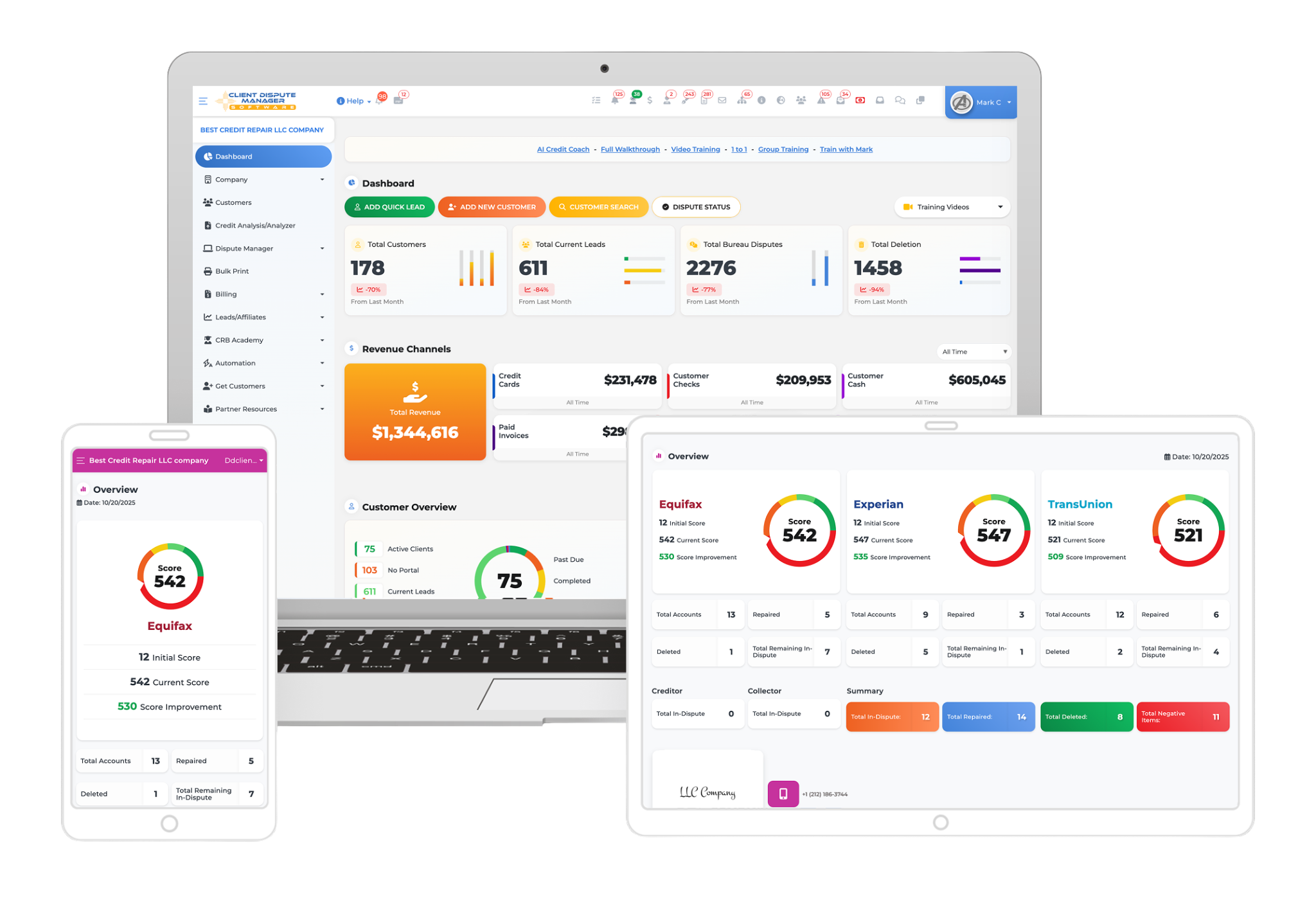
Client Dispute Manager Software is built around these requirements, with a billing module structured for post-service fee collection and contract workflows that include the CROA-required pricing disclosures as default elements of every client agreement rather than as features a business owner must configure or add separately.

Mark Clayborne specializes in credit repair, starting and running credit repair businesses. He's passionate about helping businesses gain freedom from their 9-5 and live the life they really want. You can follow him on YouTube.
Experience our credit repair software, risk-free.