Get Started for as Low a $49 for the First Month: Click Here
Written by Mark Clayborne
Last updated on April 9, 2026
Disputing inaccurate collections on your credit report requires two parallel legal mechanisms: an FCRA dispute filed directly with the credit bureau reporting the account, and an FDCPA debt validation letter sent to the collection agency itself.
Both are free. Both are legally enforceable. A collection account is disputable when it is inaccurate, older than seven years from the original date of first delinquency, or when the collection agency cannot verify the debt.
Owing the underlying debt does not disqualify you from disputing the way it is reported. A valid debt reported with the wrong balance, the wrong date, or the wrong account status is fully disputable under the Fair Credit Reporting Act.
This guide covers every collection dispute scenario that appears most frequently on consumer credit reports: medical collections, standard collection accounts, hard inquiries, and late payment disputes filed through mobile apps.
It also covers the complete step-by-step sequence for removing an inaccurate account from your credit history. For the full overview of which errors qualify for a dispute, start with the guide on what types of errors can be disputed on a credit report.

Four free official resources guide consumers through disputing collections on a credit report.
Annual Credit Report for pulling the reports that contain the collection entries, consumerfinance.gov for the CFPB dispute letter templates and complaint portal, consumer.ftc.gov for the FTC dispute guidance and sample letters, and identitytheft.gov for collection accounts that were opened fraudulently.
All four are federal government resources. None require an account, a subscription, or a payment to access. Before filing any collection dispute, the most important question to answer is whether the collection is disputable.
Many consumers assume that a collection account they legitimately owe cannot be challenged. That is incorrect. The FCRA does not require a debt to be fraudulent before you can dispute it.
A collection account is disputable under any of these conditions:
If any of these conditions apply to a collection on your report, you have grounds to dispute it. For a full explanation of what the FCRA requires of bureaus and creditors during the investigation process, see the guide on your legal rights when disputing credit report errors.

Medical bill collections follow a different dispute process from standard collection accounts because federal rules changed their reporting status in 2025. Under a Consumer Financial Protection Bureau rule effective in 2025, medical debt under $500 may no longer appear on consumer credit reports.
If a medical collection account under $500 appears on your report after that rule took effect, it is disputable as an improperly reported item. Medical collections above $500 remain reportable but must be accurate, verifiable, and not older than seven years from the original delinquency date.
To dispute a medical bill in collections under $500 that still appears on your report after the 2025 CFPB rule:
For the dispute letter format for any collection dispute, see the complete guide on how to write a credit report dispute letter.
For collection accounts that are not medical debt, the dispute process runs through the credit bureau and the collection agency simultaneously. File both at the same time. Two investigations running in parallel produce faster outcomes than one.
Filing with the credit bureau: Go to the official dispute portal of each bureau reporting the collection account. Equifax at equifax.com, Experian at experian.com, and TransUnion at transunion.com. Select the collection entry, describe the specific error, and upload your supporting documentation.
The bureau must complete its investigation within 30 days under 15 U.S.C. 1681i. Filing with the collection agency directly: Send a written dispute letter to the collection agency’s credit disputes mailing address. This address appears on your credit report and is often different from the general correspondence address.
Include the account number, a description of the specific error, and copies of every supporting document. Send by certified mail with return receipt requested. Supporting documents for a standard collection dispute depend on the error type. A paid collection still showing unpaid requires a payoff letter or settlement agreement.
A duplicate entry requires account statements from both the original creditor and the collection agency showing it is the same debt. A collection past the seven-year window requires a statement of the original delinquency date.

A debt validation letter is a separate legal mechanism from an FCRA dispute. It operates under the Fair Debt Collection Practices Act, not the FCRA. When you send a debt validation letter to a collection agency, the agency must verify that the debt belongs to you, that the balance is accurate, and that it has the legal right to collect it.
If it cannot validate the debt, it must stop collection activity and stop reporting the account to the credit bureaus. The FDCPA gives consumers 30 days from first contact with a collection agency to send a debt validation letter with the strongest legal protection.
Sending after the 30-day window still triggers a response obligation, but the agency can continue collection activity while validating. Send by certified mail with return receipt requested regardless of timing.
Your debt validation letter should include your name, the account number from your credit report, a statement that you dispute the debt and are requesting validation, and a request for the name of the original creditor, the original account number, the amount owed and how it was calculated, and proof that the collection agency has the legal right to collect this debt.
Do not include payment with a validation letter. Payment can restart the statute of limitations on old debt and creates a legal acknowledgment that the debt is yours.
You can dispute a hard inquiry on your credit report if you did not authorize it. Authorized hard inquiries, those triggered by a credit application you submitted, are not disputable. The lender had a permissible purpose to pull your credit.
Unauthorized hard inquiries, those that appear without your knowledge or consent, are fully disputable under the FCRA. The distinction matters before you file. Disputing an authorized inquiry is not effective and can be classified as frivolous.
An authorized hard inquiry is generated when you apply for credit, a loan, a lease, or certain employment positions that require a credit check. You consented to the pull either directly in an application or in a terms-of-service agreement.
Examples include mortgage pre-approval applications, auto loan applications, credit card applications, and apartment rental applications. An unauthorized hard inquiry is generated without your consent.
This happens in cases of identity theft where someone applied for credit in your name, a lender pulling your credit without a permissible purpose, or an internal review that should have been conducted as a soft inquiry but was coded as a hard pull.
An unauthorized inquiry is disputable because the creditor lacked permissible purpose under the FCRA. Review every hard inquiry on your report against your own records of credit applications submitted in the past two years.
Hard inquiries remain on your report for two years. Any inquiry you do not recognize is a candidate for a dispute or an identity theft investigation.
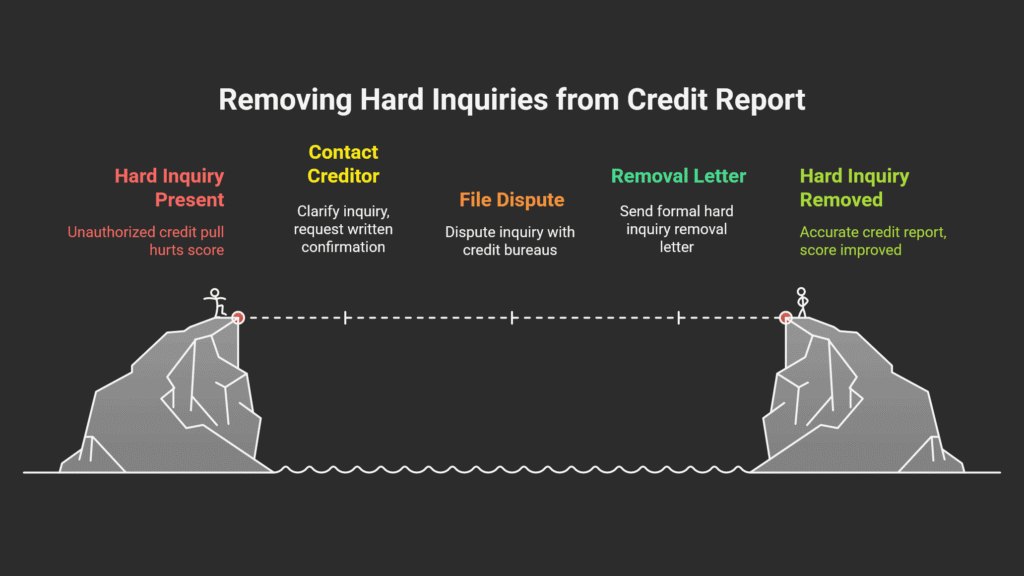
Authorized hard inquiries that are reported accurately cannot be removed early. They fall off your report automatically after two years. For a detailed breakdown of all error types that qualify for a dispute, see the guide on what types of errors can be disputed on a credit report.
Yes. Equifax, Experian, and TransUnion each offer mobile apps that include dispute functionality. You can file a dispute against a late payment notation, a collection account, or any other inaccurate entry directly through the app on your phone.
The same FCRA protections apply regardless of whether you file through a desktop browser or a mobile app. The 30-day investigation window, the free access, and the right to upload supporting documents all remain the same.
Bureau mobile apps and their dispute features:
One practical limitation applies to all three mobile apps: uploading large or multiple documents is more difficult on a phone than on a desktop browser.
For document-heavy disputes, such as a late payment dispute where you need to attach multiple bank statements, the desktop portal produces a cleaner submission. Use the mobile app for simple status corrections or single-document disputes.
Use the desktop portal for disputes that require several attachments. The filing process is the same whether you use a mobile app or a desktop portal. File separately with each bureau reporting the error.
For the complete bureau-by-bureau dispute process, see the guide on how to dispute credit report errors with Equifax, Experian, and TransUnion.
Removing an inaccurate collection account from your credit history requires filing disputes with every bureau reporting the error and sending a debt validation letter to the collection agency at the same time. These are not sequential steps.
They are parallel actions. Running both investigations simultaneously produces the fastest resolution. A collection removed through bureau investigation alone may reappear if the collection agency continues to report it. Both paths must close at the same time.
Follow this sequence in order:
Most collection accounts remain on your credit report for seven years from the original date of first delinquency with the original creditor, not the date the debt was sold to a collection agency.
An account that has passed the seven-year mark is disputable as an outdated item under the Fair Credit Reporting Act, regardless of whether the debt was ever paid.
Yes, if the information reported is inaccurate. Owing the underlying debt does not mean the collection is reported correctly. Common disputable errors on valid debts include a wrong balance, an incorrect original delinquency date, a paid collection still showing unpaid, or the same debt listed twice.
The dispute process addresses the accuracy of the reporting, not whether the underlying debt is real.
A debt validation letter is a written request sent to a collection agency under the Fair Debt Collection Practices Act requiring the agency to verify the debt belongs to you and that the balance is accurate.
If the agency cannot validate the debt, it must stop collection activity and stop reporting the account. Send by certified mail within 30 days of first contact for the strongest legal protection.
Not automatically. Paying a collection updates the status from unpaid to paid but does not remove the entry. The account remains for the full seven years from the original delinquency date.
Removal requires a successful FCRA dispute, a pay-for-delete agreement negotiated in writing before paying, or waiting for the reporting window to expire.
Yes. Under a Consumer Financial Protection Bureau rule effective in 2025, medical debt under $500 may no longer appear on consumer credit reports.
If a medical collection under $500 appears on your report after the rule’s effective date, it is disputable as an improperly reported item under current federal guidelines. Medical collections above $500 remain reportable but must be accurate and verifiable.
Cleaning up duplicate inaccurate collections on your credit report comes down to knowing your rights and taking consistent action. You need to review your reports line by line, identify repeated or incorrect entries, and submit clear disputes with supporting details. When you stay organized and follow up with each bureau, you increase your chances of getting errors removed and your report corrected.
Keep your focus on accuracy, not speed. Track every dispute, save copies of your letters, and monitor updates across all three credit bureaus. If an account cannot be verified or appears more than once, you have a valid reason to challenge it. With a simple process and steady follow-through, you can clean up your report and move closer to a stronger credit profile.

Mark Clayborne specializes in credit repair, starting and running credit repair businesses. He's passionate about helping businesses gain freedom from their 9-5 and live the life they really want. You can follow him on YouTube.
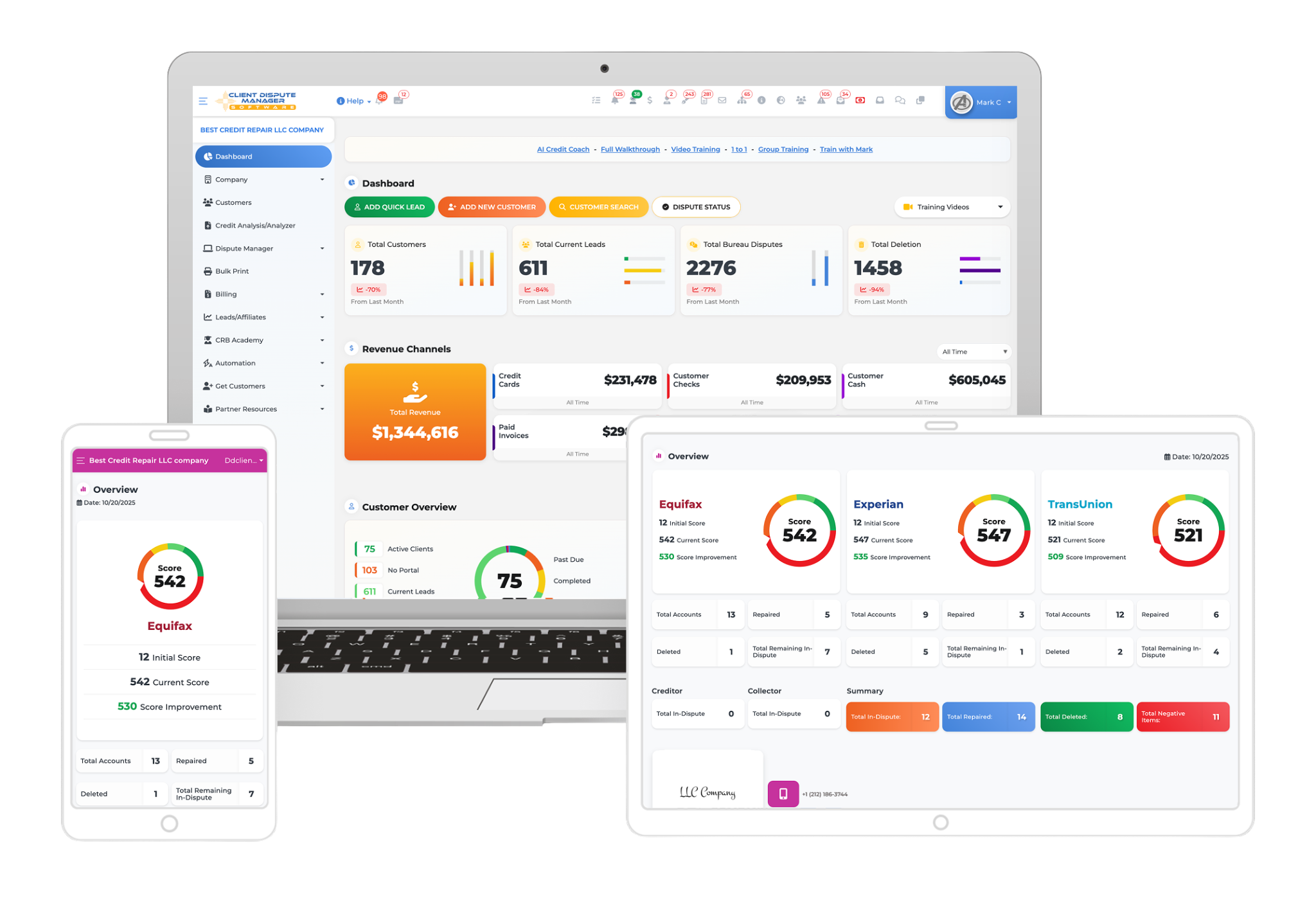
Experience our credit repair software, risk-free.