Get Started for as Low a $49 for the First Month: Click Here
Written by Mark Clayborne
Last updated on April 24, 2026
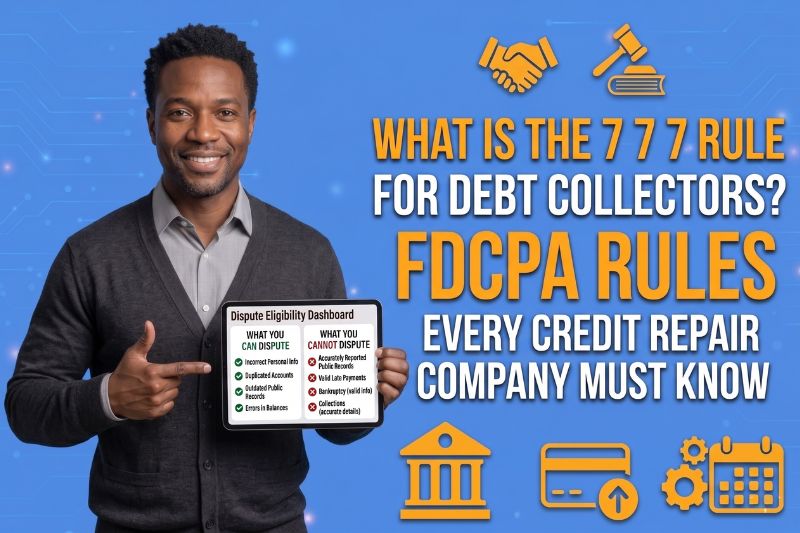
The 7 7 7 rule is a contact frequency limit established by CFPB Regulation F, which updated the Fair Debt Collection Practices Act (FDCPA) at 15 U.S.C. section 1692 and took effect on November 30, 2021: debt collectors cannot call a consumer more than seven times within a seven-day period about any single debt, and after speaking with the consumer by telephone, the collector must wait seven days before calling again about that same debt.
A collector who exceeds that limit creates a presumption of harassment under FDCPA, meaning the consumer does not need to prove they were harassed because the excess contact alone triggers the presumption and shifts the burden to the collector to rebut it.
Understanding FDCPA rules is not optional for credit repair companies that manage collection accounts on behalf of clients.
Every interaction between a collector and a client whose file a credit repair business is working creates a potential FDCPA compliance event, and a credit repair business that identifies an FDCPA violation during the course of its dispute work is not just documenting a credit report inaccuracy.
It is identifying an independent legal claim that the client may be able to pursue simultaneously with the credit bureau dispute process, which is a material difference in outcomes for the client and a meaningful differentiator for the credit repair business.

The Fair Debt Collection Practices Act at 15 U.S.C. section 1692 provides consumers with specific legal protections against three categories of unlawful collection behavior: harassment and abuse, false and misleading representations, and unfair collection practices, and each category carries its own statutory prohibition with its own enforcement mechanism and its own private right of action.
These protections apply to third-party debt collectors, which includes collection agencies, debt buyers, and attorneys who regularly collect debts, but not to original creditors collecting their own debts unless state law imposes equivalent requirements.
For credit repair business owners, understanding these protections is the baseline competency that separates operators who can identify FDCPA violations in client files from those who only recognize FCRA dispute grounds.
FDCPA’s three prohibition categories each address a distinct type of collector misconduct, and the statutory sources for each are important because they define what a consumer must document to support either a CFPB complaint or a private lawsuit.
The harassment and abuse prohibition at 15 U.S.C. section 1692d covers conduct intended to oppress or abuse the consumer, including obscene language, threats of violence, publication of a debt list, and repeated calls intended to annoy rather than to communicate.
The false representations prohibition at 15 U.S.C. section 1692e covers misrepresentations about the debt amount, the collector’s identity, legal consequences of non-payment, and the character or legal status of the debt.
The unfair practices prohibition at 15 U.S.C. section 1692f covers collecting amounts not authorized by the original agreement, taking post-dated checks under coercive circumstances, and threatening to take non-judicial action when none is available or intended.
| Prohibition Category | Statutory Source | What It Covers | Example Violation |
|---|---|---|---|
| Harassment And Abuse | 15 U.S.C. § 1692d | Conduct intended to oppress, harass, or abuse; repeated calls to annoy | Calling 15 times in three days about the same debt before CFPB Regulation F; using obscene language on a call |
| False Representations | 15 U.S.C. § 1692e | Misrepresenting the debt amount, collector identity, or legal consequences | Claiming the consumer will be arrested for non-payment; misrepresenting the balance including unauthorized fees |
| Unfair Practices | 15 U.S.C. § 1692f | Collecting unauthorized amounts; taking non-judicial action when not permitted | Adding collection fees not authorized in the original credit agreement; threatening wage garnishment without a judgment |
FDCPA section 1692c imposes specific contact restrictions on debt collectors that operate independently of the 7 7 7 rule and provide consumers with several distinct rights they can exercise at any point in the collection process.
Collectors cannot contact consumers before 8:00 a.m. or after 9:00 p.m. in the consumer’s local time zone. They cannot contact a consumer at work if the consumer communicates, either orally or in writing, that their employer prohibits such calls.
They cannot contact a consumer who is represented by an attorney, once the collector knows of that representation, and must instead direct all communications to the attorney.
The most powerful of these contact protections is the written cease communication right at 15 U.S.C. section 1692c(c): when a consumer sends a written notice to the collector stating that the consumer refuses to pay the debt or wishes the collector to cease further communication, the collector must stop all contact except for three narrow purposes: to notify the consumer that collection efforts are being terminated, to notify the consumer that the collector intends to invoke a specific legal remedy such as filing a lawsuit, or to acknowledge receipt of the notice.
A collector who continues to contact the consumer after receiving a written cease request has committed a standalone FDCPA violation regardless of how the debt was originally handled.

When collectors call more than the 7 7 7 rule allows, the excess contact creates a rebuttable presumption of harassment under CFPB Regulation F, which means the consumer does not need to independently establish that the calls were intended to harass, because the numerical excess is the evidence of harassment as a matter of regulatory design.
CFPB Regulation F, which implements FDCPA for telephone and electronic contact, defines the 7 7 7 threshold as a bright line: more than seven calls within a seven-day period about a single debt is presumptively unlawful, and a call made within seven days after a telephone conversation with the consumer about that debt is presumptively unlawful regardless of whether it would otherwise fit within the seven-call weekly limit.
CFPB Regulation F’s presumption of harassment is a deliberate design choice that shifts the evidentiary burden from the consumer to the collector.
Under the pre-Regulation F framework, a consumer who was called repeatedly had to prove the calls were intended to harass, a subjective standard that was difficult to establish without a pattern spanning many weeks.
Under Regulation F, a consumer who was called eight times in six days about the same debt has already met the legal threshold. The collector must explain why eight calls in six days does not constitute harassment rather than the consumer needing to explain why it does.
Two operational nuances in the 7 7 7 rule matter specifically for credit repair business owners managing multi-debt client files. First, the rule applies per debt, not per collector.
A collection agency holding three separate delinquent accounts for the same consumer can legally call seven times per week per account, which means a client with multiple collection accounts could receive up to twenty-one calls per week from a single collector without triggering the presumption on any individual account.
Second, calling a consumer counts against the seven-call limit regardless of whether the consumer answers. Unanswered calls and voicemail messages count as contact attempts under Regulation F.

A consumer who has received more than seven calls in a seven-day period about a single debt has three response options that can be pursued in any combination, and credit repair business owners should advise clients on all three before the client takes any action that might compromise their position.
A credit repair business that helps a client document 7 7 7 rule violations is not simply managing a credit report dispute. It is building the evidentiary record for an independent FDCPA claim that the client can pursue with an attorney simultaneously with the bureau dispute process, and the existence of that claim often changes how aggressively and how quickly the collector responds to the credit bureau dispute as well.
The three things debt collectors need to prove before legally pursuing a consumer for a debt are: ownership of the debt or authority to collect on behalf of the owner, the amount owed including all interest and fees authorized by the original agreement, and in states that require it, the right to collect in the specific jurisdiction where the consumer resides.
A collector who cannot demonstrate all three of these elements on demand does not have a legally enforceable collection claim, and a credit repair business that understands this framework is equipped to challenge not only what appears on a client’s credit report but also the underlying legal authority of the entity that placed the collection tradeline there.
| What The Collector Must Prove | Why It Matters | What Happens If They Cannot Prove It |
|---|---|---|
| Debt Ownership Or Collection Authority | Debts are frequently sold and resold, and the chain of title between the original creditor and the current collector is not always documented completely | Cannot legally pursue collection; cannot sue; credit report tradeline may be disputable as unverifiable if the furnisher cannot document ownership when the bureau forwards the dispute |
| The Exact Amount Owed | Collectors sometimes add fees, penalties, or interest not authorized by the original credit agreement, inflating the balance beyond what the consumer actually owes | Collecting an unauthorized amount is a standalone FDCPA Section 1692f violation independent of whether the underlying debt is legitimate |
| Right To Collect In Your State | Some states require debt collectors to hold a license to collect debts from consumers in that state, and collecting without a license is a regulatory violation regardless of the validity of the underlying debt | Collection activity without required state licensing is a regulatory violation; in some states, it voids the collector's ability to collect the debt at all |
The debt ownership requirement is particularly significant in the collection industry because most collection accounts on credit reports involve debt that has been sold, often multiple times, from the original creditor through successive debt buyers.
Each sale should generate a complete chain of assignment documentation, but in practice those records are frequently incomplete, which is why a properly submitted debt validation request often reveals that the collector cannot produce the documentation needed to establish its legal authority to collect the specific account at issue.
The mechanism for challenging a collector’s inability to prove its claim is the debt validation request under FDCPA section 809, codified at 15 U.S.C. section 1692g.
When a consumer receives a first communication from a debt collector, that communication triggers the consumer’s right to send a written validation request within 30 days, and upon receiving that request, the collector must stop all collection activity, including reporting or updating the tradeline on the consumer’s credit report, until it provides adequate verification of the debt.
A collector who receives a timely validation request and continues collection activity without responding has committed a standalone FDCPA violation that the consumer can pursue independent of any dispute about the debt’s validity.
The debt validation request is one of the most operationally powerful tools available in credit repair work precisely because it combines two outcomes that are difficult to achieve through credit bureau dispute alone.
If the collector can provide adequate verification, the credit repair business has gained documentation that either confirms the debt or identifies specific inaccuracies in the reported information that form the basis for a bureau dispute.
If the collector cannot provide adequate verification, the collection activity must cease and the tradeline may no longer be legally supportable on the credit report, which creates grounds for a bureau dispute based on the furnisher’s inability to verify the debt it reported.
Consumers have the right under 15 U.S.C. section 1692g to request written verification of any debt from a collector within 30 days of receiving the collector’s initial communication, and that request triggers two immediate obligations: the collector must cease all collection activity until it provides adequate verification, and it must provide the consumer with the name and address of the original creditor if the consumer requests it.
These rights are not conditional on the debt being inaccurate or disputed. Any consumer who receives a first communication from a debt collector has the right to request validation, and exercising that right forces the collector to document its authority before it can proceed with any collection activity including credit reporting.

The 30-day validation window runs from the date the consumer receives the collector’s initial communication, which FDCPA defines broadly to include the first written notice, the first telephone call, or any other first contact from the collector about the specific debt.
Under 15 U.S.C. section 1692g(a), the initial communication must include four specific disclosures, or the collector must send a separate written notice containing them within five days of the initial contact: the amount of the debt, the name of the creditor to whom the debt is owed, a statement that the debt will be assumed valid unless the consumer disputes it within 30 days, and a statement of the consumer’s right to obtain the name and address of the original creditor if different from the current creditor.
This initial notice is what the collection industry calls the mini-Miranda notice, and it is the document that triggers the 30-day window during which the consumer’s validation rights are active.
A collector that fails to include the required disclosures in the initial notice, or fails to send them within five days if they were omitted from the first contact, has committed a standalone FDCPA section 1692g violation before the consumer has taken any action at all.
Credit repair business owners reviewing collection accounts in client files should verify whether the client received a compliant initial notice because the absence of one is both an FDCPA violation and evidence that the collector’s documentation of the collection process is deficient.
When a consumer sends a written validation request within the 30-day window, the collector’s obligations change immediately.
Under 15 U.S.C. section 1692g(b), the collector must cease all collection activity, which includes calling the consumer, sending additional collection letters, and reporting or updating the tradeline on any credit report, until it provides adequate verification of the debt.
Adequate verification means documentation from the original creditor that confirms the existence and amount of the debt, not simply the collector’s own internal records showing what it believes is owed.
A letter from the collector confirming its own records does not satisfy the verification requirement. A collector that continues collection activity after receiving a timely validation request has committed a separate FDCPA violation for each collection act it takes while the verification obligation is outstanding.
A collector that reports or updates a tradeline on the consumer’s credit report during this period has committed both an FDCPA violation and a potential FCRA violation simultaneously, because the FCRA requires furnishers to ensure the accuracy of information they report, and reporting a disputed debt as current collection activity while a validation request is pending creates an accuracy problem that the bureau has a separate obligation to investigate.
That overlap between FDCPA and FCRA violations is where credit repair businesses have the most leverage in collection account cases.

The two primary legal considerations before paying any very old collection account are the state statute of limitations on filing a collection lawsuit and the risk of restarting that clock through a partial payment or written acknowledgment of the debt.
These two considerations operate on completely separate legal frameworks that many consumers and even some credit repair operators confuse with each other, and conflating them can lead to payment decisions that damage a client’s legal position rather than improving their credit standing.
Paying a collection account does not guarantee its removal from the credit report, does not necessarily improve the client’s credit score significantly, and in some states can revive a debt that a collector could no longer sue on before the payment was made.
The statute of limitations on debt collection is a state law time limit on a collector’s right to file a lawsuit to collect a debt. It runs separately from the FCRA seven-year reporting period, and the two clocks have no legal connection to each other.
A debt can be past the SOL for a lawsuit and still legally appear on the credit report if it is within the seven-year FCRA window. A debt can have already fallen off the credit report because the FCRA period has expired while still being within the SOL window for a lawsuit in some states.
Understanding both clocks separately before advising any payment strategy is not a secondary consideration. It is the foundational analysis.
| Clock Type | What It Governs | Who Controls It | Key Point For Credit Repair |
|---|---|---|---|
| Fcra 7-Year Reporting Period | Whether a negative item can legally appear on a credit report | Federal law (FCRA 15 U.S.C. § 1681c) | Runs from date of original delinquency; cannot be restarted by payment or acknowledgment |
| State Sol On Debt Lawsuits | Whether a collector can file a court judgment to force repayment | State law; varies from 3 to 10 years by state and debt type | Can be restarted by partial payment or written acknowledgment of the debt in many states |
| Collection Account Credit Impact | Whether and how much a collection tradeline suppresses the credit score | Credit scoring models (FICO, VantageScore) | Paid collections still appear on the report and may still suppress the score in some scoring models |

Zombie debt refers to old debt, often sold multiple times through successive debt buyers, that collectors attempt to collect despite the original debt being past the statute of limitations or the FCRA reporting window.
The primary risk of engaging with zombie debt without understanding the legal framework is that a partial payment, a written acknowledgment that the debt exists, or in some states even a verbal acknowledgment, can restart the statute of limitations clock and give the collector renewed legal authority to sue on a debt it could not previously pursue in court.
That revival of legal authority is permanent in many states, meaning a $25 payment toward a ten-year-old debt can transform a time-barred obligation into an enforceable current one.
Re-aging a credit report tradeline, which involves a collector updating the account date to make an old debt appear as a recent collection account, is a separate FDCPA and FCRA violation.
Re-aging extends the item’s apparent life on the credit report beyond its legal seven-year window and constitutes false reporting under FCRA section 1681s-2 and an unfair collection practice under FDCPA section 1692f.
A credit repair business that identifies a collection account whose reporting date appears inconsistent with the original delinquency date has identified both an FCRA dispute ground and a potential FDCPA violation in the same tradeline, which is one of the most common and most actionable combinations in collection account disputes.
The two categories of debt least worth paying without strategic analysis are time-barred debts where the state statute of limitations has already expired and collection accounts that have already fallen off the credit report because the FCRA seven-year reporting window has passed.
Paying either category does not guarantee credit report improvement, does not remove the tradeline in most cases, and in states where a partial payment restarts the statute of limitations, can revive legal exposure that the collector had already lost. Before paying any old collection account, confirm both the original delinquency date and the applicable state SOL.
Unsecured personal debts, including credit cards, medical bills, and personal loans, generally die with the debtor when there is no estate with assets for the creditor to pursue. Surviving family members who did not co-sign the debt are not personally liable for it.
Federal student loans are discharged upon the borrower’s death. Private student loans may survive depending on the lender’s terms. Joint debts are an exception: the surviving co-signer remains fully liable for the entire balance regardless of the other borrower’s death, and creditors can and do pursue joint account holders in that situation.
The 7 7 7 rule under CFPB Regulation F applies to all third-party debt collectors, including those collecting charged-off and collection accounts.
The rule prohibits more than seven calls within a seven-day period about a single debt, and requires a seven-day waiting period after any telephone conversation with the consumer before calling again about that same debt.
The rule applies per debt, not per collector, meaning a single collector holding multiple accounts for the same consumer can call seven times per week per account. Exceeding the limit creates a rebuttable presumption of harassment under FDCPA.
Three legal considerations apply before paying any very old collection account. First, determine whether the state statute of limitations on filing a collection lawsuit has already expired, because a partial payment restarts that clock in many states, creating new lawsuit exposure on a debt the collector could not previously sue on.
Second, determine whether the FCRA seven-year reporting period has already removed the account from the credit report, because paying an account that is no longer appearing provides no credit benefit.
Third, determine whether a pay-for-delete agreement is possible before making any payment, since some collectors will agree to remove the tradeline entirely in exchange for settlement.
Payment history is the single largest factor in most credit scoring models, accounting for approximately 35 percent of a FICO score. A collection account on the credit report signals a payment history failure and can suppress a score significantly, with the impact being greatest in the first 12 to 24 months after the collection activity appears and diminishing as the account ages.
Disputing inaccurate collection accounts under FCRA and using FDCPA debt validation rights to challenge accounts that collectors cannot verify are the two primary legal tools available for addressing the payment history damage that collection tradelines create.
The FDCPA framework, updated and strengthened by CFPB Regulation F’s 7 7 7 rule, gives consumers and credit repair businesses a set of legally enforceable contact restrictions, documentation requirements, and validation rights that operate independently of the credit bureau dispute process and are capable of producing outcomes that bureau disputes alone cannot deliver.
Collectors who exceed the seven-call weekly limit, misrepresent the debt, ignore validation requests, or attempt to revive time-barred debts are not engaging in aggressive collection tactics that consumers must simply endure.
They are committing statutory violations that carry actual damages, statutory damages up to $1,000 per action, and mandatory attorney fee awards, creating enforcement leverage that shifts the balance of the collection relationship entirely.
Credit repair business owners who understand FDCPA rules are not simply better at disputing credit report items. They are better positioned to identify the full range of legal rights their clients hold and to document the collector conduct that activates those rights, which is the difference between a credit repair service that removes inaccurate items from a credit report and one that delivers materially different financial outcomes for its clients.
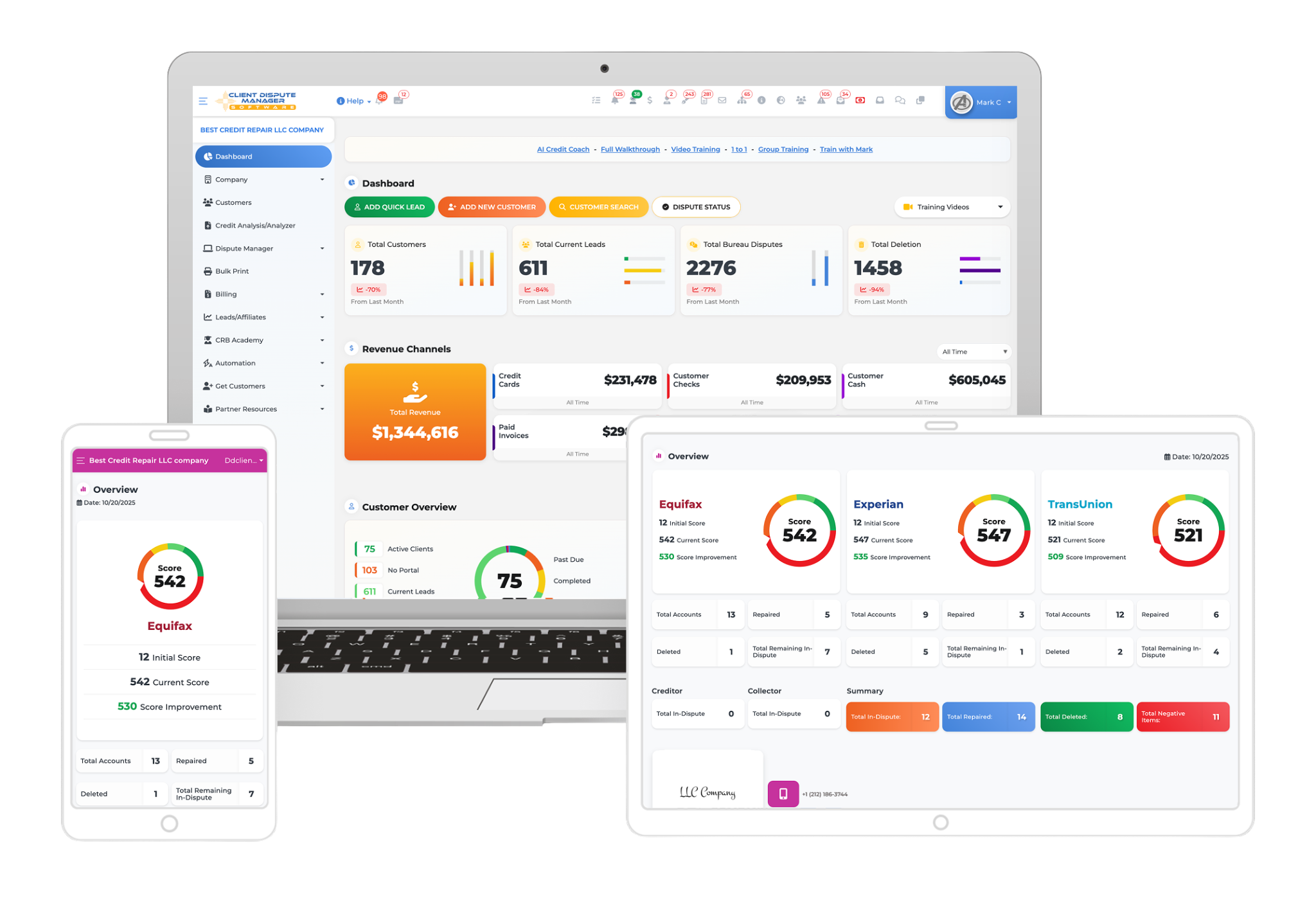
Client Dispute Manager Software is built to track both the FCRA dispute workflows and the FDCPA compliance documentation that credit repair businesses need to operate at that level, giving business owners a platform whose default capabilities reflect the regulatory complexity of the industry they are operating in.

Mark Clayborne specializes in credit repair, starting and running credit repair businesses. He's passionate about helping businesses gain freedom from their 9-5 and live the life they really want. You can follow him on YouTube.
Experience our credit repair software, risk-free.