Get Started for as Low a $49 for the First Month: Click Here
Written by Mark Clayborne
Last updated on June 10, 2026
To get clients for your credit repair business, build a referral network with mortgage brokers and real estate agents first, then optimize your Google Business Profile for local searches, and run a free credit analysis funnel to capture leads. These three channels produce paying clients faster than paid ads and cost less per acquisition.
Approximately 21% of American adults carry a FICO score at or below 620 (FICO Credit Insights Report, 2025). In October 2025, the average U.S. FICO score fell to 714, the first annual decline since 2013. The total addressable market is real, documented, and growing.
The challenge is not finding people who need credit repair. The challenge is reaching them before the 43,810 to 62,887 other credit repair businesses operating in the United States do (IBISWorld, 2025).
These 10 strategies address that challenge directly. They range from zero-cost referral outreach to automated paid funnels. Each section includes the specific actions, the relevant compliance rules, and the tools that make the system repeatable.
Getting clients is the central operational challenge for credit repair businesses because the industry’s scam history creates a trust gap that advertising alone cannot close. The U.S. credit repair market reached approximately $6.8 billion in 2025 (Research and Markets), with over 1,200 new businesses entering annually.
That volume of competition means the business that earns trust first wins the client, regardless of which channel the client found them through.
The U.S. credit repair services market reached approximately $6.8 billion in 2025, with more than 43,810 businesses competing for clients who largely seek the service before a major purchase such as a home or vehicle.
Approximately 70% of credit repair clients use the service to prepare for a home or car purchase, making mortgage-adjacent referral channels the highest-converting client source (WifaTalents, 2026).
People between the ages of 35 and 44 make up approximately 40% of credit repair clients, with household incomes under $60,000, and most are renters preparing to buy a home or a vehicle (WifaTalents, 2026).
That demographic profile has a practical implication: your best referral sources are the professionals those clients visit before they find you. Mortgage loan officers see denied applicants daily. Auto finance managers work with buyers who cannot qualify at standard rates.
Real estate agents show houses to pre-approval holders who should not yet be in the market. Seventy percent of credit repair clients use the service specifically to prepare for a major purchase. Your marketing and referral outreach should reflect that motivation directly.
Trust determines who gets the credit repair client because the industry’s documented history of advance-fee scams, false score guarantees, and illegitimate “credit sweeping” schemes has made consumers skeptical before they make first contact.
The Credit Repair Organizations Act (CROA), codified at 15 U.S.C. sections 1679 through 1679j, was enacted specifically because consumer harm from deceptive credit repair practices was widespread enough to require federal intervention. That history is your market context.
Up to 80% of credit reports contain at least one actionable error (WifaTalents, industry benchmarks). The demand is factually defensible. The barrier is not a shortage of potential clients.
The barrier is that a qualified prospect who has been burned before, or who has heard of someone being burned, will choose the operator who demonstrates credibility over the one who promises the fastest results. CROA’s prohibited practices at 15 U.S.C. section 1679b are the compliance floor, not a ceiling.
Businesses that treat compliance as a marketing asset, publishing what they legally can and cannot do, citing the statute, and documenting their process, convert skeptical prospects at higher rates than businesses that make undifferentiated promises.
Referral leads from mortgage brokers convert at 3-5x the rate of cold or aggregated leads and reduce client acquisition costs by 40-60% compared to direct marketing channels (LeadPops/WifaTalents/Causal Funnel).
Mortgage brokers are the highest-priority referral source because every applicant they cannot approve due to credit score is a pre-qualified credit repair prospect. The broker already knows the client’s financial situation, has established trust, and has a direct professional interest in seeing that client return mortgage-ready.
Referral leads from mortgage brokers and real estate agents convert at 3-5x the rate of cold leads, with mortgage broker referral conversion rates for credit repair sitting at approximately 15%. Strategic referral partnerships reduce client acquisition costs by 40-60% compared to direct marketing, making the referral channel the highest-ROI client acquisition method for most credit repair businesses (LeadPops/WifaTalents/Causal Funnel).
Mortgage brokers who cannot close a deal because the applicant’s credit score is below the qualifying threshold have a problem you can solve. The denied applicant represents lost commission for the broker.
When you repair that client’s credit and return them to the broker, the broker closes the deal. That alignment of financial interest is what makes this referral relationship durable. It is not goodwill. It is mutual economic benefit.
Other referral partners produce the same dynamic across different purchase contexts. Six partner categories produce consistent referrals:
Contact mortgage brokers through LinkedIn search, Google Maps (search “mortgage broker [city]”), open house events, local BNI chapters, and Chamber of Commerce business mixers.
The pitch is two sentences: you help clients whose credit score is blocking a mortgage pre-approval reach the threshold they need, and when you do, they come back to the broker to close. Ask for 15 minutes to show them your process and your client tracking reports.
The following cold email framework produces responses when sent to named individuals at mortgage companies:
Subject: Your clients who can’t qualify yet
“Hi [Name], I work with mortgage brokers in [city] to help their denied applicants improve their credit scores so they can return to you for pre-approval. I’d like to send you a one-page overview of what that process looks like and how I report progress back to you. Does Tuesday or Wednesday work for a quick call?”
That email runs 52 words. It names the specific problem, names the outcome the broker wants, and ends with a specific ask.
The following table shows what each partner type receives and the outreach channel that produces the best response rate:
| Partner Type | Why They Refer | Best Outreach Channel | What To Offer |
|---|---|---|---|
| Mortgage Brokers | Recover lost commission opportunities from denied applicants who need credit improvement before qualifying | LinkedIn, direct email, Chamber of Commerce events | Co-branded mortgage readiness PDF, real-time client progress reports |
| Real Estate Agents | Keep prospective buyers moving through the home purchase process | Open houses, Realtor association meetings, local networking events | Client credit timeline updates, referral tracking dashboard |
| Auto Dealers | Help sub-prime buyers qualify for improved financing options and close more sales | In-person visits to finance offices, dealership networking | Monthly status updates, same-day intake confirmation |
| Bankruptcy Attorneys | Provide clients with a structured credit rebuilding path immediately after discharge | Bar association referrals, LinkedIn, attorney networking groups | Post-discharge rebuild timeline, written client outcome reports |
| Tax Preparers | Help clients address collections and credit issues after receiving tax refunds | Local networking events, email outreach, professional associations | Collection resolution tracker, client satisfaction documentation |
| Insurance Agents | Assist clients whose insurance premiums may be affected by credit-related factors | Local business groups, referral networks, email outreach | Credit improvement progress reports, referral tracking and reporting tools |
A fully optimized Google Business Profile is the fastest free lead source for a local credit repair business because it places your business in front of people actively searching for credit help in your city, with zero ongoing ad cost.
Businesses with complete GBP profiles receive significantly more direction requests, calls, and website clicks than incomplete profiles, making setup the first operational priority for any new credit repair business.
A complete GBP for a credit repair business includes eight elements. Select “Credit Counseling Service” as your primary category. Write a description that includes the phrases “credit repair,” “dispute inaccuracies,” and your city name in the first two sentences.
Add services individually: credit report review, dispute letter preparation, credit monitoring, bureau dispute management. Upload at least 10 photos including your office or workspace, your team, and client consultation settings.
Populate the Q&A section with the five most common questions your prospects ask. Set up weekly posts using updates about the dispute process, client milestones, or local credit seminars.
The three keyword phrases that produce local credit repair search traffic are “credit repair near me,” “fix my credit [city name],” and “remove collections [city name].” Place at least two of those phrases in your GBP description.
Ask for a review immediately after a client’s first confirmed item removal or score milestone. That moment is the highest-enthusiasm point in the client relationship. A client who just saw a collection account deleted is far more likely to write a review than a client you contact three months after service ends.
CDMS’s client portal tracks dispute milestones and triggers automated review request messages tied to those events. That automation converts a manual, easy-to-forget task into a reliable part of the service delivery workflow.
Education-first content outperforms “we fix credit” advertising for inbound lead generation because the people who need credit repair most are also actively researching their situation before they spend money on a solution.
Up to 80% of credit reports contain at least one actionable error (WifaTalents), which means the universe of people researching “how to dispute a collection account” or “what happens if I have errors on my credit report” is large enough to drive consistent organic traffic to a well-structured content library.
The content topics that rank for credit repair searches and convert readers into consultation requests are those that answer specific, high-anxiety questions about the dispute process. Seven topics consistently produce qualified inbound leads:
YouTube builds the deepest trust for credit repair content because video allows prospects to evaluate your expertise and communication style before they contact you. A 7-minute video explaining the dispute process demonstrates competence in a way a paragraph cannot.
TikTok and Instagram Reels produce higher reach volume with shorter content. 60-second explanations of “why your credit score dropped” or “what a 609 letter actually does” drive profile visits and consultation requests. A blog produces the compounding SEO value that makes the other platforms more effective over time.
The free credit analysis is the highest-converting lead magnet for credit repair businesses because it gives the prospect a direct sample of the service they are considering purchasing. A lead magnet captures a prospect’s contact information in exchange for a specific, immediately useful deliverable.
The free credit analysis requires minimal time to deliver and produces the highest-intent leads: people who have already agreed to share their credit situation with you.
Five lead magnets consistently produce qualified credit repair leads:
The following table shows delivery channels and follow-up timing for each:
| Lead Magnet | Best Delivery Channel | Estimated Conversion Rate | Follow-Up Sequence Start |
|---|---|---|---|
| Free Credit Analysis | Website opt-in form with automated email delivery | 15%–25% to consultation | SMS within 5 minutes, email on Day 1 |
| Mortgage Readiness Checklist | Facebook lead ads with email delivery | 10%–18% to consultation | Email on Day 1, SMS on Day 2 |
| "5 Mistakes" Guide | Social media opt-in with email delivery | 8%–14% to consultation | Email on Day 1, Day 3, and Day 5 |
| Dispute Letter Template | Blog content upgrade | 5%–10% to consultation | Email on Day 1 and Day 7 |
| DTI Calculator | Website tool | 6%–12% to consultation | Email on Day 1 and Day 3 |
Responding to a new lead within 5 minutes increases conversion probability by 21x compared to responding after 30 minutes (Callin.io). The follow-up sequence that produces the highest consultation show rates runs across 10 days: an SMS message within 5 minutes of opt-in, an email on Day 1 with the deliverable and a booking link, a check-in email on Day 3, a social proof email with a case study on Day 5, a scarcity-neutral follow-up on Day 7, and a final email on Day 10 with a direct consultation offer.
CDMS automates the entire sequence. When a prospect completes the opt-in form, the platform delivers the lead magnet, sends the SMS within the 5-minute window, and triggers the email sequence automatically. No manual action required.
Facebook and Instagram ads produce credit repair leads at an average cost of $27.66 per lead versus $70.11 on Google Ads, making Meta approximately 2.5x more cost-efficient for this category (WordStream, 2025 Benchmarks).
Start ads only after you have at least three written testimonials and a working consultation booking funnel. An ad that drives traffic to a page with no social proof or a broken booking flow wastes budget at any CPL.
The three-step ad structure that produces the highest-quality credit repair leads uses a problem-focused video or graphic in the first frame, a free offer (credit analysis, mortgage readiness checklist) in the body, and a booking link or lead form as the call-to-action.
The prospect sees a real problem they recognize, receives an immediate value offer that costs them nothing, and books a consultation without needing to visit your website.
Facebook requires credit repair advertisers to use the Special Ad Category “Credit” for any ad promoting credit-related products or services. This category restricts certain demographic targeting options including age, gender, and ZIP code radius.
Audiences based on financial behavior (homeownership intent, mortgage interest, financial planning interest) remain available and are the most relevant for credit repair.
CROA prohibits specific claims in all marketing, including paid advertising, at 15 U.S.C. section 1679b. The following table shows the boundary between compliant and non-compliant credit repair ad copy:
| Compliant Ad Copy | Non-Compliant Ad Copy |
|---|---|
| "We dispute inaccurate items on your credit report." | "We remove negative items guaranteed." |
| "Free credit report review. See what's on your report." | "Delete your collections in 30 days." |
| "We helped [City] residents improve their credit scores." | "Raise your score 200 points fast." |
| "Book a free consultation to review your options." | "Get a new credit identity legally." |
| "We work with all three major credit bureaus." | "We fix any credit score, no matter how bad." |
| "Preparing for a mortgage? Start with your credit report." | "We guarantee mortgage approval after our service." |
Non-compliant claims violate 15 U.S.C. section 1679b regardless of the advertising platform, and the Federal Trade Commission enforces those prohibitions in digital advertising contexts.
Local SEO produces credit repair leads without ongoing ad cost by ranking your website in organic search results for the keyword phrases your local prospects use when they need credit help.
The three highest-volume local credit repair search phrases are “credit repair near me,” “credit repair [city name],” and “remove collections [city name].” Ranking for those phrases delivers inbound leads from people actively seeking the service, with no cost per click.
Build one dedicated landing page for each city or geographic area you serve. Each page targets one primary keyword: “credit repair [city name].” The page title tag and H1 include that phrase.
The page content addresses the specific credit landscape of that area where possible: local mortgage market conditions, average local credit scores, common collection types in that market.
The on-page elements that matter most for local credit repair ranking are the title tag (primary keyword in the first 60 characters), the H1 (matching or closely matching the title tag), schema markup (LocalBusiness schema with NAP: name, address, phone number), and internal links from your GBP and other content pages to the city landing page.
NAP consistency, matching name, address, and phone number across every directory, citation, and platform listing, is a local ranking signal that tells Google your business information is reliable.
Build citations on the top local directories: Yelp, Yellow Pages, Bing Places, Apple Maps, and any industry-specific credit or financial services directories. Every listing must show your business name, address, and phone number in identical format.
An affiliate program turns your satisfied clients, financial bloggers, and personal finance content creators into a distributed referral network that sends you leads on a commission basis.
The difference between an affiliate program and a referral partnership is structure: affiliates have a formal tracking link, a defined commission, and a reporting dashboard. They can promote your service independently, at scale, without requiring your time for each individual referral.
Two commission structures produce sustainable affiliate programs. A flat fee of $100-$150 per converted client (a client who completes intake and begins service) is straightforward to track and budget. A percentage of the first month’s service delivery value is preferred by affiliates who refer higher-volume clients.
Recruit affiliates from three sources: existing clients who have seen results and are willing to advocate, personal finance bloggers who write about credit improvement, and social media creators in the financial education space whose audience matches the 35-44 demographic profile. State laws on referral compensation vary.
Some states regulate credit services organization referral arrangements under their state credit services organization statutes. Review your state’s CSO law and consult a compliance attorney before launching a compensated affiliate program.
Yes. Credit education workshops and webinars generate credit repair clients because they position you as the expert in the room before a prospect becomes a lead.
An attendee who spent 45 minutes watching you explain credit report errors and dispute processes has already evaluated your expertise. The conversion from attendee to consultation is significantly higher than from a cold ad click.
Libraries, churches, community centers, Chamber of Commerce events, and credit union member education programs are the venues that produce the most motivated attendees. Request speaking slots directly from venue coordinators by positioning the workshop as a free community financial literacy resource.
The three workshop topics that fill seats and produce consultations are “How to Qualify for a Mortgage with Bad Credit,” “Understanding Your Credit Report: What Every Number Means,” and “5 Credit Myths Costing You Money Right Now.”
Zoom webinars, Facebook Lives, and YouTube Lives reach a geographically unlimited audience at no production cost. The format that converts best is a co-hosted webinar with a mortgage broker or real estate agent: both audiences are present, the content is directly relevant to a major purchase decision, and the co-host’s credibility transfers to your presentation.
Close every event with a specific offer and a booking link. Attendees who do not book during the event receive a follow-up email within 24 hours with a replay link and a second consultation offer.
Responding to a new credit repair lead within 5 minutes increases conversion probability by 21x compared to responding after 30 minutes (Callin.io). Manual follow-up at that speed is not operationally realistic across a growing lead volume. Automation is the only reliable solution.
Six elements of the lead workflow should run without manual intervention:
The average client acquisition cost for a credit repair business is $150-$300 (WifaTalents, 2026). Average monthly service delivery revenue per active client is $79-$129 (WifaTalents, 2026).
A business running automated follow-up reaches positive ROI on client acquisition within 2-3 months of the client’s first service period, compared to 4-6 months for businesses losing leads to slow manual follow-up.
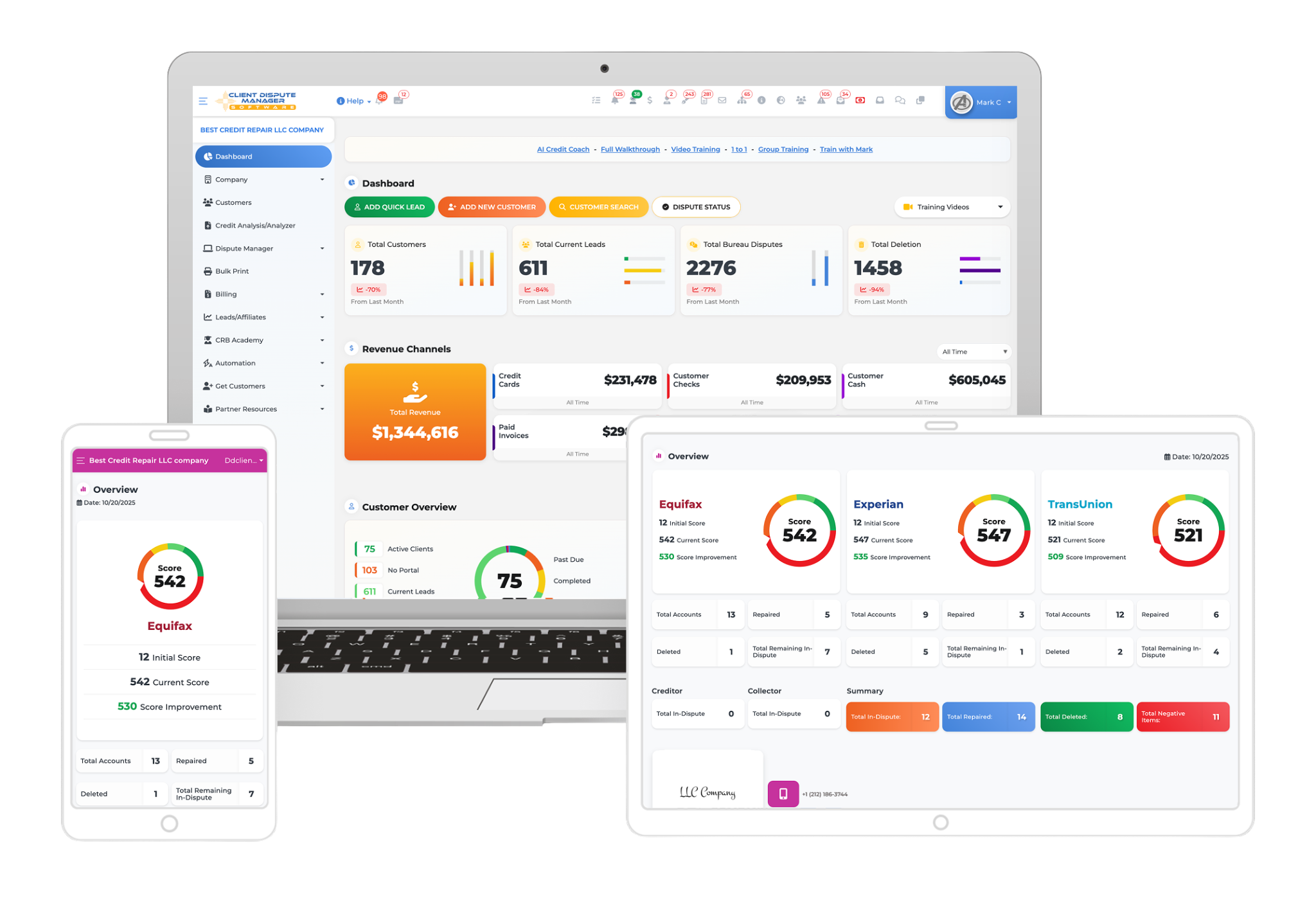
When a new lead enters Client Dispute Manager Software, the platform automatically sends an intake form, delivers the lead magnet, schedules the consultation using an integrated booking link, and triggers the full email and SMS sequence.
Once the lead becomes a client, CDMS automates the dispute workflow: pulling credit report data, generating dispute letters, tracking bureau response deadlines, and sending clients real-time updates through the client portal.
When a bureau responds with a deletion or correction, the platform logs the milestone and triggers the review request. That end-to-end automation covers the full arc from first contact to completed service period, without requiring your staff to manage each step manually.
A business using CDMS to automate intake, follow-up, dispute management, and review requests can serve a significantly larger client base with the same headcount as one managing those steps manually.
Reputation is the most durable client acquisition channel for a credit repair business because it compounds over time without ongoing cost.
A business with 50 Google reviews and documented client outcomes receives referrals from both former clients and from prospects who searched “credit repair [city]” and chose the business with the most credible review profile before making first contact.
A Google Business Profile with 15 or more reviews in the 4.5 to 5.0 range consistently outperforms profiles with fewer reviews in local search click-through rates. You need enough reviews to eliminate doubt, not to maximize a number.
Ask for a review at the moment a client sees their first concrete result: a deleted item, a score increase, or a successful bureau response. That timing is the highest-enthusiasm moment of the client relationship.
The following table shows the review request approach for each client milestone:
| Reputation Touchpoint | Best Timing | Platform | Method |
|---|---|---|---|
| First Item Deleted From Credit Report | Same day as confirmation | Google Business Profile | Automated SMS containing a direct review link |
| Credit Score Crosses A Threshold (e.g., 600, 640, 700) | Within 24 hours of score update | Google and Facebook | Automated email containing review links |
| Mortgage Pre-Approval Achieved | Within 48 hours of client notification | Google and Zillow (through referring agent) | Personalized email from the business owner |
| Service Period Completed | Final service period closing email | Automated email with milestone summary and review request link | |
| Client Refers Another Client | After the referred client completes intake | Personal thank-you message with review request |
Document score improvements as factual before-and-after comparisons without attributing the result to a specific service action that could not be replicated. Write: “Client’s score increased from 558 to 672 over eight months of dispute work on five inaccurate collection accounts.” Do not write: “We guaranteed this client would reach 680.”
The factual documentation is compliant. The outcome promise is prohibited at 15 U.S.C. section 1679b. A client referral program rewards existing clients $50-$100 for each referred client who completes intake and begins service.
Video testimonials outperform written text reviews for credit repair trust because they show a real person explaining a real result in their own words. A 90-second video of a former client describing how their score changed and what they were able to do as a result is more persuasive than five paragraphs of written praise.
CROA establishes the marketing compliance floor for every credit repair business in the United States, with the specific prohibited practices codified at 15 U.S.C. section 1679b.
Three additional federal laws govern how you contact and follow up with prospects: the Telephone Consumer Protection Act (TCPA) for SMS and phone outreach, the CAN-SPAM Act for email marketing, and the Federal Trade Commission Act for general advertising claims.
CROA’s prohibited practices at 15 U.S.C. section 1679b bar any representation that is false or misleading about the services provided, including claims that a credit repair business can guarantee a specific credit score, remove accurate information from a credit report, create a new credit identity for a consumer, or deliver results before services are actually performed. Those prohibitions apply to all marketing channels: paid ads, social media posts, referral partner materials, and website content.
The three most common non-compliant claims in credit repair marketing are: guarantees of score improvement by a specific number of points, promises that all negative items will be removed, and representations that disputed items will be deleted within a defined timeframe. Each of those claims is prohibited.
The Telephone Consumer Protection Act requires prior written consent before sending automated text messages or making automated calls to prospects.
Consent obtained through a website opt-in form (where the prospect actively selects a checkbox agreeing to receive SMS communications) satisfies the TCPA’s written consent standard for that number. Sending automated SMS messages to purchased lead lists without that documented consent creates TCPA liability regardless of the message content.
The CAN-SPAM Act requires that all marketing emails include a functioning unsubscribe link, a physical business address, honest subject lines that accurately reflect email content, and identification of the sender as a business. Unsubscribe requests must be honored within 10 business days.
Your first credit repair client most reliably comes from a warm introduction, not a paid ad. Contact five people in your personal network who work in mortgage lending, real estate, auto sales, or financial planning. Explain your service, offer a free credit analysis for any client they refer, and ask for one introduction. Most first clients come from professional connections, not strangers.
Free credit repair leads come from four sources: a fully optimized Google Business Profile that ranks for local searches, organic content on YouTube or social media that answers specific credit questions, referral introductions from mortgage brokers and real estate agents, and community education workshops at libraries or community centers. These channels require time, not ad spend.
Referral partnerships with mortgage brokers produce the highest-converting leads for credit repair businesses. Referred leads convert at 3-5x the rate of cold or paid leads (LeadPops/WifaTalents). The referral channel also has the lowest client acquisition cost: a referral from a mortgage broker costs nothing per lead and produces clients who are already motivated by a defined purchase goal.
Contact mortgage brokers directly by email or LinkedIn with a two-sentence pitch: you help their denied applicants improve their credit scores so they can return for pre-approval, and you report progress back to the broker. Offer co-branded materials and real-time client updates. Schedule a 15-minute meeting to show your process and your tracking reports.
Yes, with restrictions. Facebook requires credit repair advertisers to use the Special Ad Category “Credit,” which limits some demographic targeting. Google permits credit repair advertising under its financial services policy. Both platforms prohibit the specific claims that CROA bars at 15 U.S.C. section 1679b: guaranteed score improvements, promises of negative item removal, and representations about new credit identities.
Client acquisition for a credit repair business is a multi-channel system, not a single tactic. The businesses that sustain consistent lead flow build all three layers: a referral network that sends pre-qualified prospects, a local SEO and content presence that captures organic search demand, and an automated follow-up system that converts prospects before competitors do.
The 10 strategies in this article address each layer in sequence. The referral network with mortgage brokers, real estate agents, auto dealers, and bankruptcy attorneys provides the highest-converting leads at the lowest acquisition cost.
The Google Business Profile and local SEO infrastructure captures search demand without ongoing ad cost. Content marketing on YouTube, blogs, and social platforms builds the trust and credibility that make every other channel more effective. Lead magnets, Facebook ads, affiliate programs, and workshops each add reach and volume.
Automation, specifically the 5-minute follow-up window that produces 21x higher conversion probability, determines which leads convert and which ones go to a competitor who responded faster.
A credit repair business that operates all 10 channels with a functional automation layer reaches the point where its referral network, content library, review profile, and automated follow-up system all feed each other.
New clients generate reviews. Reviews strengthen the GBP. Strong GBP rankings produce more leads. More leads produce more completed service periods. More completed service periods produce more referrals. That cycle is what a mature credit repair client acquisition system looks like.
Experience our credit repair software, risk-free.