
Common Dispute Letter Mistakes That Get You Rejected
Written by Mark Clayborne
Last updated on April 17, 2026
On this page
Credit dispute letters fail for six specific, preventable reasons. The three most damaging are a vague error description, missing supporting documentation, and a generic template letter. All three trigger closure through e-OSCAR’s automated processing before a human reviewer sees anything in your submission.
This article covers each credit dispute letter mistake, explains exactly why it causes a rejection, and gives you the fix to use before your next letter goes out. A rejected credit dispute is frustrating, but it is almost never random.
Credit bureaus reject letters when they lack enough specific information to investigate, when the evidence needed to contradict the furnisher is missing, or when the submission contains a procedural error that prevents the investigation from starting.
Every one of those failure points is fixable. Your rejection notice tells you which one applied to your dispute. That information is the starting point for a stronger re-submission.
What Common Errors Cause Credit Report Disputes to Be Denied by Major Agencies?

Credit report disputes are denied by major agencies for two categories of reasons: content errors in what the letter says and procedural errors in how it was submitted. The sub-sections below break down the specific mistakes in each category, explain what triggers each rejection, and give you the exact fix before you resubmit.
The Six Errors That Trigger Automatic Rejection at the Bureau Level
When you submit a credit report dispute, the bureau routes it through an automated system called e-OSCAR. That system translates your letter into a two-digit code sent electronically to the furnisher. The furnisher’s system receives the code, matches it to an account record, and sends a confirmation back.
If your letter gave e-OSCAR nothing specific to work with, the furnisher confirms the original data and the bureau closes the case. The entire exchange often takes less than 24 hours without anyone reading your letter.
| Error | What Triggers It | FCRA Rule | Fix In One Sentence |
|---|---|---|---|
| Vague or generic error description | e-OSCAR codes the dispute as non-specific; furnisher confirms; bureau closes the case | Section 611(a)(1) | Name the exact error, explain why it is wrong, and state what the correct information should be |
| No supporting documentation | Furnisher's confirmation is legally sufficient without contradicting evidence | Section 611(a)(1) | Attach the one document that directly contradicts what the furnisher reported before sending |
| Missing account number or bureau reference | Bureau may investigate the wrong tradeline or return the dispute for more information | Section 611(a)(1) | Include the full account number, bureau reference number, and creditor name exactly as shown on the report |
| Generic template letter (609 or 611) | Furnishers recognize template letters and close them without substantive review | Section 611(a)(3) | Write a specific letter in your own words naming the exact account and the exact error |
| Online submission for a document-heavy dispute | Portal compression strips or degrades attachments; bureau processes without the evidence | Section 611(a)(1) | Submit by certified mail with return receipt for any dispute involving multiple or complex documents |
| Disputing multiple items with no individual basis | Bureau can designate a mass dispute as frivolous when no specific basis is provided per item | Section 611(a)(3) | Send a separate letter for each account with its own specific reason, evidence, and account identifier |
A vague error description is the single most common credit dispute letter mistake. Writing “this account is wrong” without specifying what is wrong, why it is wrong, and what the correct information should be gives the bureau nothing actionable to investigate. One clear, factual sentence naming the exact error is enough.
That specificity forces a different kind of review. Generic template letters, including widely circulated 609 and 611 letters, are recognized by furnishers in volume and processed without substantive review. Furnishers have established workflows for closing them quickly.
A letter written specifically for your account, with the exact error named and the contradicting document attached, gives the furnisher a set of specific facts to address rather than a form to confirm.
Why Might Disputes Be Rejected When Using Third-Party Credit Repair Apps?
Disputes are rejected when using third-party credit repair apps because those platforms often submit disputes through their own automated interfaces, which translate your specific complaint into a generic coded request before it reaches the credit bureau.
The account-level details that make a dispute investigable, the exact error description, the supporting document, the specific factual basis, are frequently stripped or compressed in that translation. What arrives at the bureau may be functionally identical to the vague or generic dispute type that e-OSCAR closes without substantive review.
A second problem with third-party dispute apps is document handling. Many platforms do not support attaching supporting documentation to the dispute submission, or they attach documents in formats the bureau’s system cannot process cleanly.
The dispute reaches the bureau as a coded request with no contradicting evidence, which gives the furnisher everything it needs to confirm the original data within the standard automated window.
Submitting disputes directly to each bureau, by certified mail for document-heavy cases or through the bureau’s own online portal for simple factual corrections, is the only method that guarantees your letter and documentation arrive exactly as you prepared them.
Why Are Disputes About Subjective Account Interpretations Often Rejected?

Disputes about subjective account interpretations are rejected because the FCRA’s investigation framework is built around verifiable facts, not interpretations. The bureau’s obligation under FCRA Section 611(a)(1) is to determine whether the reported information is accurate, which the law measures against the furnisher’s records.
If your dispute argues that a charge was unfair, that a fee should not have been applied, or that the creditor’s collection policy was unreasonable, the furnisher’s system confirms the charge was assessed, the fee was applied, and the policy was followed. Technically, all three are accurate in the furnisher’s records, even if the underlying decision is what you are contesting.
Disputes that succeed under the FCRA address objective factual inaccuracies: a payment reported as late that was made on time, a balance reported higher than the actual balance, an account reported as open that was closed, or a derogatory item from an account that does not belong to you.
These are discrepancies that can be confirmed or denied by comparing the reported data against a specific document. Disputes about whether the creditor should have taken a particular action belong in a direct complaint to the creditor or, in cases involving potential violations of other consumer protection laws, to the CFPB.
What Information Is Required to Prevent Credit Dispute Rejections on Major Credit Bureau Websites?
Every credit dispute submission must include five elements to prevent rejection. Missing any one of them gives the furnisher enough room to confirm the original data and close the case. The sub-sections below cover what each element requires and what happens when it is absent.
The Five Required Elements Every Dispute Letter Must Include
The account number and bureau reference number are the first two required elements. The bureau processes a high volume of disputes simultaneously.
Without the exact account number and the bureau’s internal reference number for the disputed item, the bureau may investigate the wrong tradeline or return the dispute for additional information before the 30-day investigation window under FCRA Section 611(a)(1) even starts.
Both identifiers appear on your credit report next to the tradeline you are disputing.
The creditor name exactly as it appears on the report is the third element. Not a common name variant or a shortened version. The exact string of text listed under the tradeline.
A mismatch between the creditor name in your letter and the name on the account creates a matching problem that delays or misdirects the investigation. The specific error description is the fourth element. A dispute letter needs three components: what is wrong, why it is wrong, and what the correct information should be.
A letter that provides only one or two of these gives the furnisher room to confirm the partial information it has. The consumer identification for mail submissions is the fifth. When submitting by certified mail, include a legible copy of a government-issued photo ID and a recent document confirming your current address, such as a utility bill dated within the last 60 days.
What Supporting Documentation Does a Credit Bureau Actually Need?

One specific document that directly contradicts what the furnisher reported is more effective than multiple general documents.
Acceptable types include bank statements showing a payment was made on or before the due date, payment confirmations with a date and amount, creditor letters acknowledging errors or account closures, and FTC Identity Theft Reports filed at IdentityTheft.gov for disputes involving fraud or unauthorized accounts.
The document must make the contradiction self-evident. If a reviewer needs to read your letter to understand what the document shows, the document alone is not strong enough. When submitting by certified mail, attach legible photocopies of your documents rather than originals. Keep the originals.
The bureau does not return submitted documents, and originals are irreplaceable if you later need them for a CFPB complaint, a furnisher direct dispute, or civil action. Number your attachments and reference them by number in your letter so the reviewer can confirm each document was received.
That practice also creates a clear record of what you submitted if the bureau later claims your documentation was insufficient.
What If My Identity Was Not Verified During a Credit Report Dispute?
If your identity was not verified during a credit report dispute, the bureau returns the dispute without processing it and asks for additional documentation before opening an investigation. This outcome is different from a “verified as accurate” rejection.
The bureau is not saying the information was confirmed. It is saying the submission did not include enough to confirm the dispute came from the actual account holder, and no investigation started.
To resolve an identity verification failure, resubmit by certified mail and include a legible copy of a government-issued photo ID and a document confirming your current address dated within the last 60 days.
The address on your ID and the address on the supporting document should match the address the bureau has on file. If you have recently moved, update your address with the bureau before submitting the dispute, because a mismatch between your current address and the bureau’s records will extend the identity confirmation process.
Factor in two to three additional days for the bureau to process the identity confirmation before the 30-day investigation clock starts.
What Procedural Errors Cause Credit Agencies to Reject Disputes?

Procedural errors prevent a dispute from reaching a valid investigation regardless of how well the letter itself is written. The sub-sections below cover the most common submission mistakes and how to avoid them.
Four Submission Mistakes That Prevent Your Dispute From Being Investigated
Submitting online for a document-heavy dispute is the first procedural mistake. Online portals apply compression settings to uploaded files. A bank statement that was legible when you uploaded it may be unreadable after portal processing.
When the bureau processes your dispute without seeing your evidence clearly, the outcome is no different from submitting with no evidence at all. For any dispute that relies on documents to contradict the furnisher, certified mail with return receipt requested produces a cleaner record and ensures your attachments arrive exactly as you prepared them.
The 30-day FCRA investigation window is identical for both submission methods.
Sending to the wrong address is the second. Bureau dispute processing addresses differ from their general correspondence and customer service addresses.
The correct dispute mailing address for each bureau is listed directly on your credit report. Sending to the wrong address means your letter may not reach the dispute processing unit, and the 30-day investigation clock under FCRA Section 611(a)(1) may not start from the date you mailed it.
Resubmitting the same dispute without new information is the third. FCRA Section 611(a)(3)(B) allows the bureau to close a second dispute as substantially the same as the first when no new information is included. New evidence or a new specific basis for the dispute resets that obligation entirely and is the only path to a different outcome on re-submission.
Using a third-party service that strips specificity is the fourth. Some credit monitoring platforms translate your specific dispute into a generic coded request that loses the account-level details needed for investigation. Submitting directly to the bureau by certified mail guarantees every element of your letter arrives exactly as you wrote it.
Is It Better to Dispute Credit Errors via Mail or Online to Avoid Rejections?
Certified mail is better than online submission for any dispute that involves supporting documents, has been rejected once before, or requires a precise delivery record to track the investigation window.
Online submission is sufficient for straightforward factual corrections where no documents need to be attached. The FCRA assigns the same 30-day investigation window to both methods, so the choice affects the quality of what reaches the bureau, not the timeline the bureau must follow.
Online portals carry one specific risk that certified mail does not: document handling. Portals apply file size limits and compression settings to uploaded attachments. A multi-page bank statement or a creditor letter can lose legibility after portal processing.
When the bureau processes your dispute without receiving your evidence in readable form, the outcome is identical to submitting with no evidence at all. Certified mail also creates a paper record that becomes important if you need to escalate.
The delivery confirmation receipt establishes the exact date the bureau received your dispute, which is the date from which the 30-day clock runs. If the bureau fails to respond within the required window, that receipt is your evidence. If you later file a CFPB complaint or consult a consumer attorney, a documented submission trail is significantly more valuable than a portal confirmation screenshot.
How Can I Strengthen My Evidence to Prevent a Credit Dispute Rejection?

Strengthening your evidence means selecting the one document that directly contradicts what the furnisher reported. Volume does not strengthen a credit dispute. Relevance does. The sub-sections below match evidence types to the disputes where each one produces the strongest result and explain what reporting agencies consider insufficient.
Matching Your Evidence to the Specific Type of Dispute
One specific, legible piece of evidence that clearly shows the furnished information is wrong outperforms five generic supporting documents every time. The table below matches the five most effective evidence types to the dispute scenarios where each one produces the strongest result.
| Evidence Type | Best For | What It Must Show |
|---|---|---|
| Bank Statement Showing Payment | Disputes about late payments or non-payments | Account name, due date, and payment date on or before the due date for the disputed period |
| Payment Confirmation Or Receipt | Disputes about specific transactions or amounts | Date, amount, account reference, and confirmation number; forwarded email confirmations with visible timestamps are acceptable |
| Creditor Letter Confirming Correction Or Closure | Disputes about accounts the original creditor has acknowledged as incorrect | The creditor's written statement that the account contains an error or that the account closed on a specific date |
| Ftc Identity Theft Report (Identitytheft.Gov) | Disputes involving accounts you did not open, inquiries you did not authorize, or addresses not yours | Filed FTC report plus government-issued ID; triggers FCRA Section 605B block obligation within four business days |
| Account History Or Statement Showing Correct Information | Disputes about incorrect balances, wrong credit limits, or inaccurate payment status | The correct figure for the specific period being disputed, not a current statement if the dispute is historical |
The most effective evidence in a re-dispute is a letter from the original creditor acknowledging the error or confirming the correction. That letter removes the furnisher’s ability to confirm the original data without also explaining the contradiction.
If you contacted the creditor and received any written acknowledgment, attach that letter to your re-dispute before anything else. For identity theft disputes, file the FTC Identity Theft Report at IdentityTheft.gov before submitting your bureau dispute.
Under FCRA Section 605B, the credit bureau must block information resulting from identity theft within four business days of receiving the report, your identification, and a statement that the information resulted from identity theft.
What Types of Evidence Are Generally Considered Insufficient by Reporting Agencies?
Evidence that is generally considered insufficient by reporting agencies falls into three categories: documents that confirm a fact but do not contradict the specific information being disputed, documents too general to identify the account or the period in question, and documents that assert your position without providing an independent third-party record.
A personal statement or letter written by you describing the error is insufficient on its own. The FCRA’s reasonable investigation standard requires the bureau to verify information against the furnisher’s records, and your statement does not constitute a contradicting record.
A current account statement that does not cover the disputed period is another common submission that fails. If you are disputing a late payment from 18 months ago, a current statement showing a zero balance does not prove the payment was made on time in the disputed month.
The document you attach must be specific to the period being disputed and must contain the data that contradicts what was reported for that exact period. Screenshots from online banking portals are also frequently questioned because they can be altered and are not authenticated records.
A downloaded PDF statement from your bank’s online system carries more weight than a screenshot because it contains the institution’s formatting and account information in a standardized format.
Can Credit Card Companies Assist in Disputing Credit Report Errors That Often Get Rejected?
Credit card companies can assist in resolving credit report errors, but their role is limited and distinct from the credit bureau dispute process. A credit card company is a furnisher. It is the entity that reported the information to the bureau in the first place.
Contacting your credit card company directly to report an error and request a correction is a parallel path to the bureau dispute, not a substitute for it. When your credit card company acknowledges an error in writing, it is required under FCRA Section 623(a)(2) to notify the credit bureaus and correct the information it furnished.
The practical path is to pursue both simultaneously. Dispute with the bureau by certified mail with the error description and any supporting documentation you have. Contact your credit card company in writing through its official dispute correspondence channel and request written confirmation of the error.
When that confirmation arrives, attach it to a follow-up submission with the bureau if the initial dispute has already closed as verified. A written acknowledgment from the credit card company that the data it furnished was wrong is compelling evidence the bureau cannot easily dismiss.
What Are the Best Practices for Submitting a Credit Dispute to Avoid Rejection?

Every successful re-dispute has five elements in common. The sub-sections below walk through each one and explain what happens when it is missing.
The Five Non-Negotiable Elements of a Rejection-Proof Dispute Submission
Specific error identification is the first requirement. Name the exact error, state why it is wrong, and state what the correct information should be. Include the account number and the bureau’s reference number for the disputed item.
Vague language is the leading cause of credit dispute rejection and the most straightforward problem to fix before resubmitting. One factual sentence that specifies the error clearly is more effective than three sentences that describe it generally.
One targeted supporting document per dispute is the second requirement. Choose the document that most directly contradicts what the furnisher reported. Legibility and specificity matter more than volume. A single clear bank statement showing the payment date is more effective than four documents that only partially relate to the dispute.
Certified mail with return receipt is the third requirement for any dispute that involves documents, requires a re-submission after a prior rejection, or involves an item with significant financial impact.
The delivery confirmation receipt is your record that the 30-day investigation clock started. Keep it with your copies of the letter and the supporting document you attached. One item per letter is the fourth requirement.
Disputing multiple tradelines in a single letter invites a frivolous designation under FCRA Section 611(a)(3) when specific bases are not provided for each item individually. Send a separate, specific letter for each account.
Keeping a complete copy of everything you send, including the certified mail tracking number and the delivery confirmation date, is the fifth. That record is your legal documentation if the bureau fails to investigate within the FCRA’s required 30-day window or fails to send the required frivolous designation notice within five business days.
How Can I Avoid Rejection When Disputing Credit Report Errors Through Popular Credit Monitoring Services?
To avoid rejection when disputing through popular credit monitoring services, submit your dispute directly to each bureau rather than through the monitoring service’s dispute interface. Credit monitoring services provide value as tools for tracking changes to your credit report and alerting you to new activity.
Their dispute submission interfaces are a convenience feature, not an improvement on direct submission. The same e-OSCAR coded request that reaches the bureau through a monitoring service portal can be submitted more effectively, with more specificity and with your documentation intact, by certified mail directly to the bureau’s dispute processing address.
If you prefer to use an online channel, go directly to each bureau’s own dispute portal rather than a third-party monitoring service. Experian, Equifax, and TransUnion each maintain their own dispute submission systems, and those systems are the most direct path between your letter and the bureau’s investigation process.
For any dispute where documentation is the central argument, certified mail remains the most reliable method regardless of which online option you might otherwise prefer.
Frequently Asked Questions About Credit Dispute Letter Mistakes
What Happens If My Credit Dispute Is Rejected More Than Once?
If your credit dispute is rejected more than once, the path forward depends on what was different between submissions. A second rejection following the same letter and the same evidence tells you the substantive problem has not been addressed.
A second rejection following a re-dispute with new evidence tells you the furnisher’s records are sufficient to confirm the information regardless of what you have submitted, and the escalation paths become the appropriate next step.
After two rejections with supporting evidence, file a CFPB complaint at consumerfinance.gov. The CFPB routes complaints to the bureau and requires a response within 15 days, which typically triggers an escalated review by a human analyst rather than the standard e-OSCAR automated process.
Simultaneously, file a furnisher direct dispute under Regulation V (12 C.F.R. 1022.43) by certified mail to the furnisher’s dispute correspondence address listed on your credit report.
Running both in parallel creates two independent investigation obligations within the same 30-day window. If neither produces a correction, consult a consumer attorney about your options under FCRA Sections 616 and 617.
Can I Dispute a Credit Report Error Without a Lawyer?
Yes. The FCRA gives every consumer the right to dispute inaccurate information directly with the credit bureaus and with the furnisher at no cost and without legal representation. The bureau’s investigation obligation under FCRA Section 611(a)(1) applies regardless of whether the dispute comes from an attorney or directly from the consumer.
Most credit report errors are resolved through the direct dispute process without any legal involvement. A consumer attorney becomes valuable when the bureau or furnisher has repeatedly failed to investigate or correct information despite documented evidence, or when the inaccurate item has caused documented financial harm and a civil claim under FCRA Sections 616 and 617 is the appropriate next step.
How Long Does a Credit Bureau Have to Respond to a Dispute Letter?
A credit bureau has 30 days from the date it receives your dispute letter to complete its investigation and notify you of the results under FCRA Section 611(a)(1). The window extends to 45 days if you submit additional information after the investigation has already started, or if you submitted the initial dispute after requesting your free annual credit report through AnnualCreditReport.com.
If the bureau designates your dispute as frivolous rather than opening a full investigation, it must send written notice of that determination within five business days of making it, stating the specific reason and the information you need to provide to trigger a proper investigation.
What Should I Do If the Bureau Says My Dispute Is Frivolous?
If the bureau says your dispute is frivolous, read the notice it sends within five business days. That notice is legally required under FCRA Section 611(a)(3) and must state the specific reason your dispute was designated frivolous and identify the information you need to provide before the bureau will open an investigation.
The two most common reasons are insufficient information to identify the disputed item and a submission that is substantially the same as a prior dispute. If the reason is insufficient information, add the account number, bureau reference number, and a specific error description.
If the reason is substantially the same as a prior dispute, add a document or specific factual basis not included in your prior submission. Any addition that was not part of the original dispute resets the substantially-the-same threshold under FCRA Section 611(a)(3)(B) and triggers a new investigation obligation.
Does Disputing a Credit Report Error Hurt My Credit Score?
Filing a dispute with a credit bureau does not directly affect your credit score. The act of submitting a dispute does not appear as a negative item on your report and does not reduce your score. The only score changes that occur during or after a dispute are changes driven by what the investigation finds, not by the dispute itself.
If the dispute results in a deletion or correction of a derogatory item, your score may increase because the data the scoring model uses has changed. If the dispute results in a verified result and the item stays on your report, your score remains unchanged from where it was before you filed.
Fix the Mistake Before You Resubmit
Most credit dispute letter rejections trace back to one of three fixable problems. The letter was too vague to trigger a meaningful investigation. The documentation needed to contradict the furnisher was missing.
Or the submission contained a procedural error that prevented the investigation from starting. None of those problems require starting the process over. They require reading your rejection notice carefully, identifying the specific failure point, and correcting it before your next letter goes out.
A rejection notice is a diagnostic. It tells you what the bureau needed and did not receive. The credit dispute process rewards preparation and specificity. A letter that names the exact error, attaches the one document that disproves it, and arrives by certified mail at the correct bureau address gives the furnisher almost no room to confirm the original information without also addressing your evidence.
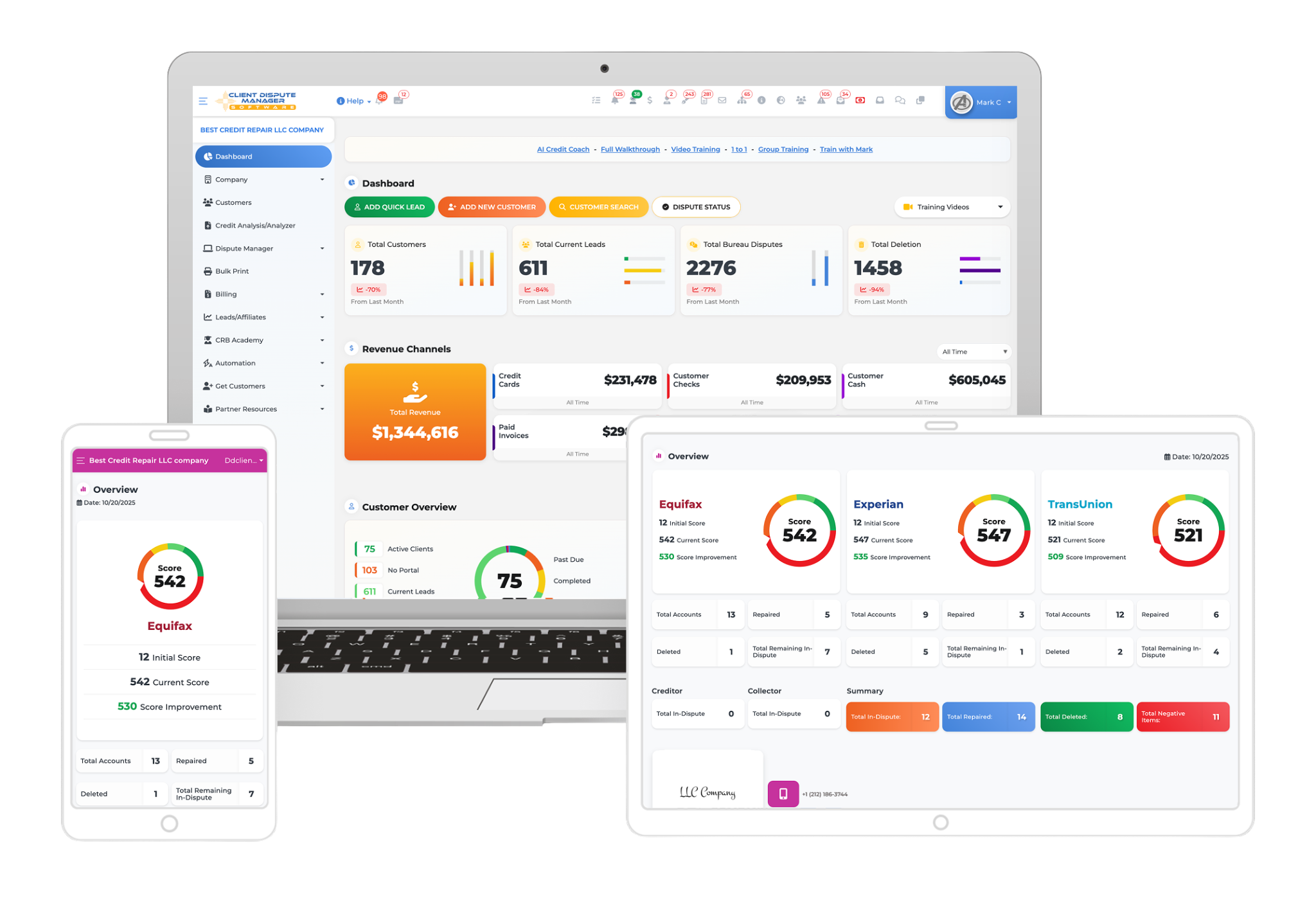
Client Dispute Manager Software is built to support that process at every stage, from organizing your first submission through tracking re-disputes, furnisher correspondence, and CFPB complaint reference numbers. The 30-day free trial includes full platform access with no credit card required.

Mark Clayborne
Mark Clayborne specializes in credit repair, starting and running credit repair businesses. He's passionate about helping businesses gain freedom from their 9-5 and live the life they really want. You can follow him on YouTube.
Start Today and Explore the Features Firsthand!
Client Dispute Manager
Free 30-Day Trial
Experience our credit repair software, risk-free.