
If you’ve recently emerged from bankruptcy, you’re probably wondering if you’ll ever be able to rebuild your credit after bankruptcy or if you’ve permanently damaged your financial future. The shame feels real, the rejections sting, and the mountain ahead looks impossibly steep. You’re not alone in feeling this way.
Here’s what most people don’t realize: bankruptcy isn’t a life sentence. It’s a legal fresh start, and your credit score can begin recovering much faster than you think. Yes, the bankruptcy will stay on your credit report for 7-10 years, but that doesn’t mean you’re locked out of financial life for a decade.
In fact, many people see their scores climb into the “good” range within just 18-24 months of following a strategic plan.
In this guide, you’ll discover the exact steps to rebuild your credit systematically from your first month post-discharge through year two and beyond.
You’ll learn which credit-building tools actually work (and which ones are predatory traps), understand the realistic timeline for your recovery, and get a clear roadmap that turns “I’m financially broken” into “I’m rebuilding competently.”
Let’s break down exactly how to transform your credit, one strategic step at a time.
Start Today and Explore the Features Firsthand!
Understanding How Bankruptcy Affects Your Credit (Chapter 7 vs. Chapter 13)

Before we dive into the specific steps to rebuild credit after bankruptcy, let’s make sure we’re on the same page about what you’re actually recovering from and what timeline you’re working with. Understanding these fundamentals will help you set realistic expectations and recognize progress when you see it.
The Bankruptcy Timeline Truth
Here’s what you need to know about how long bankruptcy stays on your credit report: Chapter 7 bankruptcy remains visible for 10 years from the filing date, while Chapter 13 stays for 7 years. But and this is crucial that doesn’t mean your credit stays damaged for that entire period. The impact of bankruptcy decreases significantly with each passing year, especially once you start rebuilding strategically.
Think of it this way: bankruptcy is like a financial reset button. Yes, it temporarily tanks your score, often dropping you into the 500-550 range immediately after discharge. But unlike collections, late payments, or maxed-out credit cards that keep hurting you as long as they exist, bankruptcy stops the bleeding. You’re starting from a clean slate with no debt, which is actually a powerful position for rebuilding.
The difference between credit after Chapter 7 and credit after Chapter 13 matters less than you might think.
Yes, Chapter 13 falls off three years earlier, but both give you the same opportunity to start demonstrating positive financial behavior immediately. Your rebuilding strategy remains essentially the same regardless of which chapter you filed.
What "Rebuilding Credit After Bankruptcy" Really Means?
Many people misunderstand what rebuilding credit after Chapter 7 bankruptcy or Chapter 13 actually involves. You’re not erasing the bankruptcy from your record that’s not possible, and anyone promising that is running a scam.
Instead, you’re demonstrating new, positive financial behavior that gradually overshadows the bankruptcy. Your credit score is essentially a prediction of future behavior based on past behavior.
The bankruptcy is one data point a significant one, yes but every on-time payment, responsibly managed credit account, and positive tradeline you add becomes another data point. Over time, you’re building a portfolio of evidence that says, “Yes, I went through bankruptcy, but look at how responsibly I’ve managed credit since then.”
This is why people often ask, “How can I rebuild credit when no one will give me credit?”
The answer: there are credit-building tools designed specifically for your situation. You won’t start with premium credit cards or large loans, but you don’t need those. You need tools that report positive payment history to all three bureaus and those are absolutely available to you.
How Long Does It Take to Rebuild Credit After Bankruptcy?

Rebuilding credit after bankruptcy isn’t about random tactics it’s a systematic journey through four distinct phases. Understanding where you are helps you set realistic expectations and celebrate real progress.
Here’s the timeline most people follow when they commit to strategic rebuilding:
Phase #1: Foundation (Months 0-6)
Your score is likely in the 500-600 range, and your primary goal is establishing basic creditworthiness again. You’re getting credit-building tools in place a secured card, possibly authorized user status and proving you can make on-time payments consistently.
This phase feels slow because you’re laying groundwork, but every foundation requires patience. Each month of perfect payment history is a brick you’re placing for everything that comes next.
Phase #2: Building Momentum (Months 6-18)
Your score is climbing into the 600-650 range now, and you’re starting to see doors open. You’ve demonstrated several months of responsible behavior, and each on-time payment has a compounding effect.
This is where you begin feeling like a participant in the financial system again rather than an outcast. You might qualify for slightly better credit products, and the rejections become less frequent.
Start Today and Explore the Features Firsthand!
Phase #3: Acceleration (Months 18-36)
You’re in the 650-700+ range, and rebuilding accelerates significantly. The bankruptcy is now several years old, your positive payment history is substantial, and you have multiple tradelines reporting successfully.
You’re no longer just “recovering from bankruptcy” you’re building genuinely good credit. Many people in this phase qualify for conventional credit products with reasonable terms.
Phase 4: Optimization (Year 3+)
At this point, you’re focused on fine-tuning: optimizing your credit mix, managing utilization strategically, and potentially addressing remaining negative items. Many people in this phase have credit scores in the 700s, and some even break into the 800s by year 5-7.
The bankruptcy becomes a footnote in your credit history rather than the defining feature.
Step #1: Pull Your Credit Reports and Dispute Inaccurate Information (FCRA Section 609)

You can’t rebuild what you can’t measure, and you can’t fix what you don’t see. Within 30 days of your bankruptcy discharge, you need to pull your credit reports from all three major bureaus Equifax, Experian, and TransUnion and review them carefully. This isn’t optional; it’s the foundation of everything that follows.
Why You Must Start with Your Credit Reports?
Your credit reports are the data source for your credit scores, and under the Fair Credit Reporting Act (FCRA), specifically Section 609, you have the legal right to review all information on your reports and dispute anything that’s inaccurate.
After bankruptcy, errors are surprisingly common: accounts that should show $0 balances might still report amounts owed, or discharged debts might incorrectly appear as collections.
These errors can tank your score by 50-100 points unnecessarily, making rebuilding much harder than it needs to be. Visit AnnualCreditReport.com (the only official free site authorized by federal law) to pull all three reports at once. Don’t use “free credit score” apps yet you want the complete reports, not just a number.
Common Post-Bankruptcy Reporting Errors
Creditors should report discharged debts as having a $0 balance with notations like “discharged in bankruptcy” or “included in bankruptcy.”
Instead, you might discover accounts still showing balances you supposedly owe, which is completely inaccurate. Some creditors illegally send discharged debts to collections after bankruptcy, violating both bankruptcy law and the automatic stay protections.
You might also find duplicate tradelines for the same debt, incorrect discharge dates, or account statuses that don’t reflect the bankruptcy. Each of these errors hurts your score and needs to be corrected immediately through the dispute process.
How to File Effective Disputes?
Under FCRA Section 611, credit bureaus must investigate disputes within 30 days and either verify the information or remove it. Send disputes via certified mail with return receipt requested it creates a paper trail and proves you exercised your legal rights.
In your dispute letter, identify each account by name and number, explain exactly what’s incorrect, state what the correct information should be, and include supporting documentation like your bankruptcy discharge papers or court documents.
Be specific and factual; generic disputes get generic responses. If the bureau can’t verify the information with the creditor within 30 days, they must delete or correct it.
Start Today and Explore the Features Firsthand!
Step #2: Get a Secured Credit Card After Bankruptcy (Your First Rebuilding Tool)

This is where active rebuilding begins, and the good news is that secured cards after bankruptcy are often available within 60-90 days of discharge. This single tool will do more for your credit score in the first year than almost anything else.
It’s your gateway back into the credit system, proving you can manage credit responsibly again.
What a Secured Credit Card Is (and Isn't)?
A secured credit card requires a cash deposit that typically becomes your credit limit if you deposit $300, you get a $300 credit limit. The critical difference from a debit card: secured cards report to all three credit bureaus as regular revolving credit accounts.
You’re borrowing money each month and paying it back, which is exactly what demonstrates creditworthiness to lenders. This isn’t a prepaid card where you’re spending your own money, and it’s not a debit card linked to your checking account.
You’re building real credit history with every on-time payment, just like someone with a traditional unsecured credit card.
How to Choose the Right Secured Card?
Not all secured cards are created equal, and choosing the wrong one can waste months of rebuilding time. Look for cards that report to all three major credit bureaus (some only report to one or two, which is useless), have no annual fee or a reasonable one under $50, offer a clear graduation path to an unsecured card after 6-12 months of responsible use, and belong to legitimate banks rather than predatory lenders.
Good options for rebuilding credit after bankruptcy include the Discover it® Secured Credit Card, Capital One Platinum Secured, and the Chime Credit Builder Card. Avoid cards with monthly maintenance fees, application fees, or anything charging you to access your own deposit.
How to Use It Strategically?
Here’s the secret to maximizing your secured card’s impact: use it for one small recurring purchase each month (like a streaming subscription), set up autopay to pay the full balance automatically, and put the card in a drawer.
You’re not using this card for everyday spending you’re using it as a credit-building tool that requires minimal management.
Keep your utilization under 30% of your limit, but ideally under 10%. If your limit is $300, never carry a balance above $30 when your statement closes. Pay the statement balance in full every month to avoid interest charges while building perfect payment history.
Step #3: Add Authorized User Status and a Credit Builder Loan

Once you have your secured card working for you, it’s time to accelerate your rebuilding timeline with two additional strategies. These tools work differently but complement each other perfectly one borrows someone else’s good credit history, while the other diversifies your credit mix.
Both can significantly boost your score within 3-6 months when used correctly.
How Authorized User Status Works
When someone adds you as an authorized user on their credit card, that entire account history including its age, payment history, and utilization can appear on your credit report almost immediately.
If they have a five-year-old card with perfect payment history and low utilization, you inherit that positive history even though you’re not the primary account holder. This is powerful after bankruptcy because it instantly adds a mature, positive tradeline to your report.
You don’t even need a physical card or permission to make purchases just being listed as an authorized user is enough to help rebuild your credit score.
Start Today and Explore the Features Firsthand!
Choosing the Right Account for Authorized User Status
The account needs excellent payment history with no late payments in the last 24 months, low utilization under 30% (preferably under 10%), significant age (older accounts provide more benefit), and a bank that reports authorized users to all three credit bureaus.
Have an honest conversation with a trusted family member or friend about your situation. Make it clear you’re not asking to use their card you’re asking them to help you rebuild by lending their good credit history.
They should understand that if they miss payments or max out the card later, it could hurt your score too, so only do this with someone financially responsible.
How Credit Builder Loans Work?
Credit builder loans work backward from traditional loans the lender puts the loan amount (usually $300-$1,000) into a locked savings account, and you make monthly payments for 12-24 months.
Those payments are reported to the credit bureaus as installment loan payments, building your payment history. Once you’ve paid in full, you receive the money plus any interest earned.
The lender has no risk because they’re holding your money, which is why they approve people rebuilding credit after bankruptcy.
Where to Get a Credit Builder Loan?
Credit unions are your best source for credit builder loans with reasonable terms and low fees. Many local credit unions offer programs specifically for members rebuilding credit. Online options include Self (formerly Self Lender) and Credit Strong, both of which are legitimate and report to all three bureaus.
Avoid companies charging excessive setup fees or interest rates above 15%. This loan diversifies your credit mix by adding an installment account alongside your revolving credit card, and you end up with forced savings as a bonus.
Step #4: Master Payment History and Credit Utilization

These two factors payment history and credit utilization account for 65% of your FICO score combined. After bankruptcy, perfecting both isn’t optional; it’s the difference between a 620 score and a 720 score with the same accounts. Master these two fundamentals, and you’ll accelerate your rebuilding timeline by months.
Why Payment History Dominates Post-Bankruptcy?
Payment history is 35% of your FICO score the single biggest factor in credit scoring. When you’re rebuilding after bankruptcy, lenders are asking one critical question: “Can we trust you to pay?” Every on-time payment answers “yes” with concrete evidence.
A single 30-day late payment can drop your score 60-100 points and suggests the bankruptcy wasn’t an isolated crisis but part of a pattern. Under the Fair Credit Reporting Act, that late payment stays on your report for seven years, essentially undoing months of rebuilding progress in an instant.
Automate Everything to Never Miss a Payment
Set up autopay for at least the minimum payment on every credit account immediately today, not tomorrow. Then create calendar reminders to pay the full statement balance before the due date for redundancy. You want multiple systems ensuring you never miss a payment because the stakes are too high.
For non-credit bills like utilities, rent, and phone services, automate those too. While most don’t report positive payment history, they absolutely report to collections if you miss payments, and that’s devastating when you’re rebuilding credit after bankruptcy.
Start Today and Explore the Features Firsthand!
What Credit Utilization Is and Why It Matters?
Credit utilization is the percentage of available credit you’re using at any given time, and it accounts for 30% of your score. If you have a $500 credit limit and carry a $150 balance, your utilization is 30%.
Credit scoring models prefer utilization below 30% overall, but the sweet spot is actually under 10% for maximum score benefit.
High utilization signals risk to lenders it looks like you’re maxing out available credit or living beyond your means, which are red flags when your credit report already shows a recent bankruptcy.
Step 5#: Monitor Your Credit Reports Monthly While Rebuilding After Bankruptcy

You need to track your progress obsessively during the first 12-18 months of rebuilding. Monthly monitoring isn’t about paranoia it’s about catching errors early, spotting trends, and getting the psychological reinforcement that your strategy is working. What gets measured gets managed, and your credit recovery is no exception.
Free Monitoring Tools You Can Use Today
Sign up for free credit monitoring through Credit Karma, Credit Sesame, or Experian’s free monitoring service immediately. Yes, these services show VantageScore rather than FICO, but they’re accurate enough to spot trends and catch new errors before they become major problems.
Check your reports monthly and look for specific things: Are your new accounts reporting correctly to all three bureaus? Are balances and payments updating as expected? Any new inquiries or accounts you didn’t open, which could signal identity theft? Is your score trending upward over 3-6 months?
These free tools also send alerts when something changes on your report, giving you real-time awareness of your credit profile.
Understanding Score Fluctuations
Your score will bounce around month to month, especially in the first 6-12 months of rebuilding. A 10-15 point drop one month doesn’t mean you’re doing something wrong it might just be temporary utilization changes or the timing of when accounts report their balances.
One account reporting a $50 balance instead of $20 can swing your score 5-10 points without any change in your actual financial behavior. Look at the trend line over 3-6 months rather than obsessing over individual monthly changes. If you’re moving from 550 to 570 to 590 over several months, that’s real progress regardless of small weekly fluctuations.
Step #6: Gradually Add New Credit Accounts While Rebuilding Credit

Between months 12-24, you’ll start receiving pre-approval offers and seeing more credit products become available to you. This is where many people either accelerate their progress or accidentally sabotage it depending on how strategically they approach new credit. The key is adding accounts at the right pace with the right timing.
The Goldilocks Principle of New Accounts
You need enough credit accounts to build a robust credit profile generally 3-5 tradelines is ideal for optimal scoring. However, opening too many accounts too quickly triggers red flags with lenders because it looks desperate and suggests you’re accumulating debt you can’t handle.
Too few accounts means you don’t have enough positive data to demonstrate consistent creditworthiness. After your first secured card, wait 6-9 months before applying for a second credit product to let that initial account mature and establish a track record.
Once you’re 12-18 months post-bankruptcy with consistent positive history, you can consider adding another account every 90-120 days safely.
Strategic Timing of Applications
Space out credit applications by at least 90 days to minimize hard inquiries on your report. Each hard inquiry costs 5-10 points temporarily and stays visible for two years, though it only impacts your score for the first 12 months. More importantly, multiple applications in a short window signals desperation to lenders reviewing your file.
Before applying anywhere, use pre-qualification tools that perform soft pulls they show you likely approval odds without hurting your score.
Target cards marketed specifically to “fair credit” or “rebuilding credit” segments, and research which issuers are historically bankruptcy-friendly (Discover and Capital One often are).
Start Today and Explore the Features Firsthand!
When to Apply for an Unsecured Card?
Most people can qualify for an unsecured credit card 12-24 months post-bankruptcy if they’ve managed their secured card perfectly and kept utilization consistently low. You’ll likely start with lower credit limits ($500-$1,500) and higher APRs than prime borrowers, but that’s fine you’re not carrying balances anyway.
The benefit of graduating to unsecured is getting your security deposit back and showing lenders you’ve proven yourself worthy of unsecured credit. When your secured card issuer offers to convert your account to unsecured (many do after 6-12 months of perfect payment history), accept it immediately it builds your credit without a new hard inquiry.
Step #7: Maintain Your Progress and Dispute Remaining Negative Items
By months 12-18, you should revisit your credit reports with fresh eyes to identify any remaining issues dragging your score down unnecessarily. You’ve built positive history, but old inaccuracies might still be lurking in the background. This ongoing maintenance ensures you’re maximizing every point possible as you continue rebuilding.
What to Look for on Your Updated Credit Reports?
Pull your reports again and look beyond the bankruptcy itself, which will legitimately remain for its full term.
Search for:
- Old collection accounts that should have fallen off after seven years
- Accounts still reporting incorrectly despite your initial disputes
- Duplicate accounts or incorrect balances that appeared after your first review
- Inquiries older than 24 months that shouldn’t be impacting your score anymore
- New positive accounts not reporting verify your secured card, credit builder loan, and authorized user status are all reporting to all three bureaus
Sometimes creditors re-report inaccurate information months after you’ve had it corrected, so vigilance pays off. You’re ensuring everything that should help you is visible, and everything that shouldn’t be there is challenged.
The Ongoing FCRA Section 609 Dispute Strategy
For older items from the chaotic period leading up to your bankruptcy, documentation may no longer exist at the creditor level. Under FCRA Section 609, creditors must verify disputed information within 30 days or remove it from your report. Send targeted disputes to each bureau reporting inaccurate information, being specific about what’s wrong and what the correct information should be.
Include any supporting documentation you have court records, discharge papers, correspondence and always send via certified mail. If they can’t verify it within the legal timeframe, they must delete it, which can provide an additional score boost on top of your rebuilding efforts.
How Client Dispute Manager Software Can Help You to Rebuild Credit After Bankruptcy?
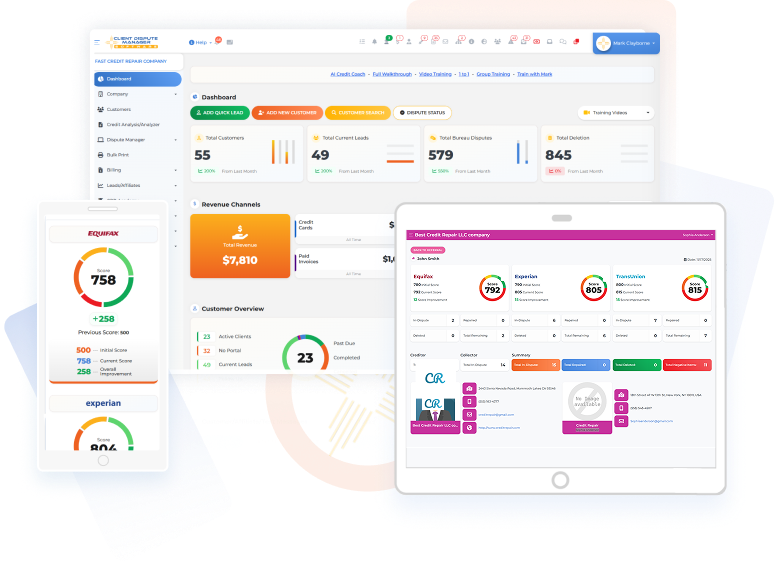
Managing all of these steps manually tracking disputes across three bureaus, maintaining payment schedules, monitoring multiple credit reports, documenting progress, and generating compliant dispute letters might work when you’re just getting started.
But as you add more accounts and deal with more moving pieces, you’ll quickly find yourself overwhelmed with spreadsheets, folders full of certified mail receipts, and the constant worry that you’ve missed a deadline or failed to follow up on a dispute. There’s a better way.
This is exactly why we built Client Dispute Manager Software. Our platform takes the administrative burden off your shoulders so you can focus on executing your rebuilding strategy consistently. Mark Clayborne, a certified credit consultant and author of “Hidden Credit Repair Secrets,” designed CDM to handle the complexities of credit rebuilding while keeping everything compliant with FCRA regulations and best practices.
With CDM, you get powerful features that simplify the entire process:
- Automated Dispute Letter Generation: Create legally compliant FCRA Section 609 and 611 dispute letters in minutes, not hours
- Three-bureau Credit Report Tracking: Monitor updates and changes across Equifax, Experian, and TransUnion in one dashboard
- Deadline Management and Follow-up Reminders: Never miss a 30-day bureau response deadline or forget to escalate unresolved disputes
- Progress Tracking and Documentation: See your score improvements over time and maintain organized records of every dispute and response
- Payment Reminders and Account Management: Stay on top of every due date across all your credit-building accounts
Whether you’re disputing post-bankruptcy reporting errors or tracking your authorized user accounts and secured cards, Client Dispute Manager Software keeps everything organized in one place. You’ll spend less time on paperwork and more time watching your credit score climb as you systematically rebuild your financial future.
Start Today and Explore the Features Firsthand!
Rebuilding Credit After Bankruptcy: Your Questions Answered
How Long Does It Take to Rebuild Credit After Bankruptcy?
Most people see meaningful score improvements within 12-18 months of strategic rebuilding if they follow the steps consistently. You might start in the 500-550 range immediately post-discharge and climb to 640-680 within the first year.
By 24-36 months, scores in the 700+ range are achievable with perfect payment history and low utilization. However, everyone’s situation differs your starting point, the number of accounts you open, how consistently you execute, and whether you have any additional negative items all impact your timeline.
The key is focusing on what you can control: on-time payments, low utilization, and gradually building your credit mix.
How Long Does Bankruptcy Stay on Your Credit Report?
Chapter 7 bankruptcy remains on your credit report for 10 years from the filing date, while Chapter 13 stays for 7 years. However and this is critical the impact on your actual credit score diminishes significantly over time, especially as you add positive payment history.
By year 2-3, if you’ve been rebuilding strategically, the bankruptcy is having minimal impact on your score even though it’s still visible on your report. Many people in year 3-4 have credit scores in the 700s despite the bankruptcy still appearing.
The notation never disappears early (anyone promising to “remove” bankruptcy is running a scam), but its influence on your financial life decreases dramatically as you demonstrate consistent creditworthiness.
How Can Client Dispute Manager Software Help Me Rebuild Credit After Bankruptcy?
Client Dispute Manager Software streamlines the entire credit rebuilding process by automating the time-consuming administrative tasks that bog most people down. Instead of manually drafting dispute letters, tracking responses from three different bureaus, and maintaining spreadsheets of deadlines, CDMS handles it all in one platform.
The software generates FCRA-compliant dispute letters for Section 609 and 611 violations, tracks your progress across Equifax, Experian, and TransUnion simultaneously, sends automated reminders so you never miss a bureau’s 30-day response deadline, and maintains organized documentation of every dispute and outcome.
You stay in complete control while the software handles the paperwork, letting you focus on maintaining perfect payment history and watching your score climb.
Your Credit Recovery After Bankruptcy: A Journey, Not a Sprint
Rebuilding credit after bankruptcy isn’t about one perfect move or a magic formula it’s about consistent, strategic action over 18-36 months. You’ve already survived the hardest part: the financial crisis that led to bankruptcy and the bankruptcy process itself.
Now you’re in the rebuilding phase, and you have a clear roadmap that thousands have followed successfully before you.
Remember, every on-time payment you make is concrete evidence that you’re creditworthy. Every month that passes with low utilization and responsible account management adds to your case. The bankruptcy will stay on your credit report for years, yes but it becomes less and less relevant as you build a portfolio of positive behavior that says, “I’m not defined by that crisis. Look at how I’ve managed credit since then.”
You’re not damaged goods. You’re someone who went through a financial reset and is now rebuilding systematically and intelligently. That’s not just respectable it’s smart.
You have what it takes to rebuild your credit, regain access to the financial system on reasonable terms, and create the stable financial future you deserve. Take it one month at a time, celebrate the small wins along the way, and trust the process.

Mark Clayborne
Mark Clayborne specializes in credit repair, starting and running credit repair businesses. He's passionate about helping businesses gain freedom from their 9-5 and live the life they really want. You can follow him on YouTube.
Start Today and Explore the Features Firsthand!
Below Is More Content For Your Review: