Get Started for as Low a $107 for the First Month: Click Here
Get Started for as Low a $107 for the First Month: Click Here
Written by Mark Clayborne
Last updated on June 10, 2026

Marketing a credit repair business requires building trust before asking for a sale. The highest-converting channel is referral partnerships with mortgage brokers, realtors, and auto dealers.
Content marketing, local SEO, and compliant paid ads support volume. Every marketing claim must comply with the Credit Repair Organizations Act (CROA), codified at 15 U.S.C. sections 1679 through 1679j.
There are 43,810 credit repair businesses operating in the United States right now, and no single company holds more than 5% of the market IBISWorld, 2025. That fragmentation creates real opportunity for operators who market with precision.
The businesses that grow in 2026 are the ones that position themselves as trusted financial educators, build referral systems with partners who already have the clients they want, and operate within a compliance framework that becomes a competitive advantage rather than a legal checklist.

Effective credit repair marketing in 2026 runs on three non-negotiable pillars: trust-first positioning, education-first content, and compliance-required messaging. The US credit repair market was valued at approximately $6.8 billion in 2025 and grew 6.3% year-over-year IBISWorld, 2025, meaning consumer demand is real.
Consumer skepticism is equally real after decades of scam operators. The businesses winning market share right now do not lead with “we remove bad items.” They lead with education.
A mortgage broker explaining credit scores to a first-time homebuyer is a more effective credit repair lead generator than any Facebook ad. A TikTok video explaining how medical debt reporting works generates more inbound trust than a banner ad promising “100-point increases.
The right channel mix depends on budget, stage of business, and target niche. This table shows eight primary marketing channels ranked by their core attributes for credit repair operators:
| Channel | Typical Cost | Difficulty | Lead Quality | Timeline To Results |
|---|---|---|---|---|
| Referral Partners | Low (time investment) | Medium | Very High | 30–90 days |
| Local SEO | Low (time and content investment) | Medium | High | 3–6 months |
| Content / Social Media | Low to Medium | Medium | Medium to High | 3–12 months |
| Google Ads | $35–$80 CPL | Medium to High | High | Immediate |
| Facebook / Instagram Ads | $25–$60 CPL | Medium | Medium to High | 1–2 weeks |
| TikTok Ads | $15–$40 CPL | Low to Medium | Medium | 1–2 weeks |
| Email / SMS Sequences | Near-zero (list dependent) | Low | Very High | Immediate for warm lists |
| Webinars / Live Q&A | Low | Medium | High | 1–4 weeks per event |
No single channel builds a credit repair business alone. Referral partnerships fill your pipeline fastest. SEO and content compound over time. Paid ads accelerate volume when you already have a working consultation funnel. Email and SMS convert the leads every other channel generates.

Every marketing decision you make as a credit repair business owner is bounded by the Credit Repair Organizations Act (CROA), codified at 15 U.S.C. sections 1679 through 1679j. The prohibited practices at 15 U.S.C. § 1679b are not fine print.
They are the hard legal limits that govern every ad, every social post, every referral script, and every landing page you publish. CFPB enforcement actions against credit repair companies increased 28% in 2025 CoinLaw, 2025.
Consumer complaints about credit repair fraud are the number one complaint category the bureau receives. That enforcement environment means compliance is not optional, and it is not just about ads.
The prohibited practices at 15 U.S.C. § 1679b(a) identify four categories of false or misleading representations a credit repair organization cannot make. Violating any one of them creates federal civil liability.
Four claims are explicitly prohibited under 15 U.S.C. § 1679b(a):
“We’ll remove all negative items” is prohibited. “Increase your credit score by 100 points in 30 days” is prohibited. “Get a fresh start with a new credit profile” is prohibited at 15 U.S.C. § 1679b(a)(3) and also constitutes federal credit fraud. These are not gray areas.
Compliant messaging is built around what the law actually allows credit repair companies to do: dispute inaccurate, unverifiable, and outdated information on a consumer’s credit report under the Fair Credit Reporting Act.
That is the legal scope of the service. Market within that scope. Compliant claims describe the service, not a guaranteed outcome. “We identify and dispute inaccurate items on your credit report” is accurate and legal.
“We help people in [city] prepare their credit for a mortgage application” is accurate and legal. “Get a free credit analysis we’ll show you exactly what’s on your report and what we can work to dispute” is accurate and legal. Business owners who frame their compliance requirements as a differentiator are not operating defensively.
They are signaling professionalism in a market known for bad actors. Every legitimate claim you make is the opposite of what the scam operators say. That contrast builds trust faster than any ad creative.
All credit repair marketing must comply with the prohibited practices provisions of the Credit Repair Organizations Act at 15 U.S.C. § 1679b(a), which prohibit guaranteed score increases, promises to remove accurate negative information, and any claim about creating a new credit identity. CFPB enforcement actions against credit repair companies increased 28% in 2025 (CoinLaw, 2025).

A credit repair business that markets to everyone converts fewer leads than one that markets to a specific persona with a specific problem. Forty percent of credit repair clients are aged 35 to 44 CoinLaw / Research and Markets, 2025 and first-time homebuyers within that group represent the most motivated buyer segment in the entire market.
They have a deadline, a financial goal, and a partner, a mortgage broker, who is already explaining why their credit score is the obstacle. Niching is not about turning away other clients.
It is about making your marketing so specific to one audience that every message lands with precision. A realtor who sees your ad targeting mortgage-ready buyers refers you a client. A veteran who sees content about VA loan credit requirements calls you that week.
Seven niche segments consistently produce motivated, convertible credit repair leads. This table maps each niche to its best referral source, most effective lead magnet, and the structural reason it converts:
| Niche | Best Referral Partner | Best Lead Magnet | Why It Works |
|---|---|---|---|
| First-Time Homebuyers | Mortgage brokers, realtors | Mortgage readiness checklist | Deadline-driven audience. Brokers already have established referral relationships and need borrowers to qualify. |
| Auto Loan Applicants | Auto dealerships, F&I managers | "Why Your Auto Loan Was Declined" guide | High referral volume. Dealers benefit when more applicants qualify for financing. |
| Medical Debt Recovery | Hospital billing departments, bankruptcy attorneys | "How Medical Collections Affect Your Credit" PDF | Medical debt reporting rules have changed, creating demand for specialized education and guidance. |
| Veterans And Military Families | VA loan officers, VSOs, military base financial counselors | "VA Loan Credit Requirements" checklist | Strong community trust networks and VA loan qualification requirements create urgency. |
| Gig Workers / Self-Employed | CPA firms, bookkeepers, staffing agencies | "Why Self-Employed Applicants Get Denied Mortgages" guide | Income documentation challenges often create confusion around lending and credit approval. |
| Bankruptcy Recovery | Bankruptcy attorneys, financial advisors | "Credit Rebuilding Timeline After Discharge" guide | Attorneys frequently encounter consumers seeking post-bankruptcy credit rebuilding resources. |
| Spanish-Speaking Consumers | Bilingual mortgage brokers, community financial centers | Spanish-language credit analysis form | Language accessibility builds trust and serves an audience often overlooked by English-only providers. |
Pick one niche and build your marketing system around it. Once referrals flow from one partner category, expand.

Referral partnerships are the highest-ROI marketing channel in credit repair, not by a small margin. 37.2% of credit repair clients choose a company based on referrals compared to only 13.4% who come through advertising Consumer Affairs / Balancing Everything, 2025.
The channel costs almost nothing to start, requires no ad budget, and produces pre-qualified leads who already trust someone who vouched for you.
The reason referrals convert better than ads is straightforward: the referral source, a mortgage broker, a realtor, a bankruptcy attorney, has already established the trust that credit repair advertising must build from scratch. The referred prospect arrives knowing who you are and why someone they already trust recommended you.
Six partner categories produce the highest referral volume for most credit repair operators:
Mortgage brokers and realtors are the highest-priority targets for most operators starting out. A single producing mortgage broker who encounters two or three credit-challenged applicants per week represents 100+ referrals per year.
Finding referral partners requires going where they already work: Google Maps searches for local mortgage brokers and realtors, LinkedIn for professional outreach, open houses to meet buyer’s agents in person, and BNI chapters where financial service professionals network weekly.
The pitch is not “I run a credit repair business.” That framing puts your business front and center. The correct pitch is: “I help mortgage brokers close deals that would otherwise fall through because of credit score problems.” You are solving their business problem, not asking for a favor.
The cold DM or email should be brief, specific, and immediately relevant to the partner’s business. Use this structure for a mortgage broker:
**Cold DM (LinkedIn):**
Subject: Helping your credit-challenged applicants close
Hi [Name], I work with loan officers in [city] who run into clients who are close but not quite at the score threshold for approval. I specialize in disputing inaccurate items and getting people mortgage-ready. If you have applicants who need 3–6 months of credit prep, I’d like to discuss a referral arrangement. Happy to get on a 15-minute call.
**Cold Email:**
Subject: I help your declined mortgage applicants get back to you
Hi [Name], I’m [Your Name], a credit repair specialist in [city]. Mortgage brokers I work with refer clients who are 20–50 points away from qualification. Once those clients complete the dispute process, they come back to the broker who referred them, ready to close. If you’d like to see how I present your clients’ progress, I can show you our client reporting portal. Available for a call this week?
Keep both under 100 words. The goal is one meeting, not one email sale.

Local SEO is the most cost-efficient long-term marketing channel for credit repair businesses that operate in defined geographic markets. It requires no ongoing ad spend, builds compounding visibility over 3–6 months, and captures high-intent searches from people actively looking for help. The key entry points are Google Business Profile, city-specific landing pages, and a consistent review acquisition system.
Your Google Business Profile is the single most important local SEO asset you control directly. Complete every field: business name, address (even if you work virtually), phone, website, service categories, hours, and service areas.
Choose “Credit Counseling Service” as your primary category. Add “Financial Services” and “Credit Repair Service” as secondary categories. Post to your profile weekly.
Short updates, questions answered, dispute tips. The posting activity signals to Google that the business is active. Photos matter: add a professional headshot, your logo, and a workspace image if applicable.
Three keyword patterns drive the highest-converting local search traffic for credit repair:
Build a dedicated landing page for each primary city you serve. The page title follows the pattern “Credit Repair in [City], [State] Free Credit Analysis.” The page body covers the most common credit problems in that area, the local partners you work with, and a clear call to action for a free credit analysis.
Reviews are the most visible trust signal in local search results and the factor that most directly affects your Google ranking against other local credit repair operators. Ask for a review at the right moment: immediately after a client sees a positive result on their credit report.
That moment is the key. A client who just received notification of a disputed item being removed is experiencing relief. That is when the request converts. Manual review requests do not scale past 15–20 active clients.
Automated workflows inside credit repair management software trigger the review request at the exact moment a dispute milestone is reached, without relying on you to remember.
NAP consistency (Name, Address, Phone number) across all local directories, Yelp, BBB, Manta, Yellow Pages, local chamber sites, supports your Google ranking. Inconsistencies suppress it. Audit your listings quarterly. Local SEO is the most cost-efficient lead generation channel for geographically focused credit repair businesses.
“Credit repair near me” and city-specific keywords capture high-intent consumers actively searching for dispute help. Automated review requests triggered after dispute milestones produce higher conversion rates than manual outreach (Client Dispute Manager Software, 2025).

Content marketing works for credit repair because the demand for educational information is structural, not trend-dependent. 44% of US consumers who check their credit report find at least one error Consumer Financial Protection Bureau, 2025.
Every one of those consumers is a potential lead for educational content about disputing inaccuracies. The content funnel starts with the question, builds trust through the answer, and converts the reader into a consultation request.
Three content categories convert credit repair readers into consultation requests at a higher rate than general credit education:
The mortgage readiness series works because it aligns with the referral partner strategy. A potential client who found your content via a mortgage readiness search is the same client a mortgage broker will refer to you.
Platform selection should match your target audience’s demographics. This table maps the four primary platforms to their optimal content format, posting cadence, and primary audience for credit repair operators:
| Platform | Best Format | Posting Cadence | Primary Audience |
|---|---|---|---|
| TikTok | Educational myth-busting videos, quick dispute tips, FCRA explainers | 2–4x per day | 18–35 |
| Instagram Reels | Before-and-after score progressions, short testimonials, credit education clips | 1–2x per day | 25–44 |
| Long-form educational posts, live Q&A sessions, Group engagement | 1x per day | 35–55 | |
| YouTube | Explainer videos, dispute tutorials, channel Shorts | 2–3x per week | All ages |
TikTok’s posting cadence (2–4 videos per day) reflects how the algorithm distributes content. High volume is rewarded in the short-form video environment. YouTube rewards depth: a 10-minute explainer on how to dispute a medical collection will generate search traffic for years.
Personal branding converts better at the early stage of a credit repair business. A named individual, “Maria helps people in Phoenix get mortgage-ready,” builds a faster trust connection than a company logo. People hire people in financial services, not brands, until the brand has established years of reputation.
Switch to company branding as a primary face when you have multiple team members, a portfolio of client results, and the operational infrastructure to support a brand that outlasts any individual. Most credit repair businesses under 100 active clients convert better under a personal brand.

Paid advertising works for credit repair businesses that already have three things in place: client testimonials that can be referenced without making prohibited claims, a functioning free consultation funnel that converts clicks into booked calls, and a clear understanding of CROA’s prohibited practices at 15 U.S.C. § 1679b. Start paid ads without those foundations and the budget generates clicks that go nowhere.
Google Ads are effective for credit repair because searches like “fix my credit” and “remove collections from credit report” come from people already in research or buying mode. Call-only ad formats work particularly well.
A prospect searching for credit repair and calling directly has higher intent than one who clicks to a landing page. The cost-per-lead benchmark for Google Ads in credit repair is $35 to $80 in 2026 garitboothe.com / industry benchmarks, 2026).
Bottom-of-funnel keywords (“credit repair [city]”, “dispute collections”, “fix my credit score fast”) produce better CPL than broad awareness terms. Google requires that financial services ads comply with its Financial Products and Services policy in addition to federal law.
Yes. Facebook and Instagram advertising is allowed for credit repair companies, but you must select the Special Ad Category labeled “Credit” when creating your campaign. That category applies when your ad relates to credit, including credit repair, credit monitoring, or loans.
The Special Ad Category “Credit” removes several standard targeting options: age targeting is limited to 18+, certain behavioral and demographic targeting based on protected characteristics is unavailable, and lookalike audiences have restricted parameters.
Lead ad formats, where the prospect fills out a form inside Facebook, work well for free credit analysis offers. Landing page traffic works when the page is fast, mobile-optimized, and offers a clear free value exchange.
TikTok ads typically produce lower CPL than Google or Facebook for credit repair operators targeting the 18–35 demographic. The creative format must feel native: talking-head videos with educational hooks outperform designed ad creative.
The audience is younger and less immediately mortgage-motivated, so TikTok ads work best as a top-of-funnel brand awareness channel paired with retargeting.
The line is the promise. Describing what you do is compliant. Promising a specific outcome is not.
| Compliant | Non-Compliant |
|---|---|
| "Free credit analysis. See what's on your report." | "We remove bad items fast. Call now." |
| "We dispute inaccurate collections on your behalf." | "Guaranteed credit score increases." |
| "Get mortgage-ready. Start with a free review." | "Delete negative items in 30 days." |
| "Dispute errors on your credit report. FCRA rights explained." | "Fresh start. New credit profile possible." |
The non-compliant column is not just risky advertising. Items three and four violate 15 U.S.C. § 1679b(a) directly. Google Ads cost-per-lead for credit repair ranges from $35 to $80 in 2026 (garitboothe.com / industry benchmarks, 2026).
Facebook advertising for credit repair is permitted but requires selection of the Special Ad Category “Credit,” which limits age and demographic targeting. All paid ad copy must comply with the prohibited practices at 15 U.S.C. § 1679b(a): guaranteed results and exact timelines are prohibited claims.

A credit repair marketing funnel converts a stranger into a paying client through a defined sequence of contact points. The funnel has eight stages, and most drop-off happens between stages two and four. Businesses that fix those drop-off points generate significantly more revenue from the same traffic volume.
The complete funnel architecture moves a prospect through the following stages:
| Stage | Action | Drop-Off Fix |
|---|---|---|
| 1. Traffic | Organic search, paid advertising, or referral traffic | Diversify acquisition sources and avoid dependence on a single channel |
| 2. Lead Magnet | Free credit analysis, checklist, guide, or educational resource | Make the offer specific to a niche problem and target audience |
| 3. AI Intake / Booking | Automated intake form connected directly to calendar scheduling | Reduce friction with one-click scheduling and fewer form fields |
| 4. Free Credit Analysis | Consultation where the consumer's credit report is reviewed | Respond within five minutes of form submission whenever possible |
| 5. Consultation | Explain disputable items, consumer rights, and realistic timelines | Set accurate expectations and avoid promises or guarantees |
| 6. Client Onboarding | E-signature process for CROA-compliant agreements and disclosures | Use standardized compliant templates to simplify enrollment |
| 7. Service Delivery | Dispute cycles, progress tracking, status updates, and partner communication | Automate milestone notifications and client communication |
| 8. Referral Request + Retargeting | Request reviews and referrals while retargeting non-converting leads | Ask for referrals after positive milestones and maintain retargeting campaigns |
The most critical timing rule in the funnel: leads who receive a response within 5 minutes of submitting a form convert at dramatically higher rates than those contacted after an hour. Every hour of delay decreases conversion probability. Automated intake systems solve this without requiring you to monitor a form inbox in real time.

The highest-ROI marketing strategy for a credit repair business is building a referral partner network with mortgage brokers, realtors, and auto dealers. Referrals account for 37.2% of credit repair client acquisitions compared to 13.4% for advertising Consumer Affairs. Pair referral partnerships with local SEO and a content strategy targeting your specific niche persona.
Your first clients come from three sources: personal network outreach to people you already know who have credit challenges, direct outreach to one local mortgage broker or realtor with a referral pitch, and a free credit analysis offer promoted through local Facebook groups or community channels. Do not spend money on ads before you have at least two or three verified client outcomes to reference.
Yes. Google Ads are permitted for credit repair businesses. You must comply with Google’s Financial Products and Services advertising policy and with CROA’s prohibited practices at 15 U.S.C. § 1679b(a). Call-only ads targeting bottom-of-funnel keywords like “credit repair [city]” and “dispute collections” produce the best results. The benchmark CPL is $35 to $80.
CROA’s prohibited practices at 15 U.S.C. § 1679b(a) prohibit four categories of claims: guaranteed credit score increases, promises to remove accurate negative information, representations that a new credit identity can be created, and misrepresentations about how long results take. Any ad, social post, or website copy that makes these claims creates federal civil liability for the business owner.
Search Google Maps for mortgage brokers, realtors, and bankruptcy attorneys in your city. Use LinkedIn to identify loan officers at local banks and credit unions. Attend BNI chapters and local real estate investor meetups. Open houses are an underused channel. Buyer’s agents who lose deals to credit problems are actively looking for a trusted credit repair resource.
Credit repair marketing operates within two structural constraints simultaneously: the federal compliance requirements of CROA at 15 U.S.C. § 1679b and the trust dynamics of a market where consumer skepticism runs high because of years of fraudulent operators.
Every channel, every message, and every piece of content a credit repair business produces exists within those boundaries. The businesses that treat both as operational requirements, rather than obstacles, build durable pipelines that paid advertising alone cannot replicate.
The 2026 playbook covered in this article spans the full marketing architecture: referral partner networks with mortgage brokers, realtors, and attorneys as the highest-ROI acquisition channel; local SEO and Google Business Profile optimization for organic lead flow; educational content on TikTok, Instagram, YouTube, and Facebook calibrated to platform-specific audiences; compliant paid advertising on Google, Facebook, and TikTok within the boundaries of 15 U.S.C. § 1679b; lead magnets and five-email nurture sequences that convert opt-ins into booked consultations; a complete eight-stage funnel from traffic to referral request; and software automation that makes every stage executable at scale.
Credit repair operators who execute this playbook, starting with referral partnerships and local SEO, adding content, then scaling with paid ads once the funnel converts, build businesses that are not dependent on any single channel.
The referral network produces leads when ad costs spike. The SEO compounds when content volume grows. The automation handles what manual processes cannot. That combination is what separates businesses that plateau at 20 clients from those that scale past 100.

Mark Clayborne specializes in credit repair, starting and running credit repair businesses. He's passionate about helping businesses gain freedom from their 9-5 and live the life they really want. You can follow him on YouTube.
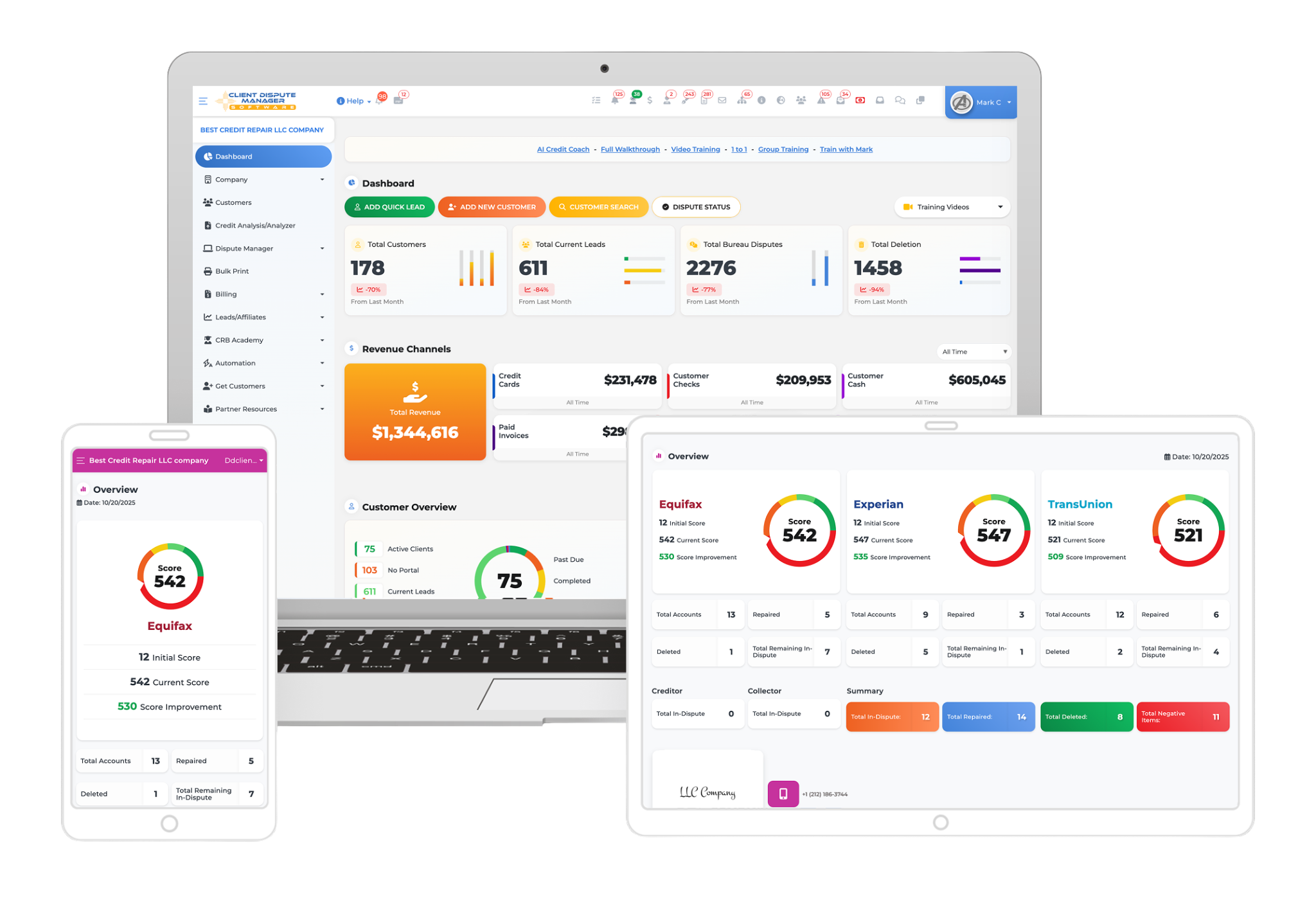
Experience our credit repair software, risk-free.