Get Started for as Low a $49 for the First Month: Click Here
Written by Mark Clayborne
Last updated on June 10, 2026

Credit repair businesses build consistent revenue through ongoing monthly service cycles. Each completed month of dispute work represents a completed service period under CROA, and clients who see active progress continue their engagements for multiple cycles.
Businesses with strong client retention average engagement: 4 to 8 months and systematic dispute tracking report the most stable revenue trajectories. The difference between a credit repair business that collapses at 10 clients and one that sustains 75 is not hustle.
It is structure. Businesses that treat each dispute round as a complete, documented service delivery event and communicate results accordingly build the retention that converts short engagements into multi-month relationships.
Businesses that focus on enrollment without building a service continuity framework churn clients after the first round and start over every month. Most credit repair business income guides present revenue projections without addressing the compliance structure that determines when income can be received.
CROA prohibits receiving any payment before services are fully performed. A business projecting $10,000 per month in revenue must first design a service delivery structure where that revenue is earned, not collected in advance. The compliance structure is the revenue model.

Credit repair businesses earn revenue by completing monthly service cycles, each constituting a fully performed service under CROA (the Credit Repair Organizations Act, 15 U.S.C. sections 1679 through 1679j).
After each completed month of dispute work preparation, submission, response analysis, and follow-up correspondence the service period is complete and compensation is earned. Businesses that maintain 20 to 30 active client engagements at typical service rates operate with predictable ongoing revenue.
The following table shows what revenue from active client engagements looks like at different scales, using a mid-range monthly service rate:
| State | Bond Requirement | Registration Required | Statutory Source |
|---|---|---|---|
| California | $100,000 | Yes (CSO registration) | CA Health & Safety Code section 1789.18 |
| Georgia | $50,000 | Yes | GA Code section 16-9-59 |
| Maryland | $25,000 | Yes | MD Code, Credit Services Businesses Act |
| Tennessee | $15,000 | Yes | TN Code section 47-18-1004 |
| Florida | $10,000 | Yes | FL Statute section 817.7001 |
| Texas | $10,000 | Yes | TX Finance Code Chapter 393 |
| All Other States | Varies | Check state CSO Act | Many states have no bond requirement |
The advance fee prohibition at 15 U.S.C. section 1679b(b) prohibits a credit repair organization from receiving any payment before the services contracted for are fully performed. This is not a technicality. It is the structural rule that defines when revenue is earned versus when it is collected.
A completed service period is one in which the work specified in the contract has been delivered in full. Under the monthly service model, that means one complete dispute round: disputes prepared and submitted to Equifax, Experian, and TransUnion, responses received and analyzed, and follow-up correspondence sent where required. Until that round is complete, no payment is permissible under federal law.
The advance fee rule shapes every part of how credit repair businesses operate. Contracts, service delivery workflows, and client communication systems must all be designed around the point of service completion, not the point of enrollment. A business that automates this process correctly earns revenue from each completed period without the compliance exposure that comes from advance collection.
Credit Repair Organizations Act guidance is maintained by the Federal Trade Commission FTC Credit Repair Guide and the full statute is available at Cornell LII
The monthly service cycle in credit repair is the completed unit of service delivery in the monthly service period model. It consists of one full round of dispute preparation, submission, response analysis, and follow-up correspondence delivered within a calendar month. When the cycle closes, the service period is complete, the statutory condition for compensation is satisfied, and the next service period begins.
Revenue continuity comes from client retention. Each completed cycle that produces visible progress, confirmed deletions, or documented dispute activity gives the client a factual basis to continue their engagement. A client who sees no communication and no documented results after month one has no reason to continue.
A client who receives a results report showing which items were disputed, which bureaus responded, and what was removed has a concrete record of ongoing service delivery. This is why client communication systems are not optional. They are the mechanism by which each completed service period is made visible to the client.
The average credit repair engagement lasts four to eight months, depending on the complexity of the client’s credit file and the pace of bureau responses. Clients with limited negative items and recoverable errors resolve faster. Clients with multiple collection accounts, charge-offs, or bankruptcies typically remain in active service engagements for longer periods.
Engagement length is the most important variable in projecting credit repair business revenue. A business with 25 active clients, a $149 monthly service rate, and an average engagement of 6 months generates approximately $22,350 from those clients across the full engagement cycle.
Engagement length multiplied by the monthly service rate equals client lifetime value for that file. Early termination is driven almost entirely by perceived lack of results.
Clients who cannot see what work was completed, which items were disputed, and what progress was made terminate early not because no work occurred, but because the work was not communicated. That is a documentation and communication problem, not a service delivery problem.

Credit repair businesses are profitable when they maintain consistent active client engagements and a referral pipeline that replaces completing clients with new enrollments.
A business with 25 active clients at a median monthly service rate of $149 and an average engagement of five months generates over $18,600 from those clients across their engagements. Profitability depends on engagement length, the number of active clients, software efficiency, and overhead. SBA Small Business Resources
Client lifetime value in a credit repair business is calculated as the monthly service rate multiplied by the average number of months of active engagement, plus the estimated referral value of satisfied clients who generate new business. At a $149 monthly service rate and a 6-month average engagement, a single client generates $894 in direct revenue.
The range of monthly service rates in the industry runs from $99 to $299 per month, based on service scope, market, and delivery model. Solo operators in competitive markets tend toward the $99 to $149 range. Established businesses with documented track records and full-service dispute management operate at the higher end.
Credit repair specialist salary data and credit repair business owner salary surveys confirm that owner income scales directly with active client volume. A business owner managing 30 active client engagements at $149 per month generates $4,470 per month in gross service revenue before overhead. At 75 active engagements, that figure reaches $11,175.
A credit repair business’s primary operating costs are software, compliance infrastructure, credit monitoring access, and staff once client volume exceeds solo capacity. Software costs for a professional credit repair platform run $99 to $299 per month depending on the platform and feature set.
Compliance costs include the written contracts required under 15 U.S.C. section 1679d, the Consumer Rights Statement required under 15 U.S.C. section 1679c, and any state-specific registration, bonding, or disclosure requirements.
These are fixed costs that do not scale with client volume. A business that builds these into its operational baseline from the first client carries them as minimal overhead per client at scale.
Staff costs emerge when active client volume exceeds the solo operator’s capacity to complete dispute cycles on schedule. The threshold varies by system efficiency but typically falls between 30 and 50 active files for a solo operator using professional software with automation.
A solo operator who builds to 20 active client engagements by month six and maintains that volume through month twelve with average 5-month engagements and a $149 monthly service rate generates approximately $17,880 in first-year service revenue.
That figure assumes a steady build rate, normal client churn, and consistent referral replacement. First-year profitability is determined by how quickly active client volume reaches the sustainability threshold.
Most credit repair businesses reach sustainable revenue with 20 to 30 active client engagements, assuming typical service rates and average engagement lengths of four to eight months. Businesses with lower overhead, higher service rates, or longer average engagements reach sustainability with fewer active files.

Active client engagements are the operating inventory of a credit repair business. Maintaining a stable base requires two parallel systems: a service delivery process that produces documented, visible results each month, and a client acquisition channel that replaces completing files with new enrollments.
Without both, client volume fluctuates unpredictably. With both, total active engagements grow or hold stable as a function of enrollment rate and average engagement length.
Three drivers of client retention in credit repair businesses:
The primary driver of early termination is perceived lack of results, which makes consistent communication about progress and verified deletions the most important retention tool. A client who receives a written or portal-accessible summary after each completed dispute round showing items submitted, bureau responses received, and confirmed deletions has an objective record of service delivery.
That record is what justifies continued engagement. Communication cadence is a compliance function as much as a retention function. The CROA contract must describe the services to be performed and the total cost under 15 U.S.C. section 1679d.
Clients who receive monthly documentation that matches the contractual description of services have no factual basis for a dispute about whether work was performed.
Results documentation in credit repair has two audiences: the client, who needs to see progress, and the regulatory record, which must show that service delivery preceded compensation. These are not competing requirements. A system that satisfies one satisfies both.
At the end of each completed service cycle, the client record should contain: the dispute letters submitted to Equifax, Experian, and TransUnion; the dates of submission and delivery; the bureau responses received; any confirmed deletions or corrections; and the items remaining in active dispute. This is a completed service period file.
It proves completion to a regulator and shows progress to a client. Documented deletions are the most powerful retention evidence. A client who sees three items removed in month two has concrete proof that the service works. A client who sees no documentation in month two cannot distinguish between a business that did the work and a business that did not.
A client’s file reaches completion when all disputable negative items have been addressed and no further dispute rounds would produce additional results. This is not a fixed time point. It is a condition determined by the credit bureaus’ responses and the remaining negative item set on the client’s report.
A client with recoverable errors and a clean payment history may reach file completion in two to four dispute rounds. A client with multiple collection accounts, bankruptcies, and charge-offs may require seven or more rounds before all disputable items have been addressed.
Neither timeline is inherently better for the business. Both represent completed service deliveries. The transition from active service engagement to file completion should be explicitly defined in the service contract.
A client who knows the criteria for completion understands the service as a process with a defined endpoint, not an open-ended ongoing obligation. That clarity reduces disputes about continued service and makes the engagement itself more defensible under CROA.

Credit repair is classified as high-risk by most payment processors based on the industry’s regulatory complexity and historical chargeback rates. This classification affects payment processing options and rates but does not reflect the legality or legitimacy of a properly structured credit repair business.
Businesses operating with CROA-compliant service delivery structures, written contracts, and documented results substantially reduce both legal exposure and payment processor friction. FTC Credit Repair Guide
The Credit Repair Organizations Act establishes federal-level compliance requirements that apply to every credit repair business in the United States regardless of state. The advance fee prohibition at 15 U.S.C. section 1679b(b) is the highest-risk provision operationally: a single instance of collecting payment before a service period is complete constitutes a federal statutory violation.
The FTC enforces CROA at the federal level. The Consumer Financial Protection Bureau CFPB credit and debt tools holds concurrent enforcement authority. States add additional layers through Credit Services Organization statutes, which impose registration requirements, surety bonds, contract disclosures, and in some cases cancellation period extensions beyond CROA’s three-day minimum.
A business operating without state registration where required, without CROA-compliant written contracts, or with advance fee structures built into its service model faces exposure at both the federal and state levels.
The FTC and CFPB have brought enforcement actions against credit repair businesses that collected fees before completing services. These are not edge cases. They are the predictable outcome of operating without a compliant service delivery structure.
CROA compliance reduces business risk in a precise way: it replaces discretionary conduct with defined legal obligations, and defined obligations are defensible in ways that discretionary conduct is not. A business that delivers a CROA-compliant written contract under 15 U.S.C. section 1679d, a Consumer Rights Statement under 15 U.S.C. section 1679c, and a documented three-day cancellation right under 15 U.S.C. section 1679e has a paper trail that demonstrates legal operation.
Business owners who build their operations around those requirements from the first client engagement are not disadvantaged by the law.
They are insulated by it, because every provision CROA imposes on them also creates legal exposure for the competitors who cut corners on the same requirements. Chargebacks, which drive the high-risk payment processor classification, are most often filed by clients who believe they were charged for services not delivered.
Documented service completion records eliminate the factual basis for most chargebacks. A client cannot credibly claim that no services were performed when the business holds dated bureau response letters, confirmed deletion records, and signed acknowledgment of each completed service period.
A credit repair business needs, at minimum, general liability insurance and errors and omissions (E&O) coverage. E&O insurance covers claims arising from errors in the dispute process or failure to deliver contracted services. General liability covers general business-related claims.
Some states require proof of insurance as part of the Credit Services Organization registration process. State registration requirements vary. Check the applicable state statute before operating in any new market. The SBA provides state-level business requirement resources that include professional licensing and insurance thresholds for service businesses.

Scaling active client engagements requires systems that maintain service delivery quality at volume. The dispute work itself, the documentation, the client communication, and the results reporting must all execute consistently whether the business has 15 active files or 150. The bottleneck in credit repair scaling is not client acquisition. It is service capacity.
A solo operator using professional credit repair software with automation can typically manage 30 to 50 active client files. Below 30 files, the manual overhead of dispute preparation, correspondence tracking, and client communication is manageable for a single operator.
Above 50 files, service quality degrades without additional capacity because the time required to complete each monthly service cycle exceeds what one person can deliver in a calendar month.
The signal that a team is needed is not a specific client count. It is when dispute round completion time extends into the next service period, when client communications fall behind, or when documentation quality declines under volume pressure.
Any of those conditions means the service delivery structure has exceeded solo capacity. The first hire in a credit repair business is typically a dispute processor, not a salesperson. Client acquisition built on a service delivery structure that cannot handle more clients creates a churn problem, not a growth problem.
Managing 50 or more active client files requires four functional systems operating in parallel. First, a dispute tracking system that records every letter sent, every bureau response received, and every confirmed deletion for each active file. Second, an automated client communication workflow that delivers results summaries at the close of each service period without requiring manual drafting.
Third, a contract and document management system that maintains compliant records for every active engagement. Fourth, a client portal or reporting interface that allows clients to view their file progress directly.
Without these systems, scaling active client volume produces declining service quality, declining retention, and declining revenue per active file. A business that grows from 20 to 60 clients without building this infrastructure does not have three times the revenue. It has three times the churn.
Credit repair software reduces the cost of scaling by automating the highest-volume, most repeatable tasks in the service delivery workflow. Dispute letter generation, bureau correspondence tracking, client progress reporting, and service period documentation are all tasks that consume operator time at a fixed rate per client.
Software that automates these tasks reduces the per-client time cost and extends the solo operator’s effective capacity. The cost comparison is direct: a solo operator spending four hours per month per client on manual dispute management hits capacity at 10 to 15 clients before time runs out.
An operator using software with dispute automation and client communication workflows manages 40 to 50 clients in the same time. The software cost, typically $99 to $299 per month, is recovered at three to five active clients above the manual capacity ceiling.

Credit repair businesses are profitable when they maintain consistent active client volume and a referral pipeline that replaces completing files with new enrollments. A business with 20 to 30 active clients at typical service rates and an average engagement length of four to six months generates sustainable ongoing revenue.
Profitability scales with software efficiency, dispute success rates, and overhead control. The most profitable operations combine high retention with low client acquisition costs through referral partner programs rather than paid advertising.
Yes. A credit repair business is scalable because the service delivery model does not require proportional increases in labor at every growth stage. Software automation extends solo operator capacity from roughly 15 clients to 40 to 50 clients without additional headcount.
Adding one dispute processor expands capacity to 80 to 100 active files. The business scales in step-function increments tied to automation capacity, not linearly with each new client. The constraint on scale is service delivery infrastructure, not market demand.
Credit repair is classified as high-risk by most payment processors based on regulatory complexity under CROA and historical chargeback rates in the industry. This classification is a merchant processing designation, not a legal judgment.
A business with CROA-compliant contracts, documented service completion records, and no advance fees substantially reduces chargeback exposure. The high-risk classification affects which payment processors will work with a credit repair business and at what rates it does not prevent operation.
Most credit repair companies operate under one of two service delivery models. The monthly service period model completes one full dispute round per month and the service period is compensated after each completed cycle.
The pay-per-deletion model defines service completion as the confirmed removal of a specific negative item and compensation follows each confirmed deletion. Both models satisfy CROA’s fully-performed standard when properly structured. The monthly service period model is more common because it creates predictable revenue and aligns with bureau response timelines.
Most credit repair businesses reach sustainable revenue with 20 to 30 active client engagements, assuming monthly service rates in the $99 to $199 range and average engagement lengths of four to eight months. A business with 25 active clients at $149 per month generates $3,725 per month in gross service revenue.
Businesses with lower overhead, higher service rates, or longer average engagements can reach sustainability with fewer active files. The sustainability threshold depends on the operator’s cost structure, not on a fixed client count.
Service continuity is the operational foundation of credit repair business revenue. The monthly service period model generates predictable income because each completed dispute cycle is a completed service delivery event, and clients who see documented results across those cycles continue their engagements for multiple periods.
The revenue model described here has three components: a CROA-compliant service delivery structure that defines when each service period is complete, a documentation and communication system that makes completed work visible to clients, and a referral pipeline that maintains active engagement volume as files reach completion.
Each component depends on the others. A business with strong service delivery but weak documentation produces churn. A business with strong documentation but no referral pipeline cannot maintain active file volume after initial growth.
Credit repair businesses that build compliance documentation into the service workflow from the first client engagement carry the same cost structure at 10 clients and at 100. The recordkeeping required by 15 U.S.C. section 1679d is not separate from the retention mechanism. It is the retention mechanism.

Mark Clayborne specializes in credit repair, starting and running credit repair businesses. He's passionate about helping businesses gain freedom from their 9-5 and live the life they really want. You can follow him on YouTube.
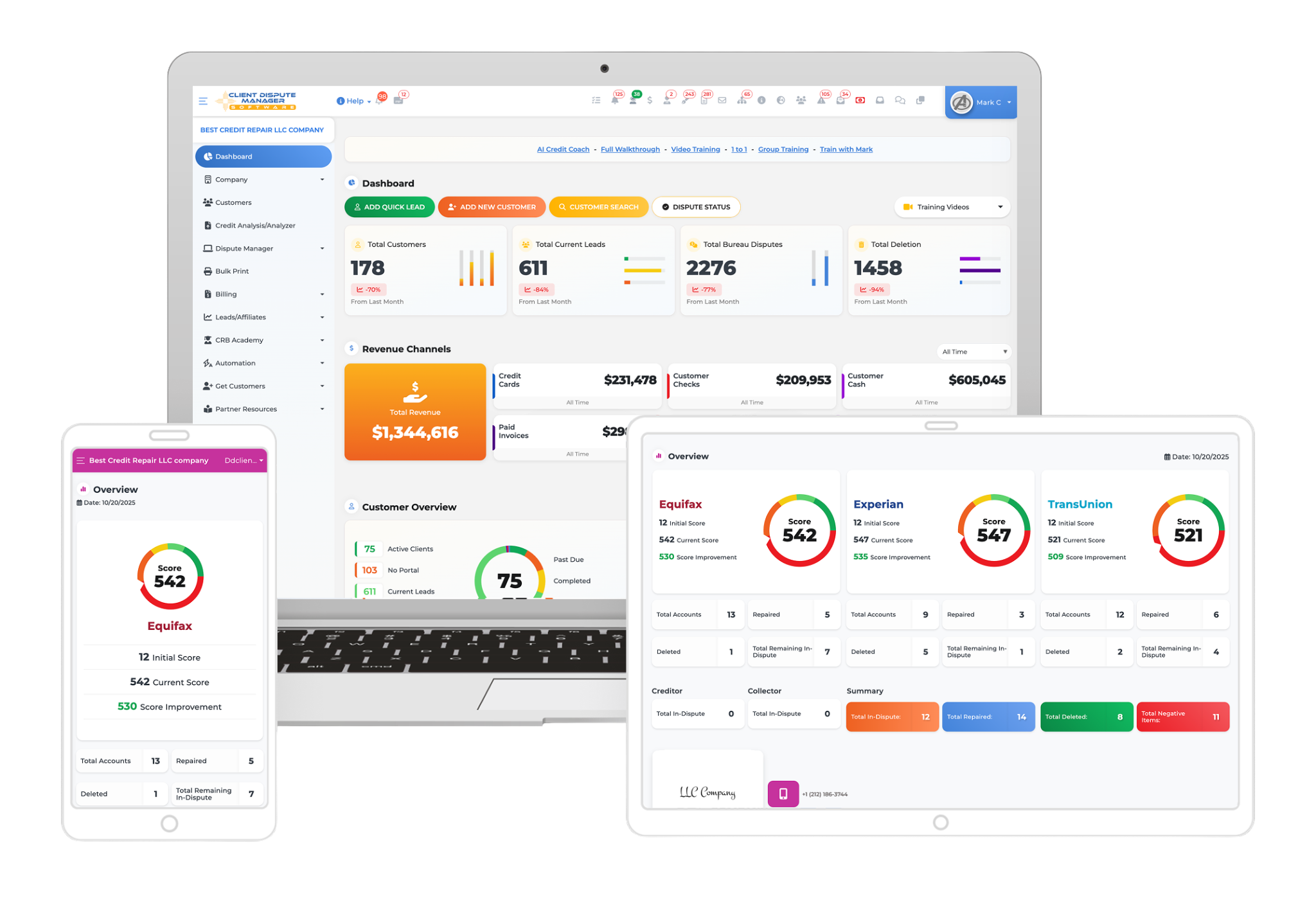
Experience our credit repair software, risk-free.