Get Started for as Low a $49 for the First Month: Click Here
Written by Mark Clayborne
Last updated on July 5, 2026
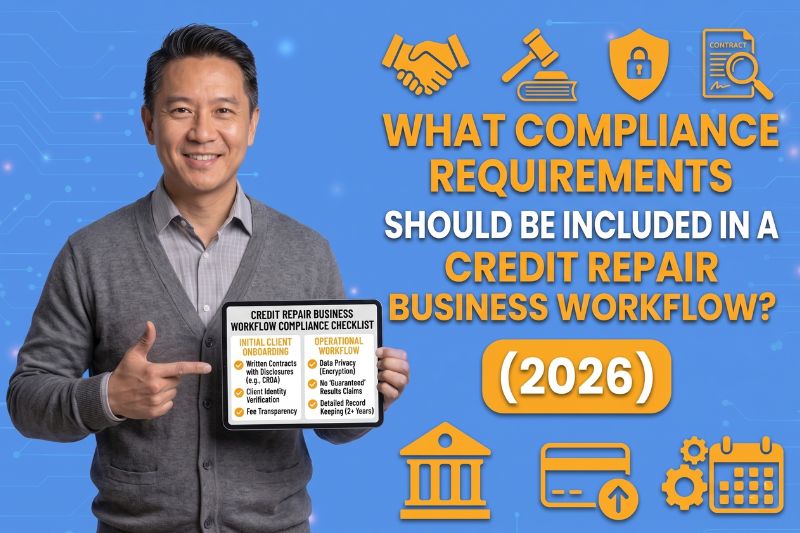
Five regulatory frameworks determine the compliance requirements that must be included in a credit repair business workflow: the Credit Repair Organizations Act (CROA, 15 U.S.C. 1679 et seq.), the Fair Credit Reporting Act (FCRA, 15 U.S.C. 1681 et seq.), the FTC Telemarketing Sales Rule (TSR, 16 C.F.R. Part 310), the Gramm-Leach-Bliley Act Safeguards Rule (GLBA, 16 C.F.R. Part 314), and state Credit Services Organization (CSO) laws.
Credit repair compliance is not a separate audit function that runs alongside the workflow. It is a set of specific requirements embedded in onboarding, dispute execution, billing, data handling, and communication steps that must be satisfied at each phase or the operator faces civil liability under CROA Section 1679g, FTC enforcement, and criminal exposure in the most serious violations.
This guide maps each governing law to the specific workflow step where it applies and explains what the compliance requirement demands, what a correctly designed platform enforces, and what the consequence of non-compliance looks like in practice.

The compliance requirements that belong in a credit repair business workflow are not a checklist applied at the end of the process. They are workflow-embedded obligations that must be satisfied at specific steps in a fixed sequence. The table below maps the most critical requirements from all five governing frameworks to the workflow step where each applies and the consequence of skipping it.
| Law | Code Section | Workflow Step | Specific Requirement | Consequence Of Non-Compliance |
|---|---|---|---|---|
| CROA | 15 U.S.C. 1679c | Client Onboarding | Consumer disclosure titled "Consumer Credit File Rights Under State and Federal Law" delivered as a separate document before any contract is signed | CROA violation. Civil liability under 1679g. FTC enforcement exposure. |
| CROA | 15 U.S.C. 1679d | Client Onboarding | Written contract with total cost, services description, estimated completion date, company name and address, and notice of three-day cancellation right | Non-compliant contract. Cannot enforce payment terms. Civil liability if any 1679d element is missing. |
| CROA | 15 U.S.C. 1679e | Pre-Dispute Window | Three-business-day cancellation period must close before any dispute work begins. Consumer may cancel without penalty during this period. | Services performed without authorization. CROA violation under 1679g. |
| CROA + TSR | 1679b(b) + TSR 310.4(a)(2) | Billing | CROA and TSR prohibit collecting any payment before services are fully performed. Billing must trigger after dispute round completion, not at enrollment. | Consumer recovers full amount paid under 1679g(a)(1)(B). TSR civil penalties up to $51,744 per violation. |
| CROA | 15 U.S.C. 1679b(a)(1) | Dispute Execution | Dispute letters must be based on truthful, accurate information. Operators cannot advise clients to make false statements to bureaus or creditors. | CROA violation. Criminal exposure under 18 U.S.C. 1028 for CPN/file segregation schemes. |
| FCRA | 15 U.S.C. 1681i | Bureau Response Tracking | Bureaus must complete investigation within 30 days of receiving a dispute. Every open round must be tracked with a send date, response deadline, and outcome log. | Missed follow-up window. Lost enforcement opportunity if bureau fails to investigate within 30 days. |
| GLBA | 16 C.F.R. Part 314 | Data Intake And Storage | Written information security program required for all consumer financial data: encryption in transit and at rest, access controls, risk assessment, incident response plan. | FTC enforcement under GLBA. State AG action. Consumer data breach liability. |
The operators who maintain long-term regulatory compliance are almost always those who built each of these requirements into the specific workflow step where it applies rather than managing them as a separate compliance layer. A compliance requirement embedded in a workflow gate cannot be bypassed accidentally.
A compliance requirement managed as a checklist item reviewed separately from the workflow will eventually be missed at the moment of highest pressure: when the operator is managing multiple new client onboardings simultaneously.
The key credit repair compliance requirements are the CROA disclosure, written contract, three-day cancellation window, post-service billing, and truthful dispute content. Each belongs at a specific workflow step and creates civil liability under CROA Section 1679g when skipped.
FCRA Section 611 adds the 30-day bureau investigation tracking requirement. TSR Section 310.4(a)(2) adds civil penalty exposure for advance fees. GLBA adds data security requirements that apply across every step where consumer financial information is collected, stored, or transmitted.
Credit repair business solutions that offer built-in compliance monitoring are those where each compliance requirement is enforced through a workflow gate rather than flagged after the fact.
A monitoring alert that notifies the operator that a disclosure was not delivered is less reliable than a platform gate that prevents the contract from being generated until the disclosure is confirmed. Client Dispute Manager Software uses workflow gates, not alerts, to enforce the CROA compliance sequence.

Federal regulations governing credit repair organizations cluster around four statutory pillars established by CROA and extended by the FCRA, TSR, and GLBA. CROA (15 U.S.C. 1679 et seq.) is the primary statute.
Its four structural pillars are mandatory disclosures before contract signing, prohibited practices including advance fees and false statements to bureaus, contractual requirements with specific written elements, and consumer cancellation rights that cannot be waived. Each pillar creates a specific workflow compliance obligation with a corresponding civil liability mechanism under Section 1679g.
The prohibited practices under CROA Section 1679b are the most consequential compliance obligations in the workflow. Section 1679b(b) prohibits receiving any payment before services are fully performed. Section 1679b(a)(1) prohibits advising consumers to make false or misleading statements to any person in connection with their credit information.
Section 1679b(a)(2) prohibits advising consumers to alter their identity, which is the CROA predicate for Credit Privacy Number (CPN) schemes that carry criminal exposure under 18 U.S.C. 1028. An operator who violates any provision of Section 1679b creates civil liability under Section 1679g, where consumers can recover the greater of actual damages or the full amount paid, plus punitive damages and attorney’s fees.
Credit repair business systems that comply with federal laws are built specifically around CROA, FCRA, and TSR requirements rather than adapted from general-purpose software.
The key indicator is workflow architecture: a compliant system prevents contract generation before disclosure acknowledgment, prevents dispute initiation before the cancellation window closes, and triggers billing after service completion.
Systems that rely on operator-configured reminders to manage those requirements cannot guarantee compliance across a growing client base. The FCRA operates alongside CROA but governs a different layer of the workflow.
Where CROA governs the credit repair company’s relationship with its clients, the FCRA governs the dispute procedure itself: the investigation timelines bureaus must follow, the obligations furnishers have when disputes are forwarded to them, and the data accuracy standards that determine what constitutes a legitimately disputable item.
The TSR extends CROA’s advance fee prohibition to telemarketed services, adding civil penalty exposure of up to $51,744 per violation on top of the consumer’s CROA lawsuit right. The FTC Act Section 5 prohibits deceptive advertising and outcome guarantees, which creates a compliance obligation that runs across every marketing touchpoint as well as every client communication.

Credit repair companies track dispute resolutions efficiently when their tracking system is built around the FCRA’s 30-day investigation window as a compliance deadline rather than an operational estimate. FCRA Section 1681i requires bureaus to complete their investigation within 30 days of receiving a dispute.
Every open dispute round must be logged with a send date that establishes the start of that window, a response deadline 30 days out, and an outcome field that documents the bureau’s determination when it arrives. Tracking that does not capture all three of those elements fails both as an operational tool and as a compliance record.
The FCRA creates a second tracking obligation that most operators address less consistently than the bureau response window: Section 1681s-2 (Section 623) requires furnishers who receive notice of a dispute forwarded by a bureau to investigate and correct or delete inaccurate information. A bureau can delete an item and a data furnisher can reinsert it after deletion.
An operator who tracks only bureau responses and not furnisher responses is monitoring half the dispute resolution process. The item remains on the client’s report because of the reinsertion, and an operator without furnisher response tracking will not detect it.
The CROA dispute truthfulness requirement under Section 1679b(a)(1) adds a third tracking obligation: the operator’s records must document that every disputed item was identified based on accurate information from the client’s credit report, not bulk-disputed without verification.
FCRA Section 611(a)(3) allows bureaus to decline to investigate disputes that are frivolous or irrelevant, which means bulk-everything dispute strategies that do not distinguish between accurate and inaccurate items create a second legal risk alongside the CROA violation.
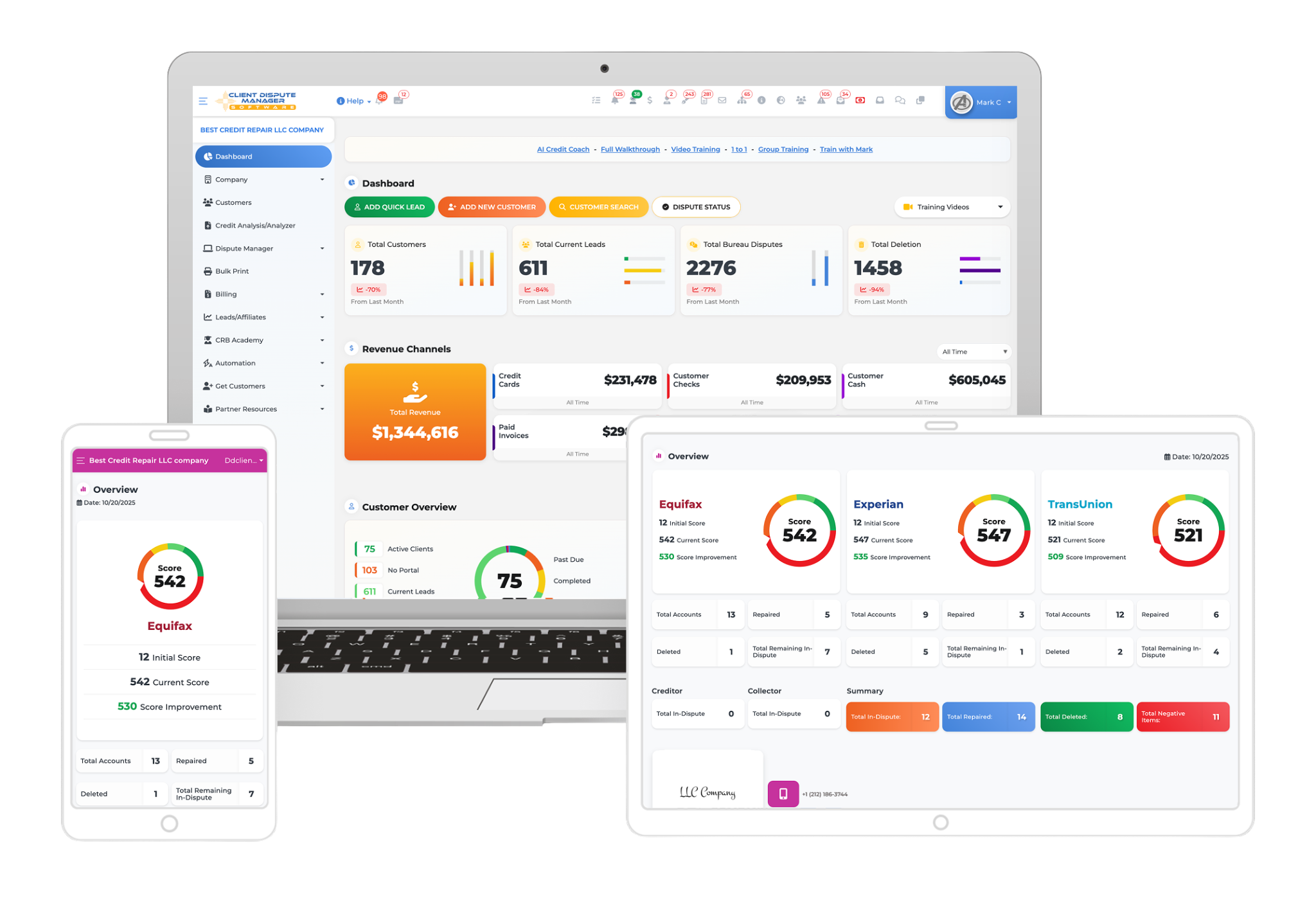
Client Dispute Manager Software surfaces every client’s open dispute rounds in a single tracking dashboard that captures bureau, send date, response deadline, and outcome. The FCRA 30-day window opens automatically on the dispute send date.
When a round closes, the platform moves the client into the next dispute cycle if items remain unresolved. Every dispute action, bureau response, and outcome determination is logged in the client file, creating the compliance record that documents dispute activity was based on accurate information and that response windows were correctly managed throughout the client relationship.
When evaluating credit repair platforms for compliance tracking, the criteria are whether the dispute send date opens the FCRA window automatically, whether both bureau and furnisher responses are logged separately, whether the response deadline is visible without manual calculation, and whether the outcome is stored in the client file as part of the dispute record. All four criteria map directly to the FCRA compliance obligations governing the dispute tracking step.
Credit repair business platforms that provide built-in compliance audits to avoid regulatory penalties are those where compliance requirements are enforced through workflow gates rather than through manual reminders or periodic review processes. The distinction is architectural.
A platform that reminds operators to deliver the disclosure is relying on the operator to act on that reminder. A platform that prevents the contract from being generated until the disclosure acknowledgment is confirmed cannot produce the most common CROA onboarding violation regardless of operator volume or attention level.
| Compliance Requirement | Code Section | How A Compliant Platform Enforces It | Without Platform Enforcement |
|---|---|---|---|
| Consumer Disclosure Before Contract | CROA 15 U.S.C. 1679c | Disclosure acknowledgment gate prevents contract generation until client confirms receipt | Operator may present contract and disclosure simultaneously or in reverse order, creating a CROA violation |
| Three-Day Cancellation Window Before Work Begins | CROA 15 U.S.C. 1679e | Cancellation window gate prevents dispute initiation until three business days after contract signing | Operator begins dispute preparation during the cancellation period, performing unauthorized services |
| Post-Service Billing Trigger | CROA 1679b(b) + TSR 310.4(a)(2) | Invoice generation is tied to dispute round completion, not client enrollment or calendar date | Operator bills at enrollment or on a fixed calendar date before the dispute round closes, violating both CROA and TSR |
| Timestamped Audit Log Of Every Client Interaction | CROA 15 U.S.C. 1679g | Every disclosure delivery, contract signature, dispute action, and invoice is logged with a timestamp in the client file | When FTC or consumer attorney requests documentation of compliance, operator has no systematic record to produce |
| Accurate And Truthful Dispute Content | CROA 15 U.S.C. 1679b(a)(1) | Dispute letters are generated based on client credit report data; platform does not generate letters for items not identified in the audit | Operator generates bulk dispute letters for all negative items without verifying accuracy of each, creating CROA violation and FCRA frivolous dispute risk |
Client Dispute Manager Software enforces each of the five compliance gates described above through the platform’s workflow sequence. The disclosure acknowledgment gate must be completed before the contract can be generated. The three-day cancellation window is built into the workflow timeline before any dispute action can be initiated.
Invoices are generated when dispute rounds close, not at enrollment. Every client touchpoint from disclosure delivery through invoice generation is timestamped and stored in an audit-ready record within the client file.
That record is what operators produce when an FTC inquiry or a consumer attorney requires evidence that the business operated within the law at every step of every client engagement.
Ensuring data privacy compliance in credit repair operations requires building the Gramm-Leach-Bliley Act Safeguards Rule (16 C.F.R. Part 314) requirements into the data collection and storage architecture of the business.
Credit repair businesses collect categories of consumer financial information that GLBA covers explicitly: Social Security numbers, credit reports, government-issued identity documents, and signed financial authorization forms.
The Safeguards Rule requires a written information security program with a designated qualified individual, a documented risk assessment, encryption of consumer data in transit and at rest, access controls limiting who can view each client’s file, vendor oversight, and an incident response plan.
The most common GLBA compliance failure in credit repair operations is the intake channel. Operators who collect Social Security numbers and identity documents through email, standard web contact forms, or PDF submissions that are emailed back are transmitting consumer financial information through channels that are not encrypted in transit.
The Safeguards Rule’s encryption requirement applies at the point of transmission, not just at the point of storage. A client who photographs their government ID and emails it to the operator has transmitted sensitive financial information through a non-compliant channel regardless of how securely the operator stores the document afterward.
The FCRA Disposal Rule (16 C.F.R. Part 682) adds a second data privacy obligation that applies when the client relationship ends. Consumer credit reports and information derived from them cannot be deleted from a shared drive or archived folder at the end of a client engagement.
The Disposal Rule requires that consumer report information be rendered permanently unreadable through burning, pulverizing, or shredding physical records and through electronic destruction methods that ensure the data cannot be recovered from digital storage. Operators who retain ended-client files indefinitely without a documented disposal process face Disposal Rule exposure in addition to their GLBA obligations.
Client Dispute Manager Software collects client data through encrypted intake forms and a secure client portal rather than through email. Clients upload identity documents and complete authorization forms within the platform, which transmits and stores all data in encrypted form.
Role-based access controls limit which team members can view each client file, satisfying the GLBA Safeguards Rule access control requirement without requiring the operator to configure a separate security system.
State privacy laws, including the California Consumer Privacy Act (CCPA, Cal. Civ. Code 1798.100), give consumers the right to request deletion of their personal data, which adds a retention management obligation that operators serving California residents must address alongside their federal GLBA and Disposal Rule requirements.

A credit repair business workflow must embed compliance requirements from five legal frameworks: CROA (consumer disclosure, written contract, three-day cancellation window, and post-service billing), FCRA (dispute accuracy, 30-day bureau investigation tracking, and furnisher response monitoring), TSR (advance fee prohibition with civil penalties up to $51,744 per violation), GLBA Safeguards Rule (encrypted data storage and access controls), and state CSO laws (surety bonds and state registrations). Each requirement applies at a specific workflow step, not as a periodic compliance review conducted separately from operations.
Four federal laws govern credit repair organizations. CROA (15 U.S.C. 1679 et seq.) is the primary statute: it prohibits advance fees, requires consumer disclosures and written contracts, and mandates a three-day cancellation right. The FCRA governs the dispute procedure and bureau investigation timelines. The Telemarketing Sales Rule extends the advance fee prohibition to telemarketed credit repair services with civil penalties up to $51,744 per violation. The FTC Act Section 5 prohibits deceptive advertising and guaranteed outcome claims in marketing and client communications.
Credit repair platforms that provide built-in compliance enforcement are those where compliance requirements are embedded in workflow gates rather than managed through manual reminders. The disclosure acknowledgment gate must prevent contract generation.
The cancellation window gate must prevent dispute initiation. The billing gate must prevent invoices before service completion. Client Dispute Manager Software enforces all three gates through platform design and stores a timestamped audit log of every client interaction that operators can produce for FTC inquiries or consumer attorneys.
The FCRA creates three compliance obligations for credit repair businesses embedded in the dispute workflow. Section 611 establishes the 30-day bureau investigation window: every dispute must be tracked with a send date and response deadline.
Section 623 requires furnishers to investigate and correct inaccurate items forwarded by bureaus, meaning operators must track furnisher responses as well as bureau responses. Section 1681b requires written client authorization before pulling any credit report. All three obligations apply to every client dispute engagement.
Yes. CROA Section 1679j allows states to enact credit repair laws that add requirements beyond CROA as long as they do not conflict with federal law. Most states with significant credit repair activity have Credit Services Organization (CSO) acts requiring state registration, surety bonds ranging from $10,000 to $25,000, and state-specific contract disclosure language.
A credit repair business must comply with both its applicable state CSO act and all federal requirements. Operators serving clients in multiple states must verify each state’s specific requirements independently.
The compliance requirements that belong in a credit repair business workflow are not organizational preferences or risk management choices. They are statutory obligations with specific civil penalties, enforcement mechanisms, and criminal exposure at their worst.
CROA’s civil liability provision, TSR’s per-violation penalty structure, FCRA’s investigation timeline obligations, GLBA’s data security requirements, and state CSO registration mandates all apply simultaneously to every client engagement.
The credit repair operators who avoid regulatory penalties are almost always those who embedded each requirement at the workflow step where it applies rather than trying to manage compliance as a separate function that runs alongside an otherwise non-compliant operational process.
Client Dispute Manager Software is built around the architecture that turns those compliance requirements into workflow gates. The disclosure must be acknowledged before the contract can be generated.
The cancellation window must close before dispute work can begin. Invoices must follow service completion. Every client interaction is timestamped and stored in an audit-ready record. Credit repair professionals who want to see what a compliance-by-design workflow looks like in practice can try Client Dispute Manager Software free for 30 days at clientdisputemanagersoftware.com. No credit card is required.

Mark Clayborne specializes in credit repair, starting and running credit repair businesses. He's passionate about helping businesses gain freedom from their 9-5 and live the life they really want. You can follow him on YouTube.
Experience our credit repair software, risk-free.