Get Started for as Low a $49 for the First Month: Click Here
Written by Mark Clayborne
Last updated on July 5, 2026

Credit repair platforms that provide automated billing and invoicing features built specifically around the advance fee prohibition are the only billing tools that reduce rather than create compliance exposure for a credit repair business.
CROA Section 1679b(b) prohibits charging or receiving payment before services are fully performed. The TSR Section 310.4(a)(2) reinforces that prohibition for telemarketed credit repair services with civil penalties up to $51,744 per violation. A generic invoicing tool that charges at enrollment violates both laws with every transaction.
This guide covers what compliant credit repair billing software requires, which payment processors serve credit repair businesses, and how to configure billing that enforces the advance fee prohibition by platform design rather than by operator memory.

When a credit repair company charges upfront fees illegally, it violates two separate federal laws simultaneously: CROA Section 1679b(b) and the Telemarketing Sales Rule Section 310.4(a)(2). The consumer can recover the full amount paid as actual damages under CROA Section 1679g(a)(1)(B) regardless of whether any other harm occurred.
The FTC can impose civil penalties up to $51,744 per TSR violation, with each individual advance fee transaction counted as a separate violation. A company that charged 50 clients illegally faces up to $2.5 million in TSR penalties before CROA civil liability from consumer lawsuits is added to the total.
The advance fee prohibition is not ambiguous. CROA Section 1679b(b) states that no credit repair organization may charge or receive any money before fully performing the services the company agreed to provide.
That prohibition applies to setup fees collected at enrollment, monthly retainers billed before a dispute round closes, and any partial payment structure that puts money in the operator’s account before the contracted services are completed. The common defense that the fee is for administrative setup work or consultation has consistently failed to protect companies in FTC enforcement actions.
CROA and the TSR create overlapping exposure from the same act. CROA 1679b(b) creates civil liability to the consumer under 1679g. The TSR creates separate FTC enforcement liability with per-violation civil penalties.
An operator who charged 10 clients $200 each before services were performed has collected $2,000 in revenue and created potential exposure of $517,440 in TSR civil penalties plus $2,000 in CROA consumer restitution. That ratio is what makes billing design the highest-stakes operational decision in a credit repair business.

Credit repair platforms that provide compliant automated billing and invoicing features are those built around a specific compliance requirement: invoices fire when a service is completed, not when a client enrolls. That design requirement distinguishes a purpose-built credit repair billing platform from a generic invoicing tool. General-purpose invoicing software charges when the operator schedules it.
Purpose-built credit repair billing ties the invoice trigger to a workflow event, specifically the close of a dispute round, which is the point at which a service has been fully performed.
The practical difference between those two billing designs is the difference between a workflow that enforces the advance fee prohibition automatically and one that relies on the operator to remember when to bill. At 10 clients, manual billing discipline is manageable.
At 50 clients across multiple dispute rounds, each at a different stage of completion, the manual approach produces errors. A single invoice generated a day before a dispute round closes is an advance fee violation. A platform that cannot generate an invoice until the round is closed cannot produce that error.
| Billing Decision | Generic Invoicing Tool | Purpose-Built Credit Repair Billing |
|---|---|---|
| When Does The Invoice Generate? | When the operator schedules it, including at enrollment before any work begins | When a dispute round closes and service delivery is confirmed |
| What Triggers The Payment Request? | Client signature on contract or a preset calendar date | Confirmed completion of the contracted service period in the workflow |
| Is An Audit Trail Created? | Invoice exists but is not linked to a service completion event | Invoice is timestamped against the dispute round that triggered it |
| What Is The Croa Exposure? | 1679b(b) violation if charged before services fully performed. Consumer recovers full amount paid under 1679g(a)(1)(B). | No advance fee exposure because billing is sequenced after service completion by the platform itself |
| What Is The Tsr Exposure? | Civil penalties up to $51,744 per advance fee transaction for telemarketed services | No TSR advance fee exposure because no payment occurs before service completion |
| What Documentation Exists For Regulatory Defense? | Invoice timestamp only; no link to service delivery event | Invoice timestamp linked to dispute round close date in the client file; audit-ready for FTC inquiry or consumer lawsuit |
Client Dispute Manager Software generates invoices when a dispute round closes, not when a client enrolls. The billing trigger is tied to service completion by the platform’s workflow design, which means the CROA and TSR advance fee prohibition is enforced by the sequence of the system rather than by requiring the operator to manually time each payment.
Every invoice is timestamped and stored against the client record and the specific dispute round that triggered it. That record is the documentation that matters in an FTC inquiry or a CROA consumer lawsuit: it demonstrates that each payment occurred after the corresponding service was completed, not before.

Recurring billing for credit repair services must be structured so each period’s charge fires after that period’s service is completed, not on a fixed calendar date. A monthly retainer that bills on the first of every month creates an advance fee violation in any month where the dispute round for that period has not closed before the billing date.
The calendar date and the service completion event are almost never perfectly aligned. A compliant recurring billing system fires the invoice when the round closes, which means the billing date varies by a few days each month based on the actual service completion timeline.
The operators who run monthly retainer models without advance fee violations are almost always those whose billing system fires on a service completion trigger rather than a calendar trigger. The distinction sounds minor but it is legally significant.
A calendar-based subscription platform generates the same invoice on the same date regardless of whether any work has been completed in that period. A service-completion-triggered billing system cannot generate an invoice for a period whose work has not closed. One enforces the advance fee prohibition automatically. The other requires the operator to catch every potential violation manually before the invoice fires.
Client Dispute Manager Software integrates with Authorize.net for payment collection and structures recurring billing so invoices fire when each dispute round closes rather than on a predetermined calendar schedule. That architecture means the subscription billing model stays compliant even for operators managing 50 or more active clients across multiple dispute rounds at different stages of completion.
The operator does not need to audit each invoice’s timing against the service completion record because the platform’s billing trigger already enforces that sequence.

Credit repair is classified as a high-risk merchant category by mainstream payment processors including Stripe, Square, and PayPal. The classification reflects the industry’s historical chargeback rates, the regulatory complexity of CROA and TSR compliance, and the reputational association between the credit repair category and fraudulent operators who have generated consumer disputes at higher rates than most service industries.
That classification results in account closures without advance notice, higher processing fees, and rolling reserves that hold a percentage of processed volume for 90 to 180 days before releasing it to the merchant. The operators who maintain stable merchant accounts in the credit repair industry are almost always those running compliant post-service billing.
The connection is direct: non-compliant operators who charge before services are performed generate chargebacks from consumers who realize they paid for nothing and dispute the charge with their card issuer. Those chargebacks are what produce the elevated chargeback ratios that lead processors to classify credit repair as high-risk in the first place.
An operator running purpose-built credit repair billing software with a post-service invoice trigger has structurally lower chargeback exposure because clients who are billed after services are delivered have no legitimate basis for a chargeback on the service timing grounds.
| Processor | Credit Repair Classification | Key Considerations |
|---|---|---|
| Stripe | High-risk. Account closures common for credit repair merchants without advance notice. | May approve initially but reserves the right to terminate accounts in high-risk categories. Not designed for credit repair billing compliance requirements. |
| Square | High-risk. Similar termination risk as Stripe. Not suitable for long-term credit repair merchant relationships. | Acceptable for initial launch but unreliable for established credit repair operations. Account holds are common. |
| Authorize.net | Established underwriting experience with credit repair merchants. | Requires underwriting approval. Integrated directly into Client Dispute Manager Software billing workflow. More stable long-term account relationship for compliant operators. |
| Paymentcloud | Specializes in high-risk merchant accounts including credit repair. | Underwriting designed for credit repair businesses. Higher fees than standard processors but greater account stability and lower termination risk. |
| Payscout | Serves high-risk industries with established credit repair merchant program. | Alternative to Authorize.net for operators who need a specialized processor with credit repair industry experience. |
The GLBA Safeguards Rule (16 C.F.R. Part 314) applies to payment data as well as credit report data. Any platform that processes client payment information must handle that data under a written information security program that includes encryption in transit and at rest, access controls, and an incident response plan.
This obligation applies regardless of which payment processor the operator uses and regardless of the platform the operator runs. Credit repair software that routes payment through a compliant integrated gateway satisfies this requirement more reliably than operators who configure payment collection through a separate tool.

The leading credit repair software options that include automated client payment tracking are those where billing records are stored against the client file rather than in a separate accounting system. Payment tracking in Credit Repair is a Compliance function, not just a financial reporting function.
The record that matters in an FTC inquiry or a CROA civil action is not the total revenue earned from a client but the timestamp of each payment against the timestamp of each completed service. Automated client payment tracking systems that create that audit trail are the ones that provide regulatory protection alongside cash flow visibility.
| Billing Feature | Why It Matters For Compliance | What To Look For In The Platform |
|---|---|---|
| Billing Trigger Configuration | Advance fee prohibition requires billing to follow service completion, not a calendar date | Invoice generation tied to dispute round close, not enrollment date or fixed monthly schedule |
| Invoice Timestamping Against Service Records | CROA 1679g civil liability defense requires documenting that payment occurred after service completion | Each invoice linked to the specific dispute round that triggered it, stored in the client file |
| 24-Month Record Retention | TSR requires 24-month retention of billing records for telemarketed credit repair services | Platform retains all payment records and billing history for the full retention period automatically |
| Payment Gateway Integration | GLBA Safeguards Rule applies to payment data; integrated gateway is more reliable than a separate payment tool | Direct integration with Authorize.net, Stripe, or a high-risk processor through the platform rather than a separate billing tool |
| Audit-Accessible Billing History | FTC inquiries and consumer lawsuits require fast access to complete billing history by client | Billing records retrievable by client with full payment history, amounts, dates, and service event linkage in one report |
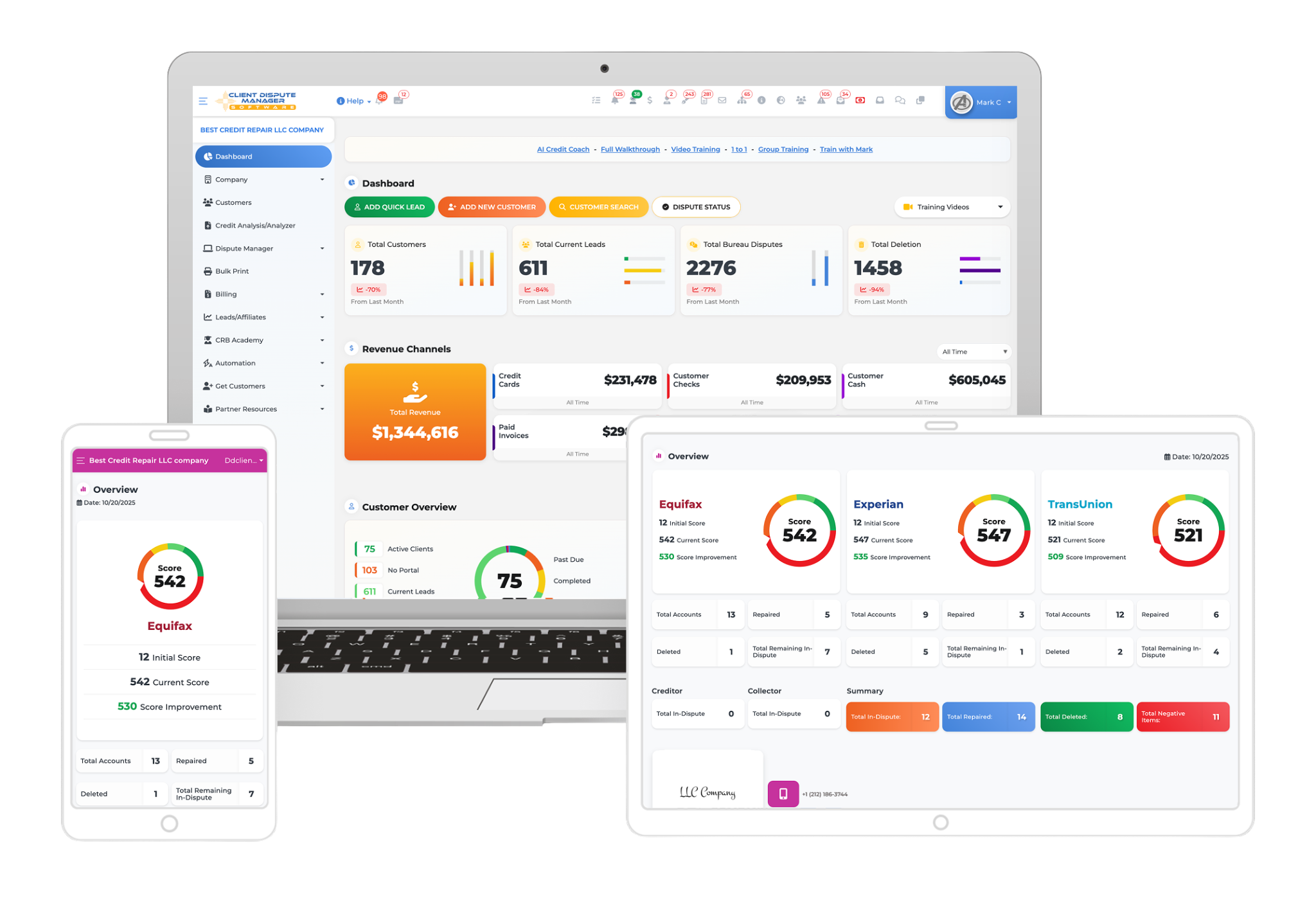
Client Dispute Manager Software stores all invoices timestamped against the client record and the specific dispute round that triggered each invoice. Every payment, its amount, its date, and the service event that preceded it is retained in the client file as part of the dispute workflow record.
The billing history is accessible from the client file without requiring the operator to cross-reference a separate accounting system. That record structure is the documentation that matters when an FTC inquiry or a consumer’s attorney requests evidence that the business billed correctly throughout the client relationship.
Yes. CROA Section 1679b(b) expressly prohibits credit repair organizations from charging or receiving any money before services are fully performed. The TSR Section 310.4(a)(2) reinforces this with civil penalties up to $51,744 per violation for telemarketed credit repair services. A consumer who paid an illegal upfront fee can recover the full amount paid as actual damages under CROA Section 1679g(a)(1)(B) regardless of what services were eventually delivered. Each individual advance fee transaction counts as a separate TSR violation.
Credit repair platforms that provide compliant automated billing are those where invoice generation is tied to service completion events rather than calendar dates or client enrollment. Generic billing tools charge when the operator schedules them, which requires manual enforcement of the advance fee prohibition.
Client Dispute Manager Software ties invoice generation to dispute round completion by workflow design, making the CROA and TSR advance fee requirement automatic rather than operator-dependent. Invoices are timestamped against the dispute round that triggered them and stored in the client file.
Recurring billing for credit repair must fire after each period’s dispute round closes, not on a fixed calendar date. A monthly subscription that charges on the first of every month creates an advance fee violation in any month where the round has not closed before that date.
Client Dispute Manager Software integrates with Authorize.net and structures recurring billing so invoices fire when each dispute round closes rather than on a predetermined calendar schedule, keeping the subscription model compliant across all active client files simultaneously.
Mainstream processors including Stripe and Square classify credit repair as high-risk and close accounts without advance notice. Specialized processors with established credit repair merchant programs include Authorize.net and PaymentCloud. Operators running compliant post-service billing have lower chargeback exposure because clients billed after services are delivered have no timing-based grounds to dispute the charge.
Client Dispute Manager Software integrates with Authorize.net, which has underwriting experience with credit repair merchants and is the most stable long-term processor relationship for compliant operators.
The FTC can impose civil penalties up to $51,744 per violation of the Telemarketing Sales Rule under 16 C.F.R. 1.98(d). Each individual advance fee transaction counts as a separate violation.
A credit repair company that collected illegal advance fees from 50 clients faces up to $2.58 million in TSR civil penalties before CROA civil liability from consumer lawsuits is added. Operators using purpose-built credit repair billing software with post-service invoice triggers eliminate advance fee exposure entirely because the invoice cannot be generated until the service is confirmed complete.
Billing in a credit repair business is not a financial administration task. It is a compliance function governed by two federal laws that impose separate and substantial penalties for the same violation. The credit repair business owners who build sustainable operations in this industry are almost always those who treated billing design as a legal decision from the start rather than a software configuration question.
A platform that generates invoices after dispute rounds close enforces the CROA and TSR advance fee prohibition by workflow sequence, which eliminates the primary source of FTC enforcement actions and consumer CROA lawsuits against credit repair companies.
That architecture is not an added compliance feature. It is the baseline requirement for operating without regulatory exposure. Client Dispute Manager Software is built around that billing architecture. The invoice trigger is tied to service completion in the platform’s workflow design,
Authorize.net integration handles payment collection, every invoice is timestamped against the dispute round that triggered it, and the full billing history is stored in the client file for audit access. Credit repair professionals who want to see how compliant automated billing functions in practice can try Client Dispute Manager Software free for 30 days at clientdisputemanagersoftware.com. No credit card is required.

Mark Clayborne specializes in credit repair, starting and running credit repair businesses. He's passionate about helping businesses gain freedom from their 9-5 and live the life they really want. You can follow him on YouTube.
Experience our credit repair software, risk-free.