Get Started for as Low a $49 for the First Month: Click Here
Written by Mark Clayborne
Last updated on July 5, 2026

A credit repair business workflow has seven core phases that run in a fixed legal and operational sequence: lead qualification, client onboarding, credit report audit, dispute round execution, bureau response tracking, compliant billing, and client communication throughout. The order is not discretionary.
The Credit Repair Organizations Act (CROA, 15 U.S.C. 1679 et seq.) requires that disclosures are delivered before contracts are signed, that the three-day cancellation window closes before dispute work begins, and that billing occurs only after services are fully performed.
The Fair Credit Reporting Act (FCRA, 15 U.S.C. 1681 et seq.) defines the 30-day investigation window that governs how disputes are tracked and followed up. Operators who reverse or skip any of those steps create compliance exposure from the first client engagement.
This guide walks through each essential step of a credit repair business workflow in the sequence it must occur, with the legal requirements embedded at the point where they apply and the operational tools that make each step repeatable across a growing client base.

The essential steps in a credit repair business workflow follow a fixed sequence determined partly by law and partly by operational logic. Compliance requirements under CROA and FCRA are embedded in steps two through six, which means skipping or reordering those steps creates regulatory exposure regardless of the operator’s intent. The table below maps all seven workflow phases with their compliance requirements and operational function.
| Step | Workflow Phase | What Happens | Compliance Requirement |
|---|---|---|---|
| 1 | Lead Qualification | Evaluate the prospect's credit situation, explain the dispute process, and confirm that the items they want disputed are genuinely inaccurate, incomplete, or unverifiable | CROA 1679b(a)(1): disputes must be based on truthful information. Never promise removal of accurate items. |
| 2 | Client Onboarding | Deliver required CROA disclosure, execute written contract, honor three-day cancellation window before any work begins, pull initial credit reports | CROA 1679c (disclosure), 1679d (written contract), 1679e (cancellation right) |
| 3 | Credit Report Audit | Review the tri-merge credit report, identify inaccurate, incomplete, or unverifiable items across all three bureaus, and build a dispute strategy by item type | FCRA 1681: only legitimately disputable items qualify. Identify items by FCRA grounds. |
| 4 | Dispute Round Execution | Generate bureau-specific dispute letters for each identified item, send to the correct bureau with supporting documentation, and log the send date and response deadline | FCRA 1681i: 30-day investigation window opens on the send date. Letters must be truthful under CROA 1679b(a)(1). |
| 5 | Bureau Response Tracking | Monitor the 30-day investigation window for each open dispute, log bureau responses when received, update client records, and determine next-round strategy based on outcomes | FCRA 1681s-2: furnishers must investigate and correct inaccurate items forwarded by bureaus. Track both bureau and furnisher responses. |
| 6 | Compliant Billing | Generate invoices after a dispute round is fully completed, collect payment through the configured payment gateway, and store all billing records timestamped against the client file | CROA 1679b(b) and TSR 310.4(a)(2): payment must occur after services are fully performed. No advance fees. |
| 7 | Client Communication | Send milestone updates at dispute submission, response window, and round close. Maintain client portal access so clients can track their own progress between operator updates | CROA 1679b: all communications must be truthful. No misleading status updates or implied outcome guarantees. |
The workflow steps above are not suggestions. Steps two through six contain embedded legal requirements that apply to every client engagement regardless of the operator’s business size, structure, or experience level.
The operators whose credit repair businesses scale without regulatory problems are almost always those who built the compliance requirements into their workflow sequence from the first client rather than trying to retrofit them after a problem had already emerged.

A compliant credit repair client onboarding process follows four steps in a fixed legal sequence: deliver the CROA required consumer disclosure as a separate document before any contract is presented, execute a written contract that meets Section 1679d requirements, honor the three-business-day cancellation window before any dispute work begins, and pull the initial tri-merge credit report only after that window has closed.
The sequence is not adjustable. CROA does not permit the contract to be signed before the disclosure is delivered, and it does not permit dispute work to begin before the cancellation period has expired.
The CROA consumer disclosure required under Section 1679c is a specific document, not a clause buried in the service contract. The Federal Trade Commission publishes the required language, and it must be provided to the consumer separately before they sign anything.
Most credit repair compliance problems trace back to this step being skipped, combined with the contract, or delivered after signing. A disclosure delivered in the wrong order provides no legal protection for the operator.
The written contract required under CROA Section 1679d must include the total cost of services, a complete description of the services to be performed, the estimated timeframe for completion, and the company’s name and principal business address.
It must also include a notice of the consumer’s three-day right to cancel without penalty or obligation. A contract that omits any of those elements does not meet CROA’s requirements regardless of how it reads in other respects.
The three-day cancellation window under Section 1679e creates a mandatory waiting period between contract execution and the first dispute action. No work, including pulling credit reports or preparing dispute letters, should begin until that window has closed.
The practical effect is that onboarding takes a minimum of four to five business days from initial engagement to first action. Operators who begin work during the cancellation window have performed unauthorized services and created liability under CROA Section 1679g.
Client Dispute Manager Software structures the onboarding process in the sequence CROA requires. The disclosure acknowledgment must be completed before the contract can be generated. The three-day cancellation window is built into the workflow timeline before any dispute action can be initiated.
CROA-compliant contract templates are included in the platform, with all required disclosure fields present and correctly worded.
Secure intake forms collect client data including identity documents and Social Security numbers through encrypted channels, which satisfies the GLBA Safeguards Rule obligation that applies to businesses handling consumer financial information.

A credit repair business workflow must embed five specific compliance requirements drawn from CROA (15 U.S.C. 1679 et seq.), the Telemarketing Sales Rule (TSR, 16 C.F.R. 310.4(a)(2)), and the FCRA (15 U.S.C. 1681 et seq.). These are not optional additions to an otherwise functional workflow. They are the conditions that must be met for the workflow to be legally compliant at every client engagement.
| Compliance Requirement | Code Section | Where It Appears In The Workflow | Consequence Of Skipping |
|---|---|---|---|
| Deliver Consumer Disclosure Before Contract | 15 U.S.C. 1679c | Step 2: Client Onboarding, before contract presentation | CROA violation. Consumer lawsuit under 1679g. FTC enforcement action. |
| Execute A Written Contract With All Required Elements | 15 U.S.C. 1679d | Step 2: Client Onboarding, immediately after disclosure delivery | Non-compliant contract. Civil liability exposure under 1679g. |
| Honor The Three-Day Cancellation Window Before Starting Work | 15 U.S.C. 1679e | Step 2 To Step 3 Transition: no work begins until window closes | Services performed without authorization. CROA violation. |
| Collect Payment Only After Services Are Fully Performed | 15 U.S.C. 1679b(b) and TSR 310.4(a)(2) | Step 6: Billing, triggered by dispute round completion | Advance fee violation. Consumer recovers full amount paid. FTC civil penalties up to $51,744 per TSR violation. |
| Generate Dispute Letters Based Only On Truthful, Accurate Information | 15 U.S.C. 1679b(a)(1) | Steps 3 and 4: Credit Report Audit and Dispute Execution | CROA violation. Criminal exposure under 18 U.S.C. 1028 for false identity claims. FCRA frivolous dispute flag under 1681i(a)(3). |
The operators who maintain long-term regulatory compliance are almost always those who treated compliance as a workflow architecture problem rather than a memory problem. A workflow that requires operators to remember to deliver a disclosure, remember to wait three days, and remember to bill only after completion is a workflow that will eventually produce a compliance failure.
The compliance requirement that is missing at the point of failure is almost never the one the operator did not know about. It is the one that the workflow did not enforce. Client Dispute Manager Software enforces each of these requirements through the platform’s workflow sequence.
The disclosure acknowledgment gate must be completed before the contract can be generated. Invoice generation is triggered by completed dispute rounds, not by client enrollment.
Every client interaction is timestamped and stored in an audit-ready record within the file. That audit trail is the documentation that matters when an FTC inquiry or a consumer’s attorney requests evidence that the business operated within the law.

The most efficient credit repair dispute tracking systems are built around the FCRA’s 30-day investigation window. FCRA Section 1681i requires bureaus to complete their investigation within 30 days of receiving a dispute, or 45 days if the consumer provides additional information during the window.
Every open dispute round needs a logged send date, a visible response deadline, and a field to record the bureau’s outcome when it arrives. Credit repair companies that track dispute resolutions efficiently build their systems around that timeline rather than treating it as background information.
Manual spreadsheet tracking fails credit repair dispute resolution at the 20 to 30 active client mark. At that volume, a single spreadsheet across three bureaus, multiple clients, and multiple dispute rounds becomes an error surface that grows faster than the operator’s ability to manage it.
A missed response deadline means a lost follow-up window. A missed follow-up means a client whose dispute outcome sat unaddressed for 30 days while the next round should already have been prepared.
FCRA Section 1681s-2 adds a second tracking obligation that many operators overlook: furnishers who receive notice of a dispute forwarded by a bureau must also investigate and correct or delete inaccurate information.
Tracking only bureau responses and not furnisher responses means the operator is monitoring half the dispute resolution process. An item can remain on a client’s report because the furnisher reinserted it after a deletion, and an operator who is not tracking furnisher responses will not catch it.
| Client | Bureau | Send Date | Response Deadline | Bureau Response | Next Action |
|---|---|---|---|---|---|
| Client A | Equifax | April 1, 2026 | May 1, 2026 | Deleted | Close item. Prepare next round. |
| Client A | Experian | April 1, 2026 | May 1, 2026 | Verified | Escalate with Metro 2 or legal grounds letter. |
| Client A | Transunion | April 1, 2026 | May 1, 2026 | Pending | Follow up if no response by deadline. |
| Client B | Equifax | March 15, 2026 | April 14, 2026 | Updated | Log update. Check furnisher. Prepare round 2. |
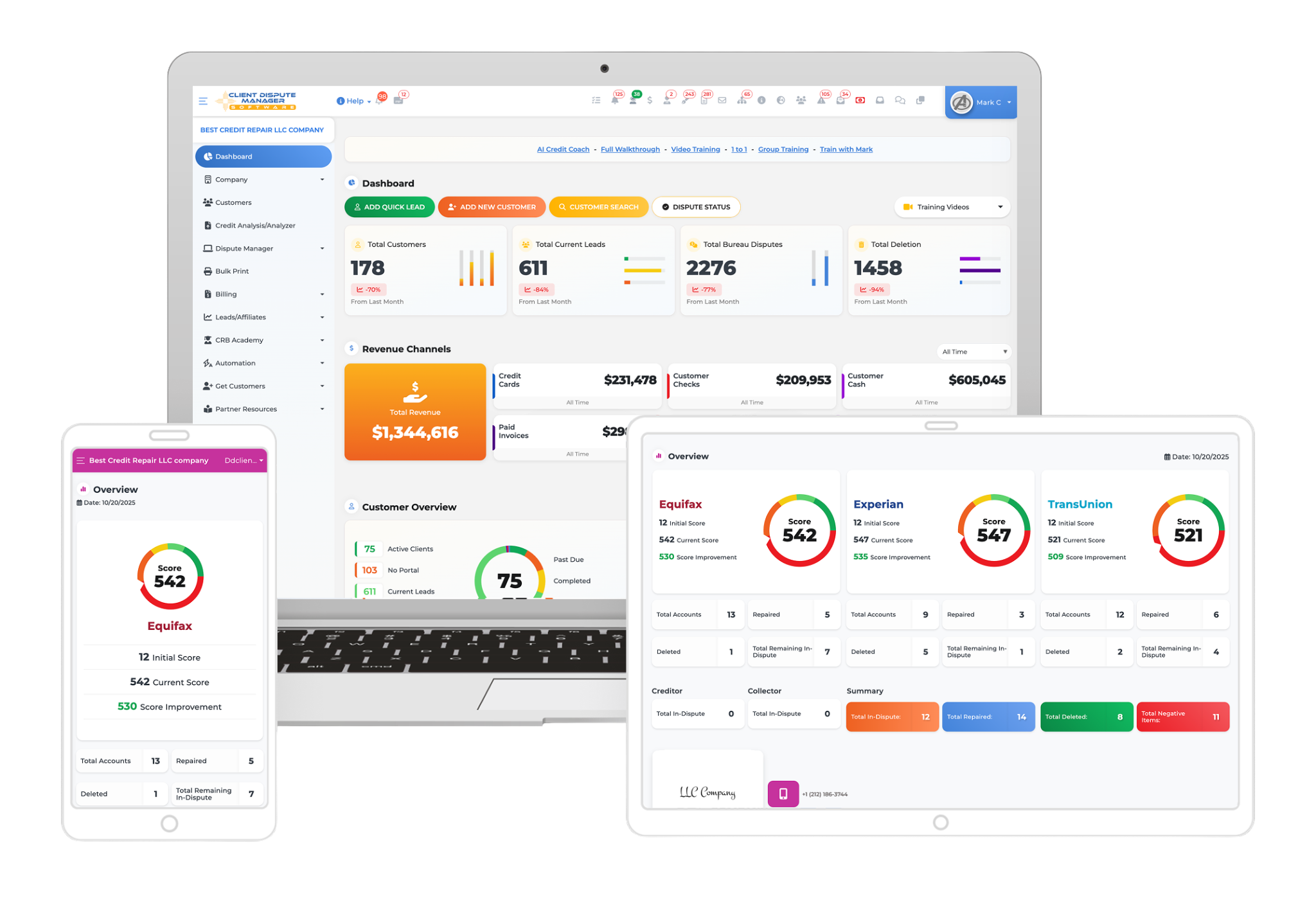
Client Dispute Manager Software surfaces every client’s open dispute rounds in a tracking dashboard showing the bureau, send date, response deadline, and an outcome field logged when the bureau responds. When a round closes, the platform automatically moves the client into the next dispute cycle if items remain unresolved.
Automated credit score alerts notify clients when their score changes without requiring the operator to manually check each account. That combination of response deadline tracking and automated client notification is what allows operators to manage 50 or more active client files without losing visibility into any individual case.

Automated client follow-up in a credit repair workflow is built around three dispute milestones that occur in every client’s engagement: when a dispute round is submitted to the bureaus, when the 30-day response window is approaching its close, and when a round closes with documented bureau responses.
An automation system that triggers communication at each of those milestones removes the manual tracking burden entirely and ensures every client receives consistent, timely updates regardless of how many other clients are active at the same time.
The operators who lose the most clients to attrition are almost always those whose clients feel uninformed rather than those whose clients have poor dispute outcomes. A client who receives clear milestone updates and can see their own progress in a client portal will stay engaged with the process through a 12-month engagement.
A client who goes six weeks without hearing anything will cancel whether or not items are being resolved. Client communication is a retention function in credit repair, not a support function. CROA Section 1679b applies to automated communications as directly as it applies to in-person statements.
Any automated message that misrepresents dispute status, implies removal of items that have not been deleted, or suggests a guaranteed outcome violates CROA’s prohibition on false or misleading representations regardless of whether a human being composed the specific message.
Automated follow-up systems must be built around factual milestone triggers, not around encouraging language that overstates results. Client Dispute Manager Software supports client communication across email, SMS, and in-portal messaging from the same platform.
Automated follow-up sequences trigger based on the three dispute milestones: a message when a round is submitted, a message when bureau responses are expected, and a message when a round closes with documented outcomes. The operator configures the sequence once and the platform runs it consistently for every active client.
Email marketing integrations connect with the operator’s existing email tools, and the client portal gives clients real-time visibility into their dispute status between operator-initiated updates.
The credit repair platforms that provide compliant automated billing and invoicing features are those built specifically around the advance fee prohibition that governs the industry. CROA Section 1679b(b) prohibits charging or receiving any money before services are fully performed.
The Telemarketing Sales Rule Section 310.4(a)(2) reinforces this for any credit repair services marketed by telephone or online, with civil penalties up to $51,744 per violation. A billing platform that charges at enrollment before any dispute round has been completed violates both laws with that single transaction.
| Billing Decision | Non-Compliant Approach | Compliant Approach |
|---|---|---|
| When Is The Invoice Generated? | At client enrollment, before any work begins | When a dispute round closes and service delivery is confirmed |
| What Triggers The Payment Request? | Client signature on the contract | Confirmed completion of the contracted service period |
| What Happens If The Client Cancels? | Client paid in advance; dispute resolution required for refund | No advance payment was collected; no refund dispute arises |
| What Is The Ftc Enforcement Exposure? | CROA 1679b(b) violation plus TSR 310.4(a)(2) at up to $51,744 per client | No advance fee exposure because billing is sequenced after service completion |
| What Does The Consumer Recover In A Lawsuit? | Full amount paid under CROA 1679g(a)(1)(B) regardless of services delivered | No advance fee paid, so no advance fee recovery available to the consumer |
Client Dispute Manager Software generates invoices when a dispute round closes, not when a client enrolls. The billing trigger is tied to service completion by the platform’s workflow design, which means the TSR and CROA advance fee prohibition is enforced by the sequence of the system rather than by requiring the operator to manually time each payment.
All invoices are timestamped and stored against the client record, creating an audit trail that documents fee timing for regulatory review or litigation defense. Stripe and Square integrations handle payment processing, with support for recurring subscription billing for operators who structure services on a monthly retainer basis.

Most solo credit repair operators hit a practical ceiling between 20 and 40 active clients, at which point the time required to manage existing client files, prepare dispute letters, track bureau responses, handle client communication, process billing, and run marketing simultaneously leaves no real capacity for growth.
That ceiling is almost always a systems problem rather than a capacity problem: the workflow has not been systematized and documented well enough to delegate the parts that do not require the owner’s direct judgment. The steps to scale a credit repair business workflow efficiently begin with solving that documentation problem before adding team members, not after.
The three primary scaling paths for a credit repair business workflow are hiring staff or virtual assistants with defined workflow roles, implementing tools with multi-user access and role-based permissions, and automating client communication and billing so the operator’s time shifts from administrative tasks to growth decisions.
All three require the same prerequisite: a workflow that is documented precisely enough to be delegated and a platform that enforces the workflow sequence so that compliance obligations survive the handoff to a new team member.
Credit repair software with multi-user access changes the scaling equation because it allows the operator to assign specific workflow functions to specific team members without giving those team members access to billing settings, administrative controls, or data outside their defined role.
A virtual assistant handling dispute letter preparation needs access to client credit report data and letter templates. They do not need access to billing configuration or other clients’ files. Role-based permissions enforce that boundary at the platform level rather than relying on the operator to manually restrict access.
Client Dispute Manager Software supports multi-user access with role-based permissions that allow operators to assign specific workflow functions across team members precisely.
The platform also offers a white-label option that allows agency owners and coaches to present the software under their own brand when building a network of sub-agents or affiliate partners, which is the third scaling path for operators building a franchise-style operation.
The white-label arrangement means partners see the operator’s brand throughout the platform rather than requiring them to use a separately licensed tool.
Scaling a credit repair business workflow without adding full-time staff requires two things working simultaneously: automation handling the communication and billing functions that previously consumed the operator’s time, and a defined process for each step that a part-time contractor or virtual assistant can execute without requiring the operator’s direct oversight on every file.
The operators who scale past 100 active clients without full-time staff are almost always those who built the process documentation and automation infrastructure before they needed them, not after they hit the ceiling.
A compliant credit repair onboarding process follows four steps in strict legal order: deliver the CROA required consumer disclosure as a separate document before any contract is presented, execute a written contract meeting Section 1679d requirements, honor the three-business-day cancellation window before any dispute work begins, and pull the initial tri-merge credit report only after that window has closed. Client Dispute Manager Software structures these steps in the correct legal sequence and includes CROA-compliant contract templates as part of the platform.
A credit repair business workflow must embed five requirements: delivery of the CROA consumer disclosure before any contract is signed, a written contract meeting Section 1679d standards, honoring the three-day cancellation window under Section 1679e before work begins, collecting payment only after services are fully performed under CROA Section 1679b(b) and TSR Section 310.4(a)(2), and generating dispute letters that contain only truthful information under CROA Section 1679b(a)(1). These requirements apply to every client engagement regardless of business size.
Credit repair companies track dispute resolutions efficiently by building their tracking system around the FCRA’s 30-day investigation window. Every open dispute round needs a logged send date, a visible response deadline, and a field to record the bureau’s outcome when it arrives. Manual spreadsheets fail once a client base exceeds 20 to 30 active files. Client Dispute Manager Software surfaces this information for every active client in one tracking dashboard and automatically moves clients into the next dispute cycle when a round closes.
Automated client follow-up in a credit repair workflow is built around three dispute milestones: when a round is submitted to the bureaus, when the response window is approaching, and when a round closes with documented bureau outcomes. An automation system tied to those milestones ensures every client receives consistent, timely updates without requiring the operator to manually manage each communication. Client Dispute Manager Software triggers these messages automatically once the operator configures the sequence, running it for every active client file simultaneously.
Scaling a credit repair business workflow requires three parallel moves: systematize and document the workflow before adding team members so that each step can be delegated without the operator’s direct oversight, implement software with multi-user access and role-based permissions to assign defined tasks without granting unnecessary access to sensitive settings, and automate client communication and billing so the operator’s time is spent on growth decisions rather than administrative tasks. Client Dispute Manager Software supports all three through its platform design and multi-user access structure.
The essential steps in a credit repair business workflow are not interchangeable. The CROA disclosure must precede the contract. The cancellation window must close before any work begins. Billing must follow service completion.
Those requirements are embedded in the workflow by law, which means a workflow that does not enforce them is a workflow that will eventually produce a compliance failure. The credit repair business owners who build sustainable, growing operations are almost always those who built compliance into their operational sequence from the first client engagement rather than trying to manage it as a separate layer on top of a workflow that was designed without it.
Client Dispute Manager Software is built around the premise that credit repair compliance is a workflow architecture problem, not a memory problem. The platform enforces the CROA disclosure sequence, the written contract requirement, the three-day cancellation window, the post-service billing trigger, and the dispute tracking timeline through the order of operations in the system itself.
Credit repair professionals who want to see what a compliant, scalable workflow looks like in practice can try Client Dispute Manager Software free for 30 days at clientdisputemanagersoftware.com. No credit card is required.

Mark Clayborne specializes in credit repair, starting and running credit repair businesses. He's passionate about helping businesses gain freedom from their 9-5 and live the life they really want. You can follow him on YouTube.
Experience our credit repair software, risk-free.