Get Started for as Low a $49 for the First Month: Click Here
Written by Mark Clayborne
Last updated on April 24, 2026
When you file a dispute with a credit bureau, the Fair Credit Reporting Act (FCRA) at 15 U.S.C. section 1681i imposes a mandatory investigation obligation on Equifax, Experian, and TransUnion: each bureau must investigate the disputed information within 30 days, forward the dispute and all supporting documentation to the data furnisher who reported the item, and either correct, delete, or verify the information before the investigation window closes.
These are not discretionary responses that a bureau can choose to provide or withhold based on the volume of disputes it receives or the perceived merit of a particular claim. They are statutory duties backed by civil liability provisions that allow consumers to sue non-compliant bureaus in federal court and recover actual damages, statutory damages, and attorney fees.
Understanding what credit bureaus are legally required to do when a dispute is filed is foundational knowledge for consumers who want to exercise their credit report rights effectively and for credit repair business owners managing dispute workflows on behalf of clients.
The FCRA framework is specific about timelines, bureau obligations, furnisher obligations, and the escalation rights that activate when a bureau fails to investigate correctly or refuses to correct information that cannot be verified.
Every step of that framework is covered in this guide, from the initial 30-day investigation window through the legal remedies available when the standard process fails to resolve a persistent inaccuracy.

The Fair Credit Reporting Act governs both the timing and the reporting obligations that apply to every credit dispute filed in the United States, and it does so through 15 U.S.C. section 1681i, which establishes the 30-day investigation window that every consumer, credit repair professional, and credit bureau must understand before the dispute process begins.
When a consumer or their credit repair representative submits a dispute to Equifax, Experian, or TransUnion, the bureau has 30 days from the date it receives the dispute to complete its investigation, notify the furnisher who reported the disputed item, and report back to the consumer with the results.
That 30-day window is not a target or a guideline. It is a statutory deadline, and a bureau that misses it without a valid statutory basis for an extension has created FCRA liability at the moment the deadline passes.
The standard 30-day investigation window under 15 U.S.C. section 1681i(a)(1) runs from the date the bureau receives the dispute, not the date the consumer mailed it or the date it was processed by a third-party service. FCRA provides one extension: if the consumer submits additional relevant information to the bureau during the 30-day investigation period, the bureau can extend the window by 15 days, bringing the maximum investigation period to 45 days.
That extension applies only in the specific circumstance where new information is submitted after the dispute is opened, and it cannot be used by the bureau as a general delay mechanism applied to all disputes in its queue.
The 30-day clock runs on every dispute filed across all three bureaus simultaneously, which means that a credit repair business managing disputes across Equifax, Experian, and TransUnion on behalf of a single client must track three separate investigation windows that may have opened on three different dates depending on when each bureau received the dispute correspondence.
The consequence of missing a follow-up within the window is not simply a delayed result. It is the loss of the leverage that FCRA’s deadline creates, because a bureau that has not received a follow-up for an overdue investigation has no automatic obligation to escalate its own non-compliance.
The bureau’s obligation during the investigation period extends beyond simply reviewing the consumer’s dispute internally. Under 15 U.S.C. section 1681i(a)(2), the bureau must promptly provide written notice of the dispute to the person or entity that furnished the disputed information, along with all relevant information the consum
er submitted with the dispute. The furnisher then has a parallel and independent obligation under 15 U.S.C. section 1681s-2(b) to investigate the consumer’s dispute, review all information provided by the bureau, and report the results of its investigation back to the bureau before the 30-day window closes.
| Party | Fcra Obligation | Statutory Source | Deadline |
|---|---|---|---|
| Credit Bureau | Investigate dispute, notify furnisher, provide furnisher all relevant dispute information | 15 U.S.C. § 1681i(a)(1) and (2) | 30 days from receipt (45 with consumer-triggered extension) |
| Data Furnisher | Investigate dispute, review all information from bureau, report results back to bureau | 15 U.S.C. § 1681s-2(b) | Must respond before bureau's 30-day window closes |
| Credit Bureau | After receiving furnisher results: correct, delete, or verify disputed information; notify consumer | 15 U.S.C. § 1681i(a)(5) and (6) | Before the 30-day investigation window closes |
The furnisher obligation is the most commonly misunderstood element of the FCRA dispute process, both by consumers filing disputes on their own and by credit repair business owners who focus exclusively on what the bureau is required to do. When a furnisher receives the bureau’s notification, it must actually review the underlying account records, not simply confirm its own reporting.
A furnisher that responds to a bureau without genuinely investigating the consumer’s specific factual claim has not met its 15 U.S.C. section 1681s-2(b) obligation, and that failure is separately actionable under FCRA independent of any bureau-level violation.

Successfully disputing a charge-off or collection requires a documented factual claim that the information on the credit report is inaccurate, incomplete, or unverifiable, and the strength of the dispute is determined by the quality and specificity of the evidence submitted rather than by the assertiveness of the langu
age used in the dispute letter. A dispute that identifies a specific inaccuracy and supports that claim with documentation triggers the bureau’s mandatory 30-day investi
gation obligation under FCRA. A dispute that states the item is incorrect without a factual basis gives the bureau grounds to classify the dispute as frivolous and terminate the investigation under 15 U.S.C. section 1681i(a)(3) without completing the process.
Effective dispute documentation falls into three categories, each of which addresses a different type of inaccuracy that may be present in a charge-off or collection tradeline. Identifying which category applies to a specific item before building the dispute package is the step that separates disputes likely to succeed from those that get confirmed as accurate on the first round and require escalation.
| Evidence Type | When To Use It | Supporting Documents Needed | What It Proves |
|---|---|---|---|
| Factual Inaccuracy Documentation | Balance, payment status, account number, or date is reported incorrectly | Account statements, payment receipts, settlement agreements, payoff letters | The specific data field on the report does not match the actual account record |
| Identity Error Documentation | The debt belongs to another person with a similar name or the same SSN | Government-issued ID, address history, affidavit of identity | The consumer is not the person responsible for the debt |
| Reporting Period Violation | The item is older than the FCRA maximum reporting period for its item type | Original delinquency date documentation, account opening records | The item has exceeded its legal reporting window and must be removed |
The reporting period violation category is the most frequently overlooked evidence type in collection disputes. Many collection accounts are re-aged when debt is sold from one collector to another, meaning the collection tradeline shows a recent date that makes the item appear newer than it actually is.
The FCRA maximum reporting period for a collection account runs from the date of the original delinquency on the underlying debt, not from the date the collection account was opened or last updated.
A collection account opened by a third-party collector in 2023 on a debt that first became delinquent in 2015 is already outside the seven-year reporting window and should be disputed on that basis with documentation establishing the original delinquency date.
Under 15 U.S.C. section 1681i(a)(3), a bureau can determine that a dispute is frivolous or irrelevant and decline to investigate it if the dispute does not include sufficient information to investigate the claim or if the information in the dispute is substantially the same as information previously submitted in a prior dispute that was already investigated.
The practical implication for credit repair business owners is that the language in a dispute letter is not what determines its validity.
The factual basis is what determines validity, and a dispute that asserts an item is wrong without specifying which data field is wrong and why gives the bureau the statutory cover it needs to dismiss the dispute without completing an investigation.
A dispute grounded in documented inaccuracy, with specific identification of the erroneous data field and supporting documentation attached, triggers the full 30-day investigation obligation and prevents a frivolous designation.
A dispute that uses assertive language but lacks factual specificity can be dismissed at the bureau’s discretion without any investigation taking place and without the consumer having any FCRA claim arising from the dismissal.
That distinction is the most operationally significant compliance rule in the FCRA dispute process for anyone building a credit repair business model around dispute volume rather than dispute quality.

Challenging outdated negative information on a credit report begins with identifying whether the item falls outside the maximum reporting period established by FCRA at 15 U.S.C. section 1681c, which limits most negative items to seven years from the date of the original delinquency and Chapter 7 bankruptcies to ten years from the date of discharge.
An item that has exceeded its legal reporting window must be removed from the credit report, and a bureau that refuses to remove it after receiving a properly documented dispute has created FCRA civil liability at the moment of refusal.
The key to this category of dispute is establishing the correct start date for the reporting period, which FCRA ties to the date of first delinquency rather than to any subsequent collection, sale, or reporting activity.
The maximum reporting periods under 15 U.S.C. section 1681c vary by item type, and understanding the correct period for each type prevents the common error of disputing items that are still within their legal window while missing items that have already exceeded it.
| Negative Item Type | Maximum Reporting Period | Period Starts From | Statutory Source |
|---|---|---|---|
| Most Negative Items (Late Payments, Collections, Charge-Offs) | 7 years | Date of original delinquency on the underlying account | 15 U.S.C. § 1681c(a)(4) |
| Chapter 7 Bankruptcy | 10 years | Date of discharge or dismissal | 15 U.S.C. § 1681c(a)(1) |
| Chapter 13 Bankruptcy | 7 years | Date of discharge or dismissal | 15 U.S.C. § 1681c(a)(2) |
| Unpaid Tax Liens | 7 years | Date of payment or date of filing (whichever is later) | 15 U.S.C. § 1681c(a)(3) |
| Civil Judgments | 7 years | Date of entry of judgment | 15 U.S.C. § 1681c(a)(5) |
| Accounts Placed For Collection | 7 years | Date of original delinquency on the account that led to collection | 15 U.S.C. § 1681c(a)(4) |
The specific dispute process for an item that has exceeded its FCRA reporting period requires establishing the date of first delinquency as the factual basis for removal, because that date is what determines when the seven-year or ten-year clock started and when it ended.
The date of first delinquency is not the date the account was sold to a collector, the date the collection tradeline was opened, or the date the account was charged off. It is the date the original account first became past due in a delinquency that was never cured, and FCRA requires furnishers to report that date accurately to the bureaus under 15 U.S.C. section 1681s-2(a)(5).
The documentation needed to support a reporting period violation dispute is evidence establishing the original delinquency date: account statements showing the first missed payment, original creditor correspondence identifying the account as delinquent, or credit report data from an earlier period showing when the account first went past due.
A bureau that receives this documentation and refuses to remove an item that is demonstrably outside the reporting window has created FCRA civil liability under both sections 1681n and 1681o, and that liability extends to the furnisher whose inaccurate reporting of the delinquency date is what allowed the item to remain on the report beyond its legal window.

Escalating a dispute with a credit reporting agency becomes necessary when the bureau completes its investigation and confirms the disputed item as accurate, a result that does not end the consumer’s rights under FCRA and does not mean the information is actually correct.
When a bureau confirms an item after investigation, FCRA provides four specific escalation mechanisms that operate independently of one another and can be pursued in sequence or simultaneously depending on the nature of the inaccuracy and the documentation available to support the consumer’s position.
Understanding all four mechanisms before beginning the escalation process is what separates a consumer who exhausts their options quickly from one who pursues the full range of rights available under the statute.
When a bureau confirms a disputed item as accurate after investigation, the consumer has four escalation options under FCRA that activate immediately upon receiving the bureau’s investigation results.
Each step is distinct, actionable, and capable of producing a different outcome depending on the specific facts of the dispute.
The method of verification request is one of the most underused escalation tools in the FCRA dispute process. Under 15 U.S.C. section 1681i(a)(6)(B)(iii), after the bureau notifies the consumer that it verified the disputed information, the consumer can request a written description of the procedure the bureau used to verify the item.
That description is the bureau’s evidence of how it satisfied its investigation obligation, and a bureau that verified an item by receiving an automated e-OSCAR confirmation from the furnisher without any document review has produced a verification record that an experienced FCRA attorney can challenge.
The CFPB complaint process at ConsumerFinance.gov/complaint is the second escalation mechanism that does not require an attorney and produces a formal regulatory record. The CFPB forwards complaints to the bureau or furnisher named in the complaint and tracks the response, creating documentation that supplements the consumer’s own records if the dispute proceeds to litigation.
A bureau that responds to a CFPB complaint differently than it responded to the original dispute, whether by removing an item it previously confirmed or by acknowledging an error in its investigation, has produced an admission that becomes evidence in any subsequent FCRA claim.

When a credit bureau refuses to correct a verified inaccuracy after a properly documented dispute and a legitimate escalation attempt, FCRA provides a private right of action that allows the consumer to file a civil lawsuit in federal or state court without waiting for a government agency to act, and the damages structure that statute creates is specifically designed to make that litigation economically viable at the individual loss amounts that are typical in credit report inaccuracy cases.
The two liability tracks at 15 U.S.C. sections 1681n and 1681o cover both knowing violations and negligent failures respectively, and each track carries a different damage structure that determines what a consumer can recover depending on how the bureau’s failure is characterized.
FCRA’s civil liability framework distinguishes between willful noncompliance and negligent noncompliance because the distinction reflects the degree of harm the bureau’s conduct inflicted and the level of deterrence required to prevent future violations.
A bureau that knowingly or recklessly violates FCRA faces the full range of damages available under willful noncompliance. A bureau that failed to exercise reasonable care in its investigation procedures faces the narrower negligent noncompliance damage structure.
| Violation Type | Statutory Source | Available Damages | What Triggers This Track |
|---|---|---|---|
| Willful Noncompliance | 15 U.S.C. § 1681n | Actual damages OR statutory damages between $100 and $1,000 per violation, PLUS punitive damages as the court allows, PLUS reasonable attorney fees and costs | Knowing or reckless disregard of FCRA requirements; includes bureau that continued a practice after learning it violated FCRA |
| Negligent Noncompliance | 15 U.S.C. § 1681o | Actual damages PLUS reasonable attorney fees and costs | Failure to exercise reasonable care in FCRA compliance; applies when violation was not knowing or reckless but still caused consumer harm |
The attorney fee provision in both liability tracks is what makes FCRA civil litigation economically viable at individual loss amounts that would not otherwise justify private representation.
Because a prevailing consumer recovers their reasonable attorney fees from the defendant, an attorney can take an FCRA case on contingency even when the consumer’s direct monetary loss is modest, knowing that the fee award provides compensation independent of the damages the client personally recovers.
That dynamic creates a functioning private enforcement mechanism that operates continuously alongside FTC and CFPB regulatory enforcement.

Identity theft victims have access to three FCRA protections that go beyond the standard dispute process and are specifically designed for situations where fraudulent tradelines are appearing on a credit report because another person used the consumer’s identifying information to open accounts.
These enhanced remedies exist because the standard 30-day investigation process was not designed to handle disputes where the underlying account is not inaccurate but is simply not the consumer’s account at all.
| Fcra Identity Theft Remedy | Statutory Source | How It Works | Bureau Response Deadline |
|---|---|---|---|
| Block Of Fraudulent Information | 15 U.S.C. § 1681c-2 | Consumer submits identity theft report and specific identification of the fraudulent tradeline; bureau must block the information from appearing on the credit report | 4 business days from receipt of identity theft report |
| Fraud Alert Placement | 15 U.S.C. § 1681c-1 | Initial 1-year fraud alert requires the bureau to notify other bureaus; extended 7-year victim alert available with identity theft report | Bureau must notify the other two bureaus within 24 hours of placing initial alert |
| Security Freeze (Credit Freeze) | 15 U.S.C. § 1681b | Prevents bureaus from releasing the consumer's credit report to new creditors without explicit consumer authorization; free for all consumers; available from each bureau independently | Must be placed within 1 business day of a request submitted by phone or online |
The block right under 15 U.S.C. section 1681c-2 is a faster and more direct remedy than the standard dispute process for identity theft victims because it bypasses the 30-day investigation window entirely and requires the bureau to act within four business days.
A bureau that fails to block information after receiving a proper identity theft report and identification of the fraudulent tradeline has committed a willful FCRA violation under section 1681n, because the statutory requirement is clear and non-compliance is necessarily knowing at the point where the bureau has received the required documentation and still declined to act.
After a bureau removes or corrects a disputed item, the updated information typically appears on a refreshed credit report within 30 to 45 days, though the exact timing depends on when the consumer pulls their next report from each bureau. Equifax, Experian, and TransUnion update their files independently, which means the corrected information may appear on a report from one bureau before the other two reflect the same change. Credit score impact following a successful dispute varies by scoring model and depends on what other information remains in the file after the removed item no longer factors into the calculation.
Four document categories should be retained throughout and after a credit repair engagement: the signed CROA-compliant service contract with all required elements, the Consumer Rights Statement with a signed or dated acknowledgment of its receipt before the contract was signed, all dispute letters and proof of mailing or certified mail receipts for each bureau submission, and all bureau and furnisher response letters with their received dates.
Retain everything for at least three years after the engagement ends to preserve the ability to pursue any CROA private right of action that might arise from the business’s conduct during the engagement.
Successful disputes require documented factual claims, not assertive language. Three evidence categories apply to most charge-off and collection disputes: account statements or payment records showing a specific data field is reported incorrectly, identity documentation confirming the debt belongs to a different person, and evidence of the original delinquency date if the item has exceeded its seven-year FCRA reporting window.
A dispute that identifies the specific inaccuracy and provides supporting documentation triggers the bureau’s 30-day investigation obligation. A dispute that asserts inaccuracy without a factual basis can be dismissed as frivolous without investigation under 15 U.S.C. section 1681i(a)(3).
FCRA provides three enhanced remedies beyond the standard dispute process for identity theft victims. Under 15 U.S.C. section 1681c-2, consumers can request a block of specific fraudulent tradelines and bureaus must act within four business days of receiving the request with an identity theft report.
Under section 1681c-1, consumers can place a one-year fraud alert that notifies all three bureaus simultaneously. A security freeze under 15 U.S.C. section 1681b prevents bureaus from releasing the consumer’s credit report to new creditors entirely, and bureaus must place or lift a freeze within one business day of an online or phone request.
FCRA provides two private lawsuit tracks for persistent inaccuracies. Under 15 U.S.C. section 1681n, willful noncompliance allows recovery of actual damages or statutory damages between $100 and $1,000 per violation, plus punitive damages and attorney fees.
Under section 1681o, negligent noncompliance allows recovery of actual damages plus attorney fees. The attorney fee provision in both tracks enables consumers to obtain legal representation on contingency at individual loss amounts that would not otherwise justify litigation, creating a functioning private enforcement mechanism independent of FTC and CFPB regulatory action.
The Fair Credit Reporting Act creates a mandatory framework of investigation obligations, reporting timelines, and consumer rights that governs every credit dispute filed with Equifax, Experian, or TransUnion. Credit bureaus must investigate disputes within 30 days, forward them to the furnisher who reported the information, and correct or delete anything that cannot be verified.
Furnishers have a parallel obligation to investigate and report their findings back before the window closes. When either party fails to meet those obligations, FCRA’s civil liability provisions at sections 1681n and 1681o create an enforcement mechanism that consumers can use without waiting for a regulator to act.
These are not courtesy protections. They are statutory duties with defined penalties attached, and the bureaus and furnishers subject to them know it. Credit repair business owners and consumers who understand the FCRA dispute framework, document their disputes correctly, and know when and how to escalate are not at the mercy of a bureau that wants to confirm every item as accurate.
They are operating within a legal structure specifically designed to give them enforcement leverage when the process does not work as it should.
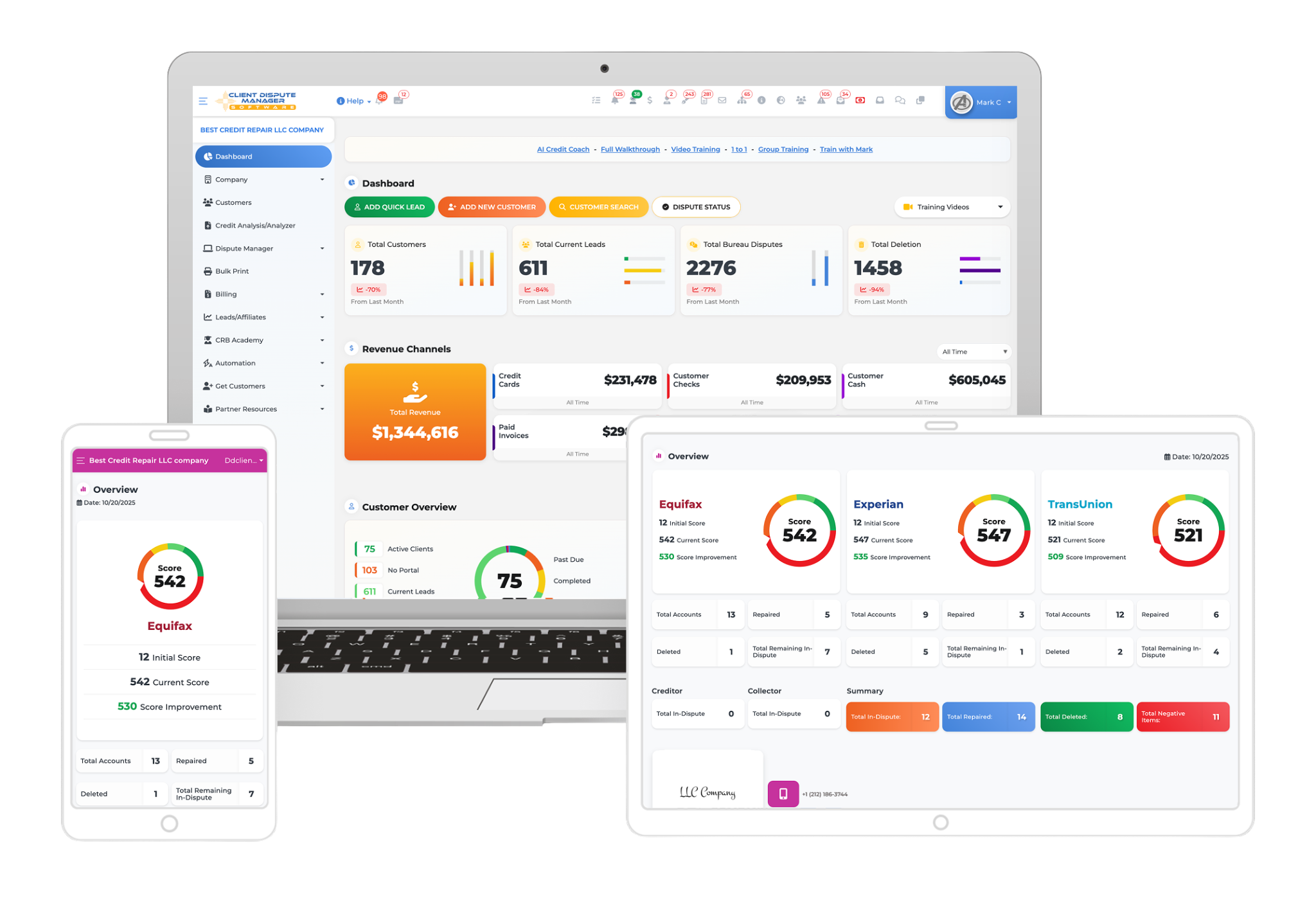
Client Dispute Manager Software is built around FCRA’s dispute timelines and documentation requirements, automating the investigation window tracking, dispute correspondence, and bureau response management that make a credit repair operation’s compliance posture as strong as the law allows it to be.

Mark Clayborne specializes in credit repair, starting and running credit repair businesses. He's passionate about helping businesses gain freedom from their 9-5 and live the life they really want. You can follow him on YouTube.
Experience our credit repair software, risk-free.