Get Started for as Low a $49 for the First Month: Click Here
Written by Mark Clayborne
Last updated on June 10, 2026

The dispute method you choose does not change your legal rights under the FCRA. The bureau has the same 30-day investigation obligation whether your dispute arrives by certified mail, through an online portal, or over the phone. What the method does change is what reaches the bureau, how your documentation is handled, and what record you have if the investigation fails.
Those differences determine which method produces the strongest result for your specific dispute situation. This article covers how each submission method processes your dispute, what each one does well and where each one creates risk, how to match the method to the type of dispute you are filing, and what the FCRA requires from the bureau regardless of which channel you use.
The goal is a clear, specific answer to the question consumers ask most: which method is most likely to produce a correction or deletion for my situation.

Certified mail is better than online submission for any dispute that involves supporting documents, requires a precise delivery record to establish the investigation start date, or is a re-dispute after a prior verified result. Online submission is better for straightforward factual corrections where no documents need to be attached, because it is faster and produces an immediate confirmation.
The FCRA assigns the same 30-day investigation window to both methods, so the choice affects what arrives at the bureau and what record you have afterward, not the timeline the bureau must follow.
The practical difference between the two methods comes down to document handling.
Online portals accept specific file formats, typically PDF, JPG, and PNG, and apply compression settings to uploaded attachments. A bank statement that was clearly legible when you uploaded it may be unreadable after portal compression. A multi-page creditor letter may lose pages.
When the bureau processes your dispute without receiving your evidence in readable form, the result is identical to submitting with no evidence at all. Certified mail does not apply any compression or filtering. What you put in the envelope is what the bureau receives.
There is also a record-keeping difference that becomes significant if the dispute escalates. Certified mail with return receipt produces a physical confirmation showing the exact date the bureau received your letter. That date is the start of the 30-day investigation clock under FCRA Section 611(a)(1).
If the bureau fails to respond within the required window and you later file a CFPB complaint or consult a consumer attorney, that receipt is the evidence establishing when the obligation started. An online portal confirmation screenshot serves a similar purpose but is less robust as legal documentation because it shows submission, not receipt.
Credit monitoring platforms reduce the chances of credit dispute rejection by alerting you to new derogatory items before they age and become harder to dispute, tracking score changes that signal a new item has appeared on your report, and in some cases providing dispute submission tools that connect directly to bureau portals.
The monitoring function gives you the earliest possible notice of an item that needs to be disputed, which matters because supporting documentation is more accessible shortly after an error appears than months or years later.
The dispute submission tools built into credit monitoring platforms carry the same document handling limitation as bureau online portals: they process disputes through automated interfaces that may translate your specific claim into a coded inquiry and strip or compress your attachments.
For monitoring purposes, these platforms provide genuine value. For submitting document-heavy disputes or re-disputes where the evidence is the argument, sending directly to the bureau by certified mail produces a more complete and defensible submission than routing through a monitoring platform’s interface.

To submit a credit dispute successfully through the official credit bureau portals, complete four steps before you begin the online submission process. First, obtain a current copy of your credit report from the bureau whose portal you are using, because the account identifiers you need, including the account number and the bureau’s internal reference number for the disputed item, appear on the report next to the tradeline.
Second, write your specific error description covering all three components: what is wrong, why it is wrong, and what the correct information should be. Third, prepare your supporting document in a PDF format that is legible at the bureau portal’s file size limits.
Fourth, note the date you submit, because that date is when the 30-day investigation window starts for an online submission. Each bureau maintains its own dispute portal with its own submission process.
Experian’s dispute center is at experian.com/disputes. Equifax’s is at equifax.com/personal/credit-report-services. TransUnion’s is at transunion.com/credit-disputes. All three require you to create or log into an account, which serves as your identity verification for the submission.
That account login is the reason online portals do not require the government-issued ID and address confirmation that certified mail submissions require. After submission, the portal provides a reference number and a confirmation of the investigation start date. Save both. The portal also allows you to track the status of your dispute while the investigation is open.
Most bureau portals provide status updates at several stages: when the investigation is opened, when the furnisher responds, and when the result is determined. The result will appear as “verified,” “updated,” or “deleted” depending on what the investigation found.
The credit repair apps most effective at navigating credit dispute rejections are those that organize the complete dispute workflow rather than simply submitting letters on your behalf. The distinction matters because the most common cause of dispute failure is not the submission channel. It is the content of the letter and the quality of the evidence attached to it.
An app that generates and submits a generic dispute letter through an automated interface does not address either problem. An app that tracks which specific evidence was attached to which submission, which factual basis was used in each prior dispute, and which bureau responded with what result on which date gives you the organizational foundation to build a stronger re-dispute.
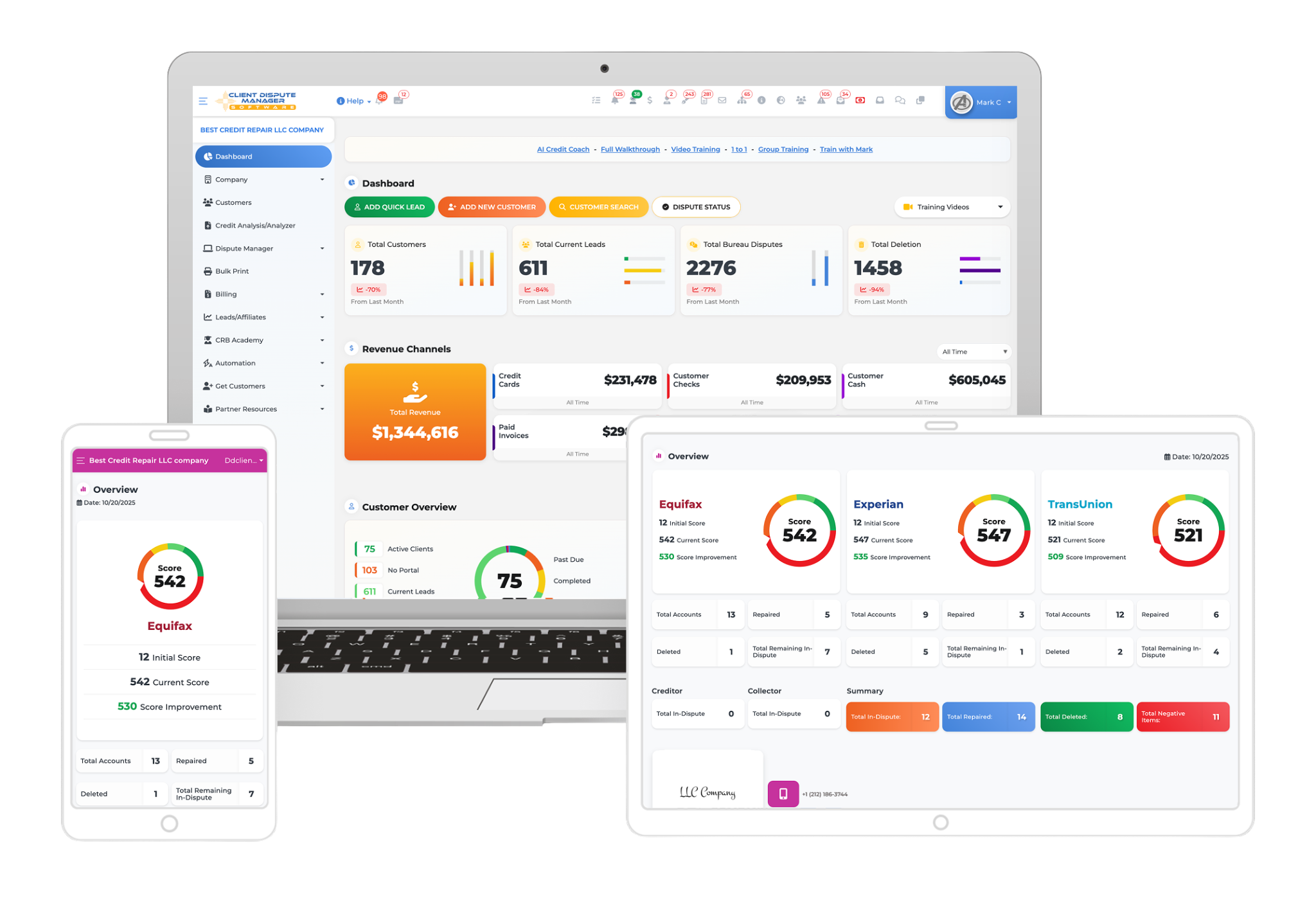
Client Dispute Manager Software is built specifically for the credit repair workflow. It tracks every submission date, every bureau response window, every document attached to each dispute, and every re-dispute deadline across multiple accounts.
That tracking function addresses the administrative failure mode that causes correctable disputes to stall: missing which document was attached before, losing the delivery confirmation date, forgetting the exact error description from the prior submission.
The platform is designed for credit repair professionals and their clients, but its organizational function is equally valuable for consumers managing multiple disputes on their own. The 30-day free trial at clientdisputemanagersoftware.com includes full platform access with no credit card required.
Tracking the status of a credit dispute after submission depends on which method you used to submit it. For online portal submissions, the status is visible in your account with the bureau where you filed. Log into your account and navigate to the dispute center to see the current status, which updates at each stage of the investigation.
For certified mail submissions, the bureau does not provide an online tracking dashboard tied to your letter. Status updates come by mail, typically within the 30-day investigation window, and the certified mail delivery receipt is your only confirmation of when the bureau received the dispute.
Each major credit bureau maintains a dispute-specific customer support channel separate from its general customer service line. Experian’s dispute support number appears on your credit report and on the dispute result notice.
Equifax and TransUnion list their dispute contact information on the same places. These dispute-specific lines connect you to representatives who can confirm whether a dispute is open, explain what the investigation result means, and provide the bureau’s dispute processing mailing address if you need to submit a follow-up by certified mail.
Customer support representatives do not have authority to override investigation results or reopen closed cases. Contacting customer support after a verified result will not produce a different outcome from the investigation that already closed.
What it can provide is clarification on the result notice, confirmation of the account reference number for a re-dispute, and direction to the correct mailing address for the bureau’s dispute processing unit. Use the customer support channel to gather the information you need for your next submission, not to appeal the result of the investigation that closed.
You can contact a credit bureau’s customer service after a rejected dispute, but customer service cannot override investigation results or reopen closed cases. The dispute investigation process is handled by the bureau’s reinvestigation department, not by its customer service representatives.
A customer service call after a verified result will not produce a reversal. What it can produce is the specific mailing address for the bureau’s dispute processing unit, confirmation of the reference number for the disputed item, and an explanation of what the result notice means.
The escalation paths that carry actual legal weight after a verified result are the re-dispute with new evidence submitted directly to the bureau, the furnisher direct dispute under Regulation V submitted directly to the furnisher, the CFPB complaint at consumerfinance.gov, and civil action under FCRA Sections 616 and 617. Each of those paths creates a new legal obligation for the bureau or furnisher.
A customer service inquiry creates no new obligation. Use customer service to gather information for your next formal submission, then use the formal submission to create the investigation obligation.

The three dispute submission methods produce different outcomes based on the type of dispute, the documentation involved, and what happens to your submission during processing.
The comparison below maps each method to the scenarios where it produces the strongest result and the risks it creates when used outside that scenario.
| Method | Best For | Key Advantage | Key Risk | FCRA Timeline |
|---|---|---|---|---|
| Certified Mail | Document-heavy disputes, re-disputes after a verified result, any dispute where a delivery record matters for escalation | Documents arrive exactly as submitted; delivery receipt establishes precise investigation start date; strongest record for CFPB complaints and legal action | Slower delivery, typically 7 to 14 days before investigation clock starts; requires identity documents for mail submissions | 30 days from receipt date on certified mail confirmation |
| Online Portal | Straightforward factual corrections with no supporting documents, or where speed matters and documentation is minimal | Fastest submission; immediate confirmation; real-time status tracking; no identity documents required beyond account login | Portal compression may degrade or strip document attachments; confirmation shows submission date, not necessarily receipt date | 30 days from online submission confirmation date |
| Phone | Checking status of an existing dispute, clarifying what a result notice means, confirming the correct mailing address for a certified mail submission | Immediate access to a representative; useful for gathering information before a formal submission | Not suitable for submitting evidence; no written record of what was stated or agreed unless you request written confirmation; carries no investigation weight on its own | Does not trigger the 30-day investigation window independently |
Phone is not a dispute submission method. It is an information-gathering tool. Filing a dispute by phone without following up with a written submission by mail or online does not reliably trigger the bureau’s investigation obligation under FCRA Section 611(a)(1).
The FCRA requires a reasonable investigation, but a phone call alone does not produce a written record that the bureau received a specific dispute, which makes it difficult to establish when the 30-day window started or what specific error you identified if the investigation result is later contested.
The certified mail and online portal methods are equally valid under the FCRA. The bureau’s investigation obligation is the same for both. The choice between them should be determined entirely by the nature of your dispute. A dispute that has no supporting documents and involves a simple factual correction, such as an incorrect address, a name spelling error, or an account that the furnisher itself has already acknowledged as closed, can be handled effectively through the online portal.
A dispute that relies on a bank statement, a creditor letter, or any other document to contradict the furnisher’s data requires certified mail to ensure the document arrives in the condition you need it to arrive in.
Online credit dispute tools that provide templates and guidance reduce common rejection reasons by ensuring the letter contains the minimum required information: the account number, the creditor name as it appears on the report, and a description of the specific error.
Tools that go further and generate letters organized around the specific FCRA grounds for the dispute, the account-level identifiers from the credit report, and a structured three-component error description produce letters that are significantly harder for the bureau to close through automated processing without engaging the furnisher on the specific claim.
The limitation of template-based tools applies when the template itself is generic. A 609 letter or a 611 letter that names the statute without identifying the specific account and specific error gives the bureau the same coded inquiry as submitting with no specific information at all. Furnishers recognize those templates in volume and close them through established workflows.
The tools that reduce rejection rates are those that force the consumer to input the specific account information, the specific error, and the specific supporting document into a customized letter structure, rather than generating a form letter that could apply to any account.

Online credit dispute services that improve dispute acceptance provide step-by-step guidance covering four specific stages: identifying the exact error on the credit report, gathering the supporting documentation that contradicts the reported information, constructing the dispute letter with all required elements, and submitting through the method most appropriate for the type of evidence involved.
Services that skip or compress any of these stages produce submissions that have the same structural weaknesses as disputes filed without guidance. The stage most commonly skipped by online dispute services is the submission method stage.
Many services default to online portal submission regardless of the documentation involved, because online submission is faster and easier to automate. For disputes that involve attached documents, that default creates the document-handling risk described earlier.
A service that provides step-by-step guidance on when to use certified mail versus an online portal, what documents are required for mail submissions, and how to format and number attachments for a bureau submission produces a meaningfully different outcome from one that routes everything through a portal interface.
The dispute method with the highest success rate is the one that matches the complexity of the documentation involved. Certified mail is the correct method for any dispute that relies on supporting documents to contradict the furnisher, because it guarantees those documents arrive exactly as submitted and produces the delivery record that supports every escalation step that follows.
Online submission is the correct method for straightforward corrections that require no documentation, because it is faster and produces an immediate confirmation. Phone is not a dispute submission method. It is a tool for gathering the information you need before a formal submission.
The FCRA gives consumers the same investigation rights regardless of which method they use.
What determines the outcome is not the channel but the content of the submission: the specificity of the error description, the relevance of the evidence attached, and whether the submission gives the furnisher a specific factual claim to address rather than a generic inquiry to confirm.
Client Dispute Manager Software is built to support that process across every submission method, tracking every document, every deadline, and every bureau response from the first disput
e through the escalation stages that follow a verified result. The 30-day free trial includes full platform access with no credit card required.

Mark Clayborne specializes in credit repair, starting and running credit repair businesses. He's passionate about helping businesses gain freedom from their 9-5 and live the life they really want. You can follow him on YouTube.
Experience our credit repair software, risk-free.