Get Started for as Low a $49 for the First Month: Click Here
Written by Mark Clayborne
Last updated on June 10, 2026
A “verified as accurate” result from the credit bureau does not mean the information on your credit report is correct. It means the bureau’s automated system processed a coded inquiry, the furnisher’s system responded with a confirmation, and the case closed. That exchange often takes less than 24 hours.
A re-dispute letter built around new evidence and a specific factual basis is what forces the bureau to open a real reinvestigation rather than route the submission through the same automated process again.
This article covers what the proper re-dispute procedure requires under the FCRA, what information every re-dispute letter must include, what technical errors cause the letter to be rejected before a human sees it, how to select the right supporting evidence, how to submit the letter so the investigation clock starts correctly, and what to do if the re-dispute also comes back verified.
Every section is built from the questions consumers ask most after receiving a first verification result.
The proper procedure for resubmitting a credit dispute after denial starts with reading the rejection notice to identify the specific reason the bureau stated for the verified result, then building the re-submission around new evidence or a new factual basis that addresses exactly that gap.
Resubmitting the same letter with the same language will not produce a different outcome. FCRA Section 611(a)(3)(B) allows the bureau to close a second submission as substantially the same as the first when no new information is included.
That statutory authority is what gives the bureau legal cover to close a re-dispute without a full reinvestigation.The investigation obligation resets when your new submission includes any information that was not part of the prior dispute.
A new document, a new specific factual basis, a new error detail that differs from what you described before, any one of these additions is sufficient to break the substantially-the-same threshold.The re-dispute is not a repeat of the first dispute.
It is a new submission built around the gap the first dispute could not close.The sequence before sending matters as much as what you write. Read the rejection notice in full. Identify what the bureau said it found. Request the method of verification in writing under FCRA Section 611(a)(6)(B)(iii) if the verification method is not clear.
Gather the new evidence that was not attached before. Then write the re-dispute letter using the structure in the sections below. The letter you send after completing those steps will produce a different result from the letter you sent before completing them.
After a major credit bureau rejects your dispute, take these six steps in order before sending anything else. First, read the rejection notice in full and identify the exact reason stated. Second, request the method of verification in writing under FCRA Section 611(a)(6)(B)(iii) to document what process the bureau used and who confirmed the information.
Third, gather new evidence that directly contradicts the reported information and was not part of your original submission. Fourth, write a specific re-dispute letter using the structure described in this article. Fifth, submit by certified mail to the bureau’s dispute processing address, which is listed on the credit report next to the disputed tradeline.
Sixth, file a furnisher direct dispute under Regulation V simultaneously, so the bureau and the furnisher are both required to investigate within the same 30-day window. Each step produces documentation. The certified mail receipt establishes the exact date the 30-day investigation clock starts.
The method of verification response documents what the bureau did. The furnisher direct dispute creates a second independent investigation obligation. That documented chain is what makes every subsequent escalation step stronger.
The information required to prevent credit dispute rejections on major credit bureau websites falls into five specific elements. Missing any one of them gives the furnisher enough room to confirm the original data and close the case without a substantive investigation.
The five elements apply whether you are submitting your first dispute or a re-dispute after a verified result. Account number and bureau reference number. The bureau processes a high volume of disputes simultaneously.
Without the exact account number and the bureau’s internal reference number for the disputed item, the bureau may investigate the wrong tradeline or return the dispute for additional information before the 30-day window under FCRA Section 611(a)(1) even starts. Both identifiers appear on your credit report next to the tradeline you are disputing. Copy them exactly.
Creditor name exactly as it appears on the report. Not a shortened version, not a common abbreviation. The exact text listed under the tradeline. A mismatch between the creditor name in your letter and the name on the account creates a matching problem that delays or misdirects the investigation before a single fact is reviewed.
Specific error description covering three components. A re-dispute letter requires all three: what is wrong, why it is wrong, and what the correct information should be. A letter that provides only the first or only the first two gives the furnisher room to confirm the partial information it holds.
All three components are required before the bureau can conduct a meaningful reinvestigation. This is the element most commonly missing from letters that get rejected. New supporting documentation not included in the prior dispute. One specific document that directly contradicts what the furnisher reported is more effective than multiple general documents.
The document must be new to the submission. Attaching the same documents from the first dispute does not reset the substantially-the-same threshold. New evidence is the mechanism that creates a new investigation obligation.
Consumer identification for mail submissions. When submitting by certified mail, include a legible copy of a government-issued photo ID and a recent document confirming your current address, such as a utility bill dated within the last 60 days.
The address on your identification should match the address the bureau has on file. Online portal submissions use account login for identity verification, making this element mail-specific.
The best practices to avoid rejection when disputing credit report errors are five rules that apply to every submission, whether it is a first dispute or a re-dispute after a verified result. The first is one letter per disputed item.
Disputing multiple tradelines in a single letter invites a frivolous designation under FCRA Section 611(a)(3) when specific bases are not provided for each item separately. The second is one targeted document per letter, the one document that most directly contradicts what was reported.
The third is certified mail with return receipt for any re-dispute, because that receipt establishes the date from which the 30-day investigation clock runs. The fourth is a reference to FCRA Section 611(a)(1) in the letter body, which signals that you understand the bureau’s investigation obligation and increases the probability of escalated handling.
The fifth is keeping a dated copy of every letter and its certified mail tracking number, because that record becomes the documentation for every escalation step that follows.
Technical errors in dispute letters lead to rejection when they prevent the bureau’s system from routing the dispute correctly or give the furnisher a basis to confirm the original data without addressing the specific claim.
The five most common technical errors are distinct from content weakness: they are structural problems in how the letter is written or submitted that cause it to fail before the substance is ever considered.
| Technical Error | Why It Causes Rejection | One-Line Fix |
|---|---|---|
| No account number or bureau reference number | Bureau cannot identify the tradeline; dispute may be routed to the wrong account or returned for more information | Include the exact account number and bureau reference number from the credit report next to the disputed tradeline |
| Vague error description | e-OSCAR codes it as non-specific; furnisher confirms; case closes without review | State what is wrong, why it is wrong, and what the correct information should be -- all three components in the same letter |
| Reusing the exact same language as the prior dispute | Bureau invokes FCRA Section 611(a)(3)(B) substantially-the-same standard and closes without a new investigation | Add new information -- a document, a new factual basis, or an error detail not in the prior submission |
| No new supporting document | Furnisher's prior confirmation stands because nothing new contradicts it | Attach the one document that most directly contradicts the reported information for the disputed period |
| Online submission for a document-heavy re-dispute | Portal compression may strip or degrade attachments; bureau processes without the evidence | Submit by certified mail with return receipt for any re-dispute with attached documents |
The vague error description is the most damaging technical error in a re-dispute because it triggers the same automated closure path as the original dispute. A letter that says “this account information is incorrect” gives the bureau nothing new to act on. The furnisher confirms the same data it reported before and the case closes again.
A letter that says “the payment due on April 15, 2023 is reported as 30 days late, but it was made on April 10, 2023, as shown in the attached bank statement” forces the furnisher to address a specific factual claim against specific evidence.
Reusing the prior dispute language is the second most consequential error in a re-dispute context specifically. In a first dispute, generic language is a weakness. In a re-dispute, it is a legal mechanism the bureau can invoke to close the case without any investigation.
The re-dispute must be demonstrably different from the original submission in both language and evidence. If the rejection notice from the first dispute identified what was missing, use that identification as the blueprint for what to add.
Avoiding common pitfalls when disputing an item on a credit file comes down to a five-point check before the letter is sent. The first check is confirming the account number in the letter matches the tradeline on the credit report exactly.
The second is verifying that the error description covers all three components: what is wrong, why it is wrong, and what the correct information should be. The third is confirming the supporting document covers the specific period being disputed, not just a current statement if the dispute is about a historical entry.
The fourth is confirming that no sentence in the letter is duplicated from the prior dispute submission. The fifth is confirming the submission method matches the complexity of the documentation: certified mail for any re-dispute with attached documents, the bureau’s own online portal only for corrections that require no attachments.
Strengthening your evidence to prevent a credit dispute rejection means identifying the one document that directly contradicts what the furnisher reported and attaching it to the re-dispute. Volume does not strengthen a credit re-dispute. Relevance does.
A single bank statement showing the payment was made on time outperforms four documents that only partially address the error. The table below matches the five most effective evidence types to the dispute scenarios where each produces the strongest result.
| Evidence Type | Best For | What It Must Show | Why It Works |
|---|---|---|---|
| Bank Statement Showing Payment | Disputes about late payments or non-payments | Account name, due date, and payment date on or before the due date for the disputed period | Directly contradicts the payment status the furnisher reported for that specific period |
| Creditor Letter Confirming Error Or Closure | Disputes where the original creditor has acknowledged the account contains incorrect information | Account number, the specific error named, and the corrected information or closure date | Removes the furnisher's ability to confirm original data without addressing the contradiction in writing |
| Payment Confirmation Or Receipt | Disputes about specific transaction amounts or dates | Date, amount, account reference, and confirmation number; email confirmations with visible timestamps are acceptable | Authenticated record of a specific transaction that is harder to dismiss than a general account statement |
| Ftc Identity Theft Report (Identitytheft.Gov) | Disputes involving accounts you did not open or inquiries you did not authorize | Filed FTC report plus government-issued ID; must name the specific accounts or items in dispute | Triggers FCRA Section 605B four-business-day block obligation, bypassing the standard 30-day reinvestigation window |
| Account History Showing Correct Figure | Disputes about incorrect balances, wrong credit limits, or inaccurate payment status | The correct figure for the specific disputed period, not a current statement if the dispute covers a historical entry | Specificity to the disputed period makes it directly contradictory in a way a general statement is not |
The most effective single piece of evidence in any re-dispute is a letter from the original creditor acknowledging the error or confirming the correction. That letter eliminates the furnisher’s ability to confirm the original data without also explaining the written contradiction from the entity that supplied the data in the first place.
If you contacted the original creditor after your first dispute and received any written acknowledgment, attach that letter to the re-dispute before anything else. It changes the nature of the investigation the furnisher is required to conduct.
For identity theft disputes, file the FTC Identity Theft Report at IdentityTheft.gov before submitting the re-dispute to the bureau. Under FCRA Section 605B, the credit bureau must block information resulting from identity theft within four business days of receiving the report, your identification, and a statement that the information resulted from identity theft.
That is a faster resolution path than the standard 30-day reinvestigation for consumers dealing with fraudulent accounts, and it applies independently of how many prior disputes were filed.
Credit dispute platforms help users gather documentation to prevent rejection by organizing the complete dispute history in one place: which documents were attached to which submission, which specific basis was used in each prior letter, and which bureau responded with what result on which date.
That organizational function addresses the second most common cause of re-dispute failure after evidence gaps. When a consumer cannot recall which document was attached to the original dispute, they risk attaching the same document again, which leaves the substantially-the-same threshold intact.
When they cannot identify the exact error description they used before, they risk reusing the same language. Both errors allow the bureau to close the re-dispute without a new investigation. Client Dispute Manager Software tracks every document, every submission date, every bureau response window, and every re-dispute deadline in one place.
The platform is built specifically for the credit repair workflow, which means the default tracking fields reflect the specific data points that matter for FCRA compliance: investigation window start dates, response deadlines, furnisher correspondence records, and CFPB complaint reference numbers. Managing those details manually across multiple accounts and multiple submission rounds is where DIY disputes most often stall.
The best practices for submitting a credit dispute to avoid rejection cover four mechanics that determine whether the 30-day investigation clock starts correctly, whether your documentation arrives as submitted, and whether you have a legal record that supports every escalation step that follows.
These mechanics apply to all dispute submissions but are especially critical for re-disputes, where a procedural error on the second submission removes your ability to argue the bureau failed to investigate without also explaining why the letter did not arrive correctly.
Certified mail with return receipt is the required submission method for any re-dispute that involves attached documentation. The delivery confirmation receipt establishes the exact date the bureau received the letter, which is the date from which the 30-day FCRA investigation clock runs.
That receipt is also evidence if the bureau fails to respond within the required window and you later file a CFPB complaint or pursue legal action. For re-disputes specifically, where the delivery date and the investigation start date are the same piece of evidence, the receipt is not optional.
The correct bureau dispute processing address is different from the general correspondence and customer service addresses for all three major bureaus. The dispute processing address is listed on your credit report next to the tradeline you are disputing.
Sending to a general address means the letter may not reach the dispute processing unit, and the investigation clock may not start from the date it was mailed. One item per envelope. Send a separate letter for each disputed account.
A single letter covering multiple tradelines invites a frivolous designation under FCRA Section 611(a)(3) when specific bases are not provided for each item individually. Each letter must stand on its own with its own account identifier, its own specific error description, and its own supporting document.
Three specific steps in the letter itself improve acceptance of credit disputes with leading credit bureaus beyond what the standard re-dispute process produces.
The first is stating explicitly in the letter that you are attaching documentation and requesting under FCRA Section 623(b)(1)(A) that the bureau forward all relevant information to the furnisher. That request puts the bureau on notice that it received contradicting evidence and creates a documented record if it fails to forward it.
The second step is referencing FCRA Section 611(a)(1) and your right to a full reinvestigation in the letter body. That citation signals that you understand the bureau’s legal obligations. Letters that cite the specific statutory basis for the reinvestigation are processed differently from letters that do not, because they signal that the consumer will follow up if the obligation is not met.
The third step is noting explicitly in the letter that this is a re-dispute submitted because the prior investigation was returned as verified as accurate and that you are providing new information not previously submitted.
That language directly addresses the substantially-the-same threshold under FCRA Section 611(a)(3)(B) and prevents the bureau from applying the duplicate designation without also addressing the new information you identified.
There is no formal appeal process for a denied credit report correction request in the administrative sense. What the FCRA provides instead is a sequence of four escalating recourse paths, each one more direct and more legally significant than the last.
Appealing a denied credit report correction means working through these paths in order, with each step building the documented record that strengthens the next.
| Escalation Path | What It Triggers | When To Use It |
|---|---|---|
| Re-Dispute With New Evidence | New FCRA reinvestigation obligation under Section 611(a)(1) if the submission includes information not in the prior dispute | Any time you have a document or specific factual basis not included in your original letter |
| Furnisher Direct Dispute Under Regulation V (12 C.F.R. 1022.43) | Furnisher must investigate within 30 days independent of the bureau and notify all credit bureaus of any correction found | When the bureau verified and you believe the furnisher's own records are directly contradicted by documentation you have |
| Cfpb Complaint At Consumerfinance.Gov | Bureau must respond within 15 days; typically triggers escalated human analyst review rather than automated processing | After one or more re-disputes have been verified through standard channels and the bureau has not corrected the information |
| Civil Action Under Fcra Sections 616 And 617 | Private right of action for actual damages, statutory damages up to $1,000 per violation, and attorney's fees paid by the defendant | When the bureau or furnisher failed to conduct a reasonable investigation and the inaccurate reporting caused documented financial harm |
The furnisher direct dispute under Regulation V is the most underused option available after a verified re-dispute. The bureau dispute and the furnisher direct dispute are independent obligations. Disputing directly with the furnisher does not require completing the bureau dispute process first, and the furnisher’s investigation obligation exists regardless of what the bureau determined.
Send a written letter by certified mail to the furnisher’s dispute correspondence address, which is listed on your credit report. Include the original creditor’s written confirmation of the error if you have it, the specific error description, and a reference to the furnisher’s obligation to investigate under Regulation V within 30 days and notify the bureaus of any correction found.
To file a credit dispute appeal after rejection by a credit bureau, the most productive immediate path is the CFPB complaint combined with the furnisher direct dispute, used simultaneously. Filing the CFPB complaint triggers escalated bureau review. Disputing directly with the furnisher forces the data owner to investigate independently of the bureau’s determination.
Running both in parallel creates two independent investigation obligations within the same 30-day window. To file the CFPB complaint, go to consumerfinance.gov and select “Submit a Complaint.” Choose “Credit reporting” as the product and “Incorrect information on your report” as the issue.
Provide the account name, the specific error, the date of the original dispute, the date of the re-dispute, and the verified result you received both times. Upload the bureau’s investigation result notices and your certified mail receipts as supporting documents. The bureau is required to respond to the CFPB within 15 days.
That response does not guarantee deletion, but it typically results in the dispute being assigned to a human analyst rather than the standard automated process. The consumer statement under FCRA Section 611(b) is available as a parallel step while the CFPB complaint and furnisher direct dispute are pending.
This statement, limited to 100 words, is added to your credit file and included in future credit reports. It does not remove the item but it informs lenders reviewing your report that the item is actively contested.
For consumers who are applying for credit during the dispute process, the statement provides an immediate record of the dispute without waiting for the investigation to close.
The five questions below address specific situations that readers of this article ask most frequently after receiving their first verified result. Each one is answered directly.
If your credit dispute was rejected due to lack of proof, the next step is identifying the specific document that directly contradicts what the furnisher reported and attaching it to a new re-dispute submission.
A rejection for lack of proof means the furnisher’s records were sufficient to confirm the reported information in the absence of contradicting evidence. That outcome is not final. It tells you precisely what was missing from your original submission.
The document you need depends on what you are disputing. For a late payment, a bank statement showing the payment was made on or before the due date for the disputed period is the required evidence.
For an account balance error, an account history statement showing the correct figure for the specific month being disputed is required. For an account that does not belong to you, an FTC Identity Theft Report filed at IdentityTheft.gov is the most effective documentation because it triggers a separate legal obligation under FCRA Section 605B that requires the bureau to block the information within four business days.
When you resubmit, state explicitly in the letter that you are providing new supporting documentation not included in the prior dispute, identify the document by name, and reference FCRA Section 611(a)(1) and your right to a full reinvestigation.
That language directly addresses the substantially-the-same threshold under FCRA Section 611(a)(3)(B) and prevents the bureau from closing the re-dispute without opening a new investigation. Submit by certified mail with return receipt so the delivery date creates a documented record of when the 30-day investigation clock started.
Credit bureaus have 30 days from the date they receive your dispute letter to complete their investigation and notify you of the results under FCRA Section 611(a)(1). The 30-day window starts from the date of receipt, not the date you mailed the letter, which is one of the reasons certified mail with return receipt is the recommended submission method. That receipt gives you the exact date the clock started.
The window extends to 45 days in two specific circumstances. First, if you submitted the initial dispute after requesting your free annual credit report through AnnualCreditReport.com. Second, if you provided additional information to the bureau after the investigation had already started.
In both cases, the additional 15 days accommodates the extra information the bureau received. If you plan to submit supporting documents, include everything with the original letter rather than following up after submission, because adding documents mid-investigation extends the window and delays the result.
If the bureau determines your dispute qualifies as frivolous rather than opening a full investigation, it must send you written notice of that determination within five business days of making it. That five-day deadline is separate from the 30-day investigation window.
If the bureau sends neither a frivolous designation notice within five business days nor an investigation result within 30 days, that failure to act is a potential FCRA violation. The certified mail receipt establishing the date of delivery is the evidence you need to pursue a CFPB complaint or legal review based on that failure.
Credit bureaus do not multiply their investigation obligations when the same dispute is submitted through multiple services simultaneously. They process them as a single dispute and issue a single investigation result. Submitting through three credit monitoring services at the same time does not create three independent reinvestigation requirements.
It creates one, routed through whichever submission path reaches the bureau’s dispute processing system first. What multiple simultaneous submissions do create is a risk of conflicting records.
If one service submits the dispute as a specific factual error and another submits the same item as a general inquiry, the bureau may process the generic version and return a verified result that does not reflect the specific basis you provided through the other service.
The most reliable path is a single, specific submission sent directly to the bureau by certified mail, so the letter arrives exactly as you wrote it and the investigation is triggered by the version of the dispute you controlled.
Submitting the same dispute through multiple services in sequence, each submission using the same language and the same evidence as the last, runs into the substantially-the-same standard under FCRA Section 611(a)(3)(B).
The bureau can close each subsequent submission without a new investigation as long as it contains no new information. The number of submissions is not what drives a different outcome. The presence of new evidence or a new specific basis in each submission is what creates a new investigation obligation, regardless of which channel you use to deliver it.
A debt validation letter is not sufficient for a credit dispute because it operates under a different federal law and serves a different legal purpose. Debt validation is a right under the Fair Debt Collection Practices Act, which requires a debt collector to verify the debt when a consumer requests validation within 30 days of first contact.
That process runs between you and the debt collector. It does not create an obligation for the credit bureau to investigate the accuracy of what the debt collector is reporting to the bureau, and it does not constitute the supporting documentation needed to trigger a meaningful reinvestigation under FCRA Section 611(a)(1).
When you submit a credit report dispute, the bureau sends a coded inquiry to the furnisher through e-OSCAR. The furnisher checks its own account records and responds. A debt validation letter that the debt collector sent you has no role in that exchange.
Even if the debt validation process revealed that the debt collector could not produce the original account records, that outcome does not automatically correct the tradeline on your credit report. It gives you information to use in a dispute, but it is not itself the evidence the FCRA’s investigation process requires.
The document that works in a credit dispute is one that directly contradicts what the furnisher is currently reporting to the bureau.
If the debt validation process produced documentation showing the account balance is wrong, the account does not belong to you, or the debt has been paid, that documentation is the evidence to attach to your dispute letter.
The debt validation letter itself is not that evidence. The records the debt collector produced during validation, or its failure to produce them, is what you convert into supporting documentation for the credit dispute.
The best ways to ensure identity verification for a credit dispute submission are to include a legible copy of a government-issued photo ID and a recent document confirming your current address with every mail submission, to ensure the address on your ID matches the address currently on file with the bureau, and to update your address with the bureau before submitting a dispute if you have moved recently.
The government-issued photo ID can be a driver’s license, state-issued ID card, or passport. The address confirmation document should be dated within the last 60 days and can be a utility bill, a bank statement, a government letter, or any official document that shows your name and current address in a format the bureau can verify.
If the address on your ID does not match the address on the supporting document, or if either address does not match what the bureau has on file for your account, the identity verification process will be extended and the 30-day investigation clock will not start until the bureau confirms your identity.
Online portal submissions handle identity verification through your account login credentials, which is why identity verification failures are more common in mail submissions than in online submissions.
For disputes that require attached documentation, certified mail is still the better submission method despite this additional step, because it guarantees your documents arrive exactly as submitted rather than being compressed or stripped by portal processing.
Factor in two to three extra days for the bureau to process the identity confirmation before the 30-day investigation window begins when submitting by mail with identity documents included.
Write the Letter the Bureau Cannot Close Without Looking
A re-dispute letter gets results when it gives the bureau something the first letter did not: new evidence, a specific factual basis that the furnisher cannot confirm without reviewing actual records, and a submission method that ensures every element of the letter and every document you attached arrives exactly as you wrote and assembled it.
The substantially-the-same standard under FCRA Section 611(a)(3)(B) is the legal mechanism the bureau uses to close repeat submissions. Breaking that mechanism requires adding something new. The re-dispute is not a louder version of the first letter. It is a more specific one.
If the re-dispute also comes back verified, the process does not end. The furnisher direct dispute, the CFPB complaint, and civil action under FCRA Sections 616 and 617 are each progressively stronger levers that the FCRA provides specifically for the situation where the automated investigation process produced a result that contradicts the evidence.
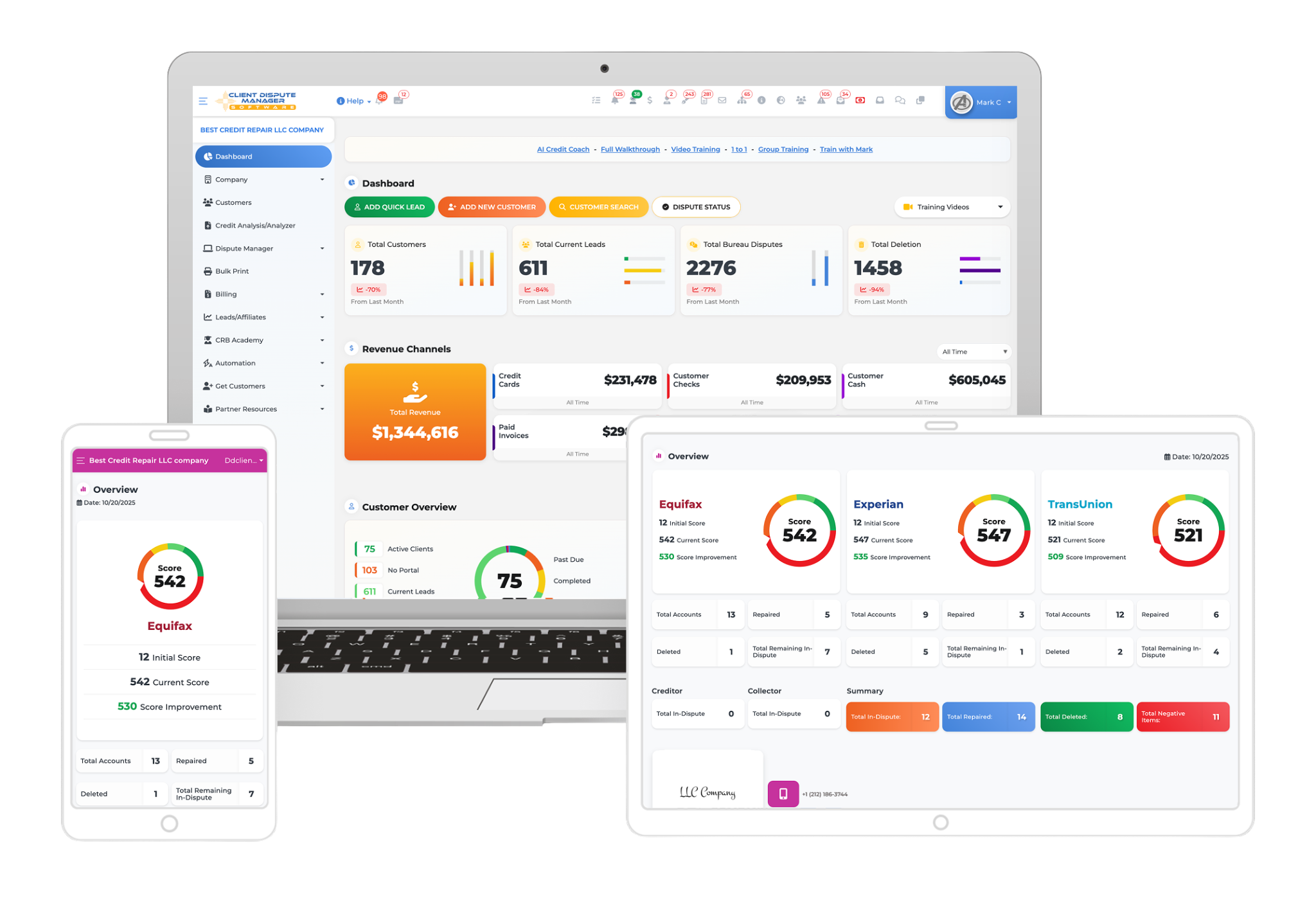
Client Dispute Manager Software is built to organize the entire workflow from first dispute through escalation, so submission dates are tracked, evidence is organized by account and round, and no deadline is missed when the process moves beyond the bureau dispute stage. The 30-day free trial includes full platform access with no credit card required.
Experience our credit repair software, risk-free.