Get Started for as Low a $49 for the First Month: Click Here
Written by Mark Clayborne
Last updated on July 13, 2026
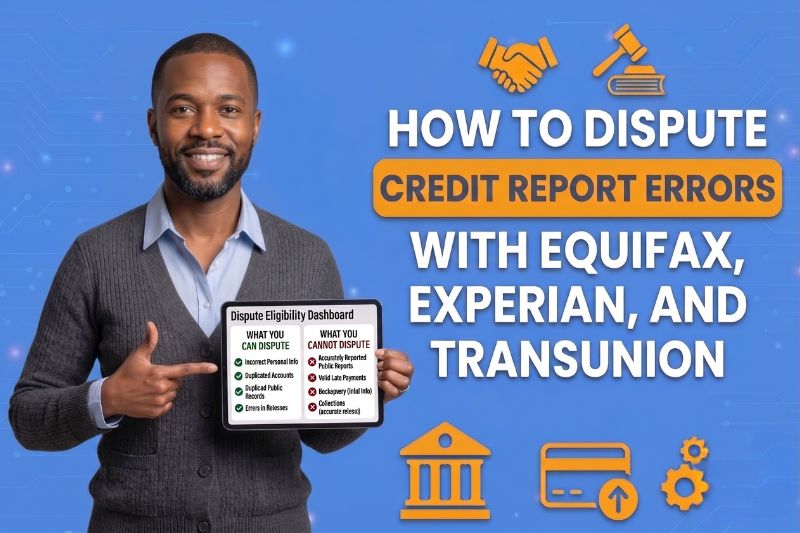
Disputing credit report errors with Equifax, Experian, and TransUnion requires a separate filing with each bureau reporting the inaccurate item. The bureaus do not share dispute information with each other.
An error removed from your Experian report stays on your Equifax and TransUnion reports until you file there separately. Each bureau offers three filing channels: an online portal, certified mail, and phone. Online is the fastest. Certified mail creates the strongest legal record.
All three channels are free. The Fair Credit Reporting Act gives you the right to dispute any inaccurate, outdated, or unverifiable item at no cost, and each bureau must complete its investigation within 30 days of receiving your submission.
This guide covers every channel, every bureau-specific portal, the documentation required to support your claim, the direct creditor dispute process that most guides skip, and the complete step-by-step sequence for removing an inaccurate account from your credit history.
If you are still identifying which items on your report qualify for a dispute, start with the guide on what types of errors can be disputed on a credit report before filing.

Start by going directly to the official dispute portal of the bureau reporting the error. Each of the three major credit bureaus, Equifax, Experian, and TransUnion, operates its own free online dispute center where you can log in, identify the item, describe the error, and upload supporting documents in a single session.
Online disputes are the fastest method. Most portals open the investigation within 24 hours of submission. No paid service or credit repair company is required. Before you log in, create an account on each bureau’s website if you do not already have one.
You will need your Social Security number, current address, and date of birth to verify your identity. Once inside, your credit report displays line by line. Select the entry you want to dispute, choose a reason from the drop-down menu, add a written description of the error, and upload your supporting documents.
The system generates a confirmation number at the end of the submission. Save that number immediately. It is the only way to track your dispute by phone if the online status tool does not update.
File a separate dispute with every bureau reporting the error. Each bureau investigates independently. Removing an item from one report does not affect the same item on another bureau’s report.
Yes. Every consumer has the right to file directly through each bureau’s official website at no cost. The online portals handle the complete process: selecting the disputed item, describing the error, uploading evidence, and tracking the investigation result.
You do not need to go through a third party. You do not need to pay for access. The portals are available 24 hours a day and allow you to file disputes against any item on your report, including accounts, inquiries, and personal information errors.
Use only the official bureau websites. Third-party sites that advertise dispute filing often charge fees, collect personal information for marketing, or redirect you to the same free portals after charging for access.
Online Dispute Portals:
Phone numbers for dispute inquiries:
Mailing addresses for written disputes:
When filing by mail, send your letter and every supporting document by certified mail with return receipt requested to the address above for each bureau you are disputing with.
Keep a copy of everything you send. For guidance on what your written dispute letter must include, see the complete guide on how to write a credit report dispute letter.

Submit supporting documents at the same time you file your dispute, not after. Every bureau’s online portal includes a document upload feature on the final screen of the dispute submission. Attach a copy of every document that directly contradicts the item you are disputing.
A dispute filed without supporting evidence gives the bureau and the data furnisher no factual basis for updating the entry. Documentation is what turns a claim into a provable dispute.
Match your documents to your error type:
After you complete the dispute form, each bureau’s portal displays an upload screen. Accepted file formats are PDF, JPEG, and PNG. Keep each file under 2MB. If a single document is larger than the limit, scan it in sections and upload each section as a separate file.
Name every file descriptively before uploading. A file named “bank_statement_february_2024.pdf” is easier for a bureau representative to match to your specific dispute than a file named “document1.pdf.”
After uploading, save the confirmation screen or email as proof the documents were received. Blurry or incomplete scans delay the investigation without extending the 30-day deadline, so review every scan before attaching.
Keep a dated dispute log from the moment you file. Record the submission date, the filing method, the confirmation number, and the bureau for each dispute. If you file by mail, use certified mail with return receipt requested.
The green return receipt card is written proof of the exact date the bureau received your submission. Under 15 U.S.C. 1681i, that date is what starts the 30-day investigation clock. Store every document you send in a dedicated dispute folder: the dispute letter, every enclosure, the certified mail receipt, and any email confirmation.
Keep this file until the matter is resolved, the item is corrected or removed, and you have confirmed the correction appears on your report. If a bureau reinserts a deleted item without notifying you within five business days, that paper trail is what supports an escalation to the Consumer Financial Protection Bureau.

Yes. Send every written credit dispute letter by certified mail with return receipt requested. Certified mail gives you two things a phone call and an online form cannot: documented proof of the exact date the bureau received your submission, and a paper trail that survives any dispute about timing.
The date on your return receipt card is the date that starts the 30-day investigation window under 15 U.S.C. 1681i of the Fair Credit Reporting Act. If the bureau misses the 30-day deadline, the disputed item must be deleted from your report.
Without certified mail documentation, the bureau can claim the 30-day window started on a different date and you have no evidence to contradict that claim. The return receipt card resolves that dispute immediately. Keep the receipt card and a complete copy of every document you enclosed, including the dispute letter itself, in your dispute file.
You will need this documentation if you file a complaint with the Consumer Financial Protection Bureau, consult a consumer protection attorney, or re-dispute the item after a denial.
For a full explanation of what the FCRA requires of bureaus during the investigation process, see the complete guide on your legal rights when disputing credit report errors.
The best way to contact Equifax, Experian, or TransUnion about a dispute depends on what you need. Online is the fastest channel for filing a new dispute and checking the status of an open investigation. Phone is the fastest channel for getting a live answer to a status question when the online portal has not updated.
Certified mail is the strongest channel when you need a legal record, are re-disputing a denied item, or are filing alongside a CFPB complaint. Online portals, phone numbers, and mailing addresses for all three bureaus are listed in the Official Portals section above.
In addition to those channels:
If you speak with a bureau representative by phone, document the date, time, and name of the person you spoke with. Follow up every phone conversation with a written summary sent by certified mail within 24 hours. That summary is your record of what was discussed if the bureau later takes a position inconsistent with the call.

You can file a dispute directly with the original creditor, the bank, lender, or collection agency that reported the inaccurate item, without going through a credit bureau at all. This is called a direct dispute.
Under the Fair Credit Reporting Act, creditors are required to investigate direct disputes and correct any inaccurate information they reported. Filing a direct dispute with the creditor simultaneously with your bureau dispute is the most effective approach for account-level errors. Two investigations running at the same time produce faster results than one.
To file a direct dispute with a creditor:
When you dispute directly with a creditor, the creditor must review your claim, investigate its own records, and correct the information it reported to the bureau if it confirms an error exists.
That obligation comes from the FCRA, which requires all data furnishers, including banks, lenders, and collection agencies, to report accurate information and to correct errors they discover. A written direct dispute cannot be legally ignored. If the creditor confirms an error, it must update the bureau’s records within a reasonable timeframe.
For collection accounts, a debt validation letter is a parallel option. Under the Fair Debt Collection Practices Act, a collection agency must verify the debt belongs to you and that the balance is correct before continuing collection activity.
If it cannot validate the debt, it must stop reporting it. Send any debt validation request by certified mail separately from your dispute letter.
Three direct methods work consistently for challenging
negative items on a credit file:

Keep every communication in writing wherever possible. If you speak with a creditor or bureau representative by phone, send a written confirmation by certified mail within 24 hours.
Include the account number, the date of the call, the name of the representative, and a factual summary of what was discussed. Use neutral, factual language in all written communications. State the error. Name the specific account.
Cite the applicable law if relevant. State the correction you are requesting. Bureau investigators and creditor representatives resolve short, well-documented, professionally written disputes faster than long letters that argue or accuse.
The goal of your letter is to present a clear factual contradiction between what the creditor reported and what your documentation shows. Let the documentation make the case.
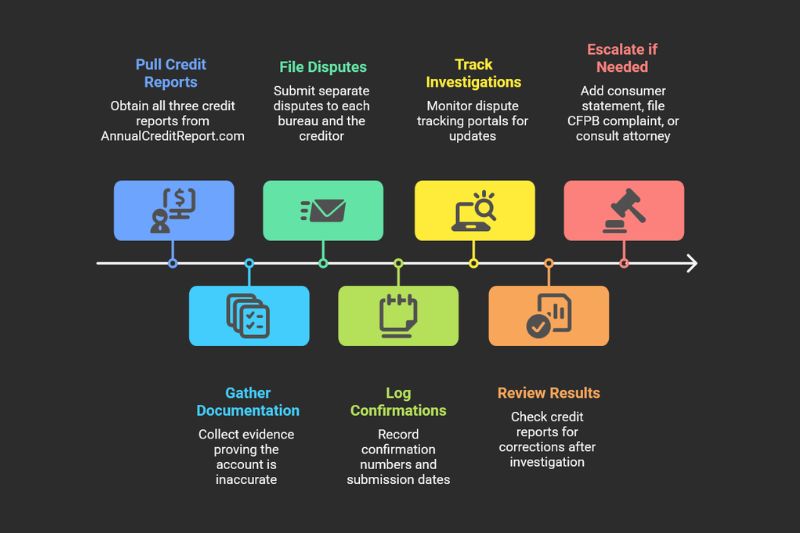
Removing an inaccurate account from your credit history requires filing disputes with every bureau reporting the error, not just one. Each bureau investigates independently and reaches its own conclusion.
An account deleted from your TransUnion report stays on your Equifax and Experian reports until you dispute it there separately. The complete removal process follows a defined sequence from the moment you identify the error to the moment you confirm the correction appears on every affected report.
Follow this sequence in order:
Yes. Each bureau maintains its own credit file and investigates disputes independently. An item removed from Experian will not be removed from Equifax or TransUnion until you file a separate dispute with each bureau reporting the inaccurate item.
Pull all three reports from AnnualCreditReport.com and confirm which bureaus are reporting the error before you file anywhere.
Under 15 U.S.C. 1681i of the Fair Credit Reporting Act, bureaus must complete their investigation within 30 calendar days of receiving your dispute. If you submit additional information during the review period, the deadline extends to 45 days. If the bureau misses the deadline, the disputed item must be deleted from your report.
Filing duplicate disputes for the same item through two channels simultaneously can create confusion in the bureau’s tracking system. The more effective approach is to file online with each bureau for speed, and to send a written dispute by certified mail to the original creditor at the same time.
Two separate parties investigating the same error simultaneously produces faster resolution than one.
If the bureau does not complete its investigation within 30 days, the disputed item must be removed from your report. File a complaint at consumerfinance.gov with the Consumer Financial Protection Bureau.
The CFPB forwards the complaint to the company with a required response deadline and can impose penalties for noncompliance with the Fair Credit Reporting Act.
No. Filing a dispute with Equifax, Experian, or TransUnion is free. The Fair Credit Reporting Act guarantees every consumer the right to dispute inaccurate or unverifiable items at no cost. You do not need a credit repair company or paid service to access any bureau’s dispute portal or to exercise your rights under federal law.
Disputing credit report errors with Equifax, Experian, and TransUnion is not a single action. It is a parallel process. File with every bureau reporting the error, file directly with the original creditor at the same time, attach documentation that contradicts the reported information, and log every confirmation number and submission date from the moment you file.
The Fair Credit Reporting Act gives the bureau 30 days to respond and requires it to correct or delete anything it cannot verify. That is not a courtesy. It is a legal obligation enforced by the Consumer Financial Protection Bureau and the federal court system.
The most common reason a credit report dispute fails is not that the error was legitimate. It is that the consumer filed without documentation, disputed with only one bureau, or stopped following up before the investigation completed.
None of those are recoverable failures, but all of them are avoidable. Pull all three reports, file with every bureau reporting the item, send certified mail to the original creditor, and check your status before day 30. The process works when you work it completely.

Mark Clayborne specializes in credit repair, starting and running credit repair businesses. He's passionate about helping businesses gain freedom from their 9-5 and live the life they really want. You can follow him on YouTube.
Experience our credit repair software, risk-free.