
Imagine running your own credit repair business from home, helping families rebuild their financial futures while you set your own schedule and build sustainable income. You’re not just dreaming about financial freedom; you’re ready to create it.
But right now, you’re stuck. The legal compliance questions keep you up at night: Will I violate CROA? What if I send the wrong dispute letter and get sued? How do I know I’m doing this the right way?
You’ve read conflicting advice online, you’re not sure what tools you need, and you’re worried that even if you start a credit repair business, clients won’t trust you or won’t stick around long enough to see results.
Here’s the truth: every single successful credit repair business owner stood exactly where you’re standing right now. The difference? They learned the proven, compliant framework that removes the guesswork.
That’s what this guide gives you seven clear steps that take you from uncertain beginners to confident business owner, operating legally and effectively.
You’re about to learn the exact process that protects you from legal risk, builds client trust from day one, and creates predictable results without manual chaos. Let’s walk through this together, the right way.
Key Takeaways:
Credit repair is a legal service, not a promise of fast score gains. You help clients use their rights under the FCRA to dispute inaccurate or unverifiable credit report items, nothing more.
Legal compliance comes first. You must follow FCRA, CROA, FDCPA, and TSR rules, use written contracts, avoid upfront fees, give a 3 day cancellation right, and never guarantee results.
Structure your business like a real company. Form an LLC, open a business bank account, meet state licensing or bonding rules, and set up secure systems to track files, deadlines, and documents.
The dispute process runs in clear cycles. Review reports, send disputes to bureaus, review responses in 21 to 30 days, escalate to furnishers when needed, and document every step.
Systems and software protect your time and compliance. Centralized credit repair software helps manage onboarding, disputes, timelines, client updates, and records so you can handle multiple clients without chaos.
What It Really Means to Start a Credit Repair Business?

Before we dive into the seven steps, let’s make sure we’re on the same page about what you’re actually building here. A credit repair business isn’t about promising miracles or guaranteeing 100-point credit score increases that’s the kind of thinking that gets people shut down by the FTC.
Instead, you’re creating a professional service that helps clients exercise their legal rights under the Fair Credit Reporting Act (FCRA).
Here’s what most people misunderstand: Credit repair is document management and legal compliance, not magic. You’re helping clients dispute inaccurate, unverifiable, or unfair items on their credit reports according to Section 611 of the FCRA. When you operate within these guidelines, you’re providing a valuable service that changes lives and you’re protected by the law.
Now let’s walk through exactly how to start your credit repair business the right way step by step, without the overwhelm.
Step #1: Understand the Legal Foundation (Your Compliance Shield)
You can’t build a sustainable credit repair business on shaky legal ground. That anxiety you feel about CROA violations or FTC fines? It’s valid. But here’s what you need to know: when you understand the rules, you can operate with complete confidence. The laws aren’t designed to stop you they’re designed to stop the scammers who give this industry a bad reputation.
The Four Laws That Govern Your Business
The Fair Credit Reporting Act (FCRA) is your most important tool. Section 611 gives consumers the right to dispute inaccurate information. Section 609 requires credit bureaus to disclose what’s in a consumer’s file. This isn’t a loophole it’s federal law, and it’s been in place since 1970. You’re simply helping clients exercise rights they already have.
The Credit Repair Organizations Act (CROA) protects consumers from fraudulent credit repair companies, and it protects you when you follow it correctly. CROA requires written contracts, prohibits upfront fees before services are performed, gives clients a three-day right to cancel, and forbids making false claims. When you build these requirements into your business from day one, you’re not just compliant you’re building trust.
The Fair Debt Collection Practices Act (FDCPA) and Telemarketing Sales Rule (TSR) add additional consumer protections. You don’t need to be a lawyer to understand these laws, but you do need to know the basics.
What Compliance Actually Looks Like?
Compliant credit repair means you use clear contracts that explain your services and fees. You never promise specific credit score increases. You never charge upfront fees before you’ve delivered services. You always give clients their three-day cancellation right. You document everything.
Does this sound complicated? It’s actually simpler than you think when you have the right systems in place. Every expert was once a beginner who just took the time to learn the rules.
Step #2: Build Your Business Infrastructure

Starting a credit repair business from home is completely viable, but you need proper business structure. Most credit repair entrepreneurs choose an LLC (Limited Liability Company) because it provides personal asset protection and is relatively simple to maintain.
This isn’t just about looking professional it’s about protecting your personal finances if your business ever faces legal challenges.
Register your LLC in your state, obtain an EIN (Employer Identification Number) from the IRS, and open a dedicated business bank account. Yes, this takes a few hours and some initial investment, but it’s the difference between running a business and running a hobby.
Licensing and Bonding Requirements
Here’s where things get specific to your location. Some states require credit repair companies to be licensed or bonded. States like Florida, Illinois, and Maryland have specific credit services organization statutes. You need to check your state’s requirements this isn’t optional.
A surety bond (typically $10,000-$100,000 depending on your state) protects consumers if you fail to deliver services. If your state requires it, factor this into your credit repair business startup costs. If your state doesn’t require bonding, consider it anyway it demonstrates credibility.
Documentation Systems From Day One
Set up a system for organizing client files, contracts, dispute letters, and bureau responses before you get your first client. You’ll need a consistent naming convention, secure storage (both digital and physical), and a way to track deadlines.
This might sound tedious now, but when you’re managing 20 clients simultaneously, you’ll thank yourself for building these habits early. You’re building a real business here, not a side hustle that might disappear next month. Take control of your credit destiny by doing this right from the start.
Step #3: Master the Dispute Process (The Core of Your Service)
Let’s demystify this. When you send a dispute letter to a credit bureau, you’re invoking your client’s rights under FCRA Section 611. The bureau has 30 days to investigate by contacting the furnisher (the company that reported the information). If the furnisher can’t verify the information, it must be removed. If they can verify it, it stays.
That’s it. There’s no secret loophole. The power comes from being thorough, accurate, and persistent.
The Credit Repair Dispute Workflow
Your credit repair business workflow should follow this pattern:
- Round 1 (Month 1): Pull current credit reports from all three bureaus. Identify inaccurate, incomplete, or unverifiable items. Send dispute letters to the bureaus citing specific errors (wrong dates, wrong amounts, accounts you don’t recognize). Document everything you send.
- Round 2 (Month 2): Review bureau responses (they typically respond in 21-30 days). Items deleted? Great document the win. Items verified? Now you escalate by disputing directly with the furnisher (the creditor or collection agency that reported the item). Request verification under FDCPA Section 809 if it’s a collection account.
- Round 3 (Month 3+): Continue the process with additional rounds if needed. Some items require multiple disputes from different angles. You’re not harassing anyone you’re exercising legal rights on behalf of your client.
Step #4: Create Your Service Structure

Before you take on a single client, you need crystal-clear definitions of what you provide. This isn’t about being rigid, it’s about protecting both you and your clients from confusion, scope creep, and unrealistic expectations. When clients know exactly what they’re getting, they trust you more and stay engaged longer.
The biggest mistake new credit repair business owners make. Promising to “do everything” without defining what “everything” means. You end up spending hours on tasks that weren’t part of your original agreement, clients expect services you never offered, and you’re exhausted trying to meet undefined expectations.
The Core Services Every Package Should Include
At minimum, your credit repair service should include these foundational elements: credit report analysis (pulling and reviewing reports from all three bureaus), dispute letter creation and submission (professionally written letters sent to bureaus and furnishers), response tracking and follow-up (monitoring bureau responses and taking next steps), and progress reporting (keeping clients informed about what’s happening with their accounts).
These aren’t optional add-ons, they’re the baseline of what credit repair means. When you document these core services in writing, you’re complying with CROA’s requirement to clearly describe what services you’ll perform. This transparency builds trust from day one.
What Belongs in Your Service Scope (And What Doesn't)
Be explicit about what you do NOT provide. You’re not a credit counselor, so you don’t create debt management plans. You’re not a financial advisor, so you don’t give investment advice. You’re not a loan officer, so you don’t guarantee credit approval. You’re not a lawyer, so you don’t provide legal advice or representation.
Under CROA, you must clearly state that you cannot guarantee specific results or credit score improvements. Build this into your service description from the start: “Our service helps you exercise your legal rights under the FCRA to dispute inaccurate or unverifiable items. While many clients see positive results, we cannot guarantee specific outcomes or score increases.”
The Service Agreement That Protects Everyone
Your written service agreement (required by CROA) should detail exactly what you’ll do, how often you’ll communicate, what the timeline looks like, and what the client’s responsibilities are.
Yes, the client has responsibilities too providing accurate information, responding to your requests promptly, not creating new negative items while you’re working on old ones.
This isn’t a legal document designed to confuse it’s a roadmap that sets expectations.
When both parties understand the scope of work, you avoid the “I thought you were going to…” conversations that damage trust.
Step #5: Set Up Your Technology Stack (Tools That Scale With You)

You can start a credit repair business with just Word documents and spreadsheets. But you’ll hit a wall fast. When you’re manually creating dispute letters, tracking deadlines in a notebook, and emailing clients individual updates, you’re not running a business you’re trapped in a full-time job you created for yourself.
The right credit repair software doesn’t just save time. It ensures compliance (contracts and disclosures are built in), reduces errors (automated tracking means nothing falls through the cracks), and lets you focus on what matters (building client relationships and growing your business).
What to Look for in Credit Repair Software?
You need a platform that handles the entire credit repair onboarding process: client intake, credit report importing, dispute letter generation, bureau tracking, client portal access, and reporting. You need CROA-compliant contracts built in. You need automation that doesn’t feel robotic.
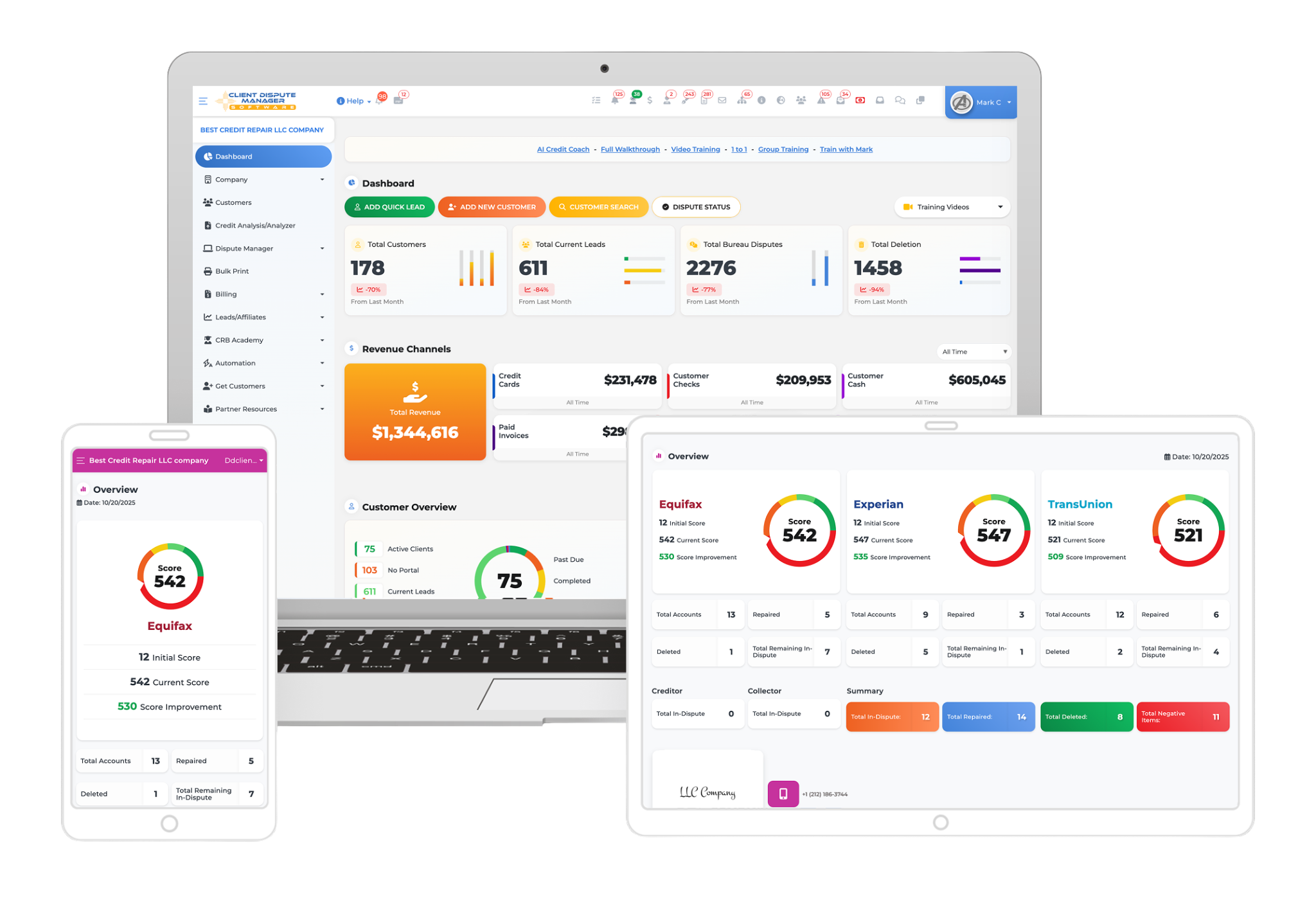
Client Dispute Manager Software: Centralize Disputes, Compliance, and Client Tracking

Client Dispute Manager Software helps you run credit repair operations in one place from the start. It replaces scattered documents, manual tracking, and disconnected tools with a single system built for dispute workflows.
The software supports the full client lifecycle. You intake clients with required disclosures. You store agreements in one record. You import credit reports and organize negative items clearly. Each action stays tied to a timestamped activity log.
This structure matters once you manage more than a few clients at the same time. Dispute cycles overlap. Bureau response dates vary. Manual tracking increases the risk of missed follow-ups. A centralized system keeps every file aligned and current.
Key Features of Client Dispute Manager Software
Client Dispute Manager Software is designed to support organized, compliant credit repair workflows. These features help you manage disputes, timelines, and client records with consistency and control.
Key Features Include:
- Centralized client records that keep intake details, contracts, disclosures, credit reports, and dispute activity stored in one secure system
- Credit report importing and organization that allows you to review negative items clearly and track disputes at the account level
- Dispute letter generation tools that create letters based on report data to reduce manual errors
- Dispute timeline tracking that shows when disputes are sent, when bureau responses are due, and when follow-up is required
- Credit bureau response tracking that records investigation outcomes and status updates for each disputed item
- Client portal access that allows clients to view updates and documents without constant manual communication
- Activity and audit logs that document every action taken on a client file for accountability and review
These features help you stay organized, manage multiple clients at once, and maintain clear records while running a compliant credit repair operation.
Start Today and Explore the Features Firsthand!
Step #6: Design Your Client Onboarding System (Building Trust From Day One)

When a potential client contacts you, they’re scared and skeptical. They’ve probably been burned before by debt settlement companies or seen ads promising 100-point score increases in 30 days. Your job in that first conversation isn’t to sell it’s to educate and set realistic expectations.
Explain how credit repair works: “We help you exercise your legal rights under the FCRA to dispute inaccurate or unverifiable items on your credit report. Some items will be removed; some might not be. Most clients see some results within 60-90 days, but every situation is different.”
When you’re honest about timelines and outcomes, you filter out the wrong clients (the ones expecting miracles) and build instant credibility with the right ones (the ones willing to commit to a real process).
Setting Communication Boundaries That Protect Your Time
You want to be accessible, but you also need boundaries. Establish clear communication channels: email for non-urgent questions (respond within 24 business hours), phone/video for scheduled check-ins (weekly or bi-weekly), client portal for 24/7 access to their account status.
When clients know exactly when and how they’ll hear from you, they don’t panic when they don’t get an immediate response. You have what it takes to serve clients well without sacrificing your personal life.
Step #7: Launch and Scale Systematically
The fastest way to get your first clients is through your existing network. Tell everyone you know that you’ve started a credit repair business. Offer your first few clients a discounted rate in exchange for testimonials and referrals. Join local business networking groups and introduce yourself as someone who helps people rebuild their credit.
Partners with real estate agents, mortgage brokers, and car dealerships. These professionals constantly work with people who need better credit. Offer to be their go-to referral partner, you help their clients, they help you build your business.
Create a simple website with clear information about your services, your pricing, and your contact information. You don’t need fancy design—you need clarity and credibility. Include a lead capture form and a free resource (like “5 Things You Should Know Before Hiring a Credit Repair Company”) to build your email list.
Client Retention Strategies That Create Stability
Getting clients is hard. Keeping them is how you build a real business. The key? Consistent communication and managing expectations. Send progress reports every two weeks, celebrate small wins (even one deletion is progress), and educate them about why some items take longer to remove.
Create a 90-day check-in process. At the three-month mark, review all progress, show them exactly what’s been accomplished, and recommit to the next phase. Most clients who cancel do it because they don’t understand what’s happening, not because nothing is happening.
Frequently Asked Questions (FAQs)
Do I Need Any Certifications or Experience to Start a Credit Repair Business?
No formal certification or prior experience is required to start a credit repair business in most states. What you do need is a solid understanding of the FCRA, CROA, and dispute processes. Many successful credit repair business owners started with no financial background at all, just a commitment to learning the laws and helping people exercise their legal rights.
How Much Money Do I Need to Start a Credit Repair Business?
You can launch a credit repair business with $1,000 to $3,000 in initial startup capital. This covers business registration fees ($100-$300), required surety bonds if your state mandates them ($300-$1,500), basic business insurance ($300-$500 annually), a simple website ($100-$500), and credit repair software ($99-$199 monthly).
Since you can operate from home and don’t need inventory or physical products, startup costs are significantly lower than most traditional businesses.
How Long Does It Take to See Results for Clients in a Credit Repair Business?
Most clients begin seeing some positive changes to their credit reports within 60 to 90 days of starting the dispute process. Simple errors like duplicate accounts or incorrect personal information often get corrected in the first dispute round (30-45 days), while more complex issues such as collections or charge-offs typically require multiple disputes rounds over 3 to 6 months.
Setting realistic timelines with clients from the beginning is crucial credit repair is a legitimate process, not an overnight fix, and honest communication about expected time frames increases client retention.
Can I Use Client Dispute Manager Software If I Am New to Credit Repair?
Yes. Many users start with no prior credit repair experience. The software is structured around standard dispute workflows, which makes it easier to stay organized while you learn the process.
Conclusion
You now have the complete roadmap seven proven steps that take you from uncertain beginner to confident business owner.
You understand the legal foundation that protects you, the business infrastructure that establishes credibility, the dispute process that drives results, the service packages that set clear expectations, the technology that scales your operations, the onboarding system that builds trust, and the launch strategies that bring in clients. This isn’t theory it’s the exact framework that successful credit repair entrepreneurs use every single day.
Every successful credit repair business owner started exactly where you are right now. They felt the same concerns about legal compliance. They wondered if clients would trust them. They worried about managing the workload. The difference between those who built thriving businesses and those who stayed stuck in analysis paralysis? They took the first step, even when they didn’t feel completely ready.
Your future clients are waiting. They’re searching right now for someone who can help them understand their credit rights, guide them through the dispute process, and support them without overpromising or using scare tactics. They need someone who operates legally, communicates clearly, and genuinely cares about their success. That someone can be you.
You have everything you need to start. Now it’s time to act.

Mark Clayborne
Mark Clayborne specializes in credit repair, starting and running credit repair businesses. He's passionate about helping businesses gain freedom from their 9-5 and live the life they really want. You can follow him on YouTube.
Start Today and Explore the Features Firsthand!