Get Started for as Low a $49 for the First Month: Click Here
Written by Mark Clayborne
Last updated on July 27, 2026
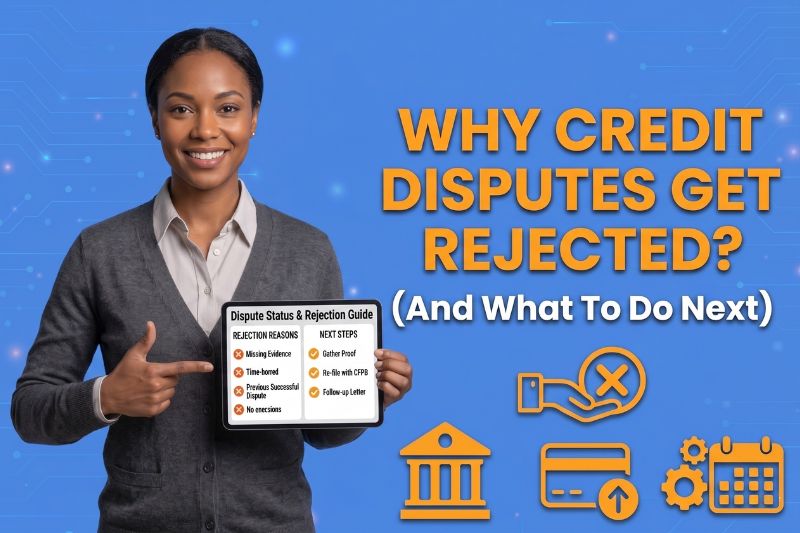
Nearly half of all credit disputes are rejected, and those rejections follow predictable patterns. The most common cause is a vague or unsupported dispute letter. FCRA Section 611 gives you specific rights to challenge any rejection, re-dispute with new evidence, and escalate through furnisher direct disputes, CFPB complaints, and legal action if needed.
This article covers the six most common rejection reasons, what each notice means under the law, and a step-by-step action plan to move forward.A rejected credit dispute can feel like the end of the road. You found an error on your credit report, you went through the process, and the credit bureau came back with “verified as accurate.”
That result is not final. Under the Fair Credit Reporting Act, a rejection opens at least three additional paths. The key is knowing which rejection type you received and what the law requires the credit bureau to do next. This guide walks through every stage of the process.

Credit bureaus reject disputes for four core reasons: the letter is too vague, the evidence is insufficient, the dispute qualifies as frivolous or irrelevant under the FCRA, or there is a procedural problem with how it was submitted.
Online portals add a fifth layer of risk because disputes are processed through an automated system that converts your letter into a two-digit code before it ever reaches the furnisher.
The dispute process is not reviewed by a human investigator the way most consumers expect. When you submit a credit report dispute, whether online, by phone, or by mail, the credit bureau routes it through a system called e-OSCAR.
That system translates the details of your dispute into a coded notice sent to the furnisher, which is the bank, credit card company, or collection agency that reported the information.
The furnisher receives that coded notice, confirms the information in its own records, and sends a confirmation code back to the bureau. The bureau then marks the item as “verified as accurate” and closes the case. In most cases, no one reviewed your original documents.
No one called the original creditor. No one audited the account history. The automated exchange satisfied the bureau’s legal obligation under the FCRA to conduct a reasonable investigation, even if the result does not feel reasonable to you.
This is why credit disputes get rejected even when the underlying information is genuinely wrong. The problem is not always the error itself. The problem is how the dispute was framed and supported. A strong, specific, and well-documented dispute forces a deeper review.
A generic one gets coded, confirmed, and closed in days.
Understanding this system is the foundation of disputing effectively. The rest of this guide covers the specific patterns that lead to rejection and the exact steps to take when a dispute comes back denied.
The six most common reasons credit disputes get rejected are a vague or generic dispute letter, missing documentation, a frivolous or irrelevant designation under FCRA Section 611(a)(3), a duplicate designation for a previously submitted dispute, an identity verification failure, and a dispute targeting accurate information that the furnisher has the right to confirm.
Each of these rejection types has a different legal basis and a different path forward.
| Rejection Reason | What Triggers It | FCRA Rule | Fix in Brief |
|---|---|---|---|
| Generic or vague letter | No specific error identified, no account number, no explanation of what is wrong | Section 611(a)(1) | Name the exact error, include the account number and bureau reference number, explain why the information is wrong |
| No supporting documentation | Dispute asserts an error but provides no evidence to support the claim | Section 611(a)(1) | Attach bank statements, payment records, a creditor letter, or any document that directly contradicts the reported information |
| Frivolous or irrelevant | Dispute is too vague to investigate or is substantially the same as a prior submission with no new information | Section 611(a)(3) | Request the reason in writing, add new specific evidence, resubmit on a different basis |
| Duplicate designation | Same dispute already submitted and investigation was already completed | Section 611(a)(3)(B) | Add information or evidence not included in the prior dispute to reset the bureau's investigation obligation |
| Identity verification failure | Bureau cannot confirm the dispute came from the account holder | Section 611(a)(1) | Submit by certified mail with a copy of a government-issued ID and a recent utility bill or bank statement |
| Disputing accurate information | The item is factually correct and the furnisher has records to confirm it | Section 611(a)(4) | This is the one type that cannot be overcome by re-disputing; options are a consumer statement, waiting for the reporting period to expire, or legal review if the reporting method itself violates the law |
A generic or vague dispute letter is the single most common cause of a credit dispute rejection. When a consumer submits a letter that says only “this account is wrong” without specifying what is wrong, why it is wrong, or what the correct information should be, e-OSCAR codes it as a non-specific dispute.
The furnisher responds with a simple confirmation and the bureau closes the case. The FCRA required the bureau to investigate, and technically it did, just not the way the consumer expected.
Missing documentation is closely related.
A dispute that identifies a specific error but provides no supporting evidence puts the entire burden of proof on the furnisher’s response. If the furnisher confirms the information is accurate, the bureau has no reason to override that confirmation without contradicting evidence.
The documents you attach to your dispute are not supplementary. They are the mechanism that forces a deeper review.A frivolous or irrelevant designation under FCRA Section 611(a)(3) is a formal legal determination. When the bureau invokes this designation, it is not required to investigate at all.
It must, however, notify you within five business days with the specific reason for the designation and an explanation of what information you need to provide. That notice is important because it tells you exactly what to fix before resubmitting.
A duplicate designation applies when you submit substantially the same dispute a second time without adding new information. The FCRA allows the bureau to decline investigation in this scenario. The critical distinction is the word “substantially.”
If your second submission includes any new information, a new document, a new specific basis, or any detail not present in the first dispute, it is no longer substantially the same and the bureau’s investigation obligation resets.
Identity verification failure is common when disputing online without supporting documents or when disputing by mail without including identification. Bureaus require a government-issued photo ID and a proof of address, such as a utility bill dated within the last 60 days, to confirm the dispute is coming from the actual account holder.
Disputing accurate information is the one scenario where re-disputing is not a viable path If the item on your report is correct and the furnisher has documentation to confirm it, the bureau will continue to report it.
In this situation, the available options are adding a brief consumer statement to your credit file, waiting for the item to age off under FCRA Section 605 reporting limits, or consulting an attorney if you believe the reporting method itself violates the law.

“Verified as accurate” does not mean the credit bureau confirmed that the information is correct. It means the furnisher responded to an automated data request with a confirmation code, often without reviewing original account documents.
The bureau’s legal obligation is to conduct a reasonable investigation under FCRA Section 611(a)(1), not to audit original records, and courts have generally allowed the automated e-OSCAR process to satisfy that standard.
When a credit bureau marks a disputed item as “verified as accurate,” most consumers assume that a human investigator reviewed the account and confirmed the information. That is rarely what happens. The bureau sends the dispute to the furnisher through e-OSCAR as a two-digit code.
The furnisher’s system receives that code, matches it to an account record, and sends a confirmation back. The entire exchange often takes less than 24 hours. The bureau then updates the dispute status and closes the investigation.
The FCRA requires credit bureaus to conduct a “reasonable investigation” under Section 611(a)(1). Courts have interpreted this standard broadly. The automated process described above has generally been found to satisfy the reasonable investigation requirement unless there is clear evidence the bureau ignored specific information the consumer provided that should have changed the outcome.
This creates an important practical insight. The more specific information and documentation you include in your original dispute, the harder it is for the bureau to close the case through automated confirmation alone.
A furnisher that receives a dispute with a bank statement showing a payment was made, a letter from the creditor acknowledging an error, or a detailed account timeline cannot simply confirm the original data without also accounting for that evidence.
If your dispute comes back “verified as accurate” and you believe the bureau did not conduct a meaningful investigation, you have the right to request the method of verification.
Under FCRA Section 611(a)(6)(B)(iii), you can submit a written request to the bureau asking for a description of the procedure used in the reinvestigation and the name and address of the information source. This request must be submitted in writing within a reasonable time after receiving the dispute result.
Bureaus often respond by confirming they used e-OSCAR, which creates documentation that becomes relevant in any subsequent escalation.
The five most common mistakes that cause credit dispute letters to be rejected are missing account identifiers, a vague error description, no supporting documentation, filing online for a document-heavy dispute, and using a generic credit repair template that furnishers recognize and close without substantive review.
Each error either prevents the bureau from identifying the tradeline or gives the furnisher everything it needs to close the case with a simple confirmation code.
| Mistake | Why It Gets You Rejected | How to Fix It |
|---|---|---|
| Missing account number or bureau reference number | The bureau cannot identify which tradeline to investigate and may apply the dispute to the wrong account | Include the full account number, the bureau's internal reference number from your credit report, and the creditor name exactly as it appears on the report |
| Vague error description | e-OSCAR codes it as a non-specific dispute; the furnisher confirms and the bureau closes the case | State what is wrong, why it is wrong, and what the correct information should be, in plain specific language |
| No supporting documentation | Without evidence, the furnisher's confirmation is legally sufficient to close the case | Attach the specific document that directly contradicts what was reported, such as a bank statement, payment confirmation, or a letter from the creditor |
| Submitting online for a document-heavy dispute | Online portals often compress or strip attachments; the bureau may process the dispute without ever seeing your evidence | For any dispute with multiple or complex documents, submit by certified mail with return receipt requested |
| Disputing every item at once with no individual reasons | Bureaus can designate a mass dispute as frivolous when no specific basis is provided for each item | Dispute each item separately with its own specific reason, supporting evidence, and account identifier |
| Using a generic template letter | 609 and 611 template letters are widely recognized by furnishers and processed as form letters without substantive review | Write a specific letter in your own words that references the exact account, describes the precise error, and attaches the actual document that disproves the reported information |
The most important thing to understand about credit dispute letter mistakes is that they compound. A letter that is both vague and unsupported gives the bureau two independent reasons to close the case without making any change.
A letter that is specific, documented, and submitted correctly by certified mail gives the furnisher almost no room to confirm the original information without also reviewing the evidence you attached. The account identifier detail is something many consumers overlook.
Credit bureaus process a large volume of disputes.Without the exact account number and the creditor name as it appears on the report, the bureau may investigate the wrong account, apply the dispute to a different tradeline, or return it for more information before the 30-day window even begins.
If your credit report lists a bureau reference number for the disputed item, include that as well. The template letter problem deserves particular attention. Generic 609 and 611 letters are widely sold and distributed as credit repair shortcuts.
They are also widely recognized by furnishers and bureaus. Furnishers receive them by the thousands and have established workflows for closing them without substantive review.
A specific letter that describes your actual situation, names the exact error, and attaches the document that disproves the reported information will almost always produce a different outcome than any template.

A frivolous designation under FCRA Section 611(a)(3) means the bureau determined your dispute does not contain enough specific information to investigate, or that it is substantially the same as a dispute you already submitted. When a bureau makes this determination, it is not required to investigate.
However, it is legally required to notify you within five business days with the specific reason and an explanation of the information you need to provide.Three specific scenarios trigger a frivolous or irrelevant designation.
First, the dispute did not provide sufficient information to investigate. This is the most common trigger. If the bureau cannot identify which item you are disputing, which error you are claiming, or what basis you have for the claim, it can invoke the frivolous designation without opening an investigation.
Second, the dispute is substantially the same as a dispute previously submitted for which the bureau or furnisher already completed an investigation. If you submit the same letter twice without adding any new information, the bureau’s prior investigation satisfies its obligation under the FCRA.
Repeating the same dispute with the same language does not create a new investigation obligation.Third, the consumer attempted to dispute every item on the report without providing specific reasons for each.
A mass dispute that lists every tradeline without identifying individual errors cannot be meaningfully investigated because there is not enough specific information to act on any single item. The most important thing to understand about a frivolous designation is the escape. The “substantially the same” standard has an explicit legal exception.
If your second submission includes information that was not in your prior dispute, a new document, a new specific basis, a new detail about why the information is incorrect, the submission is no longer substantially the same under the law.
Any addition that was not previously provided resets the bureau’s investigation obligation. This is the mechanism that makes a legitimate second-round dispute different from a repeat of the first. Under Regulation V (12 C.F.R. 1022.43), the same frivolous standard applies when you dispute directly with the furnisher.
The furnisher must notify you within five business days of making a frivolous determination, explain the reason, and identify what information you need to provide.
If a bureau or furnisher improperly designates a dispute as frivolous without sending the required notice, that failure is itself a potential FCRA violation.
Yes. Under FCRA Section 611(a)(3), a credit bureau that designates a dispute as frivolous must notify the consumer within five business days and explain the specific reason.
For disputes that result in “verified as accurate,” the bureau must provide written notice of the investigation results under FCRA Section 611(a)(6), including whether the information was verified, updated, or deleted.
There are two types of rejection notices, and the FCRA treats them differently. The first type is the frivolous designation notice. When a bureau decides not to investigate your dispute because it qualifies as frivolous or irrelevant, the bureau must send you a written notice within five business days.
That notice must state the specific reason for the designation and identify the information you need to provide in order for the bureau to open an investigation. This notice is not optional. A bureau that designates a dispute as frivolous without sending the required notice has violated the FCRA.
The second type is the investigation results notice. When a bureau completes an investigation and the result is “verified as accurate,” the bureau must provide written notice of the results.
That notice must describe the outcome of the investigation. If the investigation resulted in any change to your credit report, the bureau must provide you with a free copy of your updated report.
If no changes were made, it must inform you that the item was verified and explain your right to add a consumer statement to your credit file.
Both types of notice serve a practical purpose beyond their legal requirement.
They tell you exactly what the bureau found, what it did, and what information it says it would need to change its determination. Reading the notice carefully is the first action step after any rejection.

A rejection is not a final determination. The FCRA gives consumers at least three escalating paths after a credit dispute is rejected: re-disputing with new evidence, disputing directly with the furnisher under Regulation V, and filing a CFPB complaint.
If the bureau fails to meet its reinvestigation obligations, civil action under FCRA Sections 616 and 617 is available. The six steps below walk through each option in sequence.
Most consumers treat a rejection notice as the end of the process. It is the beginning of the next phase. Each step corresponds to a different lever the FCRA gives you, and they are designed to be used in order. Working through each step before moving to the next creates a documented record that strengthens every subsequent action.
The rejection notice contains the information you need to decide your next move. If the bureau designated your dispute as frivolous, the notice must state the specific reason and identify what information you need to provide.
If the bureau completed an investigation and returned a “verified as accurate” result, the notice must describe the investigation outcome and your right to add a consumer statement. Read the notice carefully before taking any action.
The language in the notice often points directly to the problem in your original submission, and fixing that specific problem is the fastest path to a different outcome on re-submission.

Before you resubmit, collect evidence that was not part of your original dispute. This requirement is not procedural. It is the legal test that determines whether your re-submission triggers a new investigation obligation.
Resubmitting the same letter with the same documentation gives the bureau authority to close it again as substantially the same dispute under FCRA Section 611(a)(3)(B). New evidence breaks that cycle.
Acceptable evidence includes bank statements showing a payment was made on or before the due date, a letter from the creditor acknowledging the error or confirming account closure, a payment confirmation with a date and amount, a detailed account history that contradicts what was reported, or an FTC Identity Theft Report for disputes involving fraud.
The document does not need to be elaborate. It needs to be specific, legible, and directly contradictory to what the furnisher reported.
Submit your re-dispute by certified mail with return receipt. Include the account number, the bureau’s reference number for the disputed item, the name of the creditor as it appears on the report, a specific description of the error, a clear statement of what the correct information should be, and a reference to the new evidence you are attaching. Cite FCRA Section 611(a)(1) explicitly to signal that you understand your rights and the bureau’s obligations.
Do not use a template. Write the letter in plain language that describes your specific situation and references the specific documents you are including. Keep a copy of everything you send.
Under Regulation V (16 C.F.R. Part 660 and 12 C.F.R. 1022.43), consumers have the right to dispute inaccurate information directly with the furnisher, which is the bank, credit card company, or collection agency that originally reported the information.
The furnisher is required to investigate within 30 days of receiving your dispute and to notify all credit bureaus of any correction it finds. Disputing directly with the furnisher is often more effective than re-disputing with the bureau because it forces the actual data owner to review its own records rather than simply confirming what it already sent.
To dispute directly with a furnisher, send a written letter by certified mail to the address the furnisher specifies for dispute correspondence. That address is often listed on your credit report. Include the same documentation you would include in a bureau dispute. The furnisher’s response, whether it corrects the information or confirms it, creates a documented record for any subsequent escalation.
One important limitation applies: furnisher direct dispute rights under Regulation V do not apply to public records including bankruptcies, judgments, and tax liens. Disputes involving public records must go through the credit bureau.
If re-disputing with the bureau and disputing with the furnisher have not resolved the issue, file a complaint through the CFPB’s official complaint portal at consumerfinance.gov. The bureau is required to respond to the CFPB within 15 days.
The CFPB does not adjudicate disputes or force a specific outcome, but filing a complaint creates an official record, applies supervisory pressure, and frequently produces a bureau response when direct re-disputing did not.
The CFPB complaint is also a meaningful escalation signal. It places the dispute in a regulatory database and contributes to the supervisory patterns the CFPB uses when examining bureau practices.
For individual consumers, the most practical benefit is that bureaus tend to review complaints filed through the CFPB with significantly more care than standard dispute submissions.
If the bureau failed to conduct a reasonable investigation, failed to send the required notices, or continued to report inaccurate information despite documented evidence that the information is wrong, you may have a claim under the FCRA.
Section 616 covers willful noncompliance and Section 617 covers negligent noncompliance. Both sections create a private right of action. If your claim is successful, you can recover actual damages, statutory damages up to $1,000 per violation, punitive damages in cases of willful violations, and attorney’s fees.
Consumer attorneys who specialize in FCRA cases frequently take them on contingency, meaning no upfront cost to the consumer. The National Association of Consumer Advocates (NACA) maintains a referral directory at consumeradvocates.org where you can find attorneys who handle credit reporting cases by state.

Certified mail is generally more reliable for complex or document-heavy disputes because it creates a verifiable record of delivery and ensures your attachments are received as submitted. Online portals are faster and sufficient for straightforward factual corrections where no supporting documents are needed.
Both methods trigger the same FCRA investigation timeline. The method does not change your legal rights under the FCRA.
| Method | Best For | Risk | Key Requirement |
|---|---|---|---|
| Certified Mail | Complex disputes, document-heavy submissions, re-disputes, any case where a delivery record matters | Slower delivery, typically 7 to 14 days before the investigation window begins | Copy of government-issued ID, proof of current address, legible copies of all supporting documents |
| Online Portal | Simple factual corrections and personal information updates where no supporting documents are needed | Portals may compress or strip attachments; bureau may process the dispute without receiving your evidence | Save and download your submission confirmation immediately after filing |
| Phone | Checking the status of an existing dispute or asking what documentation a bureau needs | Not suitable for submitting evidence; no written record unless you request confirmation in writing | Request a case number or written confirmation at the end of every call |
The practical difference between mail and online disputing is not about which method the FCRA prefers. Both are legally valid. The difference is about what happens to your documentation during processing.
Online portals often accept only certain file formats and apply compression settings that can make documents illegible or incomplete. When a bureau processes your dispute without seeing your attachments clearly, the outcome is no different from a dispute submitted with no evidence at all.
For any dispute that involves documents, certified mail gives you the cleanest record. You have proof of what you sent, proof of when it was received, and a physical copy of every document in the submission. If you later pursue a CFPB complaint, legal action, or a furnisher direct dispute, that documented record becomes relevant evidence.
For disputes that require only a factual correction with no supporting documents, such as a name spelling error or an incorrect address, the online portal is faster and equally effective. The 30-day investigation clock starts when the bureau receives the dispute regardless of the submission method.
You can dispute the same item more than once. However, each new submission must include information or evidence that was not part of your prior dispute. Resubmitting the same letter with the same language gives the bureau legal authority under FCRA Section 611(a)(3)(B) to close it without investigation as substantially the same dispute.
The number of submissions is not the issue. The issue is whether each submission adds something new. The “substantially the same” standard under FCRA Section 611(a)(3)(B) and Regulation V 12 C.F.R. 1022.43(c)(1)(ii) is the legal test that determines whether a repeat dispute triggers a new investigation obligation.
A dispute is substantially the same as a prior dispute when it raises the same issue, uses the same basis, and includes no additional information. In that case, the bureau’s prior investigation satisfies its legal obligation and it can close the new submission without further review.
The key is the exception. A dispute is not substantially the same when it includes information required under the Regulation V documentation standards that was not previously provided to the furnisher. Any new document, any new specific detail, any new basis for the dispute resets the cycle. This means a consumer can dispute the same item multiple times as long as each round adds something the prior round did not include.
What does not work is repetition without change. Sending the same letter three times in 60 days does not increase pressure on the bureau. It confirms that the prior investigation was sufficient. Each duplicate submission without new information reduces the credibility of the dispute and may accelerate a frivolous designation on the next attempt.
If you have disputed the same item twice with new evidence both times and received two “verified as accurate” responses, that is the point at which the CFPB complaint and legal review paths become the most productive next steps.
Two rounds of documented re-dispute with supporting evidence, both rejected, creates a meaningful record for a consumer attorney evaluating an FCRA claim.
Disputes submitted through multiple services simultaneously do not multiply the bureau’s investigation obligation.
The bureau processes them as a single dispute and issues a single result. Submitting through several credit monitoring services at the same time does not accelerate the process or create independent obligations.

Three scenarios consistently indicate that professional dispute management outperforms a DIY approach: when you are managing multiple derogatory items across more than one bureau, when your rejections involve identity theft or fraud that requires coordinated action across bureaus and the FTC, and when the same item has been rejected twice with new evidence each time and a CFPB complaint or legal review is the appropriate next step.
There is no rule that says you cannot handle a credit dispute on your own. Many consumers successfully resolve credit report errors without any outside help. But there are specific situations where the administrative complexity, the legal stakes, or the volume of documentation involved makes professional tools or professional assistance worth considering.
The first scenario is volume and complexity. If you are managing three or more derogatory items across two or more bureaus, keeping track of submission dates, 30-day investigation windows, re-dispute deadlines, furnisher correspondence, and CFPB complaint reference numbers is a substantial administrative task. Missing a deadline does not just delay the process. It resets it. A dispute management system that tracks every submission, every response, and every open deadline removes the most common source of DIY failure in multi-item cases.
The second scenario is identity theft. Disputes involving fraudulent accounts, unauthorized inquiries, or stolen identity require a coordinated approach that includes bureau disputes, furnisher direct disputes, FTC identity theft reports, and in some cases credit freezes and fraud alert placements across all three bureaus.
Managing this workflow manually across multiple institutions simultaneously is the type of situation where a structured system produces more consistent results than a manual one.The third scenario is the double-rejection pattern. If you have disputed the same item twice, added new evidence each time, and received two “verified as accurate” responses, continuing to re-dispute is unlikely to produce a different outcome.
At that point, the most productive path is a CFPB complaint combined with a consultation with a consumer attorney. Having a complete and organized record of both prior disputes, including submission dates, delivery confirmations, the evidence attached, and the bureau’s response notices, significantly strengthens the case you bring to either one.
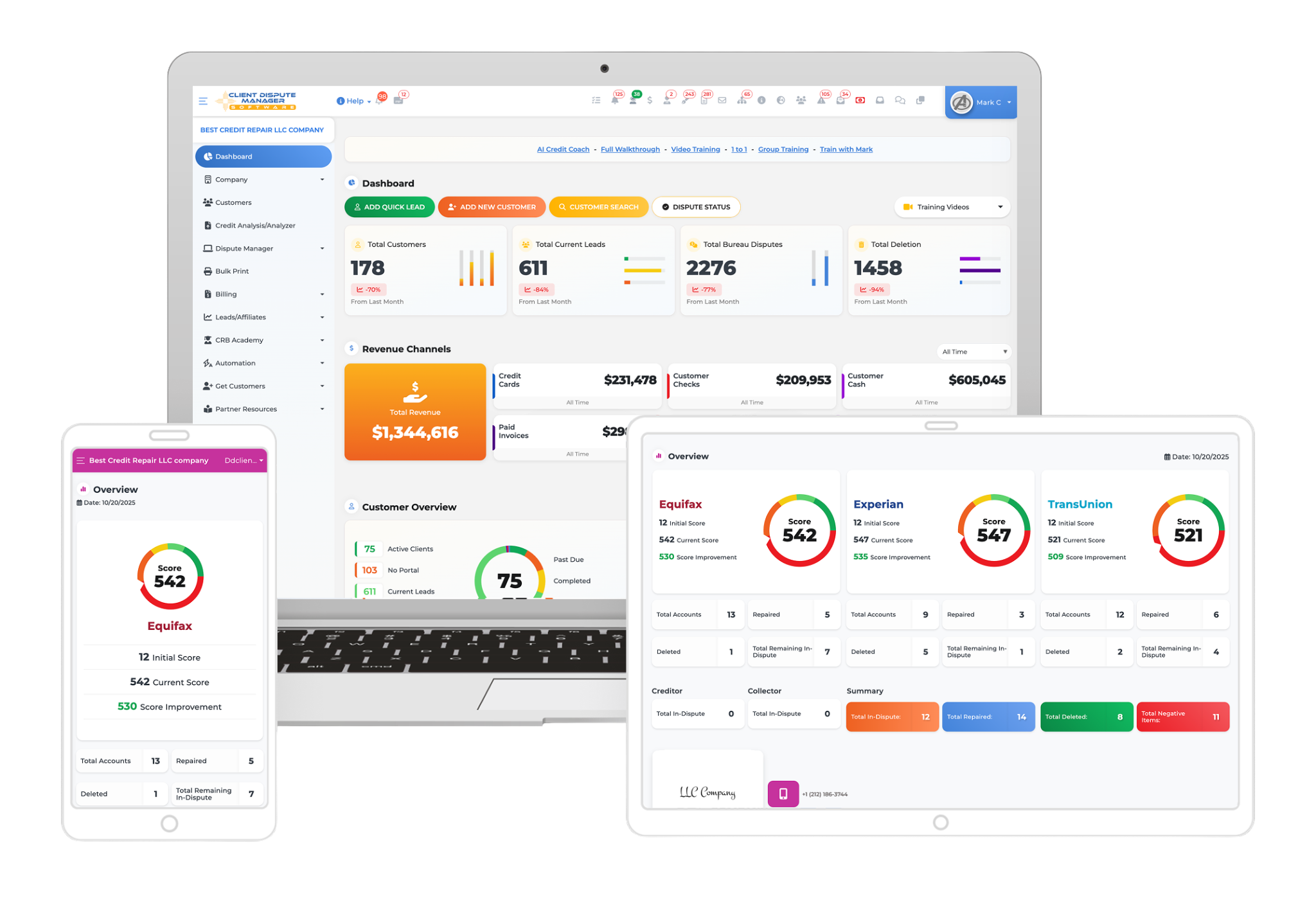
Client Dispute Manager Software is built for managing the dispute workflow from first submission through escalation. It tracks every letter, every deadline, every bureau response, and every re-dispute window in one place.
For consumers managing more than two disputes or dealing with a first rejection, it removes the administrative complexity that leads to missed steps and repeated delays.
The questions below address the most common specific situations consumers encounter after a credit dispute rejection. Each answer reflects the applicable FCRA standard and the practical steps available.
A duplicate designation means the bureau determined your new submission is substantially the same as a dispute you previously submitted for which an investigation was already completed. The bureau is not required to investigate again under FCRA Section 611(a)(3)(B). However, the duplicate designation only applies if your new submission includes no new information.
If you add a new document, a new specific basis, or any detail that was not in your prior dispute, the submission is no longer substantially the same and the bureau must investigate. Request the duplicate notice in writing, identify what new information you can add, and resubmit with that addition clearly documented.
A rejection for lack of proof means the furnisher’s records were sufficient to confirm the information as accurate in the absence of contradicting evidence. Your next step is to identify the specific document that would contradict what was reported.
A bank statement showing a payment, a creditor letter confirming a correction, a payment receipt with a date and amount, or any record that directly contradicts the furnisher’s data is what you need.
Submit that document with a new dispute letter by certified mail, state the specific error, and reference the new evidence you are attaching. The addition of that document resets the substantially-the-same threshold.
Identity verification failure happens when the bureau cannot confirm the dispute came from the account holder. This is common when disputing online without attachments or when disputing by mail without including required identification.
To resolve it, resubmit by certified mail with a legible copy of a government-issued photo ID and a recent document confirming your current address, such as a utility bill or bank statement dated within the last 60 days.
The address on your identification and the address on the supporting document should match the address the bureau has on file for you.
Under FCRA Section 611(a)(1), credit bureaus have 30 days from the date they receive your dispute to complete their investigation and notify you of the results.
The window extends to 45 days if you provide additional information after the investigation has begun, or if you submitted the dispute after requesting your free annual credit report through AnnualCreditReport.com.
If the bureau fails to respond within the applicable window and did not invoke the frivolous designation, it is generally required to delete the disputed item. Keeping the certified mail delivery receipt and tracking the delivery date is important for precisely this reason.
Waiting does not increase the risk of a formal rejection, but it can reduce your practical options. Evidence becomes harder to obtain over time. Creditor records are often purged after several years. Payment histories become more difficult to reconstruct.
If the item you are disputing is close to its reporting period limit under FCRA Section 605, disputing it may not be the best use of effort because it will age off the report on its own. For items well within the reporting window, earlier disputes generally produce better outcomes because supporting documentation is still available from both the consumer and the original creditor.
Disputes involving identity theft or fraud follow a different process than standard disputes. File an identity theft report at IdentityTheft.gov and obtain a formal FTC Identity Theft Report before submitting your dispute. Submit that report along with your dispute to each bureau.
Under FCRA Section 605B, consumers with documented identity theft can request a block on inaccurate information resulting from the theft. The bureau must block that information within four business days of receiving the identity theft report, the consumer’s identification, and a statement that the information resulted from identity theft.A CFPB complaint is available if any bureau fails to process the block correctly.
A rejected credit dispute is a data point, not a verdict. It tells you what the bureau found, what it did not find, and what the law requires it to do next.
The three-tier action path available to every consumer after a rejection is clear: re-dispute with new evidence, dispute directly with the furnisher under Regulation V, and escalate through the CFPB or legal channels if the bureau continues to fall short of its obligations. Each step creates documentation that strengthens the next one.
The consumers who get results are the ones who treat each rejection notice as instruction. They read it, identify the specific problem, and return with a more targeted submission. Client Dispute Manager Software is designed to support that process at every stage, from organizing your first dispute through tracking re-disputes, furnisher correspondence, and CFPB complaint reference numbers.
If you are dealing with a rejected dispute and are not sure where to start, begin with Step 1 in the action plan above. Read the notice. Find out exactly what the bureau said. Then work forward from there.

Mark Clayborne specializes in credit repair, starting and running credit repair businesses. He's passionate about helping businesses gain freedom from their 9-5 and live the life they really want. You can follow him on YouTube.
Experience our credit repair software, risk-free.