
The credit repair industry is one of the most in-demand financial services sectors in the country right now. With 77 million Americans carrying poor or damaged credit scores, $1.277 trillion in credit card debt hitting a record high in late 2025, and a $6.8 billion industry growing steadily, the opportunity for new credit repair business owners has never been clearer.
But starting a credit repair business in 2026 also means entering one of the most heavily enforced regulatory environments in financial services history. Since 2024, the FTC and CFPB have collected more than $2.8 billion in penalties from credit repair companies including a $2.7 billion judgment that shut down the largest credit repair firm in the country. The opportunity is real. So are the consequences of getting it wrong.
This guide covers everything you need to know before you launch updated with 2026 laws, landmark enforcement actions, state licensing requirements, startup costs, software, and the client acquisition strategies that are actually working right now. Whether you are starting from scratch or ready to go full-time, this is the foundation every compliant, profitable credit repair business is built on.
Key Takeaways:
- Follow federal rules like CROA and FTC’s Business Opportunity Rule, plus your state’s requirements before starting.
- Register your business, use written contracts, and include cancellation rights to stay compliant.
- Credit repair software (like Client Dispute Manager Software) helps with automation, compliance, and client management.
- Avoid false promises, secure client data, and communicate clearly to build long-term credibility.
- Keep learning, invest in training/certification, and use retention strategies to scale your credit repair business.
The Legal Landscape Shifted Dramatically in 2024–2026

The federal laws governing credit repair businesses have not changed but how aggressively they are enforced has. Five federal laws apply to every credit repair business operating in the United States: the Credit Repair Organizations Act (CROA), the Fair Credit Reporting Act (FCRA), the Telemarketing Sales Rule (TSR), the Fair Debt Collection Practices Act (FDCPA), and the Gramm-Leach-Bliley Act (GLBA). CROA bans advance fees and requires written contracts with every client.
The TSR adds a six-month waiting period before you can collect fees on any telemarketed service. Understanding all five is not optional it is the foundation your business stands on.
The Five Federal Laws Every Credit Repair Business Must Follow
Every credit repair business owner needs to know these laws before taking a single client. Here is what each one covers and why it matters to your operation:
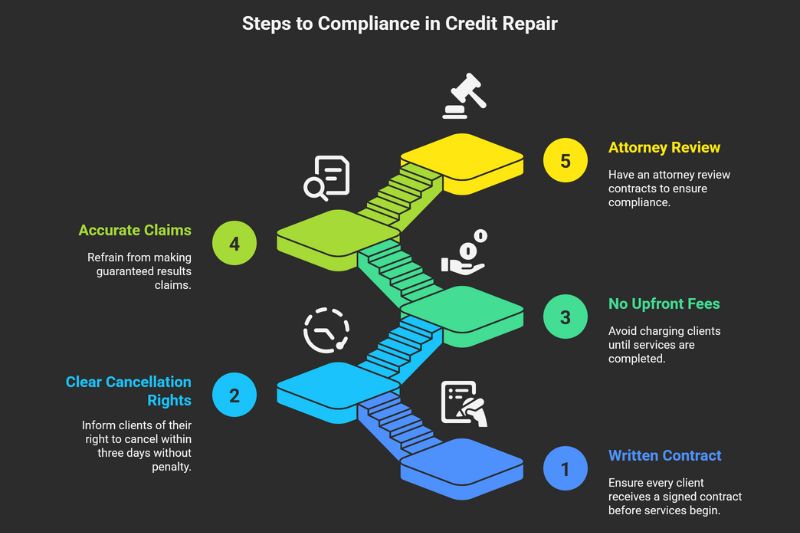
- Credit Repair Organizations Act (CROA): 15 U.S.C. § 1679 CROA is the primary federal law governing credit repair businesses. It prohibits charging any fee before services are fully performed, requires a written contract before work begins, gives clients a three-day right to cancel without penalty, and mandates a pre-contract consumer rights disclosure. Violating CROA gives clients a private right of action meaning they can sue you for actual damages, punitive damages, and attorney fees.
- Fair Credit Reporting Act (FCRA): 15 U.S.C. § 1681 The FCRA governs how credit information is collected, reported, and disputed. It gives consumers the right to dispute inaccurate information directly with credit bureaus and it gives your clients the right to have you dispute on their behalf. As a credit repair business owner, you need to understand the 30-day investigation timeline, the reinvestigation process, and what constitutes a legally valid dispute.
- Telemarketing Sales Rule (TSR): 16 CFR Part 310 The TSR is the most heavily enforced law in the credit repair industry and the least understood by new operators. If your business uses any form of telemarketing to acquire clients, including inbound calls generated by your advertising, you cannot collect fees until six months after documented results are achieved. The $2.7 billion Lexington Law judgment was built almost entirely on TSR violations. More on that in the next section.
- Fair Debt Collection Practices Act (FDCPA): 15 U.S.C. § 1692 The FDCPA regulates how debts are collected. While credit repair businesses are not debt collectors, your work regularly intersects with collection accounts on your clients’ reports. Understanding FDCPA protections helps you identify which collection items are legally disputable and advise clients on their rights when dealing with collectors directly.
What the CFPB Pause Means for Your Business and What It Doesn't?

Since February 2025, the CFPB has been operating under a near-complete enforcement suspension under the Trump administration. The bureau reduced its workforce by approximately 88 percent, dropping from roughly 1,700 employees to around 200. More than 42 active enforcement actions were dismissed or rolled back, and the agency’s supervisory examination program was effectively paused.
For credit repair business owners, this creates a misleading sense of reduced risk. Here is what has actually changed and what has not.
What Changed?
The CFPB is no longer initiating new credit repair enforcement actions. The agency that brought the Lexington Law case is currently inactive as an enforcement force.
What Did Not Change?
The laws themselves. CROA, the TSR, the FCRA, and the FDCPA are all still fully in effect. The FTC remains an active and aggressive enforcer the Growth Cave $48.6 million judgment and The Credit Game $3.5 million settlement in 2025 were both FTC actions, not CFPB. State attorneys general across the country have stepped into the enforcement gap, and several states including Massachusetts, New York, and California have increased their own credit repair enforcement activity.
The CFPB pause does not reduce your compliance obligations. It changes who is most likely to come after you if you cut corners. Operating as though the regulatory environment has relaxed is one of the most dangerous assumptions a new credit repair business owner can make in 2026.
State Requirements Vary Wildly and Getting Them Wrong Can Shut You Down
No federal license is required to start a credit repair business. However, approximately 25 states require registration as a Credit Services Organization (CSO), and 15 to 20 states require surety bonds ranging from $5,000 to $100,000. Some states including Georgia effectively prohibit credit repair businesses altogether.
Always verify your state’s specific requirements before taking your first client, because operating without proper registration or bonding exposes you to fines, forced refunds, and permanent industry bans.
States That Require Surety Bonds: Amounts, Costs, and Where to Get Them
A surety bond is a financial guarantee that protects your clients if your business fails to deliver services as promised or violates state law. When a state requires a credit repair surety bond, it is not insurance for you it is protection for the people you serve.
Understanding which states require bonds, how much those bonds cost, and how to obtain one is one of the first compliance steps every new credit repair business owner needs to complete.
Credit repair surety bond requirements vary significantly from state to state. Illinois and Nebraska require the highest bond amounts in the country at $100,000 each. Louisiana and California are also among the highest. At the other end of the spectrum, Florida and Texas require $10,000 bonds, though Texas requires a separate $10,000 bond for each business location you operate.
The actual cost of a surety bond is not the face amount. Bond premiums typically run 1 to 2 percent of the required face amount annually, based on your personal credit score. That means a $25,000 bond in Ohio costs approximately $250 to $500 per year for an operator with good credit. A $100,000 bond in Illinois costs $1,000 to $2,000 per year under the same conditions. Applicants with lower credit scores may pay 5 to 10 percent of the face amount.
Here is a state-by-state breakdown of credit repair surety bond requirements for the most active states:
| State | Bond Required | Bond Amount | Est. Annual Premium | Licensing Authority |
|---|---|---|---|---|
| Arizona | Yes | $5,000–$25,000 | $50–$500 | AZ Dept. of Financial Institutions |
| California | Yes | $100,000 | $1,000–$2,000 | DFPI |
| Delaware | Yes | $15,000 | $150–$300 | Dept. of Justice |
| Florida | Yes | $10,000 | $100–$200 | Office of Financial Regulation |
| Georgia | — | — | — | Effectively prohibits CROs |
| Illinois | Yes | $100,000 | $1,000–$2,000 | Dept. of Financial & Professional Regulation |
| Indiana | Yes | $25,000 | $250–$500 | AG's Office |
| Kansas | Yes | $25,000–$1,000,000 | Varies by revenue | Office of the State Bank Commissioner |
| Maine | Yes | $25,000 per location | $250–$500 | Dept. of Professional & Financial Regulation |
| Maryland | Yes | $50,000 | $500–$1,000 | Dept. of Labor |
| Nebraska | Yes | $100,000 | $1,000–$2,000 | Dept. of Banking & Finance |
| Ohio | Yes | $50,000 | $500–$1,000 | AG's Office |
| Oregon | Yes | $25,000 | $250–$500 | Dept. of Consumer & Business Services |
| Texas | Yes | $10,000 per location | $100–$200 | Office of Consumer Credit Commissioner |
| Virginia | Yes | $25,000 | $250–$500 | State Corporation Commission |
Your Real Startup Costs Are Lower Than You Think

Starting a credit repair business from home costs between $500 and $5,000 in the first year. Essential expenses include LLC formation ($50–$500), a surety bond in states that require one ($100–$2,000 per year), credit repair software ($50–$179 per month), business insurance ($200–$500 per year), and a website ($100–$500).
You do not need an office, employees, or expensive federal certifications to launch.
The 2026 credit repair business model is digital-first, home-based, and built around software automation and that makes it one of the most accessible service businesses you can start.
The 2026 Credit Repair Business Startup Cost Breakdown
One of the most common misconceptions about starting a credit repair business is that it requires significant capital. The traditional image of a financial services firm office space, staff, equipment, advertising budgets does not apply here.
Over 65 percent of credit repair businesses now operate entirely from home, and the software tools available in 2026 allow a solo operator to manage 50 or more clients without a single employee.
The table below covers every realistic startup cost a new credit repair business owner will encounter, from formation through the first 12 months of operation.
| Expense | Low Estimate | High Estimate | Notes |
|---|---|---|---|
| LLC Formation | $50 | $500 | Varies by state; file directly with Secretary of State |
| EIN (Employer ID Number) | $0 | $0 | Free at IRS.gov — takes 10 minutes online |
| Surety Bond | $100/yr | $2,000/yr | Required in ~20 states; 1–2% of bond face amount |
| Credit Repair Software | $107/mo | $329/mo | Client Dispute Manager Software starts at $107/mo with 30-day free trial |
| Website | $100 | $500 | WordPress on shared hosting; domain + hosting included |
| Business Insurance (E&O + General Liability) | $200/yr | $500/yr | Required before signing client contracts |
| Cyber Insurance | $300/yr | $700/yr | Required under GLBA for handling client financial data |
| High-Risk Merchant Account | $0 setup | $500 setup | 3–5% per transaction; no monthly fee with most providers |
| Initial Marketing Budget | $200/mo | $1,000/mo | Content creation, local SEO, and modest paid ads |
| Total First Year | $2,000 | $10,000 | Home-based, solo operator |
Payment Processing Is Your Biggest Operational Headache

Credit repair is classified as a high-risk industry by all major payment networks. PayPal, Stripe, Square, Zelle, and Cash App explicitly prohibit credit repair services and will freeze your funds without warning if they identify your business type.
You must use a specialized high-risk merchant account, which charges 2.5 to 5 percent per transaction compared to the standard 1.5 to 2.5 percent.
Without a proper high-risk merchant account in place before you launch, you cannot legally and safely take client payments and the consequences of using a prohibited processor are worse than most new operators realize.
Why Mainstream Processors Won't Touch Credit Repair and What Happens If You Try?
Understanding why credit repair is considered high-risk by payment networks helps you avoid the mistake that derails many new operators in their first 90 days.
Payment processors classify industries by chargeback rates, regulatory exposure, and reputational risk. Credit repair scores high on all three. Clients who do not see results as quickly as they expected dispute charges with their banks.
Regulatory scrutiny of the industry generates negative press that processors want no association with. And the history of bad actors in credit repair has created blanket restrictions that affect every operator in the space compliant or not.
The list of mainstream processors that explicitly prohibit credit repair businesses includes PayPal, Stripe, Square, Zelle, Cash App, QuickBooks Payments, and Venmo. These are not gray-area interpretations of their terms of service. Each platform’s acceptable use policy contains specific language excluding credit repair, credit counseling, and credit restoration services.
The Advance Fee Ban Is Non-Negotiable and the TSR Makes It Even Stricter Than You Think
Under CROA (15 U.S.C. § 1679b), credit repair companies cannot charge or receive any payment until services are fully performed. The FTC’s Telemarketing Sales Rule adds a stricter layer on top: if your business uses any form of telemarketing to acquire clients, you cannot collect fees until six months after achieving documented results and providing proof via a consumer credit report.
Together, these two laws define exactly when and how credit repair companies can charge and violating either one carries penalties that have reached into the billions. Understanding the credit repair advance fee ban before you set your pricing model is not a compliance formality. It is the single most important legal decision your business will make.
What CROA Says About Charging Clients: The Rule in Plain English
The CROA payment rules for credit repair businesses come down to one foundational principle: you cannot take money before you deliver results. Section 1679b(b) of CROA states explicitly that no credit repair organization may charge or receive any money or other valuable consideration for the performance of any service that the credit repair organization has agreed to perform before such service is fully performed.
In practice, that means the following arrangements are prohibited under CROA regardless of how they are labeled or structured:
A setup fee charged at the time of enrollment before any dispute work has begun. A first-month fee collected at signup before the first round of disputes is submitted.
A retainer collected to “reserve your spot” before services start. An enrollment fee described as covering administrative costs incurred before any substantive work is performed.
All of these are advance fees under CROA.
The name you give the fee does not change its legal character. What matters is whether services have been fully performed at the time payment is collected. If they have not, the fee is prohibited.
The TSR Six-Month Rule: The Law That Bankrupted the Largest Credit Repair Company in History
The Telemarketing Sales Rule is the most consequential law in the credit repair industry for one reason: most credit repair businesses use telemarketing without knowing they are doing it. Understanding the TSR credit repair rule and specifically the six-month fee prohibition it imposes is what separates operators who stay in business from those who receive a federal enforcement action.
The TSR (16 CFR § 310.4(a)(2)) prohibits credit repair companies that use telemarketing from requesting or receiving payment for credit repair services until three conditions are all met simultaneously: the promised results have been achieved, a consumer report from a consumer reporting agency has been provided to the client documenting those results, and six months have elapsed since the results were achieved.
The definition of telemarketing under the TSR is the critical point that most new operators miss. Telemarketing does not only mean outbound cold calls. Under the TSR, telemarketing includes any plan, program, or campaign conducted to induce the purchase of goods or services that involves more than one interstate telephone call.
That definition covers inbound calls generated by your advertising meaning if a prospective client sees your Facebook ad, calls your business number, and enrolls over the phone, that transaction is covered by the TSR telemarketing provisions. It covers calls made in response to your Google ads, your YouTube videos, your Instagram content, or any other marketing material that prompts a phone call.
Client Dispute Manager Software: Your All-in-One Tool for Credit Repair Success

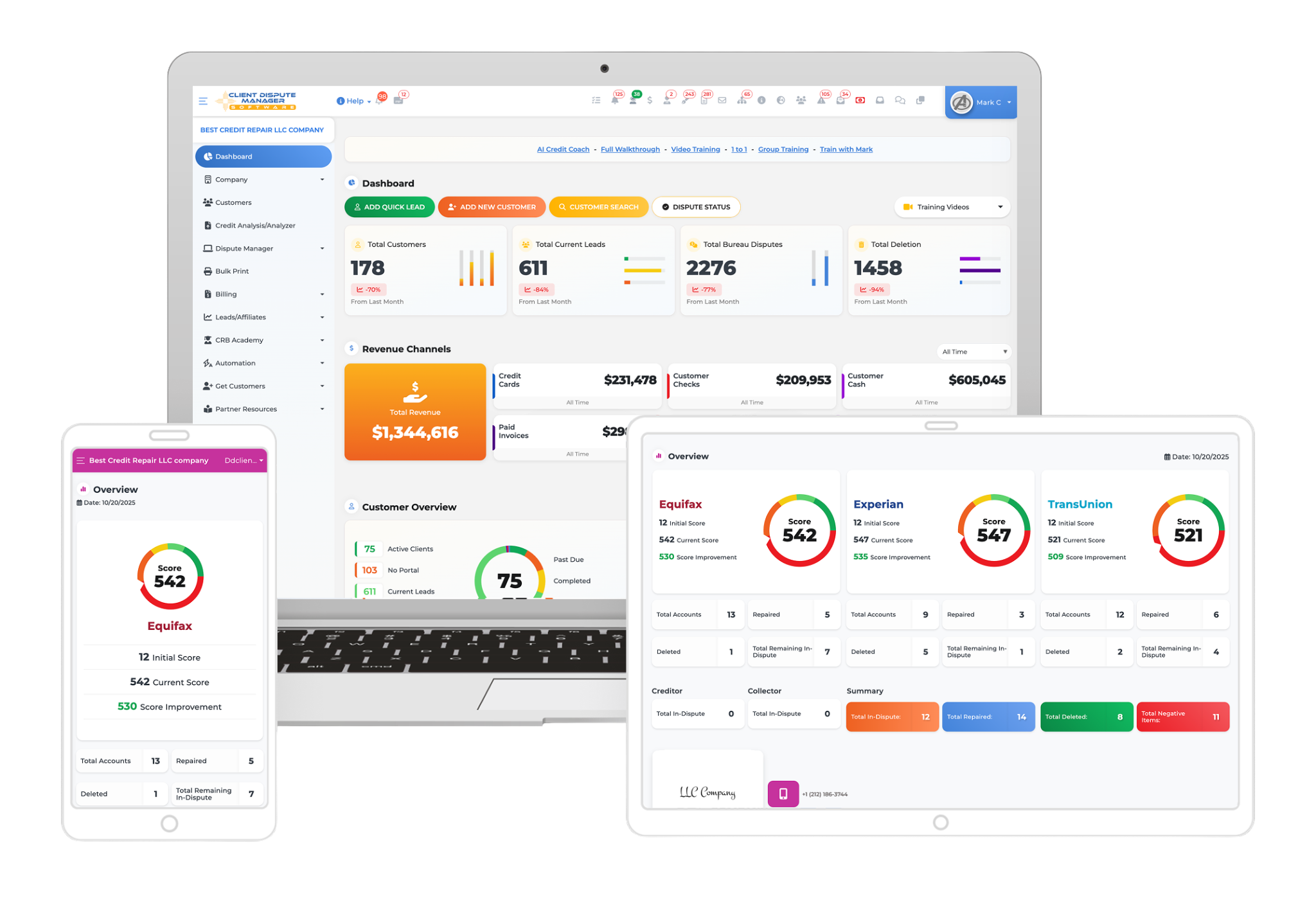
One powerful option that many entrepreneurs use is Client Dispute Manager Software. It was designed specifically for people who want to start a credit restoration business or take their existing company to the next level.
Instead of juggling spreadsheets, documents, and random tools, this all-in-one platform brings everything together so you can work smarter, not harder.
Here are some of the most important features that make it stand out:
- Dispute Letter Generation: Save hours by creating letters with just a few clicks. The software includes dozens of templates that you can customize, so you don’t have to start from scratch every time.
- Client Portal Access: Give your clients their own secure login. They can see updates, track progress, and even upload documents directly to their account—reducing the number of phone calls and emails you’ll need to answer.
- Automated Workflows: Tired of doing the same tasks over and over? The system automates follow-ups, reminders, and dispute cycles. This not only saves time but also ensures nothing slips through the cracks.
- Compliance Safeguards: Staying compliant with CROA and FTC rules is built into the software. From proper recordkeeping to contract templates, the system helps you avoid costly mistakes and stay on the right side of the law.
- Progress Tracking and Reports: Easily show clients the results of your work. The software creates reports that highlight deleted items, disputes in progress, and overall credit improvement. This transparency builds trust and keeps clients engaged.
- Secure Data Storage: Every piece of client information is encrypted and stored safely. You’ll know that sensitive data is protected, which is crucial for both compliance and peace of mind.
- Scalability for Growth: Whether you’re running your business from home or planning to grow into a full office with a team, the software is built to grow with you. Add more clients, team members, or services without worrying about outgrowing the system.
By bringing all these features together, Client Dispute Manager Software helps entrepreneurs launch and grow their businesses with confidence. It takes away the stress of manual work and gives you the tools you need to build a professional, client-focused credit repair company.
Start Today and Explore the Features Firsthand!
Develop Transparent Client Communication in Your Credit Repair Business Plan
When starting a credit repair business, many entrepreneurs focus on marketing, software, and laws. But one of the most overlooked keys to success is clear client communication. Your clients are often stressed and uncertain about their financial future.
If you keep them in the dark, they’ll lose trust quickly. If you’re open and honest, they’ll feel reassured and more likely to stick with your services long-term.
Building Trust When You Start a Credit Repair Business
Clients often come to you after dealing with rejection, high interest rates, or even debt collectors. They’re hoping for quick results, but as you know, credit repair takes time. That’s why it’s your job to set realistic expectations right from the start.
Here are a few ways to build trust:
- Be Upfront About Timelines: Explain that some disputes may take 30–45 days to process and that results vary.
- Avoid Big Promises: Never guarantee a score increase or a specific outcome. Instead, focus on your proven process.
- Share Progress Often: Let clients know what’s happening with their disputes and accounts.
This level of honesty not only builds trust but also keeps you in compliance with the law.
Examples of Clear Client Communication Practices
If you want your credit repair business plan to stand out, add communication strategies as part of your daily operations.
For example:
- Welcome Packet: Provide every new client with a simple guide explaining how the process works.
- Monthly Updates: Send regular progress reports through email or your software’s client portal.
- Client Calls or Check-ins: Schedule short follow-ups so clients know you’re invested in their success.
- Transparent Contracts: Make sure agreements clearly explain services, fees, and cancellation rights.
When you make communication a priority, clients are more likely to stay with you, recommend your services, and trust you to help them through one of the most challenging parts of their financial journey.
Plan for Client Retention and Professional Growth in Your Credit Repair Business Plan

Client retention is about making sure customers stay with you long enough to see results. If clients leave too soon, they won’t get the benefit of your work, and your business will constantly struggle to replace lost revenue.
Here are some retention strategies you can build into your operations:
- Regular Updates: Send progress reports and explain what’s happening behind the scenes.
- Client Education: Teach customers about budgeting, credit utilization, and healthy financial habits.
- Excellent Support: Make yourself available for questions and provide quick responses.
- Loyalty and Referral Programs: Reward clients who stick with you and encourage them to refer friends.
When clients feel informed and supported, they’re far more likely to stay with you until they reach their goals.
Retention isn’t the only part of growth you also need to think about where you want your company to be in 2, 5, or even 10 years. Do you want to stay a one-person business, or expand into a larger team with employees and multiple service offerings?
Frequently Asked Questions About Starting a Credit Repair Business
Do I Need a License to Start a Credit Repair Business?
No federal license is required. However, approximately 25 states require formal registration as a Credit Services Organization (CSO), and 15 to 20 states require a surety bond ranging from $5,000 to $100,000. Georgia effectively prohibits for-profit credit repair businesses altogether. The proposed ESCRA Act (H.R. 306) would mandate state licensing nationwide if passed. Until then, your compliance obligation is determined entirely by the state where you operate.
How Much Does It Cost to Start a Credit Repair Business From Home?
Starting a home-based credit repair business costs between $500 and $5,000 in the first year. Primary expenses include LLC formation ($50 to $500), a state surety bond where required ($100 to $2,000 per year), credit repair software ($50 to $179 per month), and business insurance ($500 to $1,200 per year). No physical office, employees, or federal certification is required to launch.
Can Credit Repair Companies Charge Upfront Fees Before Completing Services?
No. CROA prohibits credit repair companies from collecting any payment until services are fully performed. Setup fees, enrollment fees, and first-month fees collected before dispute work begins are all illegal advance fees regardless of how they are labeled.
The Telemarketing Sales Rule adds a six-month waiting period after documented results for any business using telemarketing. The $2.7 billion Lexington Law judgment was built almost entirely on these two violations.
What Is the Best Credit Repair Software for Someone Just Starting Out?
Client Dispute Manager Software is the strongest starting point at $107 per month with a 30-day free trial. It includes an AI-powered dispute engine, 296-plus Metro 2-compliant letters, a client portal, and CROA-compliant billing controls. Built by Mark Clayborne, author of Hidden Credit Repair Secrets, the platform is designed specifically for credit repair operators.
Conclusion
Starting a credit repair business is more than just sending dispute letters it’s about building a company that is legal, ethical, and built to last. From learning federal and state laws to drafting compliant contracts, choosing the right software, and planning for client retention, every step matters.
When you put compliance, honesty, and professionalism at the center of your credit repair business plan, you protect yourself and create trust with the people you serve.
Remember, this industry is about hope. Most of your clients will come to you feeling stressed, overwhelmed, and ready for a fresh start. If you follow the 10 steps in this guide, you’ll not only help them repair their credit you’ll also build a business that grows steadily and earns respect in the community.
If you’re ready to take the next step, make sure you’re equipped with the right training and the right tools. The Client Dispute Manager Software Certification Program and 15-Step Roadmap is a great place to start. It gives you everything you need training, certification, software, and compliance support to launch with confidence and grow without guessing.

Mark Clayborne
Mark Clayborne specializes in credit repair, starting and running credit repair businesses. He's passionate about helping businesses gain freedom from their 9-5 and live the life they really want. You can follow him on YouTube.
Start Today and Explore the Features Firsthand!